
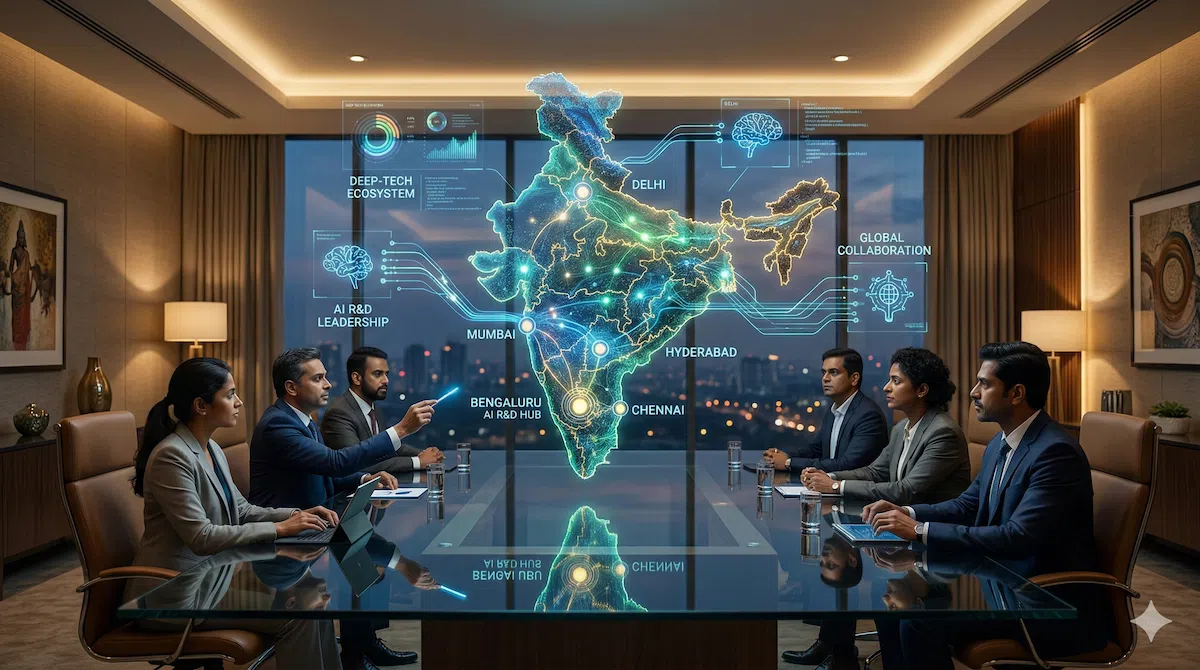
For three decades, the global technology narrative surrounding India was singular: it was the world’s back office. Silicon Valley built the core intellectual property, and Indian IT hubs provided the outsourced labor to maintain it. However, as we look at the State of AI in India 2026, that archaic model is officially dead. India has violently pivoted from being a passive consumer of Western software to an aggressive architect of global deep-tech infrastructure.
Today, the Indian AI ecosystem is characterized by a unique philosophy: building for a billion scales, in dozens of languages, under severe infrastructural constraints. This is not about building luxury chatbots. It is about deploying artificial intelligence in India to solve existential bottlenecks in healthcare, credit access, and agriculture, while simultaneously sparking a Make in India deep tech manufacturing boom. From vernacular language models translating Supreme Court judgments to AI agents optimizing complex agricultural supply chains, the landscape is experiencing unprecedented velocity.
Key Takeaways
- The Death of IT Outsourcing: The traditional services model is being replaced by autonomous AI agents and “vibe coding” platforms built by domestic founders.
- Solving for the Next Billion: Startups are aggressively deploying AI into core legacy sectors—from diagnosing tuberculosis via smartphones in rural villages to untangling the chaotic national logistics grid.
- Sovereign Intelligence: Backed by aggressive government policies, India is actively building its own foundational computing infrastructure, domestic GPU clusters, and proprietary Indic LLMs to ensure data sovereignty and technological independence.
The Core Industries Disrupted by AI
The true value of AI in the Indian subcontinent is not found in shiny consumer applications, but in its ability to leapfrog massive infrastructural gaps. When analyzing the State of AI in India 2026, we must look at how legacy sectors are adopting this technology.
Healthcare & Rural Diagnostics: Healing the Divide
India faces a severe doctor-to-patient ratio deficit, particularly outside of Tier-1 metropolitan cities. In rural areas, the waiting time for a radiologist to review a simple chest X-ray can stretch into weeks, leading to devastating delays in treating highly contagious diseases like tuberculosis or pneumonia. This is exactly where the ecosystem of Indian AI startups is stepping in, replacing the need for physical specialists with intelligent, edge-computing software.
Today, frontline health workers (ASHA workers) are being equipped with portable diagnostic tools powered by sophisticated machine learning. By utilizing low-bandwidth AI models that run directly on standard smartphones, a health worker in a remote village can capture an image of an X-ray or a retinal scan, and the AI will flag anomalies—like diabetic retinopathy or early-stage lung infections—with over 95% accuracy in mere seconds. This shifts the healthcare model from reactive treatment to proactive, hyper-local triage.
Furthermore, these systems are designed to operate entirely offline, circumventing the notorious connectivity issues plaguing rural infrastructure. By deploying AI in Indian healthcare startups, venture capitalists and medical innovators are effectively decentralizing the hospital system. They are bringing expert-level diagnostic capabilities directly to the patient’s doorstep, democratizing access to life-saving medical insights for hundreds of millions of citizens who have historically been left behind by the modern healthcare grid.
Financial Services & FinTech: The Credit Revolution
The backbone of India’s digital economy is the Unified Payments Interface (UPI), processing billions of micro-transactions monthly. Yet, despite this massive digital footprint, a vast majority of the Indian population—from street vendors to gig economy workers—remains “credit invisible.” They lack formal credit scores, making it impossible for traditional banks to underwrite loans. Artificial intelligence is completely dismantling this barrier by inventing entirely new paradigms for risk assessment.
Instead of relying on archaic credit bureau data, AI-driven FinTech platforms analyze thousands of alternative data points in real-time. By feeding machine learning algorithms a user’s UPI transaction history, mobile utility payments, digital footprint, and even SMS behavioral patterns, these systems generate highly accurate, dynamic credit profiles instantly. This allows digital lenders to disburse “sachet loans” (micro-credit of ₹500 to ₹5,000) to individuals and small merchants within seconds, with astonishingly low default rates.
Beyond credit inclusion, AI is acting as the ultimate shield against the rising tide of digital fraud. Deep learning models continuously monitor the national financial grid, detecting anomalous transaction patterns and blocking sophisticated cyber-attacks before money leaves an account. To understand how algorithmic underwriting and predictive security are merging, explore our full breakdown on AI in Indian FinTech. By unleashing AI on financial services, India is not just optimizing banking; it is effectively banking the unbanked at an unprecedented, continental scale.
Agriculture & Drone Tech: Precision Farming
Agriculture employs nearly half of India’s workforce, yet it is notoriously unpredictable. Fragmented landholdings, rapidly changing climate conditions, and unpredictable monsoon cycles mean that a single bad season can push millions of farmers into debt. The integration of AI into the agricultural sector is shifting farming from a game of ancestral guesswork to a precise, data-driven science.
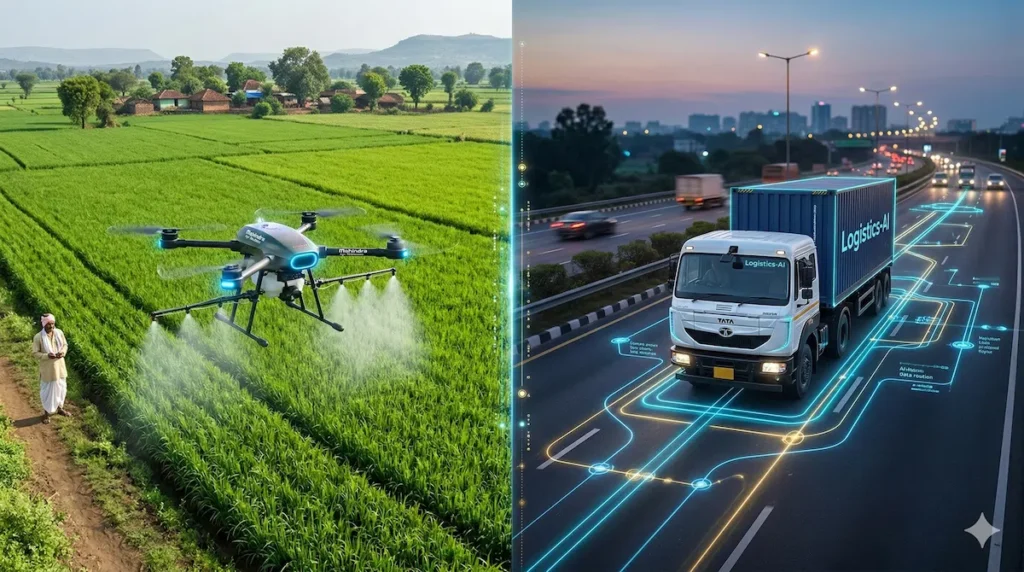
In states deeply affected by erratic weather, specialized startups are deploying autonomous fleets of drones equipped with high-resolution computer vision and multispectral sensors. These AI-powered drones fly over fragmented farmlands, analyzing crop health, detecting early signs of pest infestations, and mapping out exact soil moisture levels. This hyper-local data is then fed into predictive machine learning models that advise farmers—via SMS in their native languages—on the exact day to sow seeds, the precise amount of fertilizer to use, and the optimal time to harvest.
This precision farming slashes the cost of expensive inputs like water and chemical pesticides, drastically improving profit margins for smallholder farmers. Moreover, state governments are utilizing this macro-level AI data to predict regional crop yields, manage supply chains, and issue proactive crop insurance payouts before a drought fully devastates a community. The fusion of aerospace hardware and predictive software is revolutionary, and you can dive deeper into this shift in our report on AI in Indian agriculture and drone tech.
Supply Chain & Logistics: Untangling the Grid
India’s geography is a logistical nightmare. Moving goods across fractured interstate borders, navigating congested national highways, and dealing with unpredictable weather has historically resulted in billions of dollars lost to transit delays and fuel inefficiencies. For the government’s massive manufacturing ambitions to succeed, the physical supply chain requires a digital nervous system.
AI is providing that exact software layer. Massive commercial trucking fleets are now abandoning traditional route planning in favor of predictive freight routing. AI algorithms process millions of live data points—including traffic density, toll plaza bottlenecks, and hyper-local weather patterns—to push dynamic, fuel-optimized routes to drivers in real-time. This algorithmic orchestration prevents trucks from sitting idle on flooded highways and predicts engine maintenance issues before vehicles break down, saving enterprise fleets millions.
Simultaneously, the quick-commerce explosion in Tier-1 cities is driving the adoption of massive warehouse automation. Deep learning models dictate inventory positioning inside “dark stores,” predicting exactly which neighborhoods will order specific goods on any given day. This foresight allows platforms to mathematically solve the chaotic “last-mile” delivery puzzle through dense urban streets. Read how this B2B software shift is saving the economy billions in our analysis of AI in Indian logistics and supply chains.
Electric Vehicles (EV) & Battery Tech: Solving Hardware Bottlenecks
India is undergoing one of the fastest electric mobility revolutions in the world, largely driven by two-wheelers and commercial three-wheelers. However, this transition faces severe environmental hurdles, most notably the blistering 45°C Indian summers. Extreme heat accelerates lithium-ion battery degradation and significantly increases the risk of catastrophic thermal runaway (battery fires).
Startups quickly realized that standard physical hardware cannot survive these conditions without intelligent oversight. Consequently, the battleground has shifted to AI-powered Battery Management Systems (BMS). Instead of static sensors, these edge-AI chips continuously ingest real-time voltage and temperature data across individual battery cells. The machine learning models predict thermal spikes before they happen, dynamically throttling vehicle performance or safely isolating weak cells to prevent combustion and drastically extend the battery’s operational lifespan.
Furthermore, predictive AI is entirely curing “range anxiety” for commercial delivery drivers. By mapping out the availability of public charging infrastructure and analyzing a driver’s specific route, payload, and real-time traffic, the software directs riders to the nearest smart grid exactly when they need a recharge. To understand why software is the true winner of the mobility race, explore our deep dive into AI in the Indian EV sector.
EdTech’s Second Wave: Personalized Vernacular Learning
Following the post-pandemic crash of massive EdTech unicorns, the Indian education sector was left searching for a sustainable model. The “spray and pray” approach of selling expensive, generic video lectures to the masses failed. Now, AI is powering EdTech’s highly profitable “Second Wave” by focusing on hyper-personalization and breaking the country’s massive language barriers.
In a country where regional languages dictate commerce and culture, traditional English-first coding and STEM courses naturally excluded millions of rural students. Today, AI-driven platforms leverage advanced natural language processing to act as personal, 1-on-1 tutors. These intelligent systems dynamically adjust the difficulty of a math or physics curriculum based on the student’s real-time performance, ensuring they actually master concepts rather than just memorizing them.
More importantly, these AI tutors are being deployed in native dialects—from Bengali to Marathi to Tamil. A student in a remote village can now learn complex Python programming via an AI tutor that speaks and evaluates their code entirely in their mother tongue. This technological democratization of quality education is bridging the rural-urban divide faster than any government initiative. Discover the mechanics of this educational rebirth in our feature on AI in Indian EdTech.
Automating the Legal System: Clearing the Backlog
The Indian judiciary is currently buckling under the weight of roughly 50 million pending court cases. “Justice delayed is justice denied” is an everyday reality, largely due to a legal ecosystem choked by endless paperwork, massive manual research requirements, and complex, multi-lingual historical precedents. Artificial intelligence is stepping in as the ultimate paralegal, threatening to completely automate the backlog.
B2B LegalTech startups are deploying specialized Large Language Models trained strictly on Indian penal codes and constitutional law. These AI platforms can ingest, scan, and summarize a 1,000-page corporate contract or litigation file in mere seconds, flagging compliance risks and extracting key clauses that would take a human lawyer a week to find. This allows law firms and corporate legal departments to operate with staggering velocity.
Furthermore, Indic LLMs are currently being utilized to translate decades of complex Supreme Court judgments from English into regional languages, making legal precedent accessible to local district courts and everyday citizens. Predictive AI is even being used to analyze a judge’s past rulings to calculate the probability of success for specific arguments. Dive into how technology is accelerating justice in our analysis of AI in Indian LegalTech.
Retail & The ONDC Revolution: Empowering the Kirana
For years, local mom-and-pop stores (Kiranas) were losing ground to massive, VC-funded e-commerce monopolies like Amazon and Flipkart. The playing field was fundamentally uneven; the monopolies had predictive algorithms, automated supply chains, and massive data silos. The Open Network for Digital Commerce (ONDC)—a revolutionary government-backed interoperability protocol—is using AI to democratize this power.
Through the ONDC architecture, a local Kirana store in Mumbai can suddenly become digitally visible to any consumer using any buyer app (like Paytm or PhonePe). However, AI is the true engine making this viable. Startups are plugging AI modules into the ONDC network to give small merchants predictive inventory powers—telling a shopkeeper exactly how much milk or rice to stock based on hyper-local demand forecasting.
Additionally, AI algorithms automatically route the fulfillment of these orders to the cheapest, fastest hyper-local delivery provider on the network, entirely removing the need for a central corporate middleman. This is shifting retail power back to the grassroots level, turning 12 million Kirana stores into hyper-efficient micro-warehouses. Read about this massive digital disruption in our guide to AI and the ONDC revolution.
The Deep-Tech Infrastructure & Indic LLMs
A major factor defining the State of AI in India 2026 is the shift from using foreign LLMs to building native foundational infrastructure.
For India to truly capitalize on the artificial intelligence revolution, applying foreign software to domestic problems is not enough. Relying on Western models like OpenAI’s GPT or Google’s Gemini poses massive risks regarding data privacy, cultural nuance, and the exorbitant costs of API calls. The defining shift in the Indian AI ecosystem is the aggressive push to build foundational infrastructure—the models, the data sets, and the agentic frameworks—from the ground up.

The Foundational Model War
The race to build India’s own foundational large language models (LLMs) is fiercely competitive and heavily capitalized. Western models are fundamentally flawed for the Indian subcontinent; they are trained primarily on English datasets and lack the cultural and contextual nuances required to operate in a nation with 22 official languages and thousands of dialects. The ecosystem realized that whoever controls the foundational model controls the future of digital India.
This realization ignited the Indian foundational model war, spearheaded by two major players with vastly different approaches. On one side, we have Krutrim, founded by Ola’s Bhavish Aggarwal, which rapidly achieved unicorn status. Krutrim is building massive, generalized models trained on vast troves of Indian data, aiming to be a holistic, multi-lingual assistant for the masses.
On the other side is Sarvam AI, heavily backed by Peak XV and Khosla Ventures, which is taking a hyper-focused approach. Instead of just text, Sarvam is pioneering voice-first foundational models, recognizing that the next 500 million Indian internet users will interact with technology through speech, not keyboards.
This rivalry is pushing the boundaries of what domestic engineering can achieve. To understand the strategic differences, token economics, and geopolitical implications of these two giants, read our comprehensive Krutrim vs Sarvam AI comparison. Furthermore, you can explore how voice-native architecture is changing the game in our deep dive on the Bengaluru voice AI startup, Sarvam.
Developing Indic Language AI
The most significant barrier to AI adoption in India is linguistics. Less than 15% of the Indian population speaks English fluently. If artificial intelligence is to democratize access to legal, medical, and financial services, it must “think” in Hindi, Tamil, Bengali, and Marathi. Historically, tech giants simply used translation wrappers—taking an English prompt, translating it to Hindi, processing it in English, and translating the output back. This method is incredibly slow, computationally expensive, and notoriously inaccurate regarding cultural context.
The solution is the development of native Indic LLMs. Startups and research institutions like AI4Bharat are building datasets from scratch to train models natively in regional languages. This involves solving complex technical challenges, such as optimizing “tokenization.” Standard English tokenizers break down Indian scripts incredibly inefficiently, causing a single Hindi word to cost three times as much compute power as an English word.
By building specialized Indic tokenizers, Indian deep-tech engineers are slashing the cost of running these models, making them economically viable for small businesses and developers. This linguistic technological sovereignty is crucial for digital inclusion. Learn exactly how developers are breaking the language barrier in our extensive report on developing Indic language AI models.
Small Developer Models
While massive trillion-parameter models get the mainstream media attention, they are financially impractical for 99% of Indian developers. Running a massive LLM requires immense cloud computing power, which destroys the profit margins of bootstrapped startups and independent creators. The Indian ecosystem has recognized that for everyday B2B applications—like automating customer support or summarizing legal PDFs—you do not need a supercomputer.
This has led to the explosion of Small Language Models (SLMs) tailored specifically for the Indian developer community. Models like Kruti and BharatGPT Mini are designed to be incredibly lean, highly accurate, and capable of running locally on “edge devices” (like a smartphone or a standard laptop) without needing a constant connection to expensive cloud servers.
These lightweight models are empowering a new generation of grassroots developers in Tier-2 and Tier-3 cities to integrate AI into their local software solutions without bleeding venture capital on server costs. They are the democratizing engines of the tech ecosystem. Discover how these hyper-efficient models are changing the economics of software development in our analysis of Indian AI models for developers, Kruti, and BharatGPT Mini.
The “Vibe Coding” Revolution
Perhaps the most disruptive trend emerging from India’s deep-tech sector in 2026 is the paradigm shift in how software itself is created. For decades, India’s tech dominance was rooted in IT outsourcing—armies of engineers writing syntax line-by-line for global corporations. Today, Indian founders are building the very tools that make traditional coding obsolete.
Enter the era of “Vibe Coding.” Leveraging advanced Agentic AI, platforms are empowering non-technical users to build production-ready, full-stack applications using only natural language prompts. Instead of writing code, a user simply describes the “vibe,” the business logic, and the desired outcome. Autonomous AI agents then write the backend, configure the databases, and deploy the application instantly.
This is not a niche concept; it is attracting massive global capital. Startups like Emergent Labs—founded by twin brothers from Bihar—recently hit a staggering $100 million ARR in just eight months, securing massive rounds from top-tier Silicon Valley and Japanese investors. This proves that global capital views India as the epicenter for the next generation of developer tools. Dive into the mechanics of this software democratization in our breaking news report on the vibe coding AI India revolution and Emergent Labs.
Government Policy, Hardware, and VC Funding
To fully grasp the State of AI in India 2026, we have to examine the billions of dollars flowing from government initiatives and venture capital.
Technology does not scale in a vacuum. For India to transition from an IT service hub to an AI superpower, it requires a synchronized trinity: visionary government policy, massive investments in physical hardware (compute), and aggressive venture capital allocation.
The Sovereign AI Mission & Semiconductors
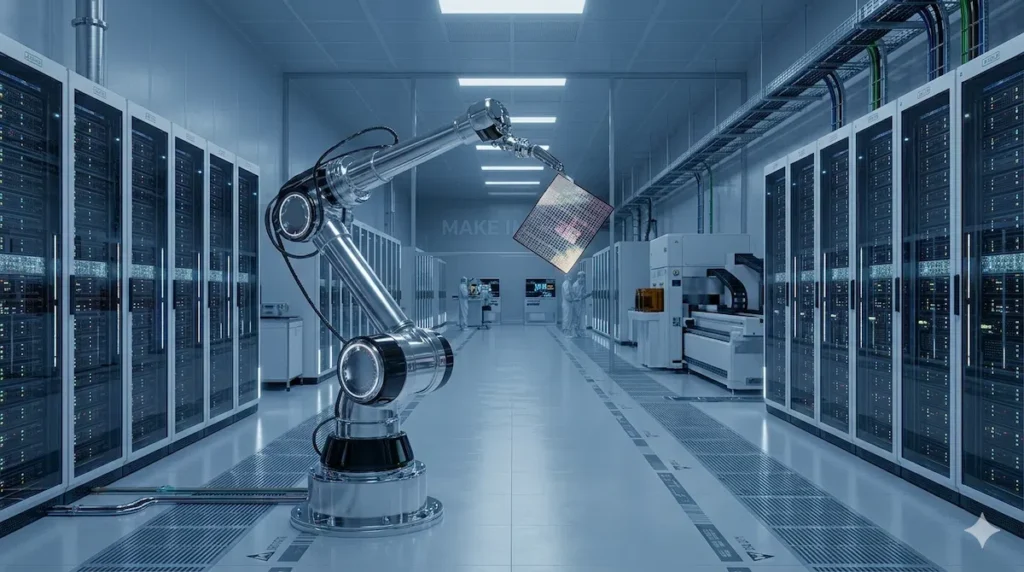
In the age of AI, compute (GPU power) is the new oil. Currently, the global supply of high-end GPUs is dominated by a few American corporations and manufactured almost exclusively in Taiwan. Recognizing that relying on foreign compute is a massive national security and economic risk, the Indian government launched the Sovereign AI mission. Backed by an initial ₹10,372 crore (and expanding), this mission is subsidizing massive GPU clusters within India, making compute available to domestic startups and researchers at drastically reduced rates.
However, true sovereignty requires manufacturing the silicon itself. India is aggressively building a domestic semiconductor ecosystem from scratch. Through massive Production Linked Incentive (PLI) schemes, the country has attracted giants like Micron and partnered with entities like PSMC to build cutting-edge fabrication plants (fabs) in Gujarat and Assam.
This hardware push ensures that the chips powering the next decade of artificial intelligence are designed, packaged, and eventually fabricated on Indian soil. It is the ultimate “Make in India” deep-tech ambition. Read our comprehensive analysis of this national compute strategy in our articles on the India Sovereign AI mission and the multi-billion dollar India semiconductor boom.
The Regulatory Landscape & Deepfakes
With massive technological power comes the potential for unprecedented societal disruption. As India entered its massive 2024 and subsequent state election cycles, the dark side of AI emerged rapidly: hyper-realistic deepfakes, synthetic voice cloning, and algorithmic misinformation. The Indian government quickly realized that unregulated AI poses a direct threat to democratic integrity and financial security.
Unlike the European Union’s heavy-handed AI Act, which many criticize for stifling innovation, India is pioneering a balanced, agile regulatory framework. The upcoming Digital India Act focuses heavily on algorithmic accountability, mandatory digital watermarking for synthetic media, and strict intermediary liabilities for social media platforms that host deepfakes. The goal is to create “safe harbors” for startups to innovate while ruthlessly penalizing malicious actors.
Furthermore, India is leveraging its geopolitical weight to shape global AI governance, championing the needs of the Global South. Through initiatives spearheaded during its presidency of the Global Partnership on Artificial Intelligence (GPAI), India is ensuring that global AI guardrails are not exclusively dictated by Western tech monopolies. Explore the intricate balance between innovation and safety in our reports on the India deepfake regulations 2026 and the diplomatic triumphs of the New Delhi Declaration on AI.
Venture Capital Trends for 2026
The flow of venture capital is the ultimate indicator of an ecosystem’s health and trajectory. In the post-ZIRP (Zero Interest-Rate Policy) era, the “tourist capital” that previously flooded into generic consumer SaaS and cash-burning quick-commerce startups has dried up. However, the “smart money” is aggressively doubling down on Indian deep tech.
Top-tier global venture firms—including Peak XV Partners, Lightspeed, and Khosla Ventures—have explicitly stated that India is their primary focus outside of Silicon Valley. They are writing massive checks for startups building Agentic AI, Indic LLMs, autonomous robotics, and AI-driven climate tech (like EV battery management systems).
Investors are no longer looking for Indian clones of American companies; they are funding uniquely Indian solutions to complex, billion-scale problems, knowing these solutions can eventually be exported to the rest of the developing world. To see exactly where the institutional money is flowing and how founders are structuring their pitches, read our definitive guide to AI startup funding in India and VC trends for 2026.
Conclusion: The State of AI in India 2026 and Beyond
The State of AI in India 2026 is not a story of a developing nation trying to catch up; it is the blueprint of a technological superpower asserting its dominance. The narrative has fundamentally shifted from consumption and outsourcing to creation and sovereignty.
By aggressively deploying artificial intelligence into its core legacy industries—healthcare, logistics, agriculture, and finance—India is digitally leapfrogging decades of infrastructural decay. Simultaneously, by funding domestic GPU clusters, building native Indic language models, and pioneering the “vibe coding” revolution, Indian founders are ensuring that the fundamental building blocks of the future are crafted in Bengaluru, Hyderabad, and Pune, rather than just San Francisco.
For investors, policymakers, and global tech leaders, the message is clear: the Indian AI ecosystem is no longer the world’s back office. It is the world’s deep-tech laboratory, solving the most complex problems for the next billion internet users. The era of Indian AI has officially arrived.