
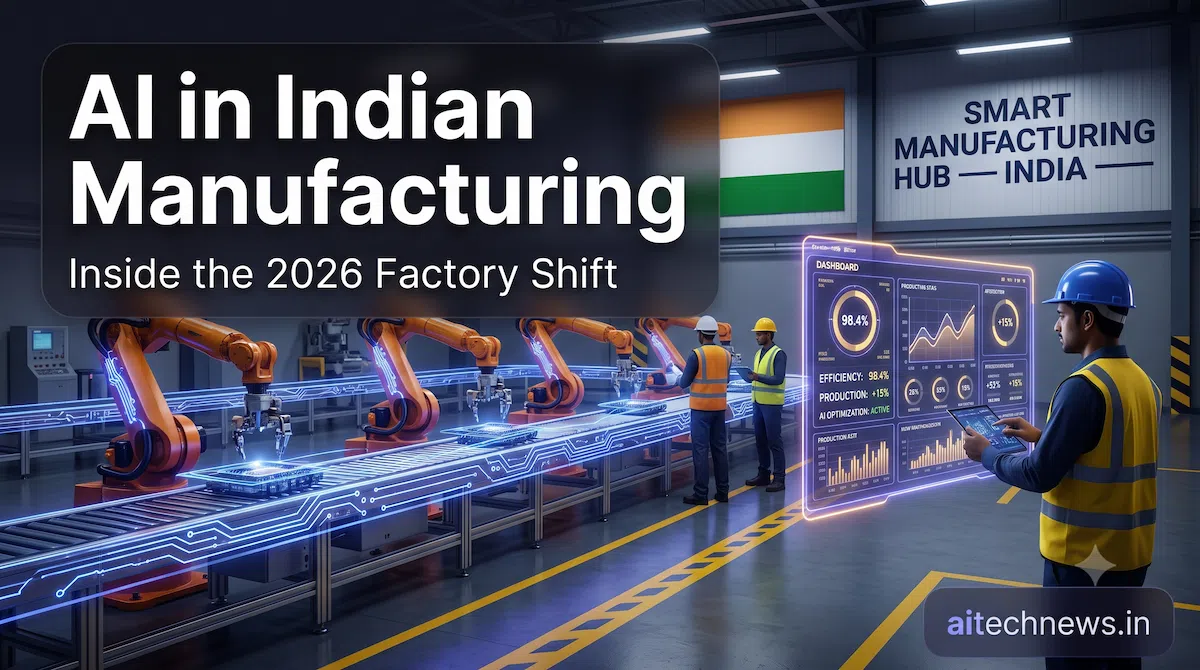
AI in Indian manufacturing is no longer a pilot project confined to boardroom slide decks. Walk onto the floor of a large Indian factory today and you’ll see computer vision systems scanning products for defects, predictive maintenance tools flagging equipment failures before they happen, and supply chains increasingly run on forecasting software rather than gut instinct. But the story has a second half that gets less attention: while India’s largest manufacturers race ahead, the 63 million small and mid-sized businesses that make up the backbone of the sector are barely getting started.
Here’s what’s verifiably happening — and what’s still just a projection.
The Government’s Big Bet: The PLI Scheme
India’s push toward AI-enabled manufacturing didn’t happen by accident — it’s backed by one of the largest industrial policy interventions in the country’s history.
The Production-Linked Incentive (PLI) scheme, spanning 14 strategic sectors including electronics, pharmaceuticals, automobiles, and textiles, carries an approved outlay of ₹1.91 lakh crore. As of March 31, 2026, according to the Commerce and Industry Ministry’s own figures presented in the Lok Sabha, the scheme has:
Attracted actual investments exceeding ₹2.40 lakh crore
Generated more than 14.15 lakh direct and indirect jobs
Enabled cumulative exports of over ₹15.2 lakh crore
Helped cut mobile phone imports by roughly 77%, with around 99.2% of phones used in India now made domestically
The scheme doesn’t hand out cash for buying AI tools directly — it rewards companies for hitting incremental production and sales targets, and manufacturers investing in automation, robotics, and AI-driven quality systems are generally the ones best positioned to hit those targets at scale. Electronics has been the standout performer under the scheme; battery and solar manufacturing have lagged behind their targets, according to independent trackers of the programme’s sector-by-sector results.
What Large Manufacturers Are Actually Doing
Tata, Mahindra, and Reliance are the names that come up most often in conversations about AI adoption in Indian manufacturing — and for good reason. All three have publicly discussed deploying AI-driven tools across their operations:
Computer vision for quality inspection — used to catch defects on production lines faster and more consistently than manual checks
Predictive maintenance — using sensor data to flag equipment issues before they cause unplanned downtime
AI-driven supply chain and demand forecasting — helping coordinate with suppliers and manage inventory more precisely, , part of a broader shift toward AI-driven logistics and supply chain management across Indian industry
Independent, verifiable performance figures for individual plants (exact defect-reduction percentages, plant-specific cost savings) are not consistently published by these companies, so we’re not going to hand you invented numbers dressed up as fact — a mistake worth flagging since a lot of manufacturing-AI content online does exactly that. What’s verifiable is the direction: large Indian manufacturers are treating AI-driven automation as core infrastructure, not an experiment, and government incentive structures are reinforcing that shift.
Where India Actually Stands vs. China
China’s manufacturing automation lead is real and well documented — though some of the headline numbers repeated online don’t hold up to scrutiny.
What’s verified: China installed over 2 million industrial robots by 2024, accounting for roughly 54% of global robot demand, with a robot density of around 392 robots per 10,000 manufacturing workers — well above the global average. China’s manufacturing workforce has also shrunk significantly even as exports have grown, a pattern researchers attribute largely to automation.
Claims about an exact count of fully unmanned “lights-out” factories in China (or in India) vary wildly by source and aren’t backed by a consistent, citable figure — so treat any specific number you see quoted for this with real skepticism, ours included in earlier drafts.
The real, uncomfortable point for India: cheap labour is no longer a durable advantage. Wage gaps with China have narrowed in many manufacturing hubs, and countries like Vietnam now offer comparable labour costs with faster-growing automation adoption in electronics assembly. That leaves India needing to compete on productivity and quality — which is exactly the gap AI-driven automation is meant to close.
The MSME Problem: 63 Million Businesses, Mostly Left Behind
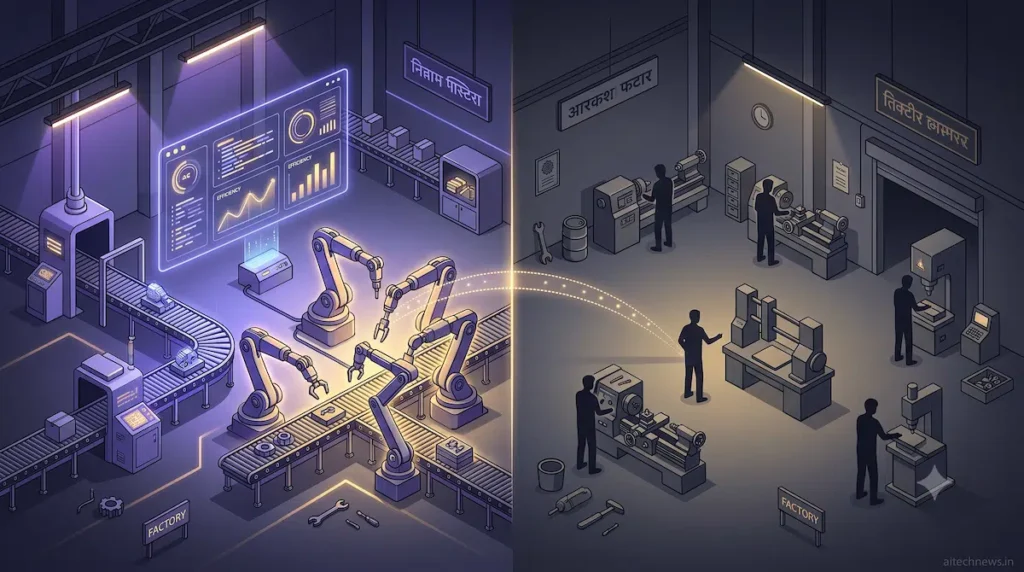
This is the part of the story that gets buried under the large-enterprise headlines.
India’s Micro, Small, and Medium Enterprises sector — commonly cited at around 63 million enterprises — contributes roughly 30% of GDP and employs a large share of India’s manufacturing workforce. Yet AI adoption in this segment lags dramatically behind large enterprises, for reasons that are structural, not attitudinal:
Capital constraints — deploying even basic AI-driven quality control or predictive maintenance systems requires upfront investment most MSMEs can’t easily justify on thin margins
Skills gap — hiring data scientists or ML engineers is realistic for a Tata or Mahindra; it’s a stretch for a mid-sized manufacturer in a tier-2 city, a symptom of the wider AI talent shortage playing out across Indian industries
Legacy infrastructure — much of India’s MSME manufacturing base runs on machinery that predates IoT-sensor integration, making retrofitting expensive
What’s being done about it:
The National AI Marketplace, under the IndiaAI Mission, is designed to connect smaller manufacturers with subscription-based, pay-as-you-go AI tools instead of requiring large upfront capital outlays
SIDBI (the Small Industries Development Bank of India) has directed funding toward MSME digitisation, including preferential lending for manufacturers adopting AI and automation
A real, working example of the vendor side of this gap: Bengaluru-based Ati Motors builds autonomous mobile robots for material handling — its Sherpa line has been deployed across more than 50 manufacturing facilities globally, including for companies like Bosch and Hyundai, after raising over $37 million in venture funding. Similarly, Wobot.ai offers AI-powered video analytics for safety and compliance monitoring — including PPE detection — that plugs into a factory’s existing CCTV setup rather than requiring new hardware, a model built specifically to lower the cost of entry for smaller manufacturers.
These are genuine examples of India’s AI-for-manufacturing startup ecosystem building tools priced for the MSME segment — but the honest picture is that adoption at scale hasn’t caught up to the availability of these tools yet.
What This Actually Means Going Forward
The trajectory is fairly clear, even where specific future numbers remain projections rather than facts:
Large enterprises will keep moving fast, pushed by PLI incentives, export-quality requirements, and direct competitive pressure from China and Vietnam.
The MSME question is the one that will decide how broad-based this transformation actually is. If India’s smaller manufacturers can’t close the adoption gap, the risk isn’t hypothetical — it’s losing export contracts to competitors (domestic or foreign) who can meet AI-enabled quality and delivery standards MSMEs currently can’t match.
The vendor ecosystem serving MSMEs is real but still early. Companies like Ati Motors and Wobot.ai show the model works technically; whether it works at the scale of tens of millions of small manufacturers is still an open question, not a settled one.
If you’re building in this space, the opportunity isn’t in convincing large enterprises that AI matters — they already know. It’s in making AI-driven manufacturing tools genuinely affordable and simple enough for a 50-person auto parts shop in Coimbatore to adopt without hiring a data science team.
FAQs
How much is India’s PLI scheme worth, and how does it relate to AI adoption?
The PLI scheme has an approved outlay of ₹1.91 lakh crore across 14 sectors. It doesn’t fund AI tools directly, but by rewarding companies for hitting production targets, it indirectly pushes manufacturers toward automation and AI-driven quality systems needed to meet those targets at scale. As of March 2026, the scheme had attracted over ₹2.40 lakh crore in actual investment and generated more than 14.15 lakh jobs.
Which Indian companies are using AI in manufacturing?
Large manufacturers including Tata, Mahindra, and Reliance have publicly discussed using AI for computer-vision-based quality inspection, predictive maintenance, and supply chain forecasting. Specific plant-level performance figures for these deployments aren’t independently published, so treat exact percentages you see cited elsewhere with caution.
Why are Indian MSMEs slow to adopt AI in manufacturing?
Capital constraints, a shortage of AI/ML talent outside major cities, and legacy machinery not built for sensor integration are the main structural barriers. Government initiatives like the National AI Marketplace and SIDBI’s MSME digitisation funding are aimed at closing this gap, alongside startups like Ati Motors and Wobot.ai building lower-cost, subscription-based AI tools for smaller manufacturers.
Is India ahead of or behind China in manufacturing automation?
Behind, and the gap is structural. China had installed over 2 million industrial robots by 2024 (about 54% of global demand) with a robot density far above the global average. India’s advantage in cheap labour has also narrowed as wage gaps with China and Vietnam shrink, making automation and AI adoption less optional and more of a competitive necessity.