
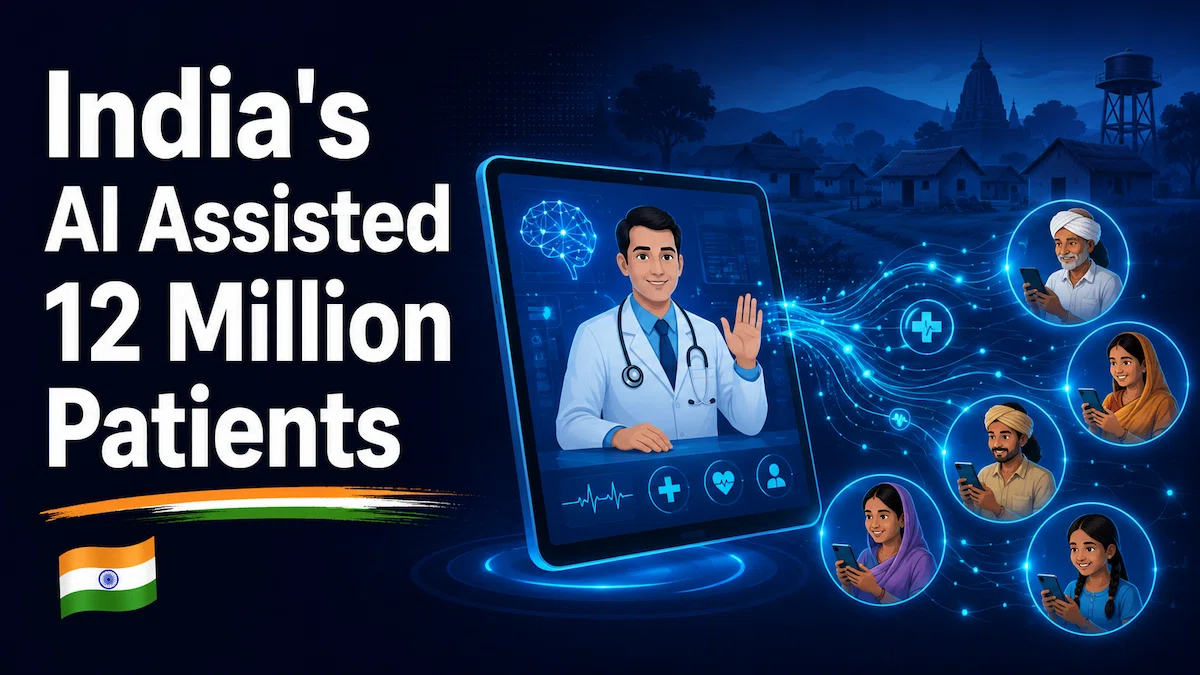
While the world debates whether AI will replace doctors, India’s government has quietly built something far more remarkable: a public healthcare AI system that has already assisted 12 million patients with AI-recommended diagnoses — and nobody in the global tech media is talking about it.
This is not a startup pilot. It is not an experiment confined to an urban hospital. It is a national-scale, government-backed, publicly verifiable AI deployment running on India’s own telemedicine infrastructure — and the numbers, confirmed by the Ministry of Health and Family Welfare (MoHFW) and the Press Information Bureau (PIB), are staggering.
What Is eSanjeevani — And Why Does It Matter for AI?
eSanjeevani is India’s national telemedicine platform, launched to provide remote healthcare consultations to citizens across the country — from metro hospitals to the smallest primary health centres in rural India.
Between April 2023 and November 2025, the platform conducted 282 million telemedicine consultations. To put that in perspective: that is more consultations than the entire population of Brazil receiving a doctor’s appointment — all through a government-run digital system.
But the more significant development is what happens inside those consultations: artificial intelligence.
The AI System: Clinical Decision Support at National Scale
India’s Ministry of Health and Family Welfare has integrated an AI tool called the Clinical Decision Support System (CDSS) directly into eSanjeevani. The system works like this:
When a patient connects with a doctor through eSanjeevani, the CDSS analyses the patient’s symptoms and medical record data in real time. It then provides the doctor with AI-generated differential diagnosis recommendations — a ranked list of the most likely conditions the patient may have, along with suggested next steps.
The doctor remains in charge. The AI assists. But that assistance has already made a measurable difference.
According to official government data tabled in the Lok Sabha by Union Minister of State for Health Prataprao Jadhav:
📊 Key Stats — eSanjeevani CDSS
Accuracy Note: The 12 million figure refers to consultations where AI assisted doctors with diagnostic recommendations — not autonomous AI diagnoses. The doctor retains full clinical authority. This distinction matters, and it makes the scale even more impressive: this is human-AI collaboration at population scale.
The TB Story: AI Saving Lives at the Grassroots
Beyond eSanjeevani’s CDSS, India has deployed AI across its National TB Elimination Programme — with results that should be front-page news globally.
Two AI tools are in active use:
1. Cough Against TB An AI-powered screening tool that analyses cough audio patterns to detect potential pulmonary TB cases in community settings. In the geographies where it has been deployed, it has identified 12–16% more TB cases than conventional screening methods would have caught — patients who would otherwise have gone undiagnosed and untreated.
2. Prediction of Adverse TB Outcomes An AI model that analyses patient data to predict which TB patients are at highest risk of serious complications. Since its deployment, India has recorded a 27% decline in adverse TB outcomes — meaning fewer deaths, fewer treatment failures, and fewer drug-resistant cases escalating.
For a country where TB remains a major public health burden, these are not incremental improvements. They are transformative.
The Surveillance Layer: 4,500+ Disease Outbreak Alerts
India’s AI health infrastructure also includes the Media Disease Surveillance (MDS) platform — an AI system that continuously scans digital news sources, social media, and public data streams across India to detect early signals of infectious disease outbreaks.
Since its launch in April 2022, MDS has generated 4,500+ event alerts, giving district health officials advance warning of potential outbreaks before they escalate. In a country of 1.4 billion people spread across 28 states and 8 Union Territories, this kind of AI-powered early warning system is genuinely life-saving infrastructure.
Why This Is the Most Underreported AI Story of 2026
Open any major tech publication today and you will find headlines about:
- The latest ChatGPT or Claude model update
- AI chip IPOs
- Silicon Valley funding rounds
What you will not easily find is a rigorous, data-backed story about a government deploying AI to improve healthcare outcomes for 12 million citizens who might otherwise have had access only to an overstretched primary health worker.
✅ Why This Story Is Credible
Verified government data (MoHFW, PIB, Lok Sabha records)
Peer-reviewed academic backing (published on medRxiv by an AI Centre of Excellence of the Government of India)
Real outcomes — not benchmarks, not demos, not projected impact
Scale that no private company has matched in the healthcare AI space
The medRxiv study, conducted between 2022 and 2024, describes India’s CDSS initiative as “the first government-supported, large-scale CDSS integration in a developing country, offering a replicable, ethical, and contextually grounded model for other LMICs [Low and Middle-Income Countries] to advance equitable and quality telehealth services.”
In other words: the world should be studying what India built.
What This Means for Indian AI Startups and Developers
If you are an Indian developer, health-tech founder, or AI researcher, there are several important takeaways from this story.
The government is a real customer. The MoHFW has not just published a policy paper — it has deployed AI in production at national scale. The procurement pathway exists. The political will exists. The data infrastructure exists. For health-tech startups, this is a significant signal.
The problem of doctor shortage is real — and AI is the most scalable solution. India had approximately 0.8 doctors per 1,000 population as of 2022, well below the WHO-recommended 1:1,000 ratio. In rural India, the gap is far wider. A CDSS that makes each doctor 20–30% more efficient in a telemedicine context is not a luxury — it is essential infrastructure.
Multilingual and contextual AI is a genuine moat. The eSanjeevani CDSS was built specifically for India’s healthcare realities — branching logic that accounts for language, regional disease patterns, and the constraints of primary health workers. Western CDSS tools, as the medRxiv paper notes, largely fail to contextualise to India. This is an enormous opportunity for Indian AI builders.
Open data + government platform = startup launchpad. The 282 million consultations flowing through eSanjeevani represent one of the richest real-world healthcare datasets in any developing country. As the IndiaAI Mission continues to expand access to compute and data, the opportunity to build on top of this infrastructure is significant.
The Bigger Picture: AI for Bharat, Not Just Bengaluru
India’s AI story is too often told through the lens of Bengaluru startups, IIT researchers getting hired by OpenAI, or Indian engineers building LLMs in Silicon Valley.
The eSanjeevani story is something different. It is AI designed by Indians, built for Indians, deployed by the Indian government, and benefiting Indians — many of whom live in villages where the nearest specialist doctor is hours away.
That is what “AI for Bharat” actually looks like in practice. Not a chatbot. Not a productivity tool for knowledge workers. A clinical AI system helping a primary health worker in rural Odisha give a more accurate diagnosis to a patient who walked two kilometres to reach the health centre.
The government has also designated AIIMS Delhi, PGIMER Chandigarh, and AIIMS Rishikesh as Centres of Excellence for Artificial Intelligence in Health — building the research infrastructure needed to sustain and expand this work.
Key Numbers at a Glance
What to Watch Next
The IndiaAI Mission is currently building AI-powered personal health assistants for preventive care — the next layer on top of the diagnostic tools already deployed. NITI Aayog is constructing a database of 20,000+ cancer patient profiles (radiology and pathology images) to enable AI-assisted cancer diagnosis. And the Ayurgenomics initiative — recognised by WHO in July 2025 as a global model — is using AI to integrate genomic data with Ayurvedic Prakriti constitution types for personalised medicine.
India is not experimenting with healthcare AI. It is deploying it — at a scale that no other country in the developing world has matched.
Bottom Line
The global AI conversation in 2026 is dominated by model releases, funding rounds, and chip IPOs. But the most consequential AI deployment of the year may well be happening inside India’s public health system — quietly, at population scale, with verified outcomes.
12 million patients. 282 million consultations. A 27% decline in adverse TB outcomes. 4,500 disease outbreak alerts.
These are not projections. They are already real.
FAQs
Is eSanjeevani’s AI actually diagnosing patients on its own?
No. The AI acts as a decision-support tool for doctors — it analyses symptoms and suggests possible diagnoses, but the doctor makes every final call. Think of it as a very smart second opinion, not a replacement for clinical judgment.
Is this data officially verified or just government claims?
Both the 12 million and 282 million figures are sourced from a written reply in the Lok Sabha by Minister of State Prataprao Jadhav, published by MoHFW and PIB, and independently backed by a peer-reviewed medRxiv preprint from a Government of India AI Centre of Excellence.
Can Indian health-tech startups build on top of eSanjeevani?
The IndiaAI Mission is actively encouraging this. The platform’s dataset (282 million consultations) is one of the richest real-world health datasets in any developing country, and the government has designated AIIMS Delhi, PGIMER Chandigarh, and AIIMS Rishikesh as AI Centres of Excellence specifically to support further development.
Sources: Ministry of Health and Family Welfare (MoHFW), Press Information Bureau (PIB), Lok Sabha written reply by Minister of State Prataprao Jadhav, medRxiv preprint by Government of India AI Centre of Excellence, IBEF, India Semiconductor Mission.