
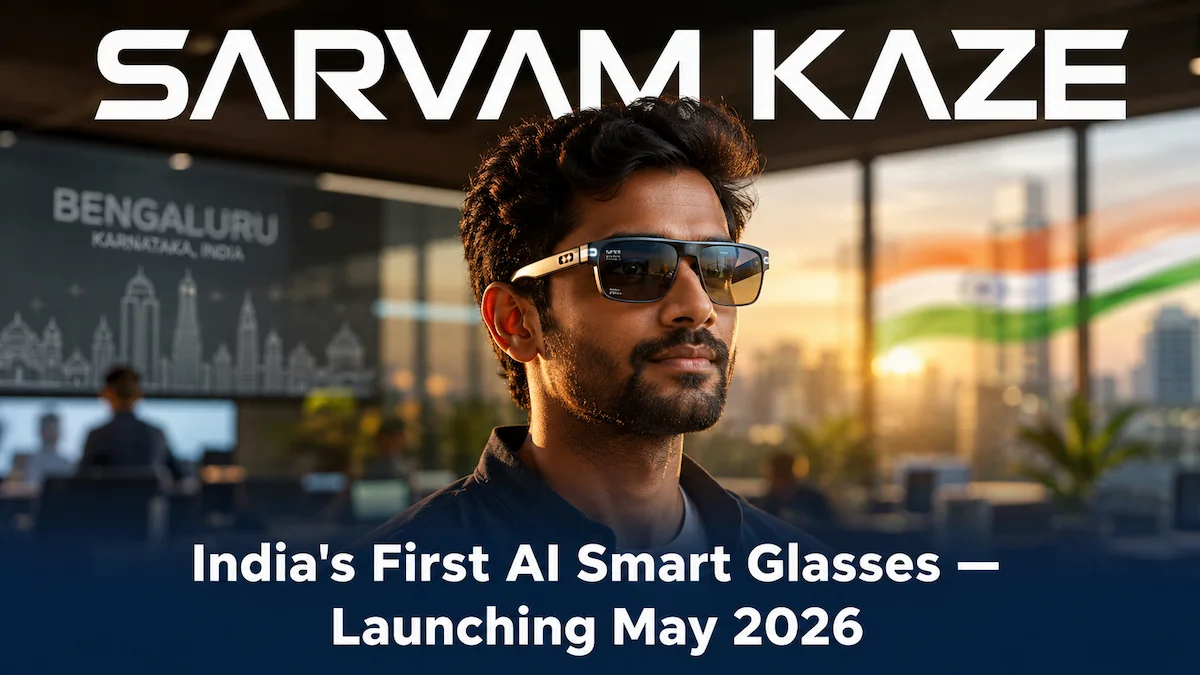
Sarvam Kaze AI smartglasses India launch is just around the corner — and if you are an Indian developer, a tech professional, or simply someone tired of hearing that cutting-edge AI hardware always arrives in the US first, this one is for you. Bengaluru-based Sarvam AI confirmed the launch window as May 2026, which means the wait is measured in days — not months.
This is not a prototype. This is not a CES concept that quietly disappears. When Prime Minister Narendra Modi became the first person to physically try the Sarvam Kaze at the India AI Impact Summit in February 2026, it sent an unmistakable signal: this is real, it is imminent, and India is about to have its own answer to Meta’s Ray-Ban smart glasses.
What Exactly Is Sarvam Kaze?
At its core, the Sarvam Kaze is a pair of AI-powered smart glasses designed from the ground up inside India, by an Indian company, running Indian AI models. It is Sarvam AI’s first hardware product — a deliberate leap from the company’s world of large language models and enterprise APIs into something you can actually wear on your face.
Co-founder and CEO Pratyush Kumar put it plainly on X when he unveiled the device: “Launching Sarvam Kaze, our foray into getting our models into your hands with our devices — designed and built here in India.” He followed that up with a line that could become a tagline for the entire Made in India AI movement: “Designed in India, built in India, fitted with AI from India. All in your hands this May.”
From the images and teaser video released so far, the Kaze follows the now-familiar smart glasses form factor — a clean, everyday spectacle frame with cameras and microphones embedded discreetly into the arms. Think Ray-Ban Meta in silhouette, but the intelligence running underneath is entirely different. Where Meta’s glasses route everything through Meta AI — an American model, trained on American data, optimised for English — Kaze runs on Sarvam’s own in-house AI stack, which supports over 10 Indian languages.
The device is engineered to listen, understand, and respond in real time. The cameras capture what you see, feeding context to the AI. The result is a hands-free assistant that can hold a conversation in Hindi, Tamil, Gujarati, Bengali, or Kannada without the latency and language garbling that plagues current foreign AI systems when handling Indian scripts and spoken patterns.
Why This Matters More Than Another Gadget Launch
India has a complicated history with hardware. The country produces brilliant software engineers and world-class AI researchers. But when it comes to actually manufacturing and shipping AI hardware domestically? The track record is thin. Most “Made in India” wearable tech either relies on Chinese OEM components or quietly ships hardware designed elsewhere.
Sarvam is staking its reputation on the claim that Kaze is genuinely different — built here, not just assembled here. Kumar and co-founder Vivek Raghavan are not newcomers to building systems at India’s scale. Raghavan spent over a decade as a biometric architect on Aadhaar, overseeing a platform that enrolled over a billion Indians. Kumar has a PhD from ETH Zurich, spent years at IBM Research and Microsoft Research, and was a founding force behind AI4Bharat at IIT Madras. These are people who understand what “population scale” actually means.
The Kaze is not just a consumer product. It is a proof of concept that India can do the full stack — models, infrastructure, enterprise APIs, and now wearable hardware — without routing intelligence through a server in California.
The Company Behind the Glasses: Sarvam AI’s Rocket Trajectory
If you haven’t been tracking Sarvam closely, here is the context that explains why this launch is a big deal beyond the device itself.
Sarvam AI was founded in August 2023. By December 2023 — barely four months in — it raised $41 million in a Series A led by Lightspeed Venture Partners, with Peak XV Partners and Khosla Ventures participating. That was already the largest seed-stage raise for an Indian AI startup at the time.
Then, in April 2025, the Ministry of Electronics and Information Technology (MeitY) selected Sarvam as one of the companies to develop India’s sovereign foundational AI model under the IndiaAI Mission — a government programme backed by over ₹10,000 crore. That selection came with access to government-supported GPU infrastructure, including NVIDIA H100 clusters through Yotta Data Services.
By February 2026, at the India AI Impact Summit in New Delhi, Sarvam launched two open-source LLMs — the Sarvam 30B and Sarvam 105B — trained from scratch on Indian language data and released under the Apache 2.0 licence. The 105B model, named Indus, is a Mixture-of-Experts architecture that activates approximately 10.3 billion parameters per token while handling over 10 Indian languages.
And then came the funding news that put Sarvam in a different league entirely. Bloomberg reported in early April 2026 that Sarvam is raising $300 million to $350 million at a valuation of $1.5 billion to $1.55 billion, with Bessemer Venture Partners expected to lead the round and Nvidia, Amazon, and Prosperity7 Ventures participating. That would make Sarvam India’s newest AI unicorn and the recipient of the largest-ever capital infusion into a pure-play Indian AI company.
NVIDIA’s participation is particularly significant. The world’s most powerful AI chipmaker does not bet on companies lightly. Its entry into the Sarvam cap table is effectively an endorsement that Sarvam’s approach — sovereign models, Indian language-first architecture, edge deployment — is technically sound and strategically important.
Kaze vs Meta Ray-Ban: The Comparison That Matters
Meta’s Ray-Ban smart glasses sold over seven million units in 2025 alone. They have proven that there is genuine mass-market demand for AI wearables that look like normal glasses — not sci-fi headsets. Kaze enters a validated category, which is actually the best-case scenario for an early mover from India.
Here is where Kaze has a structural advantage: language. A large portion of India’s 1.45 billion population is more comfortable speaking in their native language than typing in English. Meta’s glasses work reasonably well in English; their Hindi and Tamil comprehension is functional at best. Kaze is built natively for the languages that actual Indians use at home, at work, and in the street. If the on-device AI performs as Sarvam’s other products have — the company claims its voice agents handle over 100 million interactions with sub-500ms latency — Kaze could be genuinely superior for the Indian market.
The developer angle is also meaningful. Sarvam has said developers will be able to build custom applications for the Kaze platform through the Sarvam developer tools. That is the same playbook Meta used to grow its ecosystem — and Sarvam already runs an active startup programme, providing API credits and engineering support to early-stage Indian AI companies.
What We Still Do Not Know
Transparency requires noting what is still unconfirmed as of today. Sarvam has not released official pricing, battery life specifications, camera resolution, or an exact launch date within May 2026. The “May 2026” window is the stated target from co-founder Kumar, confirmed across multiple reports, but no pre-order or retail listing has gone live yet.
There is also a legitimate question about manufacturing claims. Some analysts in the XR space have flagged that India-origin hardware often relies on Chinese OEM components despite “Made in India” branding. It is a fair concern, and one that will only be answered when the device ships and is independently verified. In the meantime, you can join the official Kaze waitlist on Sarvam’s website to be among the first notified at launch.
Why Indian Developers Should Pay Attention Right Now
If you are building in the Indian AI space — whether you are a solo developer, a startup founder, or a product manager at an IT firm — Kaze represents a potential distribution platform. An AI wearable with open developer tools, native Indian language support, and government backing is the kind of platform that does not come along often.
For a deeper look at the on-device AI architecture powering Kaze — including how Sarvam’s edge models run offline without sending data to any server — the company’s official Sarvam Edge blog post is worth reading.
For Indian consumers, the pitch is simpler: a device that actually understands you, in the language you think in, built by a company that cannot afford to get India wrong — because India is the only market it is built for.
The race to put AI on your face is no longer just a Silicon Valley story. A Bengaluru startup is about to tell the world that India can do hardware too.
FAQs
When will Sarvam Kaze AI smartglasses launch in India?
Sarvam AI co-founder Pratyush Kumar confirmed the launch window as May 2026. As of May 14, no exact date or pre-order link has been announced yet. Follow Sarvam AI’s official channels for the live update.
What languages does Sarvam Kaze support?
Sarvam Kaze supports over 10 Indian languages including Hindi, Tamil, Telugu, Kannada, Bengali, and Gujarati — powered entirely by Sarvam’s own in-house AI models, not third-party systems like Meta AI or Google Gemini.
How is Sarvam Kaze different from Meta Ray-Ban smart glasses?
Unlike Meta Ray-Ban glasses, which run on Meta AI and are optimised primarily for English, Sarvam Kaze is built natively for Indian languages and runs on sovereign Indian AI models. It also offers a developer SDK so Indian startups can build custom apps directly on the platform.
Sources: Analytics Insight, Indian Startup News, Bloomberg, Croma Unboxed, Business Standard, Wikipedia/Sarvam AI, Outlook Business, Founderpin. All facts verified from primary or credible secondary sources. Pricing and hardware specs to be updated at official launch. Published: May 14, 2026.
Pingback: Muse Charm: Meta's AI Keychain, Price, Specs and India Status