

Key Takeaways
- Validated Indian AI tools for radiology, TB screening, diabetic retinopathy, and clinical documentation exist and are deployable today — most Indian doctors simply don’t know which ones to trust or where to start.
- India’s ABDM ecosystem now connects 670,000 healthcare professionals to a live digital health infrastructure — but using patient data with AI tools triggers DPDP Act obligations that most clinicians have never been briefed on.
- There is no binding AI liability law in India — if an AI tool you use gives a wrong diagnosis and a patient is harmed, current law puts the accountability squarely on you, the doctor.
AI for doctors in India is no longer a future conversation — it’s a 2026 reality that most clinicians are underprepared for. Over 42,000 Indian doctors have already registered for the government’s new AI-in-medicine training programme. That number, from January 2026, tells you something important: the profession knows AI is coming. What it doesn’t tell you is whether those same doctors know which tools are worth using, how to use them without breaching patient data laws, or what happens legally if an AI recommendation turns out to be wrong.
This is the article that bridges that gap. Not a conference brochure about AI’s “transformative potential” — but a practical account of what clinical AI looks like on the ground in India right now, what the government has actually built, and where the liability landmines are buried.
If you’re an Indian doctor, medical educator, hospital administrator, or health-tech founder, what follows is the most useful thing you’ll read on this topic in 2026.
Why Indian Doctors Can’t Afford to Ignore AI in 2026
Start with one number: India has approximately 0.7 doctors per 1,000 people. The WHO recommends at least 1 per 1,000. That gap isn’t closing fast enough through medical college expansion alone. AI isn’t a productivity tool in this context — it’s a structural necessity.
The government understands this. Union Minister Anupriya Patel, speaking at the Health of India Summit 2026, said fears of AI replacing doctors are “largely misplaced.” The goal, she emphasized, is augmentation — helping the doctors who exist to reach patients they could never have reached otherwise.
That framing matters. India’s AI-in-healthcare push isn’t being driven by Silicon Valley-style disruption narratives. It’s being driven by the cold arithmetic of a country with 20% of the world’s disease burden and a chronic shortage of specialists outside metro cities.
The doctors who adapt earliest will have a significant professional and institutional advantage. The ones who ignore it may find themselves legally exposed in ways they haven’t considered.
Best AI Tools for Doctors in India Right Now (2026)
The honest answer is: a small but growing set of validated, India-built tools are already in clinical use. Here’s where AI for doctors in India is actually working.
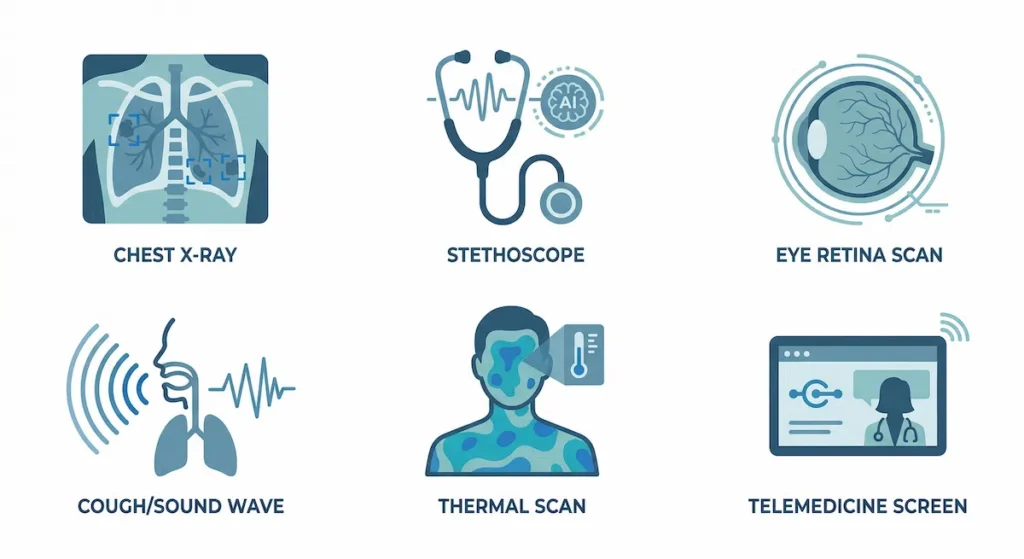
Radiology and imaging: Qure.ai Mumbai-based Qure.ai has built AI that analyses chest X-rays within seconds and flags tuberculosis, lung abnormalities, and other conditions. It’s WHO-evaluated and being used across hospital networks in India and internationally. For a radiologist in a district hospital dealing with 200 scans a day, this is not a future promise — it’s a working triage tool.
Tuberculosis screening: Wadhwani AI’s “Cough Against TB” India carries 28% of the world’s TB burden. Wadhwani AI developed a smartphone-based tool that analyses cough audio recordings to screen for likely TB before formal diagnosis. It’s among the most well-documented public health AI deployments in the country, and it’s being used as a frontline screening layer — not a replacement for clinical confirmation.
Diabetic retinopathy: MadhuNetrAI Launched in December 2025, MadhuNetrAI screened over 7,100 patients across 38 healthcare facilities in its first six months. It’s India’s first AI-assisted community screening programme for diabetic retinopathy — a condition that causes preventable blindness in millions of poorly controlled diabetic patients across the country.
AI-powered stethoscope: AiStetho AiStetho picks up heart and lung sounds, runs them through machine learning, and provides diagnostic insights — particularly useful in rural settings where cardiology specialists are scarce. A general physician in a primary health centre can use it to flag patients who need referral.
Cancer screening: Thermalytix Combines thermal imaging with AI to detect early signs of breast cancer without radiation. Non-invasive, portable, and designed specifically for screening programmes in under-resourced settings.
Clinical documentation: AI scribes Less headline-grabbing but arguably the highest daily-use application. AI transcription and documentation tools are reducing the time doctors spend writing up notes, discharge summaries, and referral letters. For a busy outpatient department processing 80–100 patients a day, this alone is significant.
eSanjeevani CDSS Inside India’s national telemedicine platform — which has handled 282 million consultations between April 2023 and November 2025 — AI-powered Clinical Decision Support Systems analyse patient symptoms and medical records to assist doctors in real-time. If you’re consulting through eSanjeevani, you’re likely already interacting with AI.
How ABDM Integration Changes Your Daily Workflow
The Ayushman Bharat Digital Mission is the infrastructure layer that makes all of this work at scale. As of mid-2025, it had created 799 million digital health IDs, onboarded 410,000 healthcare facilities, and connected 670,000 healthcare professionals to a common digital backbone.
For a practicing doctor, this means patient records, diagnostic reports, and prescription histories can theoretically follow the patient across providers. AI tools plugged into the ABDM ecosystem can access this longitudinal data to improve diagnostic accuracy.
But it also means something your hospital’s IT team may not have told you: every time patient data flows into an AI system, you may be triggering obligations under the DPDP Act 2023.
The Digital Personal Data Protection Act requires data fiduciaries — which includes hospitals and, by extension, the doctors working within them — to obtain free, specific, and informed consent before processing patient data. AI diagnostic tools that ingest clinical images, lab reports, or health records qualify as processing. If your hospital is using such a tool and hasn’t built proper consent workflows, both the institution and the treating doctor can be exposed.
Most clinicians have no idea this applies to them. That’s not a criticism — it’s a gap in how AI tools have been rolled out.
The Government’s AI Push: SAHI, NBEMS Training, and India’s First AI Clinic
Three developments from early 2026 are worth knowing about.
SAHI Framework (March 2026) The Ministry of Health and Family Welfare released the Strategy for AI in Healthcare for India — a national framework for ethical and effective AI integration in the health ecosystem. It covers validation standards, data governance, human oversight requirements, and the role of institutions like AIIMS Delhi, PGIMER Chandigarh, and AIIMS Rishikesh, which have been designated Centres of Excellence for AI in healthcare.
NBEMS AI Training Programme The National Board of Examinations in Medical Sciences launched an online programme aiming to equip 50,000 doctors with foundational AI skills for clinical practice, diagnostics, research, and decision-making. It crossed 42,000 registrations within weeks of launch. The programme is free. If you haven’t registered, that’s worth looking at.
GIMS Greater Noida AI Clinic (January 2026) The Government Institute of Medical Sciences inaugurated India’s first government-run AI clinic — combining AI with genetic screening to detect cancer, cardiac, kidney, and liver diseases at early stages. It’s a model the government intends to replicate nationally. The significance isn’t just clinical — it signals that AI diagnostics are now officially part of India’s public health infrastructure, not a private-sector experiment.
AI Hallucinations and Patient Self-Diagnosis: The Risk Indian Doctors Face Daily
Here is something that should concern every practicing doctor in India: patients are already using ChatGPT and Gemini to self-diagnose, then walking into your clinic with an AI-generated conclusion in hand.
Wadhwani Foundation’s Dr. Shrishendu Mukherjee flagged this explicitly at the Health of India Summit: people using AI to self-diagnose are now requesting specific antibiotics based on what an AI told them. In a country where antimicrobial resistance already causes approximately 2.67 lakh direct deaths annually, this is a live clinical problem — not a hypothetical.
On the tools side, a Nature Medicine trial found that 6.5% of AI cardiology responses contained clinically significant hallucinations. Not wrong in a minor way — clinically significant. Cardiologist Eric Topol, cited in a March 2026 TIME investigation, noted that while AI systems working independently have outperformed physicians in five separate studies, the hallucination rate in high-stakes contexts remains a genuine patient safety concern.
The practical implication for Indian doctors: any AI tool you use requires human oversight, not passive acceptance. Treat AI output the way you’d treat a junior resident’s recommendation — worth considering, requires verification, and your responsibility to sign off on.
Legal Liability: If AI Gets It Wrong in India, Who Pays?
This is the question most AI tool vendors would prefer not to answer directly. So here it is plainly.
India currently has no binding AI-specific healthcare liability law. The frameworks that exist — the Consumer Protection Act 2019, the DPDP Act 2023, the IT Act 2000 — provide partial coverage but were not designed for autonomous AI decision-making in clinical settings.
The DPDP Act covers data consent and privacy. The Consumer Protection Act allows patients to claim compensation from manufacturers of defective AI systems. But neither creates a clear accountability framework for what happens when an AI system gives a wrong diagnostic recommendation that a doctor acts on.
Medico-legal literature references what’s called the “30–70 rule” — AI contributes roughly 30% of diagnostic input, the clinician the remainder. But Indian law doesn’t recognise this split. The doctor remains fully accountable under the current framework, regardless of what the AI said.

This has a direct practical implication. If you use an AI tool in clinical practice:
- Document that you used it — in the patient record, note the tool and the output
- Document your independent clinical assessment — make clear that the decision was yours
- Obtain informed consent for AI-assisted diagnosis where applicable, especially in sensitive cases
- Don’t use unvalidated consumer AI tools (ChatGPT, Gemini) for clinical decisions without clear disclosure and verification
The ICMR has published guidelines on AI in healthcare prioritising transparency and accountability. Adhering to them is currently your best risk management in the absence of binding law.
The SAHI framework, released in March 2026, is the government’s attempt to create a more coherent regulatory structure — but it is, as yet, a policy document, not enforceable law. Binding legislation on AI healthcare liability is still a gap India hasn’t filled.
Until it does, the liability sits with you.
FAQs
Which AI diagnostic tools are approved or validated for use in India?
Qure.ai (chest X-ray, TB, lung cancer screening) is WHO-evaluated and widely deployed. MadhuNetrAI has been validated through government-backed community screening. Wadhwani AI’s Cough Against TB tool is integrated into the National TB Elimination Programme. ICMR guidelines recommend using tools that have undergone formal clinical validation in Indian populations — check whether any tool you’re considering has published validation data from Indian cohorts.
Can I use ChatGPT or Gemini for clinical decisions?
Not without significant caution. Consumer AI tools are general-purpose, not medically validated, and known to produce clinically significant hallucinations. If you use them, treat output as background research — not as diagnostic support. Never use patient-identifiable data with these tools, as that would likely breach DPDP Act consent requirements. For clinical AI, use validated, purpose-built tools.
Which AI tool is best for doctors in India?
Depends on specialty. Qure.ai for radiology, AiStetho for primary/rural care, MadhuNetrAI for diabetic retinopathy screening. No single best — match the tool to your clinical need.
If an AI tool gives a wrong diagnosis and a patient is harmed, am I liable?
Under current Indian law, yes — the doctor remains the primary accountable party. The DPDP Act and Consumer Protection Act don’t create a shared liability framework between clinicians and AI developers. Document your independent clinical assessment, note AI tool usage in patient records, and don’t rely on any AI output without verification. The legal landscape may evolve — SAHI signals regulatory intent — but as of mid-2026, the doctor carries the risk.
Is the government providing free AI training for Indian doctors?
Yes. The National Board of Examinations in Medical Sciences launched an online AI training programme in January 2026, targeting 50,000 doctors. Over 42,000 have already registered. The Indian College of Artificial Intelligence in Medicine (ICAIM) also runs structured certification programmes. Both are accessible online. Given that AI literacy is increasingly a professional necessity — and may eventually factor into standard of care determinations — this is worth prioritising.
Is AI used in government hospitals in India?
Yes. GIMS Greater Noida runs India’s first government AI clinic (January 2026). eSanjeevani’s 282 million consultations use AI-powered decision support. Qure.ai is integrated into the National TB Elimination Programme.
📌 Disclaimer
Last updated: April 2026
This article is for informational and editorial purposes only and is based on publicly available information at the time of writing. It does not constitute legal, financial, or investment advice. Any company logos, brand names, trademarks, or images used in this article remain the property of their respective owners and are used only for identification, commentary, or editorial reference where applicable.