
India carries the world’s second-highest economic burden from diabetes — yet its pharmaceutical giants are still watching the AI drug discovery revolution from the sidelines.
When Novo Nordisk — the Danish company behind Ozempic and Wegovy — announced a landmark partnership with OpenAI in April 2026, the global pharmaceutical industry took notice. The deal is not about building a chatbot for doctors. It is about using the most advanced AI in the world to scan billions of molecular combinations, spot patterns invisible to human scientists, and cut years off the timeline from lab bench to patient bedside.
The question that no Indian publication has asked loudly enough is this: when does India get its version of this deal?
What Novo Nordisk and OpenAI Actually Announced
The partnership, announced on April 14, 2026, is one of the most comprehensive AI integrations ever signed in the pharmaceutical sector. Unlike earlier pharma-AI deals that focused narrowly on a single research function, the Novo-OpenAI agreement covers the entire drug development pipeline.
Under the agreement, Novo Nordisk will deploy OpenAI’s most advanced models across drug discovery, clinical trial design, manufacturing, supply chain, and commercial operations. Pilot programs have already launched across R&D, manufacturing, and commercial functions, with full company-wide integration targeted by end of 2026.
“Integrating AI in our everyday work gives us the ability to analyse datasets at a scale that was previously impossible, identify patterns we could not see, and test hypotheses faster than ever,” said Novo CEO Mike Doustdar at the announcement. “This means discovering new therapies and bringing them to market faster than ever before.”
OpenAI CEO Sam Altman put the broader ambition plainly: “OpenAI has been expanding aggressively into life sciences — and this deal is its biggest healthcare bet yet. This collaboration will help Novo Nordisk accelerate scientific discovery, run smarter global operations, and redefine the future of patient care.”
Critically, the partnership also includes a workforce upskilling component — OpenAI will help Novo build AI literacy across its entire global organisation of approximately 68,800 employees. The deal includes strict data governance and human-in-the-loop oversight to ensure regulatory compliance.
Why Novo Nordisk Needed This — and Fast
Novo Nordisk did not reach for this deal from a position of strength. It reached for it from competitive pressure.
For years, the Danish company dominated the GLP-1 market — the class of drugs that includes Ozempic and Wegovy, which have reshaped diabetes and obesity treatment globally. But by early 2026, US rival Eli Lilly had surged ahead with its own obesity drugs, including ZepBound. In early 2026, Novo’s next-generation obesity therapy CagriSema failed to match Lilly’s ZepBound in late-stage trials, sending Novo’s stock down roughly 16%.
The OpenAI partnership is, in part, a response to that setback — a bet that AI can accelerate the discovery of new molecules and clinical strategies fast enough to regain lost ground.
Novo is not alone. Eli Lilly has signed over 16 AI partnerships since 2025, including a $2.75 billion deal with AI-focused biotech Insilico Medicine for oral therapeutics, and a $1 billion pact with NVIDIA. Sanofi partnered with OpenAI and Formation Bio in 2024 with the declared ambition of becoming “the first biopharma company to be AI-powered.” McKinsey estimates AI could unlock $60–110 billion annually for the pharmaceutical and medtech sectors by accelerating compound identification, trial design, and regulatory submissions.
The global pharma AI race has officially started. The winners will reach patients faster. The laggards will wait years longer — and pay far more to catch up.
India’s Stake: The Diabetes Capital of the World
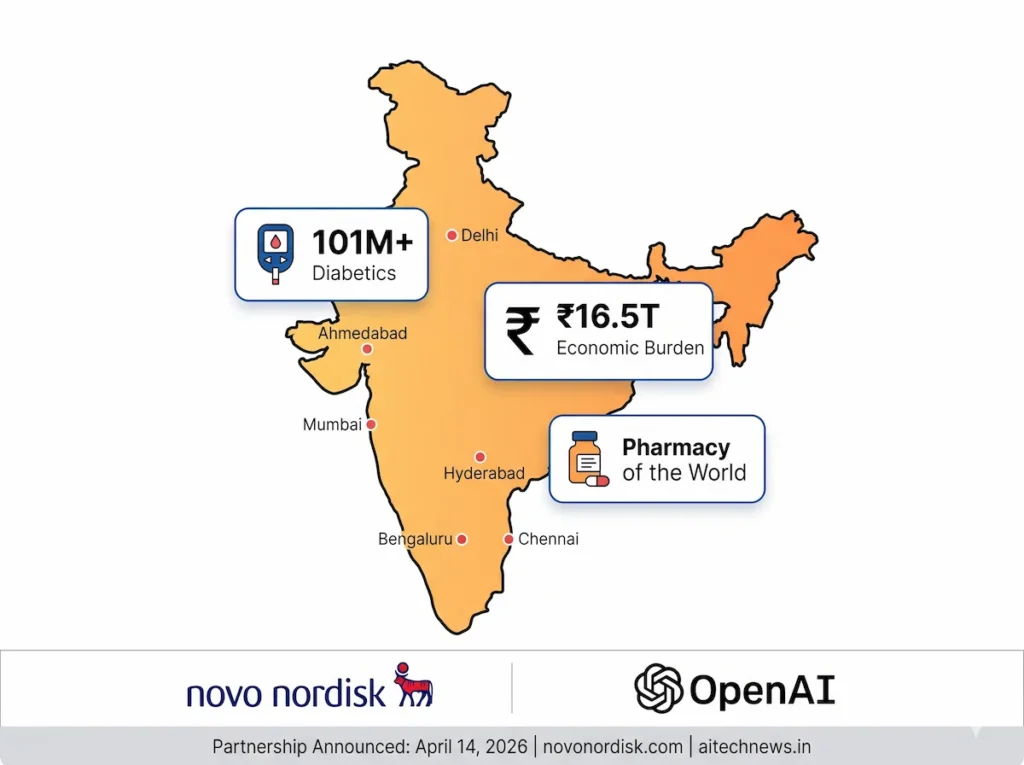
Here is the number every Indian pharma executive should have pinned to their wall: $16.5 trillion.
That is India’s cumulative economic burden from diabetes, according to a January 2026 global study — the second-highest in the world, behind only the United States. India accounts for a staggering share of the global diabetes burden, with tens of millions of adults affected and projections showing the crisis deepening through 2031 as urban lifestyles, dietary changes, and genetic predispositions combine.
The irony is painful. India is called “the pharmacy of the world” for good reason. Indian companies — Sun Pharma, Dr. Reddy’s, Cipla, Lupin, Biocon, Zydus Lifesciences — supply affordable generics to patients across 170+ countries. India’s pharmaceutical industry revenues are projected to cross $280 billion in 2026. More than six million people are employed in the sector.
And yet, when it comes to AI-powered drug discovery, the country that carries one of the planet’s largest diabetes burdens has no Novo Nordisk-OpenAI equivalent to point to.
What Indian Pharma Is Actually Doing With AI (And What’s Missing)
To be fair, India’s pharmaceutical giants are not completely asleep on AI. According to a September 2025 analysis published by Sify, Sun Pharmaceutical is using AI for molecule screening, toxicity prediction, and automating literature reviews. Dr. Reddy’s is deploying computer vision for packaging validation and piloting chatbots for chronic therapy adherence. Cipla has integrated AI into smart inhalers and partnered with IITs for respiratory diagnostics. Biocon is investing in protein modelling and genomics-driven cancer therapies.
These are meaningful steps. But they are operational AI — efficiency tools applied to existing processes. What Novo Nordisk just bought from OpenAI is something fundamentally different: generative AI applied to the hardest part of drug development — finding new molecules and de-risking the discovery process itself.
The gap is significant. Indian pharma’s traditional competitive advantage has been cost-effective generic manufacturing — producing proven molecules cheaply at scale. That model is being squeezed from two sides simultaneously: AI is making it possible for global companies to develop new drugs faster and cheaper, while regulatory pressure and generic market saturation are compressing margins on existing products.
Sun Pharma’s Chairman Dilip Shanghvi acknowledged the challenge directly earlier this year, noting that while traditional drug development might involve $2–3 million, genuine innovation requires hundreds of millions over extended periods. Sun itself is targeting R&D spending of around 5.8–6% of sales for FY2026 — a positive sign, but still modest relative to global innovators.
The Sovereign AI Angle: India Has Tools It Isn’t Using
India is not without resources here. The IndiaAI Mission, launched under MeitY, has created infrastructure specifically to support AI-driven innovation in priority sectors including healthcare. The NITI Aayog report on AI for inclusive development explicitly highlights the opportunity to use AI to improve healthcare delivery for India’s 490 million informal-sector workers. The IndiaAI Innovation Challenge 2026, currently accepting applications, offers government contracts worth up to ₹1 crore for AI solutions applied to public health systems including AYUSH.
The Indian Institute of Chemical Technology, various IIT labs, and startups like Bugworks Research and Terralogic Biosciences are building AI tools for drug repurposing and antimicrobial resistance — problems that disproportionately affect India. These efforts deserve far more attention, funding, and industry partnership than they are receiving.
India also has a hidden asset: data. The country’s vast and genetically diverse patient population represents one of the richest possible training datasets for AI models aimed at disease detection and drug response prediction. South Asian populations are known to develop diabetes at lower BMIs than Western populations — a distinction that global models built on Western data may not capture well. An Indian pharma-AI initiative built on domestic patient data could build models genuinely superior for Indian patients, and potentially exportable across the Global South.
What Needs to Happen Next
The Novo Nordisk-OpenAI deal should be a wake-up call for India’s pharma ecosystem. A few things need to happen:
Industry consortiums: Indian pharma giants should explore consortium-style AI partnerships — pooling anonymised research data and jointly funding AI infrastructure, similar to how European pharma companies have collaborated on early-stage research. No single Indian company has the data volume or AI budget of a Novo Nordisk individually, but collectively they could be competitive.
Government as catalyst: The IndiaAI Mission’s computing infrastructure — including the planned high-performance computing nodes being rolled out under the mission — should be made explicitly available to pharma AI applications, not just to IT startups.
Talent pipelines: India trains extraordinary data scientists. The pharma sector needs to become a more competitive employer for AI talent — currently losing it to fintech, IT services, and global AI labs.
Startup integration: India’s growing cohort of pharma AI startups — Bugworks, Terralogic, and others — need direct pathways to partner with established pharma companies, not just academic grants. The Novo model shows that even a company with 68,000 employees and decades of R&D experience concluded it needed an outside AI partner.
The Bottom Line
The Novo Nordisk-OpenAI partnership is a signal, not just a news story. It marks the point at which generative AI crossed from being a productivity tool in pharma to becoming a core drug discovery strategy. The companies that move fast on this will find new molecules faster, fail cheaper, and reach patients sooner. The ones that wait will face a compounding disadvantage.
India has more to gain from this technology than almost any other country — and more to lose from falling behind. With the world’s second-largest diabetes burden, a world-class pharmaceutical manufacturing base, and one of the richest patient datasets on the planet, India is sitting on a potential advantage that could be transformative.
The question is whether Sun Pharma, Cipla, Dr. Reddy’s, Biocon, and Lupin will move fast enough to claim it — or whether they will still be reading about Western pharma’s AI breakthroughs five years from now.
FAQs
Is the Novo Nordisk–OpenAI deal exclusive to diabetes and obesity drugs?
No. While Novo Nordisk is best known for diabetes and obesity treatments like Ozempic and Wegovy, the partnership covers the company’s entire drug development pipeline — from target identification and clinical trial design all the way through manufacturing, supply chain, and commercial operations. The full integration is targeted by end of 2026.
Which Indian pharma companies are currently using AI in drug discovery?
A few are making early moves. Sun Pharma is using AI for molecule screening and toxicity prediction, Dr. Reddy’s for packaging validation and chronic therapy chatbots, Cipla for AI-powered smart inhalers, and Biocon for protein modelling in cancer research. However, none has yet signed a comprehensive AI partnership comparable to the Novo–OpenAI deal that covers end-to-end drug discovery and operations.
Can Indian startups participate in pharma AI development in India?
Yes — and right now is a good time to act. The IndiaAI Innovation Challenge 2026, run by MeitY’s IndiaAI Mission, is actively inviting Indian startups, researchers, and developers to build AI solutions for public health systems, including AYUSH-related disease management. Selected teams can win government contracts worth up to ₹1 crore. Applications are currently open at indiaai.gov.in.
Sources: Novo Nordisk official press release (April 14, 2026); CNBC; Bloomberg; BioPharm International; Drug Discovery World; IntuitionLabs analysis; The Week India (January 2026); Sify (September 2025); McKinsey & Company pharma AI analysis.