
Key Takeaways
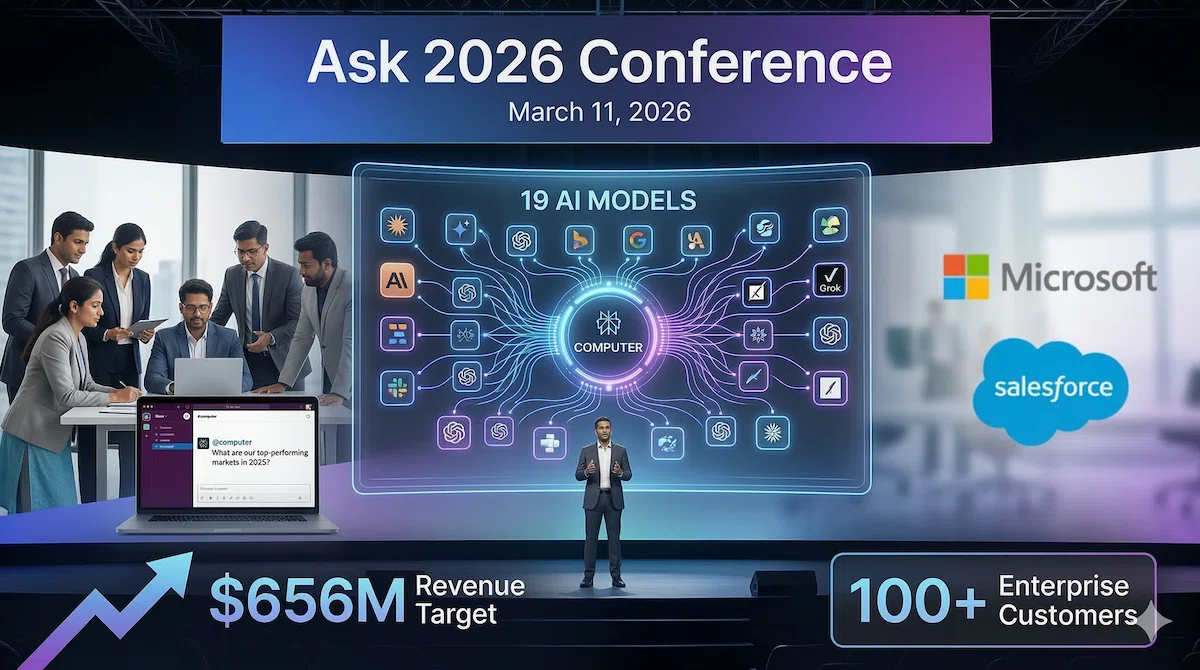
- Perplexity launched Computer for Enterprise at Ask 2026 conference on March 11 — The multi-model AI agent orchestrates 19 different AI models simultaneously with Slack integration and Snowflake connectors, positioning the $20 billion startup as a direct Microsoft Copilot and Salesforce competitor with $656 million annual revenue targets for 2026
- 100+ enterprises messaged Perplexity over one weekend demanding access after viral demonstrations — Users built Bloomberg Terminal-style financial dashboards and replaced six-figure marketing tool stacks in single weekends, triggering enterprise adoption wave that Indian IT giants (TCS, Infosys, Wipro) are now integrating into agentic AI workflows for clients
- Indian enterprises face $200/month adoption decision as agentic AI market hits $985 billion by 2030 — CrewAI survey shows 100% of enterprises plan to expand agentic AI use this year with 65% already in production, but Indian IT services companies must navigate pricing pressure as AI agents automate managed services representing 22-45% of their revenue
On Wednesday, March 11, 2026, Perplexity—the AI-powered search company valued at $20 billion—announced at its inaugural Ask 2026 developer conference that Computer, its multi-model AI agent, is now available to enterprise customers. The move transforms the three-year-old startup from consumer search disruptor into direct competitor against Microsoft, Salesforce, and legacy enterprise software controlling corporate America.
The enterprise launch arrives barely two weeks after Computer debuted for consumers, where it triggered what Perplexity describes as a viral moment. Users on social media demonstrated the agent building Bloomberg Terminal-style financial dashboards, replacing six-figure marketing tool stacks in single weekends, and automating workflows that previously required dedicated teams. Perplexity says more than 100 enterprise customers messaged the company over a single weekend demanding access.
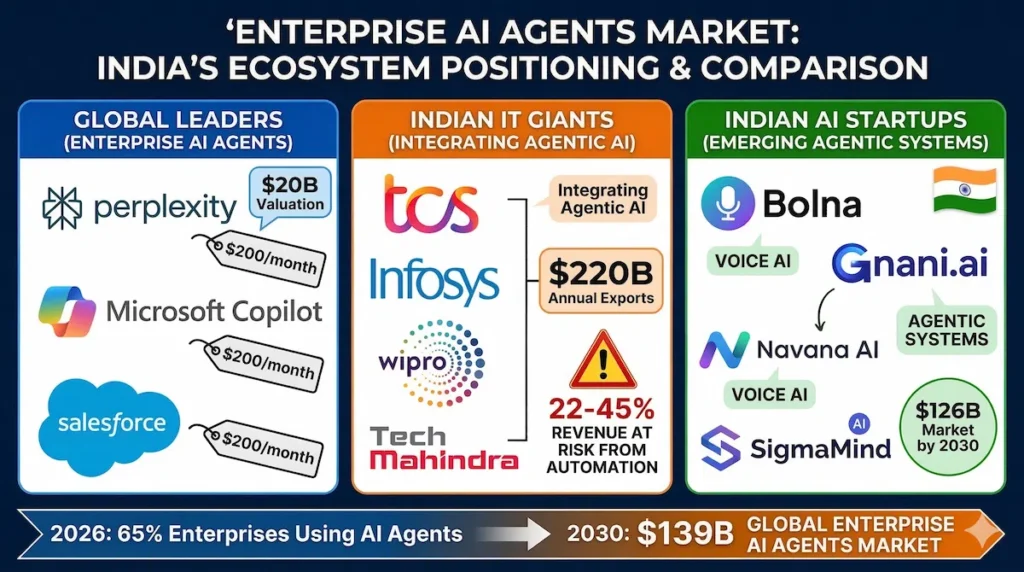
For India’s technology ecosystem—home to TCS, Infosys, Wipro, and thousands of AI startups competing in the $126 billion market opportunity projected by 2030—Perplexity’s enterprise push represents both validation and competitive threat. Indian IT services companies control over one-third of global IT services brand value and export $220+ billion in technology services annually. But as AI agents automate the managed services business representing 22-45% of their revenues, these firms must integrate agentic capabilities or face margin compression.
19 Models, One Orchestration Layer
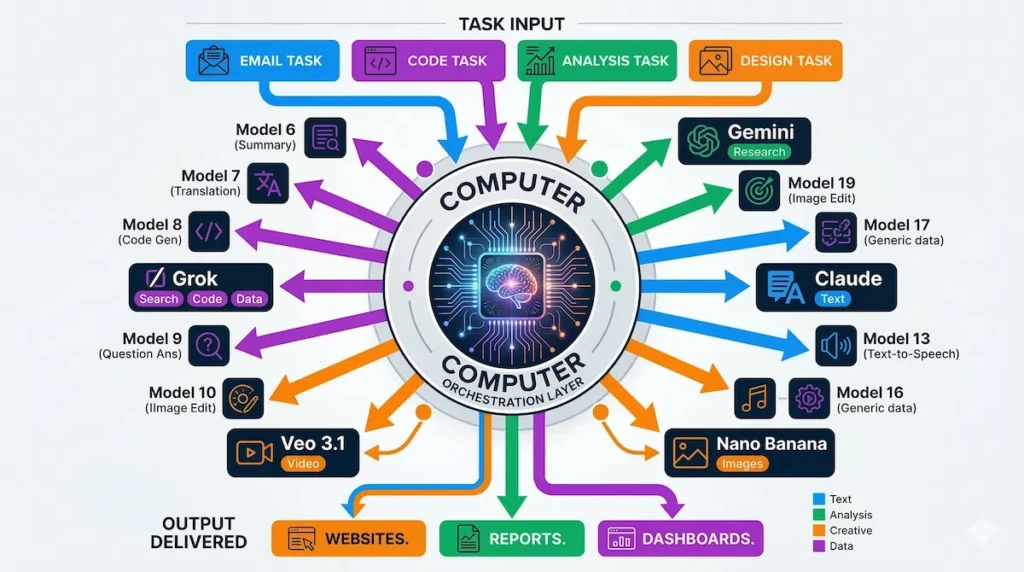
Perplexity Computer’s core architecture orchestrates 19 AI models simultaneously, routing specific tasks to whichever model performs best for that job. Need to generate images? The system delegates to Nano Banana. Video production? Veo 3.1. Deep research? Gemini. Quick searches? Grok. The agent dynamically selects optimal models across coding, analysis, content creation, and data processing.
This model-agnostic approach carries an embedded bet: that no single AI provider will dominate every capability, and enterprises will demand the ability to route tasks to the best available model for each job. Perplexity’s internal data supports this thesis. The company’s enterprise usage shifted dramatically over the past year—from 90% of queries routing to just two models in January 2025, to no single model commanding more than 25% of usage by December 2025.
The enterprise-specific features announced at Ask 2026 embed Computer where organizations already work. Employees can now query @computer directly inside Slack channels and threads, then continue conversations in Perplexity’s web interface or mobile app—the same full-power orchestration engine, with identical model selection and connector access, embedded where teams already collaborate.
Computer integrates with 400+ applications including Gmail, Outlook, GitHub, Linear, Notion, Snowflake, and Salesforce. It can read emails, update project management tools, query databases, and post to communication channels. Tasks can run for hours, days, or even weeks asynchronously. Users can run dozens of Computers in parallel, each working on different projects simultaneously.
The $656 Million Revenue Sprint
The financial stakes are massive. Research firm Sacra estimates Perplexity hit approximately $148 million in annualized revenue by mid-2025. The company’s internal projections target $656 million in annual recurring revenue by end of 2026—requiring roughly 230% growth. Computer for Enterprise, priced to scale across entire organizations at $200 per month per user, is designed to help close that gap.
CEO Aravind Srinivas told Fortune the company is pivoting to “boutique” users making “GDP-moving decisions” rather than maximizing monthly active users. Perplexity executives described prioritizing enterprise subscriptions, particularly for deep research. “You don’t hear us talk about MAUs ever, because we’re not actually on a mission to get as many users as possible,” one executive said in a briefing.
The company has raised approximately $1.5 billion in total funding at a $20 billion valuation. Perplexity says it is no longer reliant on other companies’ APIs for its web index and now has its own AI-optimized search infrastructure.
Why Indian Enterprises and IT Giants Should Pay Attention
For India’s AI ecosystem, Perplexity’s enterprise launch carries three strategic implications.
First, the agentic AI market is inflecting upward precisely where Indian strengths lie. According to a February 2026 CrewAI survey, 100% of surveyed enterprises plan to expand agentic AI use this year, with 65% already using AI agents in production. Organizations report automating an average of 31% of workflows. Fortune Business Insights projects the global agentic AI market will grow from $9.14 billion in 2026 to $139 billion by 2034—a compound annual growth rate of 40.5%. Gartner forecasts 40% of enterprise applications will feature task-specific AI agents by 2026, up from less than 5% in 2025.
Ganesh Gopalan, co-founder and CEO at deep-tech firm Gnani.ai, told Business Standard that 2026 will be the year AI agents move from conversation to action and become embedded into core enterprise workflows. “Agentic systems will become the default operating layer for customer operations, risk and service workflows,” Gopalan said.
Indian startups are already building in this space. Bolna, a Y Combinator-backed Voice AI Orchestration platform purpose-built for Indian enterprises, gives businesses power to build and deploy voice AI agents directly from transcripts and FAQs. Bajaj Finance disburses $600 million in consumer loans annually almost entirely through voice AI powered by portfolio startup Navana AI, according to Antler India partner Nitin Sharma.
Second, Indian IT services giants are integrating agentic AI but face margin pressure. At the India AI Impact Summit 2026 last week, major AI companies announced partnerships with Indian IT firms. Tata Consultancy Services partnered with OpenAI, while Infosys tied up with ChatGPT maker to drive enterprise AI adoption. Tech Mahindra is deploying NVIDIA NeMo Agent Toolkit for autonomous network operations.
But Gartner senior principal analyst Biswajit Maity warned that while Indian IT companies will play a “pivotal role in enterprise AI adoption,” clients are demanding AI agents be incorporated into services—which means pricing will take a hit. Jefferies downgraded most large Indian IT firms to hold or underperform, cutting price targets up to 33%, warning that AI could shrink the managed services business representing 22-45% of revenues.
Third, the $200/month price point democratizes enterprise AI for Indian SMEs. Unlike Microsoft 365 Copilot (expensive enterprise-only), Perplexity’s consumer-friendly pricing makes advanced AI agents accessible to India’s 63 million MSMEs, solo entrepreneurs, and students. Indian developers gain access to frontier-quality agentic AI at negligible cost compared to building proprietary systems.
The Trust Obstacle and Security Concerns
The most significant challenge facing Perplexity’s enterprise ambitions isn’t technology—it’s trust. The company is three years old and asking chief information security officers to route sensitive Snowflake data, legal contracts, and proprietary business intelligence through its platform.
CEO Srinivas addressed this head-on at Ask 2026. “The story of Perplexity in the enterprise is—we have tens of thousands of enterprise customers and only six people on our enterprise go-to-market team,” he said, emphasizing operational efficiency but acknowledging the trust-building required.
Perplexity drew sharp contrast with tools like OpenClaw, which typically run on local machines with broad access to files, passwords, and settings. Srinivas compared this to malware because of how easily it can damage data or expose sensitive information. Perplexity’s approach keeps work in the cloud, letting users hand off tasks to a tool that works for hours or months without giving AI full control over personal devices.
The company also announced Personal Computer on March 11—software that runs persistently on a user-provided Mac mini or similar always-on machine, giving AI direct access to local files and apps. Available only to Perplexity Max subscribers via waitlist, Mac-only at launch, this addresses enterprises wanting local-cloud integration with data sovereignty.
FAQs
How does Perplexity Computer differ from Microsoft Copilot for Indian enterprises?
Perplexity Computer orchestrates 19 different AI models (including Claude, Gemini, Grok) to route each task to the best model, while Microsoft Copilot primarily uses OpenAI’s GPT-4. Perplexity is priced at $200 per month per user with transparent billing, whereas Microsoft Copilot requires Microsoft 365 E3/E5 licenses (expensive enterprise bundles). For Indian SMEs and startups, Perplexity’s standalone pricing is more accessible than Microsoft’s enterprise-only approach. However, Microsoft has deeper integration with Office apps Indian businesses already use daily (Excel, Word, Outlook), while Perplexity requires adopting new workflows.
Can Indian IT companies like TCS, Infosys integrate Perplexity Computer for client projects?
Yes, and they’re already moving in this direction. TCS partnered with OpenAI, Infosys with ChatGPT maker, and Tech Mahindra deployed NVIDIA NeMo Agent Toolkit—all announced at India AI Impact Summit 2026. Indian IT firms can integrate Perplexity Computer into client solutions through API access and enterprise subscriptions. However, Gartner warns this creates pricing pressure: clients demand AI agents be incorporated into managed services, reducing billable hours and margins. Indian IT companies must navigate the transition from labor-intensive services (high margin) to AI-augmented delivery (lower margin but more scalable).
Is the $200/month pricing affordable for Indian startups and SMEs?
For Indian startups with funding or revenue, $200/month ($2,400/year) is manageable compared to hiring dedicated employees for tasks Computer automates. A single marketing analyst costs ₹40,000-80,000/month (₹4.8L-9.6L/year), while Computer handles research, content, analysis for $200/month. However, for India’s 63 million bootstrapped MSMEs, $200/month remains expensive. Indian alternatives like Bolna (voice AI orchestration), SigmaMind AI (conversational AI platform), and Gnani.ai (agentic systems) offer localized pricing and Indic language support at lower cost points. Enterprises should evaluate whether multi-model orchestration justifies premium pricing versus specialized Indian solutions.
What should Indian developers building AI agents learn from Perplexity’s approach?
Perplexity’s success validates the orchestration layer strategy: don’t build foundational models, orchestrate existing ones intelligently. Indian AI startups can leverage open-source models (Llama, Mistral, DeepSeek) and commercial APIs (Claude, Gemini) to build specialized agents for Indian verticals—legal (Sarvam’s A1 for lawyers), agriculture (Cropin’s farm management), finance (Navana AI for lending). The key differentiation is domain expertise and local integration (UPI, Aadhaar, IndiaStack), not raw model performance. Perplexity’s 19-model architecture proves enterprises value best-tool-for-job flexibility over single-vendor lock-in, which favors Indian startups offering India-specific solutions over global platforms.