
📌 Source Notice — June 25, 2026
The core technical details in this article are sourced from OpenAI’s official press release and blog post published June 24, 2026. The “50% lower cost” figure is attributed to Broadcom CEO Hock Tan via Bloomberg — this is not a claim made in OpenAI’s own official release, which used the phrase “substantially better performance-per-watt.” No independent benchmarks have been published yet. We flag claims by source throughout.
OpenAI just announced its first custom silicon chip. It is called Jalapeño. It was designed from scratch in nine months, is already running workloads in the lab, and is aimed specifically at making AI inference — the part that powers every ChatGPT response, every API call, every Codex suggestion — significantly cheaper to deliver at scale.
For Indian developers currently paying ₹471 per million input tokens on GPT-5.5, that matters.
Here is everything you need to know, with the hype separated from what is actually confirmed.
TL;DR — If You Are in a Hurry
| Question | What We Know Right Now |
|---|---|
| What is Jalapeño? | OpenAI’s first custom AI chip, built for LLM inference (not training) |
| Who built it? | Co-developed with Broadcom; manufactured by TSMC; system integration by Celestica |
| How fast was it built? | Design to tape-out in 9 months — claimed to be the fastest ASIC cycle ever for a chip of this class |
| When does it deploy? | Initial deployment targeted by end of 2026 |
| Will it reduce API prices for developers? | Possibly — but no OpenAI price cut has been announced |
| Does this affect Nvidia? | For inference, yes — longer term. For training, Nvidia remains the dependency |
| What does it mean for Indian developers today? | Nothing immediate. Potentially significant if it leads to lower API pricing in 12–18 months |
What Jalapeño Actually Is
Jalapeño is an ASIC — an Application-Specific Integrated Circuit. Unlike the general-purpose GPUs made by Nvidia that power most AI today, ASICs are designed to do one job extremely well and nothing else. In this case, that job is running large language model inference at scale.
OpenAI is calling it an “Intelligence Processor” in its press release. The architecture is optimised entirely for the inference workload: generating tokens for ChatGPT, responding to API requests, running Codex, and powering future agentic products that OpenAI expects to carry significantly higher compute volume than today’s chatbot interactions.
The chip does not replace Nvidia for model training. OpenAI’s press release and follow-up statements are clear on this point — Jalapeño targets inference only. Training large models still depends on GPU clusters, and Nvidia’s grip on that workload remains intact for now.
What makes Jalapeño strategically significant is not the chip in isolation. It is what the chip represents: OpenAI moving toward vertical integration over its most expensive and fastest-growing cost centre.
The Numbers — What Is Claimed and by Whom
This is where attribution matters, so we are being precise.
What OpenAI’s official release says: Engineering samples of Jalapeño are already running GPT-5.3-Codex-Spark workloads in the lab at production target frequency and power. Early testing shows “substantially better performance-per-watt versus current state-of-the-art.” A detailed technical report is promised “in the coming months.” No benchmark figures are published yet.
What Broadcom’s CEO Hock Tan said (via Bloomberg, not OpenAI’s release): Inference costs per token could fall by approximately 50% once Jalapeño is deployed at scale.
What is not yet confirmed: Independent benchmarks. Published performance specifications. Any announced change to OpenAI’s API pricing. Any India-specific deployment plan.
The 50% cost figure is worth tracking — Hock Tan has direct visibility into the chip’s capability since Broadcom led the silicon implementation. But it comes from one source, is not in OpenAI’s own official materials, and refers to theoretical production economics rather than announced pricing. Treat it as a directional signal, not a budget line.
Nine Months from Idea to Silicon
The timeline is genuinely noteworthy. OpenAI says Jalapeño went from design start to tape-out — the point at which chip designs are finalised and sent to the fab for manufacturing — in nine months.
For context, complex custom AI chips typically take two to four years from design start to first silicon. Google’s TPU development cycles run in the multi-year range. Amazon’s Trainium and Inferentia chips took years to reach production. A nine-month cycle, if accurate, suggests either a narrower design scope than a general-purpose accelerator, or significant process maturity from the Broadcom and TSMC partnership — likely both.
The chip is manufactured at TSMC. Broadcom handled silicon implementation and the Tomahawk networking integration. Celestica is responsible for board, rack, and system-level integration — the hardware infrastructure that slots into OpenAI’s and Microsoft’s data centres.
The Vertical Integration Play — and Why OpenAI Is Doing This Now
Jalapeño is not a surprise if you have been watching the industry. Every major cloud provider that runs significant AI workload has moved toward custom silicon for inference:
- Google has TPUs (now in their seventh generation)
- Amazon has Trainium (training) and Inferentia (inference)
- Microsoft has Maia, co-developed with OpenAI’s data centre ambitions
- Meta has MTIA (Meta Training and Inference Accelerator)
OpenAI is the last major AI platform at scale to announce its own silicon — and arguably the one with the most direct incentive, since inference cost is its largest operating expense.
The economics are straightforward. Nvidia charges a significant premium for H100 and H200 GPUs because they are the only chip that can run frontier model inference reliably at the scale OpenAI needs. Custom silicon trades that flexibility for lower cost-per-token on a fixed, well-understood workload. For a company running billions of API calls per month, even a 10% improvement in inference efficiency compounds into hundreds of millions of dollars annually.
The move also reduces OpenAI’s dependence on a single supplier for its most critical infrastructure — a strategic priority that became more urgent after supply constraints in 2023 and 2024 created significant capacity bottlenecks.
Market Reaction: AVGO Up, Then Mixed
Broadcom (AVGO) shares rose approximately 2 to 3.4% on the day of the announcement — June 24, 2026 — as investors priced in the long-term revenue implications of a major new ASIC customer at gigawatt scale.
One tracker showed a subsequent dip of approximately 3% the following day, which analysts attributed to broader semiconductor sector weakness rather than anything specific to the Jalapeño announcement. The distinction matters: semiconductor stocks move with macro and sector sentiment as much as with individual product news. One day of movement in either direction is not a signal about Jalapeño’s commercial prospects.
Nvidia’s stock showed minimal immediate reaction, which is consistent with the inference-only framing of the chip — Nvidia’s training revenue is not directly threatened by what OpenAI announced.
The India Angle — What This Could Mean for Indian Developers
No India announcement has been made. No India-specific deployment timeline, pricing, or availability has been communicated by OpenAI or Broadcom. Everything in this section is forward-looking analysis, not reported fact. We are flagging this clearly because the distinction matters for budget planning.
With that framing: here is why Indian developers should care about Jalapeño.
The current cost reality. Indian developers using OpenAI’s API today pay approximately ₹471 per million input tokens and ₹2,827 per million output tokens on GPT-5.5, at the current exchange rate of roughly ₹94–95 per dollar. Add 18% GST under the reverse charge mechanism and a foreign transaction fee of 3.5 to 5% on most Indian cards, and the effective rupee cost is materially higher than the dollar price suggests. Our detailed breakdown of AI API costs in India is here.
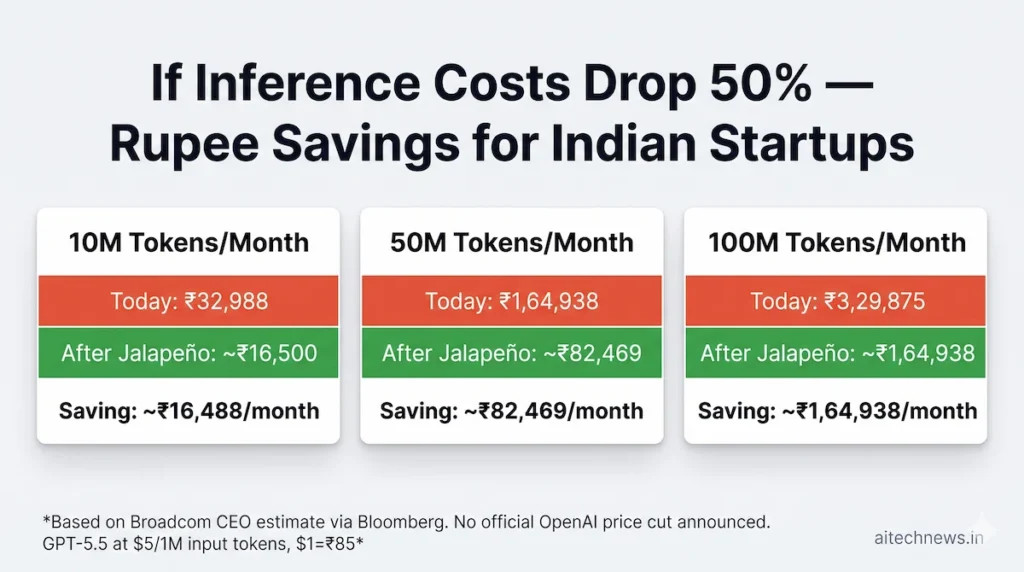
What a 50% reduction would mean in rupees. If Broadcom’s CEO’s figure of ~50% lower inference cost eventually translates into lower API pricing — a significant if — the input cost on a GPT-class model could fall from ₹471 to roughly ₹235 per million tokens. For a startup currently spending ₹33,000 per month on 10 million tokens, that is approximately ₹16,500 in monthly savings. At 50 million tokens, the savings would be around ₹82,000 per month.
The GPU cost comparison. For Indian startups and enterprises exploring whether to build on APIs or run their own models, the local GPU cost context is relevant. Subsidised compute through the IndiaAI Mission runs at approximately ₹65 to ₹150 per GPU hour. Commercial hyperscaler rates in India — AWS Mumbai, Azure India, Google Cloud Mumbai — typically run ₹300 to ₹600 or more per hour for GPU instances. If Jalapeño genuinely delivers substantially lower inference costs at scale, the make-vs-buy calculus for mid-sized Indian enterprises shifts further toward buying API access rather than managing GPU infrastructure.
The Microsoft deployment connection. Microsoft is cited in OpenAI’s press release as a major expected customer for Jalapeño capacity at gigawatt scale. Microsoft’s Azure India infrastructure already serves a significant share of enterprise AI workloads in the country. If Jalapeño capacity comes online in Azure data centres, Indian enterprises using Azure OpenAI Service could potentially benefit from the cost improvement — though again, no announcement of this has been made.
What changes nothing (yet). OpenAI has not reduced API prices in connection with this announcement. Jalapeño is not in production — deployment is targeted for end of 2026, with full gigawatt-scale rollout on a multi-generation timeline. The chip may perform exactly as described, better, or worse. Independent benchmarks will determine how the performance-per-watt claim holds under real-world production conditions.
For Indian developer budget planning in 2026, nothing changes today. For planning in 2027 and beyond, Jalapeño is a relevant development to monitor.
What Remains Unconfirmed — A Checklist
Before any coverage of Jalapeño finds its way into your business case or investor deck, here is what we do not yet know:
- No published benchmarks. All performance claims are company-sourced. OpenAI’s own technical report is promised “in the coming months.”
- No pricing change announced. OpenAI has not cut or indicated it will cut API prices as a result of this chip.
- No India availability or timeline. The deployment roadmap mentions Microsoft and other partners — not India specifically.
- The 50% figure is from one source. Hock Tan, Broadcom CEO, via Bloomberg. Not from OpenAI’s own press release.
- Inference only. Training workloads — still the largest capital expenditure in AI — remain on Nvidia hardware.
The Bigger Picture: OpenAI as a Full-Stack Company
Greg Brockman, OpenAI’s President, framed the announcement with a statement that the world is moving toward a compute-powered economy. The chip strategy fits that framing.
OpenAI launched as an AI research lab. It became a product company with ChatGPT. It is now building silicon. The logical progression — models, products, infrastructure — mirrors what Amazon, Google, and Microsoft did over fifteen years of cloud computing. The companies that control their full stack ultimately have more pricing flexibility, lower marginal costs, and more resilience against supplier leverage. Jalapeño is OpenAI’s entry into that category.
Richard Ho, who leads hardware at OpenAI, described the chip as built specifically to power not just current products but future agentic workloads — the multi-step AI agents that OpenAI and others are betting will represent the next wave of AI usage. Agentic tasks generate significantly more tokens per user interaction than simple Q&A. The inference demand from agents is expected to be substantially higher than today’s chatbot usage, which makes having your own inference silicon a more urgent priority than it would have been two years ago.
What to Watch For — A Monitoring Checklist for Indian Developers
| Milestone | Why It Matters |
|---|---|
| OpenAI technical report (promised “coming months”) | Will provide actual benchmark data — first real test of the performance-per-watt claim |
| AVGO earnings call mentions of Jalapeño revenue | Will indicate whether the chip is on commercial deployment track |
| OpenAI API price changes in late 2026 | Direct signal of whether inference savings are being passed to developers |
| Azure India announcements | Microsoft’s India infrastructure is the likely route for Jalapeño capacity to reach Indian enterprise customers |
| IndiaAI Mission GPU allocation updates | Provides the alternative cost baseline for Indian teams considering self-hosting vs. API |
Frequently Asked Questions
What is OpenAI’s Jalapeño chip?
Jalapeño is OpenAI’s first custom AI chip — called an “Intelligence Processor” in their announcement. It was co-developed with Broadcom, manufactured at TSMC, and is designed specifically for LLM inference workloads. It is not a training chip. Initial deployment is targeted for end of 2026.
Will Jalapeño reduce OpenAI API prices for Indian developers?
No price reduction has been announced. Broadcom’s CEO has cited ~50% lower inference costs as a potential outcome, but this refers to OpenAI’s internal economics, not API pricing. Whether and when any savings reach developers depends on OpenAI’s pricing decisions.
Does Jalapeño replace Nvidia GPUs?
Only for inference workloads. Training large models still requires Nvidia hardware. Jalapeño targets the inference side — serving responses to API calls, running ChatGPT, and future agentic workloads.
When will Jalapeño be available in India?
No India-specific timeline has been announced. Initial deployment is with Microsoft and other hyperscale partners. Given Microsoft’s existing Azure India infrastructure, there is a possible path to Indian availability, but no confirmed timeline exists.
Should Indian startups factor Jalapeño into their AI cost planning for 2026?
For 2026 budgets, no — nothing has changed in current API pricing. For 2027 planning and beyond, it is worth monitoring as a development that could meaningfully reduce the rupee cost of using OpenAI APIs at scale.