
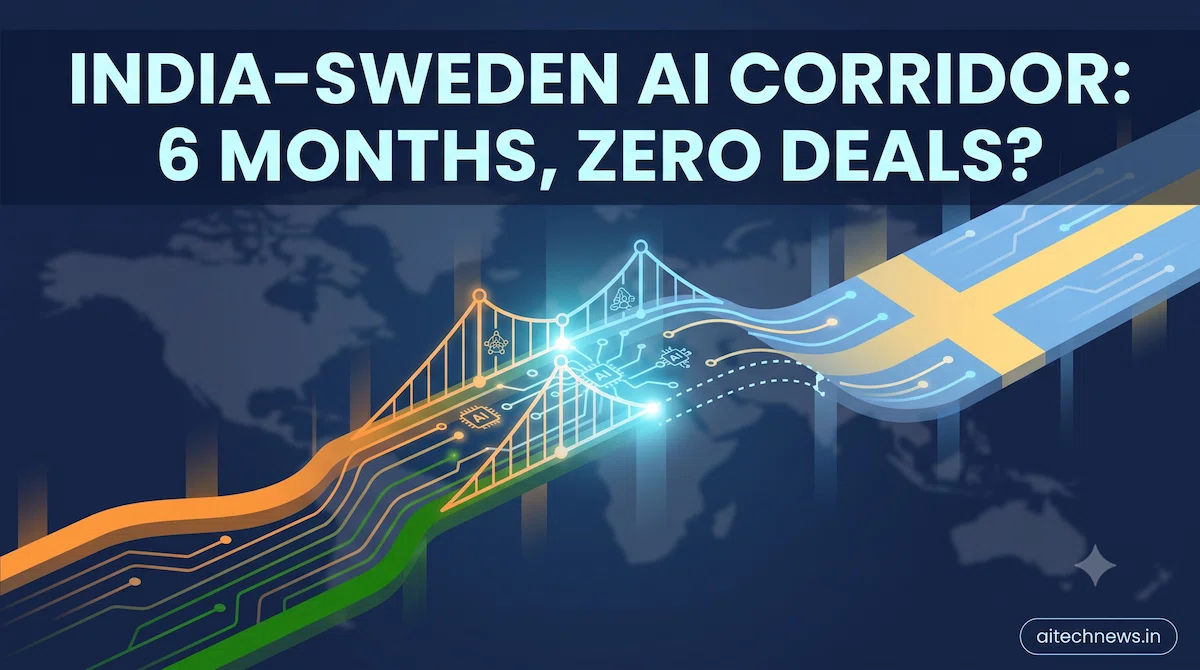
In February 2026, India and Sweden stood on a stage in New Delhi and announced something with a catchy name: the India Sweden AI Corridor, officially called the Sweden-India Technology and Artificial Intelligence Corridor, or SITAC. It was billed as a flagship platform that would connect two very different AI ecosystems — Sweden’s industrial engineering depth and India’s scale, talent, and digital infrastructure — and turn that combination into real projects.
Six and a half months later, the two sides sat down again. This time in a conference room at Electronics Niketan, New Delhi, on September 7, 2026. Officials from India’s Ministry of Electronics and Information Technology (MeitY), the IndiaAI Mission, the Swedish Embassy, Business Sweden, and eight companies from each side spent an afternoon discussing what could come next.
We went back through every public document on the India Sweden AI Corridor — from the original February announcement to this week’s readout — to answer one question: what has actually been delivered? Based strictly on the public record, the answer is a useful lesson in how government AI diplomacy moves versus how startups expect AI news to move.
A note before we go further: absence from the public record is not the same as proof that nothing is happening behind closed doors. What follows describes what has been officially disclosed, not what may or may not exist privately.
What the India Sweden AI Corridor Was Supposed to Do
The corridor was born as a Statement of Intent, signed in February 2026 between the IndiaAI Mission and Business Sweden on the sidelines of the India AI Impact Summit in New Delhi. A Statement of Intent is not a contract or a funding commitment — it’s a formal handshake, a framework document that says two parties agree to work together without locking in specifics.
At the time, IndiaAI Mission’s then-chief operating officer Kavita Bhatia described the pairing as two nations positioned to co-architect a trusted AI future together. Sweden’s Trade & Invest Commissioner to India, Sofia Högman, said the agreement would turn shared vision into outcomes.
The framework laid out six broad activities: conferences and workshops, ecosystem exchanges, visits to innovation hubs, engagement between companies and investors, identification of joint innovation platforms, and promotion of AI deployment across priority sectors. Notice what’s missing from that list — funding figures, named pilot projects, or delivery timelines. It was a plan to make a plan.
The September 7 Meeting: Who Showed Up, and What Was Said
This week’s session was the first substantial public follow-up since February. According to the official readout, the meeting opened with remarks from Ajit Kumar, Joint Secretary at MeitY’s International Cooperation Division, followed by IndiaAI Mission CEO Saurabh Vijay and Sweden’s Deputy Head of Mission, Agnes Julin.
IndiaAI’s pitch to the Swedish delegation covered the mission’s core priorities: compute capacity, datasets and models, sector-specific AI, startup financing, and its Safe & Trusted AI initiative. The Swedish side, led by Business Sweden’s Johnny Eriksson, walked through Sweden’s own priorities in AI and digitalisation. Discussion topics reportedly included data governance, data localisation rules, and what responsible AI adoption looks like for foreign companies entering India.
That’s a legitimate and useful conversation. It’s also, functionally, the same conversation that could have happened in February.
The Companies in the Room — But No Contracts on the Table
The most concrete part of the entire six-month arc is the guest list, and it’s genuinely worth paying attention to if you’re an Indian AI company wondering whether this corridor matters to you.
On the Swedish side: Autoliv, Consat, IKEA, Saab, Sandvik AI, Sandvik Intelligent Manufacturing, SKF, and Volvo Group.
On the Indian side: Tech Mahindra and Tata Consultancy Services represented the IT services majors, alongside a group of smaller AI-native companies — Zenteiq, Avataar AI, Innefu, CoRover.ai, Gnani, and Globals ITES.
That second list matters more than it might look at first glance. Gnani and CoRover.ai are Indian conversational-AI and voice-AI companies; Innefu works in cybersecurity and analytics; Avataar AI and Zenteiq are newer entrants in the enterprise AI space. Getting a seat at the table with Volvo Group, Saab, and SKF — three companies with serious industrial-AI and manufacturing budgets — is a real opportunity, even if nothing has been signed yet.
But that’s exactly the point: nothing has been signed yet. The official language used to describe the outcome of this meeting is telling. The readout says discussions are “expected to contribute” toward a sustained engagement agenda, “including potential pilots, testbeds, ecosystem partnerships.” Every verb is conditional. There is no dollar figure, no named pilot, no signed memorandum of understanding, and no delivery date anywhere in the public record.
Where the India Sweden AI Corridor Stands After Six Months
SITAC: The Six-Month Scorecard
Based on official IndiaAI Mission and Business Sweden statements, February–September 2026. Reflects the public record only — not necessarily the full picture of private discussions.
None of this means the India Sweden AI Corridor is a failure. India runs comparable technology-cooperation frameworks with other countries — its Initiative on Critical and Emerging Technology with the US (now evolved into the TRUST initiative) and its AI cooperation arrangement with the UAE both took well over a year between initial announcement and their first concrete, named outcomes.
In our assessment, based on that pattern, diplomatic AI frameworks are generally built for durability rather than speed, and SITAC’s pace so far looks unremarkable rather than alarming when measured against those comparisons — though every bilateral relationship moves on its own timeline, and we’re not aware of a standardized benchmark for how fast these frameworks are “supposed” to move.
But it does mean that every headline calling this week’s meeting a “launch” of anything is wrong. The corridor launched in February. What happened this week was a check-in, and a fairly early-stage one at that
What This Means for Indian AI Startups and IT Firms
If you run an AI company in India and you’re wondering whether to pay attention to SITAC, here’s the practical read:
What This Means for You, Depending on What You Build
Enterprise & Industrial AI Startups
Especially anything touching manufacturing, voice AI, or cybersecurity. In our view, Volvo Group, Saab, SKF, and Sandvik are large, established industrial firms — their presence in the room looks like a genuine door for Indian enterprise-AI vendors, even if it takes time to walk through. This is our editorial read on the participant list, not a confirmed business pipeline.
Consumer AI & App-Layer Startups
This particular corridor looks unlikely to matter much in the near term. SITAC’s stated goals do include broader trade and market-access facilitation, but nothing in the public record so far points specifically toward consumer-facing AI, funding rounds, or app-layer market access.
IT Services Companies
TCS and Tech Mahindra’s presence signals that the bigger players see this as a relationship worth maintaining, not necessarily a near-term revenue line. Treat it as a slow-burn relationship-building exercise, similar to how these firms treat other bilateral trade dialogues.
The Bigger Pattern: Diplomacy Speed vs Startup Speed
The real story of the India Sweden AI Corridor isn’t Sweden or India specifically — it’s a mismatch that shows up in almost every government-led AI partnership right now. AI moves in product-launch cycles measured in weeks. Bilateral government frameworks move in dialogue cycles measured in quarters or years. Both speeds are legitimate for their purpose, but conflating them in headlines does readers a disservice.
The next milestone worth watching for isn’t another dialogue session — it’s the first named pilot, the first rupee or krona of committed funding, or the first Indian startup that lists a Swedish enterprise client because of this corridor. Until one of those three things is publicly announced, “AI Corridor” remains, on the public record, a framework with a good name rather than a working pipeline — even if there’s more happening behind the scenes than has been disclosed so far.
We’ll track this one and update when there’s an actual deal to report.
FAQs
What is the India Sweden AI Corridor (SITAC)?
SITAC, or the Sweden-India Technology and Artificial Intelligence Corridor, is a bilateral framework signed in February 2026 between India’s IndiaAI Mission and Business Sweden to promote AI collaboration between the two countries across industry, startups, and academia.
When was the India Sweden AI Corridor launched?
It was signed in February 2026 as a Statement of Intent on the sidelines of the India AI Impact Summit in New Delhi. It was not launched or re-launched in September 2026 — the September 7 event was a follow-up bilateral dialogue.
Which companies are involved in the India Sweden AI Corridor?
As of the September 2026 dialogue, Swedish participants included Autoliv, Consat, IKEA, Saab, Sandvik AI, Sandvik Intelligent Manufacturing, SKF, and Volvo Group. Indian participants included Tata Consultancy Services, Tech Mahindra, Zenteiq, Avataar AI, Innefu, CoRover.ai, Gnani, and Globals ITES.
Has the India Sweden AI Corridor delivered any funded projects yet?
No. As of this writing, no funded pilots, signed commercial deals, or named investments have been publicly disclosed under the corridor. Official statements describe only “potential” pilots and partnerships.
Sources & Disclaimer
This article is based on official statements from the IndiaAI Mission, Business Sweden, and the Ministry of Electronics and Information Technology (MeitY). No funded pilots or commercial deals under SITAC had been publicly disclosed at the time of publishing. This is an independent analysis by aitechnews.in and is not affiliated with the Government of India, IndiaAI Mission, or Business Sweden.