
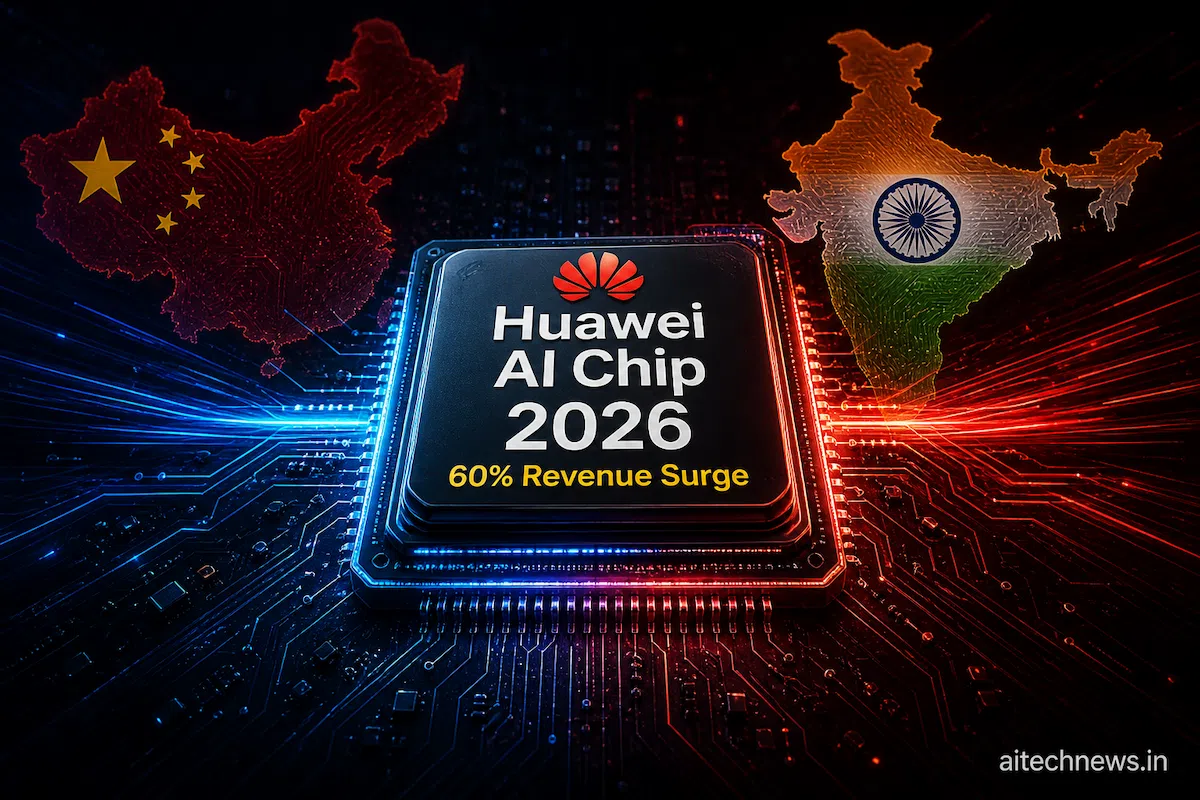
Something big is happening in the Huawei AI chip 2026 story — and most Indian tech blogs haven’t caught up yet.
China’s Huawei is expecting revenue from its AI chips to surge at least 60% in 2026, reaching approximately $12 billion — up from $7.5 billion last year. The numbers come from the Financial Times, citing two people with direct knowledge of the matter, and were picked up by Reuters this morning.
But this is not just a China story. It is not just a chips story. It is the clearest signal yet that the global AI hardware race is splitting into two lanes — one led by Nvidia, one being built by China. And for Indian developers, startups, and policymakers, understanding which lane India can access may be one of the most important questions of 2026.
Huawei AI Chip 2026: Meet the Ascend 950PR
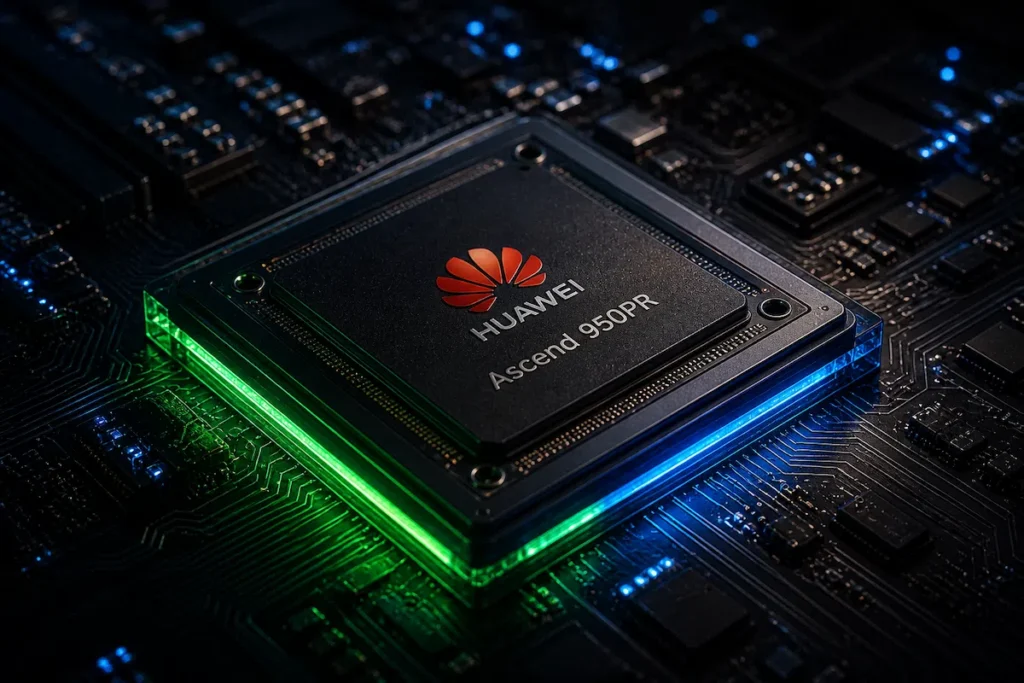
At the center of this story is Huawei’s latest AI processor — the Ascend 950PR.
The chip entered mass production in March 2026 and has already captured the majority of Huawei’s AI chip orders for the year. China’s biggest tech companies — including ByteDance, Alibaba, and Tencent — have placed large orders for the 950PR, according to FT’s sources. Huawei plans to ship approximately 750,000 units in 2026, with full-scale shipments ramping in the second half of the year.
An upgraded version — the Ascend 950DT — is planned for launch in Q4 2026, alongside two additional SMIC fabrication plants dedicated entirely to Huawei’s chip production, further expanding output capacity.
It is worth being clear about what the 950PR is, and what it isn’t. Huawei’s chips still lag Nvidia’s most advanced products by at least two chip generations in raw performance. This is not a Blackwell killer. But that framing misses the real story entirely.
The Real Story: Inference, Not Training
Here is the insight that most coverage of this story will miss — and it is the one that matters most.
Huawei is not trying to beat Nvidia at training giant AI models. It is positioning the 950PR specifically for AI inference — the computation that happens when a deployed AI model generates a response to your query.
Think of it this way:
- • Training = Teaching an AI model. Extremely compute-intensive. Requires the most powerful chips (Nvidia H100, H200, Blackwell). Done once or periodically.
- • Inference = Running that trained model for users. Done billions of times per day. Requires fast, efficient, cost-effective chips.
As AI moves from the research lab into everyday products — chatbots, AI agents, customer support tools, coding assistants — inference demand will dwarf training demand. Every time a user types a prompt into ChatGPT, Claude, or any AI product, that is an inference call.
Huawei is betting that this is where the real money will be, and the 950PR is designed specifically to win that market. The FT report confirms this: “Huawei is betting that inference, which is technically less challenging than model training, will be a bigger future source of demand as AI applications such as agents become more widespread.”
This is a smart, strategic play — and it is working.
Why Nvidia Is Stuck
To understand Huawei’s opportunity, you need to understand why Nvidia is stalling in China.
Nvidia’s troubles in the Chinese market are not about chip quality. They are about a regulatory trap that has caught the company between two governments.
In March 2026, Nvidia CEO Jensen Huang confirmed the company had finally received US government licences to sell its H200 chips to China. Good news — except no shipments have actually been made. Why? Because Beijing has told Chinese tech companies to limit their use of Nvidia chips to overseas operations, while US regulators require that all Nvidia chips ordered by Chinese clients be used only inside China. The two requirements directly contradict each other, making customs clearance impossible.
The result: Nvidia’s H200 has the paperwork to enter China, but cannot physically get there.
Meanwhile, Beijing is actively directing Chinese tech companies toward domestic alternatives. The message from the Chinese government is clear: support Huawei, reduce Nvidia dependency.
Jensen Huang himself acknowledged the stakes in a recent interview: “The day that DeepSeek comes out on Huawei first, that is a horrible outcome for our nation.” He warned it could lead to a world where “AI models around the world are developed and they run best on non-American hardware.”
That day, it appears, is getting closer.
DeepSeek V4 Changed Everything
The surge in Huawei chip orders did not happen in a vacuum. The catalyst was DeepSeek V4 — the latest model from China’s most prominent open-source AI lab, which earlier this month confirmed it used Huawei’s 950PR for inference.
DeepSeek V4 is a frontier-class AI model with 1.6 trillion parameters, released under an open MIT licence. It is competitive with the best models from OpenAI and Google on several benchmarks. The fact that it runs inference on Huawei hardware — not Nvidia — sent a powerful signal across China’s AI industry: domestic chips are ready for production workloads.
It is important to be precise here: the FT report notes that the majority of V4’s training was still done on Nvidia chips. But the inference deployment on Huawei is the proof-of-concept the market needed. Orders followed immediately.
The CANN vs CUDA Problem — Huawei’s Real Weakness
No honest coverage of this story should ignore Huawei’s biggest challenge: software.
Nvidia’s dominance in AI computing rests on two pillars — hardware and CUDA — its proprietary software platform that developers use to write code for Nvidia GPUs. CUDA has a 15+ year head start, an enormous developer community, and deep integration into every major AI framework including PyTorch and TensorFlow.
Huawei’s equivalent is called CANN (Compute Architecture for Neural Networks). It started a full decade after CUDA. The FT article cites developers who say CANN “has drawn complaints for being difficult to use, which greatly increases clients’ operating costs.” While improvements are being made, the gap remains significant.
This is the friction that slows Huawei’s adoption outside China. Developers who have spent years building on CUDA do not switch easily. For now, Huawei’s gains are largely confined to the Chinese domestic market — which is itself enormous, but not global.
How Big Is This Market? Morgan Stanley’s Numbers
The scale of what is happening in China’s AI chip market is striking.
Morgan Stanley forecasts China’s AI chip market will reach $67 billion by 2030, with 86% expected to be supplied by Chinese companies — up from a market that Nvidia previously dominated, selling $17.1 billion worth of chips in China in fiscal year 2025 alone (mostly the H20, a watered-down chip designed specifically for the Chinese market under export controls).
This year, Morgan Stanley estimates the domestic Chinese AI chip supply at approximately $21 billion — with Huawei’s projected $12 billion representing the single largest share.
Two forces are driving this, in Morgan Stanley’s own words: “a rapid rise in AI inference demand… and persistent export controls, making localization a long-duration feature of China’s AI compute market rather than a temporary policy response.”
This is not a short-term blip. It is a structural market shift.
🇮🇳 What Does This Mean for India?
This is where aitechnews.in readers need to pay close attention — because the India angle here is significant, and almost entirely ignored in Western coverage.
1. The GPU Cost Problem Is Real in India
Indian AI startups and researchers face a genuine GPU access crisis. Nvidia’s H100 and H200 chips are expensive, often waitlisted, and priced in dollars. The IndiaAI Mission has committed to building a shared AI compute infrastructure, but demand far outstrips supply. Any credible alternative to Nvidia GPUs — even for inference workloads — could meaningfully reduce costs for Indian startups building AI products.
2. India Is Not Subject to US-China Export Restrictions
Here is the key geopolitical nuance: the US export controls that block Nvidia from selling advanced chips to China do not apply to India. India can legally import Nvidia’s most advanced chips. But India can also choose to explore Huawei’s Ascend ecosystem — particularly for inference use cases where the performance gap matters less.
If Huawei’s 950PR becomes the dominant inference chip for cost-sensitive markets, Indian cloud providers and startups could benefit from lower-cost AI compute options — especially for regional language models and lighter inference workloads.
3. GIFT City and Gujarat’s AI Infrastructure Opportunity
Gujarat is positioning itself as India’s AI infrastructure hub. The Gujarat AI Park near Gandhinagar and GIFT City’s emerging data center ecosystem are at the center of India’s AI compute buildout. As global AI hardware supply chains diversify — away from a pure Nvidia monoculture — Indian policymakers and data center operators have an opportunity to build hardware-agnostic infrastructure that can work with multiple chip ecosystems.
4. The Bigger Picture: India Must Watch This Carefully
India has deliberately stayed out of US-China tech tensions, pursuing strategic autonomy. The bifurcation of the global AI chip market into a Nvidia/US ecosystem and a Huawei/China ecosystem creates both risk and opportunity for India. Getting locked into only one ecosystem — whether US or Chinese — limits India’s flexibility. Watching how this plays out in 2026 will be critical for IndiaAI Mission planners.
What Happens Next?
A few things to watch in the coming months:
- • H2 2026: Huawei’s 750,000-unit 950PR shipments ramp up — real-world performance data will emerge
- • Q4 2026: Ascend 950DT launches, targeting training workloads — Huawei’s most direct Nvidia challenge yet
- • Q4 2026: Two new SMIC fabs dedicated to Huawei chips come online — production capacity could exceed projections
- • 2030: Morgan Stanley’s $67B China AI chip market forecast — watch if Huawei’s 86% domestic share prediction holds
Bottom Line
Huawei’s 60% AI chip revenue surge is real, verified, and significant. But the deeper story is strategic: China is systematically building a self-reliant AI hardware stack, starting with the inference layer where Nvidia is weakest and where future AI demand will be greatest.
For Indian developers and startups, this is not a distant geopolitical story. It is a hardware economics story that could directly affect GPU access, cloud computing costs, and AI infrastructure choices in India over the next two to three years.
Nvidia still leads globally. CUDA still dominates. But the gap is narrowing — and the rules of the AI chip market are being rewritten in real time.
aitechnews.in will continue to track this story closely.
FAQs
Is Huawei’s AI chip better than Nvidia?
Not yet. Huawei’s Ascend 950PR still lags Nvidia’s most advanced chips by at least two generations in raw performance. However, for AI inference workloads — which is where most day-to-day AI demand comes from — it is competitive enough that China’s biggest tech companies like ByteDance and Alibaba are placing large orders.
Can Indian companies use Huawei AI chips?
Yes. Unlike China, India is not subject to US export restrictions on Huawei chips. Indian startups and cloud providers can legally explore Huawei’s Ascend ecosystem — especially for cost-sensitive inference workloads — as an alternative to expensive Nvidia GPUs.
Why is Nvidia not selling chips in China despite having US approval?
It is caught in a regulatory deadlock. The US requires that Nvidia chips sold to Chinese buyers be used only inside China. But Beijing is telling Chinese companies to limit Nvidia chip usage to overseas operations only. These two rules directly contradict each other, making customs clearance impossible — so H200 shipments to China remain at zero.
Sources: Financial Times (May 1, 2026, reporter Zijing Wu, Hong Kong), Reuters (May 1, 2026), Morgan Stanley AI chip market analysis
⚠️ Disclosure: The $12B revenue projection is based on orders already received, as reported by FT citing two sources with direct knowledge. Reuters noted it could not independently verify the FT report at time of publication. aitechnews.in reports this with appropriate editorial caution.