

Anthropic doesn’t wait around. Just 41 days after releasing Claude Opus 4.7 in April, the San Francisco AI lab quietly dropped a successor on Thursday evening — Claude Opus 4.8. And while the version number sounds incremental, what’s actually inside this release is anything but.
For Indian developers who live inside Claude Code, or for startup teams building on Anthropic’s API, this launch has immediate, practical implications. Same price. Meaningfully better performance. And a brand-new feature that lets Claude orchestrate up to 1,000 AI agents simultaneously on a single task. That’s not a roadmap item. That’s available right now.
What Actually Changed in Opus 4.8
The headline benchmark is a 69.2% score on SWE-Bench Pro — the hardest real-world software engineering test that uses actively-maintained codebases with no public solution leakage. For context, Opus 4.7 scored 64.3% on the same test. GPT-5.5 sits at 58.6%. Gemini 3.1 Pro comes in at 54.2%. On this particular measure, Opus 4.8 is comfortably ahead of both.
And that’s not the only number worth noting. Independent benchmarking firm Artificial Analysis placed Claude Opus 4.8 at the top of their Intelligence Index with a score of 61.4 — ahead of GPT-5.5 (60.2) and even the previously released Claude Opus 4.7 (57.3). That ranking factors in ten separate evaluations including GDPval-AA, Terminal-Bench Hard, GPQA Diamond, and Humanity’s Last Exam.
One honest caveat: GPT-5.5 still leads on Terminal-Bench 2.1, the pure terminal-coding benchmark. Anthropic has not claimed a clean sweep, and neither should any coverage of this launch.
The Feature Nobody Saw Coming: Dynamic Workflows
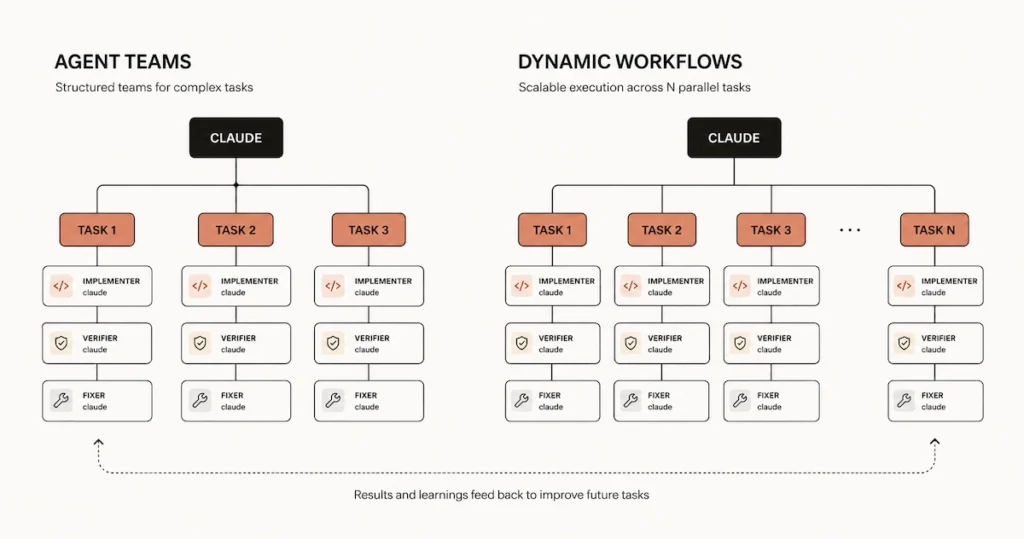
The benchmark numbers are good. But the feature that has the developer community genuinely excited is something different entirely — Dynamic Workflows, now available as a research preview inside Claude Code.
Here’s what it does: you describe a complex task to Claude (say, a codebase-wide migration touching 200,000 lines of code), and instead of working through it sequentially, Claude writes an orchestration script on the fly, spins up a swarm of parallel subagents — up to 1,000 of them — assigns each one an independent piece of the problem, and then verifies the results before reporting back to you.
Think of it as Claude becoming a project manager, a QA team, and a developer all at once. As one developer on X described it: “Set /model to opus 4.8, set /effort to ‘ultracode’, use ‘workflow’ in your prompt — Claude will write an orchestration script, spawn a subagent swarm, verify results, and report back.”
This is Anthropic’s most direct answer yet to the growing demand for AI that can handle truly large-scale, multi-step engineering work without a human babysitting every step.
Better, Faster, and Finally Cheaper to Run Fast
The pricing story is worth reading carefully. Standard Opus 4.8 remains at $5 per million input tokens and $25 per million output tokens — identical to Opus 4.7. No surprise there.
But Anthropic has also introduced a Fast Mode: 2.5x the speed of standard, at $10/$50 per million tokens. The important part? That fast mode is three times cheaper than the equivalent fast mode was on previous Opus models. For Indian startups burning through API credits on high-volume workloads, that’s a meaningful cost reduction without sacrificing the flagship model’s quality.
Anthropic has also reset all weekly and hourly usage limits for claude.ai users alongside this launch — a quiet but practical gift for power users who’ve been hitting caps.
The Honesty Upgrade That Matters More Than It Sounds
One improvement in Opus 4.8 that deserves more attention than it’s getting: the model is reportedly four times less likely than Opus 4.7 to let flaws in its own code pass without flagging them. In practical terms, this means Claude is more likely to say “I’m not sure about this part” or “this function might fail under these conditions” rather than confidently handing you broken code.
Anthropic frames this as a shift in how they evaluate agentic AI — from raw task completion to what they call “metacognition”: the model’s ability to know what it doesn’t know. For anyone who has debugged AI-generated code at 2am, this is genuinely useful.
“Claude Opus 4.8 has noticeably better judgment. It asks the right questions, catches its own mistakes, pushes back when a plan isn’t sound.”
— Tom Pritchard, Staff Engineer, early tester
Where Can Indian Developers Access It Right Now?
Opus 4.8 is live today across all major platforms:
- claude.ai — Pro plans and above (Dynamic Workflows requires Team, Enterprise, or Max)
- Anthropic API — model ID:
claude-opus-4-8, at $5/$25 per million tokens - Amazon Bedrock — available now for AWS users
- Google Cloud Vertex AI — confirmed by Google Cloud’s official X account within hours of launch
- Microsoft Foundry — also live at launch
For Indian developers working on GCP — which is the default cloud for a large chunk of Bengaluru and Hyderabad’s startup ecosystem — Google Cloud Vertex AI access means zero migration friction. You can switch to claude-opus-4-8 in your existing Vertex configuration today.
Quick Benchmark Snapshot
| Benchmark | Opus 4.8 | Opus 4.7 | GPT-5.5 | Gemini 3.1 Pro |
|---|---|---|---|---|
| SWE-Bench Pro | 69.2% | 64.3% | 58.6% | 54.2% |
| SWE-Bench Verified | 88.6% | 87.6% | — | — |
| GPQA Diamond | 93.6% | — | — | — |
| AA Intelligence Index | 61.4 | 57.3 | 60.2 | — |
| Terminal-Bench 2.1 | 74.6% | — | Leads | — |
Sources: Anthropic official announcement, Artificial Analysis Intelligence Index (independent), CursorBench 3.1. Note: most Anthropic-cited benchmarks are self-reported. Independent results from Artificial Analysis confirm the leading position on the overall Intelligence Index.
What’s Coming Next From Anthropic
One more thing worth watching: multiple sources confirm that Claude Mythos — Anthropic’s larger, more powerful model class that has been quietly deployed to select enterprise partners — is expected to move toward wider general availability in the coming weeks. Anthropic has reportedly been completing stronger cybersafety checks under Project Glasswing before that broader release. Sonnet 4.8 is also expected to follow.
For now, Opus 4.8 is the best model Anthropic has ever made publicly available. And at the same price as its predecessor, there’s very little reason not to test it today.
FAQs
Is Claude Opus 4.8 free to use in India?
Not entirely. You can access it on claude.ai with a Pro plan (paid). Developers can use it via the Anthropic API at $5 per million input tokens and $25 per million output tokens — same price as the previous Opus 4.7.
What is the Dynamic Workflows feature in Claude Opus 4.8?
Dynamic Workflows lets Claude automatically write an orchestration script, spin up hundreds of parallel AI subagents (up to 1,000), and verify the results — all in one session inside Claude Code. It is designed for large, complex tasks like migrating an entire codebase. Available for Team, Enterprise, and Max plans.
Is Claude Opus 4.8 better than GPT-5.5?
It depends on the task. Opus 4.8 leads on SWE-Bench Pro (69.2% vs 58.6%) and tops the Artificial Analysis Intelligence Index at 61.4. However, GPT-5.5 still leads on Terminal-Bench 2.1. For most coding and agentic tasks, Opus 4.8 has the edge — but neither model wins everything.
Disclosure: Benchmark figures cited include both Anthropic self-reported evaluations and independent third-party results from Artificial Analysis. Where figures are Anthropic’s own, they are noted. Elon Musk’s reported praise of this model was not independently verified and has not been included in this article. aitechnews.in has no commercial relationship with Anthropic.