
Key Takeaways
- AI in Indian manufacturing has reached unprecedented scale with giants like Tata and Mahindra — Tata Steel’s Jamshedpur plant cut defects 35% using computer vision, saving ₹200 crore annually, while Mahindra’s Chakan factory reduced inventory costs 30% through AI-powered supply chain optimization
- The ₹2.8 lakh crore PLI scheme is accelerating smart factories India transformation across 14 sectors—but a stark divide exists: large enterprises hit 23% AI adoption while 63 million MSMEs remain stuck at just 8%
- This isn’t optional anymore—it’s existential—China operates 50,000+ fully automated “lights-out” factories versus India’s ~200, and the manufacturers deploying AI fastest will be the only ones left standing by 2028
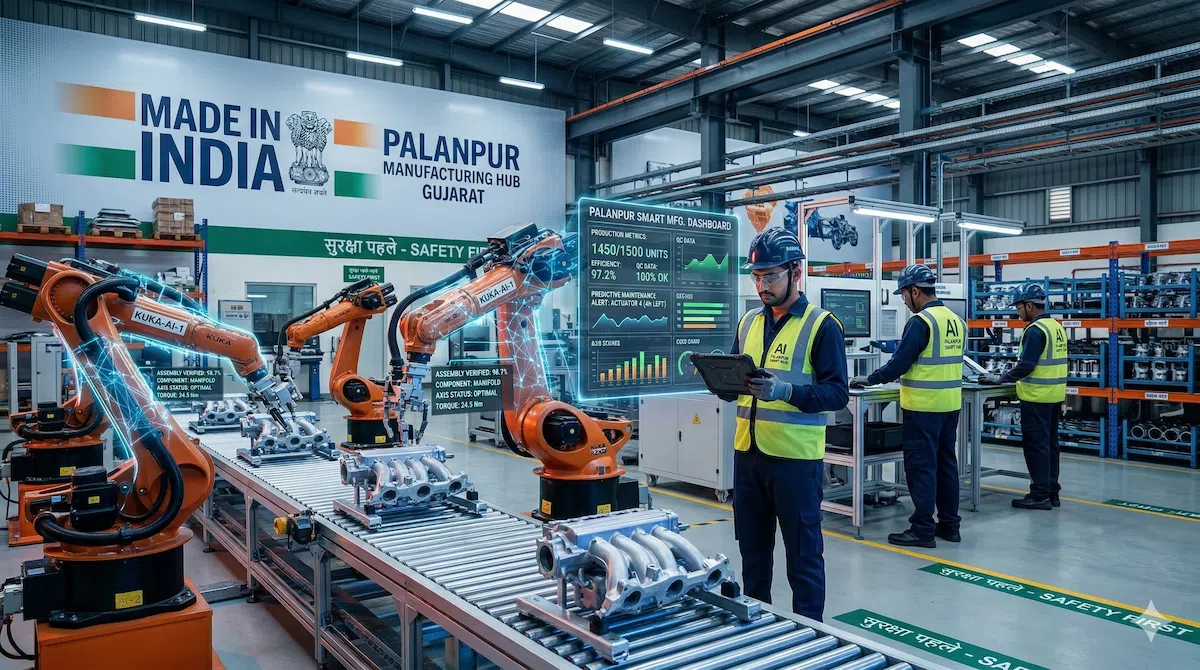
AI in Indian manufacturing has moved from boardroom speculation to factory-floor reality. Walk into Tata Steel’s sprawling Jamshedpur plant on any given day, and you’ll witness something that would have seemed impossible a decade ago.
Massive steel coils worth lakhs of rupees move through quality inspection stations at superhuman speed. Computer vision systems powered by AI algorithms scan every millimeter of surface for microscopic defects that human eyes would miss. The result? A 35% reduction in quality defects and ₹200 crore in annual cost savings.
This isn’t a futuristic prototype. This is Indian manufacturing in 2026.
Three hundred kilometers away in Chakan, Maharashtra, Mahindra & Mahindra’s automotive factory tells a similar story. AI-driven supply chain optimization systems predict demand fluctuations, automatically adjust inventory levels, and coordinate with hundreds of tier-2 suppliers in real time. Inventory holding costs? Down 30%. Production delays due to parts shortage? Nearly eliminated.
And in Gujarat’s Jamnagar, Reliance Industries’ massive refinery—one of the world’s largest—has deployed thousands of IoT sensors feeding data into AI models that simultaneously optimize process efficiency and worker safety. The system predicts equipment failures days before they occur, schedules maintenance during planned downtimes, and has reduced unplanned shutdowns by 40%.
These aren’t isolated experiments. They’re the opening salvos in India’s most consequential industrial transformation since independence—the race to build AI-powered smart factories that can compete with China’s automation juggernaut and Vietnam’s cost advantages.
The question isn’t whether AI in Indian manufacturing will happen. It’s whether India’s 63 million small and medium enterprises can afford to deploy it before they’re crushed by larger, AI-powered competitors.
The ₹2.8 Lakh Crore PLI Scheme Accelerating AI in Indian Manufacturing
The Indian government isn’t leaving this transformation to chance.
Through its Production-Linked Incentive (PLI) schemes spanning 14 critical sectors—semiconductors, automobiles, pharmaceuticals, textiles, renewable energy equipment, and beyond—New Delhi has committed ₹2.8 lakh crore to explicitly incentivize domestic manufacturing that embraces Industry 4.0 India technologies.
The strategic logic is brutally simple: India cannot compete on cheap labor anymore.
China’s minimum wage in manufacturing hubs has surpassed India’s in many regions, yet Chinese factories produce at 3-5x Indian productivity levels. How? Automation. Vietnam offers labor costs comparable to India’s, but Vietnamese electronics manufacturers have achieved 2x higher AI manufacturing automation adoption rates.
The PLI scheme’s AI manufacturing component works like this:
Companies investing in AI-powered quality control, predictive maintenance, or autonomous material handling systems receive additional incentive points when calculating their production-linked benefits. A pharmaceutical manufacturer deploying computer vision for tablet inspection gets preferential treatment over one relying on manual quality checks. An automotive component maker using AI-driven demand forecasting qualifies for higher PLI payouts than competitors using Excel spreadsheets.
This policy architecture is working.
By December 2025, PLI schemes had catalyzed cumulative investments exceeding ₹2.16 lakh crore with sales crossing ₹20.41 lakh crore. A significant portion of this capital is flowing into AI infrastructure: edge computing hardware, industrial IoT sensors, collaborative robots (cobots), and computer vision systems.
Real-world proof of AI manufacturing automation impact:
Tata Motors’ Pune facility now produces 300 cars daily with 40% fewer workers than pre-AI deployment. But here’s the counterintuitive outcome: worker salaries increased 25% on average. Why? The remaining workers supervise AI-powered robotic systems, monitor predictive maintenance dashboards, and troubleshoot complex automation workflows—all higher-skill, higher-pay roles.
L&T’s heavy engineering division deployed AI-powered computer vision to inspect weld quality in pressure vessels and offshore platforms. Manual inspection required 2-3 days per vessel with 85-90% accuracy. AI vision systems complete inspections in 6 hours with 98% accuracy, enabling L&T to bid on contracts where delivery timelines were previously impossible.
Reliance New Energy, part of Reliance Industries, is combining Siemens’ digital twin technology with NVIDIA Omniverse for virtual factory simulation. Engineers can test production line changes, equipment configurations, and workflow optimizations in a virtual environment before implementing them physically—eliminating costly trial-and-error on live production floors.
This is the new competitive reality: AI adoption isn’t about incremental efficiency gains. It’s about qualifying for government incentives, meeting export-grade quality standards, and surviving in markets where Chinese and Vietnamese competitors deploy AI as baseline infrastructure.
The SME Crisis: India’s 63 Million Left Behind
But there’s a darker side to this AI revolution—one that threatens the backbone of Indian manufacturing.
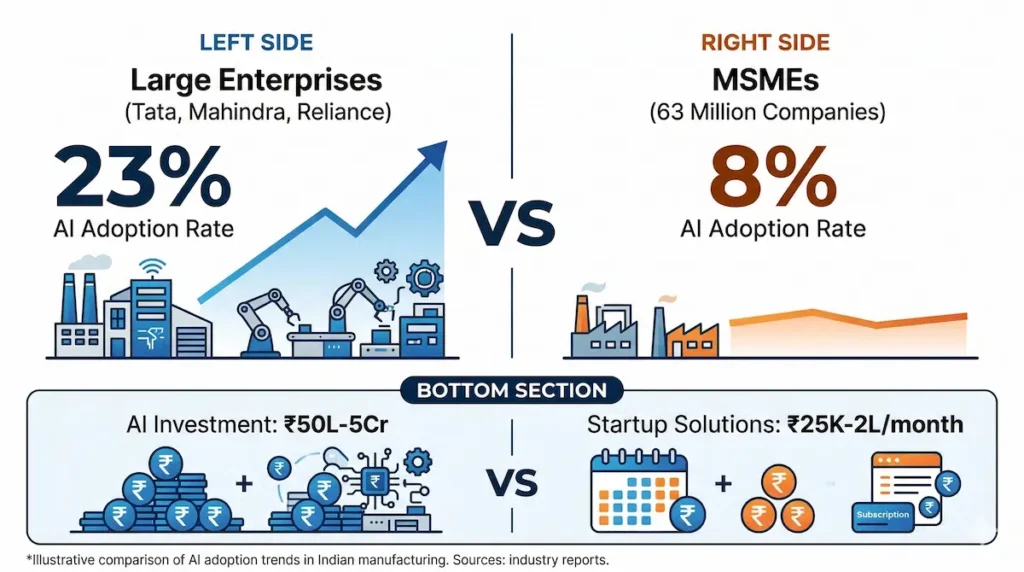
India’s 63 million Micro, Small, and Medium Enterprises (MSMEs) contribute 30% of GDP and employ 110 million workers. Yet their AI adoption rate sits at just 8% compared to 23% among large enterprises like Tata, Mahindra, and Reliance.
The reasons are straightforward but brutal:
Capital constraints: Basic AI quality control systems cost ₹50 lakh to ₹5 crore to deploy. Predictive maintenance platforms require ₹1-3 crore investments. For MSMEs operating on thin margins with limited access to institutional capital, these are existential bets.
Skills gap: Operating AI systems requires data scientists, machine learning engineers, and technicians trained in edge computing. Large enterprises can afford ₹15-25 lakh annual salaries for such talent. MSMEs in tier-2 and tier-3 cities cannot.
Infrastructure incompatibility: Many MSME factories run decades-old machinery that wasn’t designed for IoT sensor integration. Retrofitting legacy equipment with smart sensors often costs more than the AI software itself.
Make in India AI initiatives are attempting to bridge this chasm:
The National AI Marketplace, launched under the IndiaAI Mission, connects SMEs with vetted AI solution providers offering modular, pay-as-you-go AI tools. Instead of ₹5 crore upfront investments, manufacturers can subscribe to cloud-based AI quality inspection for ₹50,000-1 lakh monthly.
SIDBI (Small Industries Development Bank of India) allocated a ₹10,000 crore fund specifically for MSME digitization, with preferential lending rates for manufacturers deploying AI, IoT, and automation technologies.
Indian AI manufacturing startups are building SME-focused solutions:
Detectron (Bengaluru) offers computer vision-based defect inspection deployable in 48 hours with zero coding required. Their system learns from human inspectors for the first week, then autonomously flags defects. Pricing: ₹60,000-2 lakh monthly based on production volume—accessible for mid-sized manufacturers.
Ati Motors (Bengaluru) builds autonomous mobile robots (AMRs) for material handling that cost 60% less than international competitors. Their robots learn factory paths from human operators, eliminating expensive pre-programming. Tier-2 automotive component makers are deploying 5-10 Ati robots for the price of a single imported AGV.
Cogos (Pune) provides AI-powered supply chain optimization specifically designed for MSMEs with 10-50 suppliers. Their platform integrates with existing ERPs (or works standalone), uses WhatsApp for supplier communication, and costs ₹25,000-50,000 monthly—versus ₹50 lakh-1 crore enterprise solutions.
Wobot.ai (Gurugram) deploys AI video analytics for worker safety monitoring. Their system detects PPE violations, unsafe behaviors, and restricted area access in real time. Cost: ₹15,000-30,000 per camera monthly versus ₹2-5 lakh per camera for imported systems.
Yet despite these solutions, the adoption gap persists.
A 2025 survey by NAMTECH (National Manufacturing Technology Programme) revealed that 62% of MSMEs cited “uncertain ROI” as the primary barrier to AI adoption. Translation: they’re unconvinced AI will generate enough productivity gains to justify costs before larger competitors or foreign imports destroy their market position.
This skepticism may prove fatal.
India vs China: The Manufacturing AI War India Cannot Afford to Lose
The global manufacturing landscape has fundamentally shifted, and India is racing against a ticking clock.
China’s AI-powered manufacturing advantage is staggering:
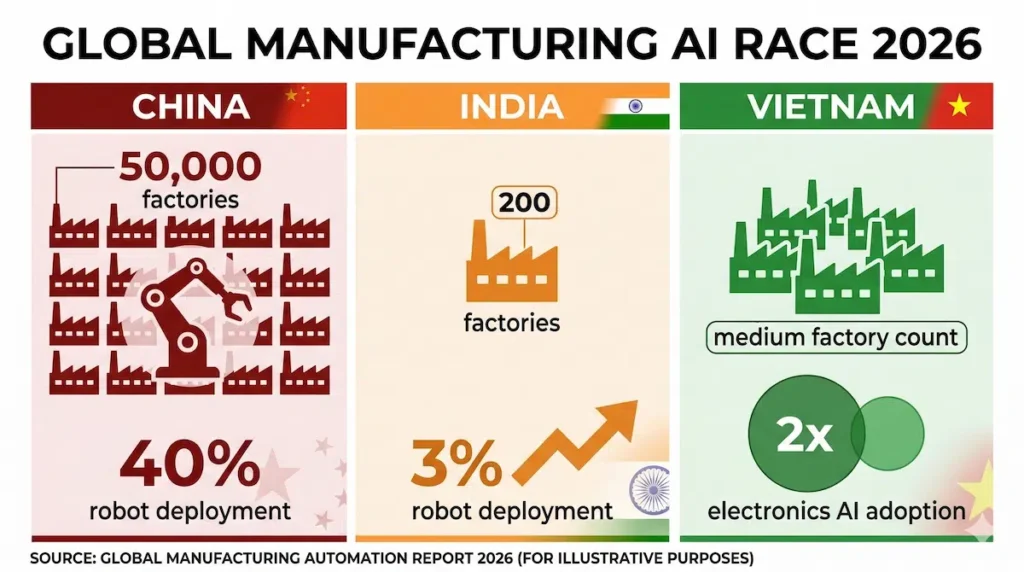
- 50,000+ “lights-out” factories operating with minimal human intervention
- 40% of global industrial robots deployed (versus India’s 3%)
- Government-mandated AI adoption targets for all manufacturing sectors by 2027
- Vertical integration where semiconductor fabs, robotics manufacturers, and AI software companies are domestically owned
Vietnam’s strategic positioning threatens Indian electronics exports:
- Labor costs competitive with India but 2x higher AI adoption in electronics assembly
- Samsung, Apple, Intel shifting production from China to Vietnam—not India
- Government subsidies explicitly targeting AI-powered precision manufacturing
India’s traditional competitive advantages are eroding:
Cheap labor? China’s minimum wage has caught up in many provinces, yet Chinese productivity remains 3-5x higher due to automation. Vietnam offers comparable wages with superior infrastructure and faster regulatory approvals.
The brutal truth: India cannot win a “cheap labor” race anymore. The only path forward is “AI-augmented Indian workforce.”
What does this mean in practice?
Instead of 10 workers manually assembling smartphone components, one skilled technician supervises 10 collaborative robots (cobots) performing assembly while AI vision systems check quality in real time. That technician earns 3-4x a manual assembly worker’s salary—but produces output equivalent to 50 manual workers with near-zero defect rates.
Tata Electronics (Hosur, Tamil Nadu) operates India’s most advanced semiconductor assembly facility using this exact model. Each production line technician monitors 8-12 robotic arms via touchscreen dashboards showing real-time performance metrics. When anomalies occur, the AI system flags issues and suggests corrective actions. Workers implement fixes, and the AI learns from their interventions.
Output per worker? 12x higher than traditional assembly lines.
Quality defect rate? 98.5% reduction compared to manual processes.
Worker retention? 85% after two years versus 40-50% in manual roles—because workers are learning advanced technical skills that command premium wages across the industry.
This is India’s only viable manufacturing future: fewer workers, higher skills, AI augmentation, premium wages, and export-grade quality that can compete with Chinese efficiency at Indian cost structures.
The Market Impact in India: ₹8-12 Lakh Crore Productivity Unlock
The Indian government’s 2025 manufacturing white paper projects AI adoption will hit 67% by 2030, up from 23% in 2025.
If achieved, this transformation could unlock ₹8-12 lakh crore in productivity gains across India’s ₹40 lakh crore manufacturing sector—equivalent to 2-3% additional GDP growth annually.
But there’s a critical “if.”
Large enterprises will deploy AI regardless—they have capital, government incentives, and existential competitive pressure. The ₹2.8 lakh crore PLI scheme ensures Tata, Mahindra, Reliance, L&T, and other conglomerates continue accelerating smart factories India deployments.
The real question is India’s 63 million MSMEs.
If MSME AI adoption remains at 8% through 2028, here’s what happens:
Market consolidation: Large, AI-powered manufacturers undercut MSME pricing while delivering superior quality. MSMEs lose contracts to larger domestic players or cheaper Chinese imports.
Export uncompetitiveness: Global buyers demand zero-defect quality, just-in-time delivery, and real-time supply chain visibility—all impossible without AI systems. Indian MSMEs get shut out of export markets.
Talent drain: Skilled workers migrate to AI-augmented factories offering 25-40% wage premiums, leaving MSMEs unable to attract or retain talent.
Estimated MSME closures by 2030: 15-25% (9.5-15.75 million enterprises) if AI adoption doesn’t accelerate.
But if government initiatives, startup solutions, and financing mechanisms successfully push MSME AI adoption to 40-50% by 2030:
New export opportunities: Indian MSMEs qualify for global supply chains demanding Industry 4.0 compliance.
Productivity surge: ₹3-5 lakh crore in additional MSME output from AI-driven efficiency gains.
Employment transformation: 20-30 million manufacturing workers upskilled into higher-wage, AI-augmented roles.
This is India’s ₹8-12 lakh crore question: Can policy, capital, and technology converge fast enough to bring MSMEs into the AI manufacturing revolution before competitive pressures destroy them?
The manufacturers that thrive by 2030 won’t be the biggest. They’ll be the ones that deployed AI fastest—whether they’re Tata Steel or a 50-employee auto component shop in Coimbatore.
India’s “Make in India 2.0” isn’t about humans assembling products anymore. It’s about humans supervising intelligent machines that assemble products at superhuman speed and zero-defect quality.
The revolution is here. The question is who survives it.
FAQs
What is AI in Indian manufacturing and how is it being used?
AI in Indian manufacturing refers to the deployment of machine learning algorithms, computer vision systems, predictive analytics, and autonomous robotics across factory operations. Companies like Tata Steel use AI-powered computer vision for quality control (35% defect reduction), Mahindra employs AI for supply chain optimization (30% inventory cost savings), and Reliance uses IoT + AI for predictive maintenance and safety monitoring. Applications span quality inspection, demand forecasting, equipment maintenance prediction, autonomous material handling, and production process optimization.
How much does it cost for Indian SMEs to adopt AI in manufacturing?
Basic AI systems for Indian SMEs range from ₹50 lakh to ₹5 crore for upfront deployment, but newer cloud-based and subscription models have dramatically reduced barriers. Startups like Detectron offer computer vision quality inspection for ₹60,000-2 lakh monthly, Cogos provides AI supply chain tools for ₹25,000-50,000 monthly, and Wobot.ai deploys safety monitoring for ₹15,000-30,000 per camera monthly. Government initiatives like SIDBI’s ₹10,000 crore MSME digitization fund and the National AI Marketplace are making AI adoption financially accessible for smaller manufacturers.
Why is India lagging behind China in manufacturing AI adoption?
China operates 50,000+ fully automated “lights-out” factories versus India’s ~200, and controls 40% of global industrial robot deployments compared to India’s 3%. The gap stems from China’s earlier industrial automation push (started 2015), massive government subsidies for AI infrastructure, vertical integration of semiconductor-robotics-AI supply chains, and mandated AI adoption targets across manufacturing sectors. India’s challenge is twofold: large enterprises (23% AI adoption) are catching up rapidly via PLI schemes, but 63 million MSMEs remain stuck at 8% adoption due to capital constraints, skills gaps, and legacy infrastructure incompatibility.
What is the PLI scheme’s role in driving AI manufacturing in India?
The Production-Linked Incentive (PLI) scheme allocates ₹2.8 lakh crore across 14 manufacturing sectors with explicit incentives for AI adoption. Companies deploying AI-powered quality control, predictive maintenance, or automation systems receive preferential treatment when calculating production-linked benefits. By December 2025, PLI schemes catalyzed ₹2.16 lakh crore in investments and ₹20.41 lakh crore in sales, with significant capital flowing into AI infrastructure—industrial IoT sensors, edge computing, collaborative robots, and computer vision systems—making AI deployment economically attractive for large manufacturers.