
🔑 Key Takeaways
- ✦ Bloomberg confirmed on May 26, 2026 that China is requiring government approval for top AI professionals at DeepSeek and Alibaba before overseas travel.
- ✦ The restrictions target founders, senior researchers, and executives — the most internationally connected layer of China’s AI ecosystem.
- ✦ China previously barred the Manus AI co-founders from travel and blocked Meta’s $2 billion acquisition of the company in April 2026.
- ✦ Global AI talent demand is at a record high — ManpowerGroup’s 2026 survey says AI skills are now the hardest to fill worldwide.
- ✦ India, with its growing foundational model ecosystem (Sarvam AI, Krutrim), government investment (IndiaAI Mission), and English-speaking talent base, is the natural alternative hiring destination.
- ✦ Indian AI startups may also benefit from slower international research output from Chinese labs.
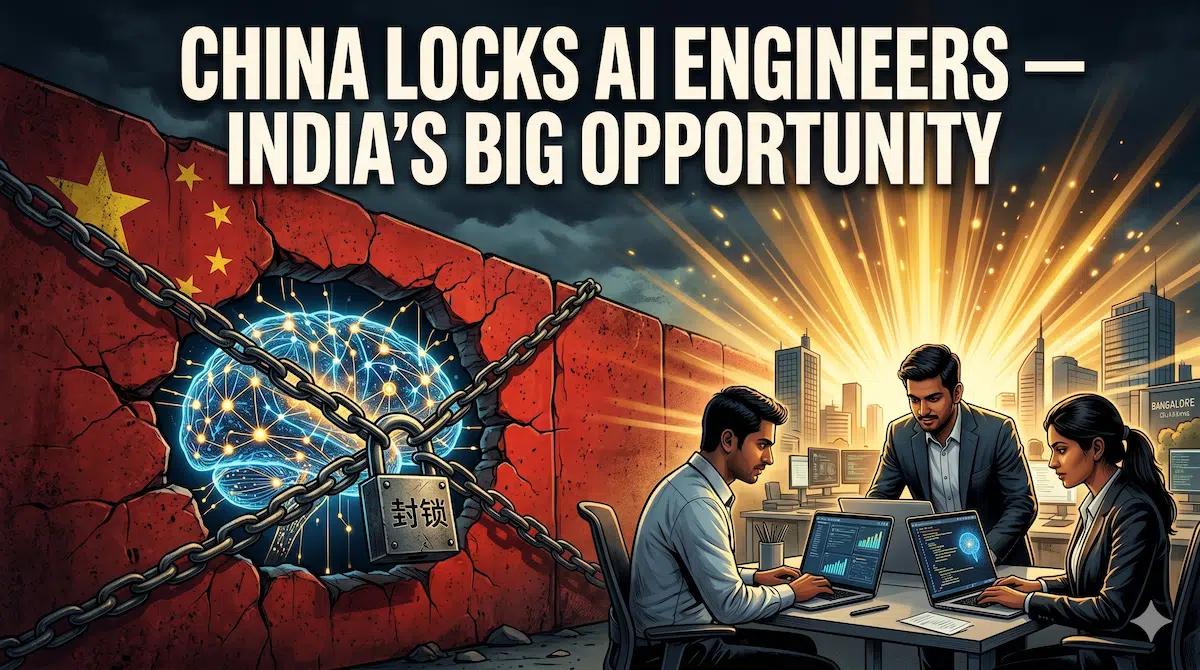
China has officially locked its top artificial intelligence engineers inside the country. In a move that feels more Cold War than Silicon Valley, Beijing is now requiring government approval before AI researchers and executives at companies like DeepSeek and Alibaba can travel overseas.
The China AI travel ban on DeepSeek and Alibaba talent — confirmed by Bloomberg on May 26 — places these engineers in the same restricted category as nuclear scientists and senior state-owned enterprise executives. And while this is deeply troubling for the engineers affected, for India’s fast-growing AI ecosystem, it may just be the opening the country has been waiting for.
What Exactly Did China Do? The China AI Travel Ban Explained
Bloomberg broke the story on Tuesday, May 26, citing multiple people familiar with the matter who requested anonymity. The report states that Chinese government agencies have begun imposing formal travel restrictions on individuals involved in “advanced AI work” considered “strategically important” to the country.
In plain terms: if you are a top AI researcher, founder, or executive at a firm like DeepSeek or Alibaba, you now need explicit government approval before you can board a flight abroad. This is not a subtle advisory or an informal discouragement. It is a hard gate.
Neither DeepSeek nor Alibaba has publicly commented on the restrictions. China’s Ministry of Industry and Information Technology did not respond to media requests. But the Bloomberg report — sourced through multiple independent channels and corroborated by Business Standard India — is credible and consistent with a pattern that has been building for months.
This is not the first signal. Bloomberg had earlier reported similar restrictions on certain DeepSeek executives in December 2025. Before that, the co-founders of Manus AI — Xiao Hong and Ji Yichao — were barred from leaving China while regulators reviewed Meta’s $2 billion acquisition of the company. Chinese authorities ultimately blocked that deal in late April 2026, with the National Development and Reform Commission issuing a one-line order to “unwind” the transaction. The Manus case was the warning shot. What happened on May 26 is the full volley.
Why Is Beijing Doing This?
To understand the travel restrictions, you have to understand how China thinks about AI — not as a product category, but as a national security infrastructure.
Beijing has spent the better part of the last five years building one of the most capable AI ecosystems on earth. DeepSeek’s models rattled global markets in early 2025 precisely because they showed that Chinese AI labs could compete with — and in some benchmarks, outperform — top Western frontier models at a fraction of the cost. Alibaba’s Qwen model family has similarly earned global respect among developers.
That intellectual capital, in China’s view, belongs to the state. It has always enforced this logic for nuclear scientists and top defence researchers. It is now applying the same logic to AI engineers.
The trigger appears to be the accelerating decoupling between the US and Chinese AI ecosystems. As Washington tightens chip export controls and scrutinises Chinese-origin acquisitions, Beijing is doing the reverse — locking its best minds inside its own borders. The Manus deal was the clearest example: a Chinese-origin AI startup tried to relocate to Singapore, got acquired by Meta for $2 billion, and Beijing promptly killed the deal and barred the founders from leaving.
The message is unambiguous. China’s top AI talent is now considered a sovereign asset. And sovereign assets do not get to move freely.
Who Is Actually Affected?
According to the Bloomberg report, the restrictions apply to a specific — and very high-value — category of professionals:
- Startup founders working on advanced AI
- Senior AI researchers and scientists
- Executives at private AI firms with strategic importance
This is not a blanket ban on every software engineer in China. But it is targeted precisely at the people who matter most: the ones who attend NeurIPS and ICML, who build relationships at international labs, who recruit talent from global universities, and who keep Chinese AI research plugged into the global conversation.
If these restrictions hold — and there is no indication they won’t — it will gradually make China’s AI ecosystem more insular. International conferences will lose Chinese representation. Cross-border research collaborations will slow down. And critically, global technology companies looking to hire elite AI talent will have one fewer pool to draw from.
The India Angle: A Door That Just Swung Wide Open
Here is where it gets genuinely exciting for Indian readers.
The global demand for AI talent is not hypothetical. According to ManpowerGroup’s 2026 Talent Shortage Survey — the largest of its kind, covering 39,000 employers across 41 countries — AI skills have, for the first time ever, surpassed all other categories to become the most difficult roles to fill globally. India is not immune: 82% of Indian employers reported difficulty finding skilled AI talent in 2026, per the same survey. NASSCOM projects AI-related job demand in India will cross 1 million by 2026, with only around 16% of IT professionals currently meeting that bar.
But here is the other side of that equation: India has the raw material. The country ranks among the top three in Stanford University’s Global AI Vibrancy Tool. Indian AI talent concentration has grown more than threefold since 2016. Companies like Sarvam AI — the government-backed sovereign LLM provider operating with 4,000 H100 GPUs — and Krutrim, India’s first AI unicorn founded by Ola’s Bhavish Aggarwal, are building foundational models that are drawing international attention.
Now layer in what China just did.
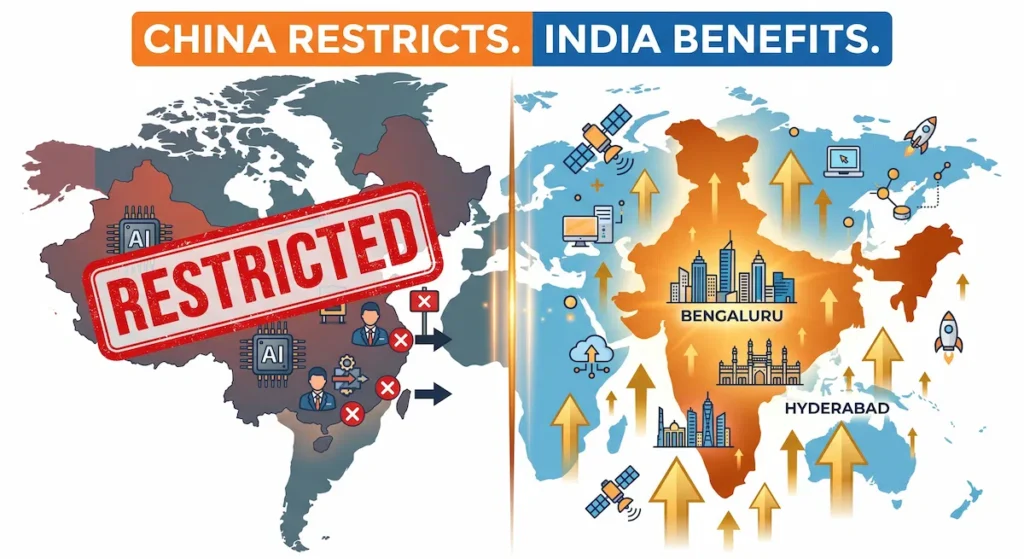
Global tech companies — American, European, Japanese, Middle Eastern — that were previously considering Chinese AI talent as part of their hiring pipelines now face a harder reality. That talent is locked in. The alternative? India.
Indian AI engineers in Bengaluru, Hyderabad, and increasingly in Tier-2 cities like Ahmedabad, Pune, and Indore, are already delivering world-class work. They speak English. They work across time zones. They are not subject to travel restrictions or government-mandated approval processes. And with Reliance Jio announcing a USD 120 billion AI commitment in February 2026 — the largest private AI investment in Indian history — the infrastructure to support them is arriving fast.
For companies building serious AI pipelines, India just became the most obvious answer to a question China used to help answer.
What This Means for Indian Startups and the Ecosystem
The opportunity is not just at the individual hiring level. It cascades across the entire ecosystem.
Indian AI startups that were competing in niche global markets alongside Chinese counterparts will find the competitive landscape shifting. DeepSeek’s open-weight models, for instance, have been widely used by developers globally — including Indian startups building on top of them. If travel restrictions create a chilling effect on DeepSeek’s research output, the innovation cycle from that lab may slow. Indian labs building alternative open models, including Sarvam’s work on Indic language models, could step into that gap.
There is also the conference and research collaboration angle. International AI conferences — NeurIPS, ICLR, ICML — are where research relationships are built, where hiring happens, and where the global AI conversation is shaped. If top Chinese researchers can no longer attend freely, Indian researchers have more room and more visibility. This is a soft-power shift that compounds over years, not months.
And then there is the government dimension. The IndiaAI Mission, with its ₹10,371 crore budget and growing compute infrastructure, is already orienting India as a global partner for “safe and sovereign AI.” Beijing’s move to treat its AI engineers as national-security assets will only deepen the contrast. India’s pitch to the world — open, collaborative, democratic AI development — just got louder by comparison.
A Reality Check Before You Get Too Excited
It would be naive to treat this as a clean win with no complexity.
First, the restrictions as reported are targeted, not absolute. China is not shutting down its AI labs. DeepSeek and Alibaba will continue publishing research, releasing models, and operating at scale within China. The travel ban constrains human movement, not intellectual output delivered digitally.
Second, India’s own AI talent gap is real and significant. The Bain & Company report projects that by 2027, AI job openings in India will be 1.5 to 2 times the available talent pool. The country cannot simply absorb global demand without massive investment in upskilling — and that work is still very much in progress.
Third, global companies hiring AI talent do not pivot overnight. Recruitment pipelines, visa processes, and location strategies take time. The benefit to India will accrue gradually, not immediately.
That said, direction matters more than speed in structural shifts like this. And the direction is clear.
The Bigger Picture: AI as Geopolitics
What China did on May 26 is part of a much larger pattern. The US has export-controlled advanced chips. China is now export-controlling its people. Both moves are expressions of the same logic: in the age of AI, the humans who build the systems are as strategically important as the chips they run on.
India has an opportunity to be neither side in that conflict — but the beneficiary of it. A country that is genuinely open, that welcomes talent from everywhere, that is building sovereign capability without building a wall around its engineers, is the natural magnet for global AI investment and collaboration.
The China AI travel ban on DeepSeek and Alibaba engineers is a story about Beijing’s anxiety. But it is equally a story about India’s opening. The question is whether Indian institutions — government, startups, and universities — are ready to move fast enough to seize it.
Given what has been built in the last two years, there is genuine reason for optimism.
FAQs
Why is China banning AI engineers from travelling abroad?
China views its top AI talent as a national security asset. Beijing wants to prevent technology leaks and brain drain, especially after the US tightened chip export controls and blocked Chinese AI acquisitions like Meta’s $2 billion Manus deal.
Which companies are affected by China’s AI travel ban?
The travel restrictions primarily target senior AI researchers, founders, and executives at private firms like DeepSeek and Alibaba. The Manus AI co-founders were also barred from overseas travel earlier in 2026.
How does China’s AI travel ban benefit India?
As China locks its top AI talent inside its borders, global tech companies are turning to India to fill the gap. With a growing AI ecosystem — including Sarvam AI, Krutrim, and the IndiaAI Mission — India is well-positioned to become the world’s preferred AI talent destination.
Sources: Bloomberg (May 26, 2026), Business Standard India (May 26, 2026), Fortune (April 28, 2026), CNBC (April 27, 2026), ManpowerGroup 2026 Talent Shortage Survey, NASSCOM, Digital in Asia AI Ecosystem Report 2026, Bain & Company India AI Talent Report, IndiaAI Mission official data.