
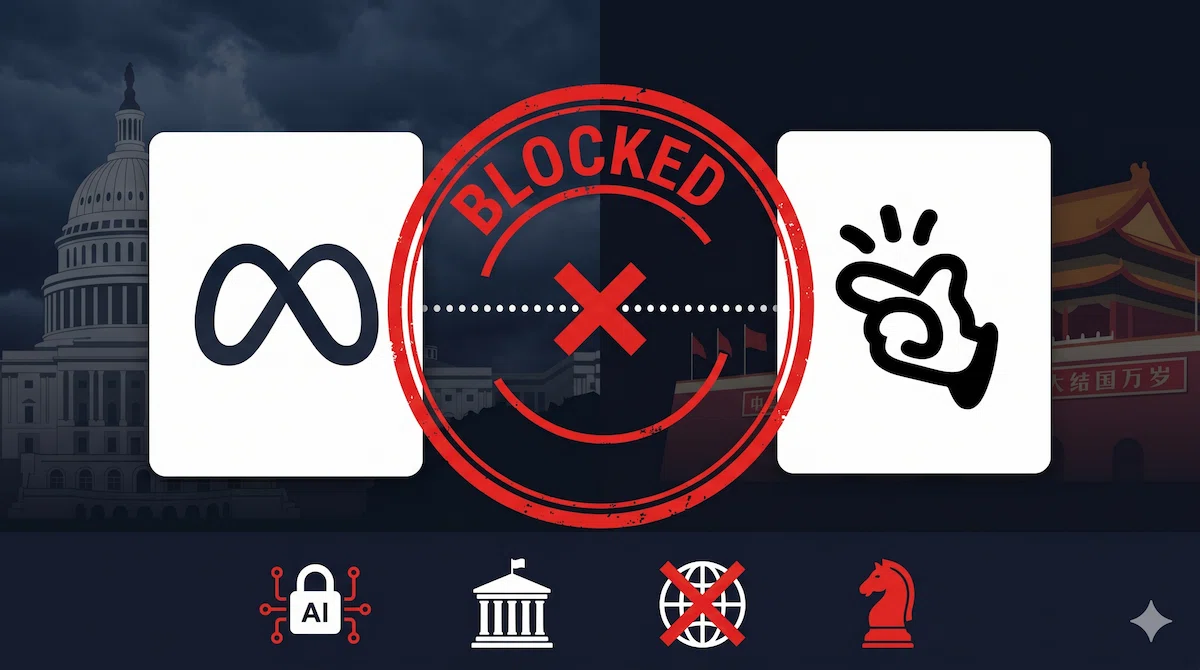
In a surprise move on Monday, China’s top economic planning body officially blocked Meta’s $2 billion acquisition of Manus — a Singapore-based AI agent startup founded by Chinese entrepreneurs. The National Development and Reform Commission (NDRC) issued a brief statement ordering both parties to withdraw the transaction, sending shockwaves through the global AI investment community just hours ago.
Meta had announced the Manus acquisition in December 2025, pitching it as a strategic move to leapfrog rivals in the fast-growing AI agents space. Manus, created by startup Butterfly Effect, had hit $100 million in annual recurring revenue within just eight months of launch — a world record at the time. It raised $75 million at a $500 million valuation, backed by Silicon Valley’s Benchmark. Beijing launched a probe into the deal in January 2026, and by March, had reportedly barred Manus co-founders Xiao Hong and Ji Yichao from leaving China — part of a broader pattern of China targeting US-linked AI technology transfers that has rattled Silicon Valley.
| What This Means for India
For a country of 1.4 billion people racing to build its own AI ecosystem, this is a signal India cannot ignore. Indian AI startups — many of which are eyeing acquisitions by US tech giants — now face a new reality: governments worldwide are watching cross-border AI deals more closely than ever. Indian founders backed by both US and Chinese investors may soon find themselves caught in the same geopolitical crossfire. Regulatory bodies like MeitY and DPIIT may use this moment to accelerate India’s own framework for AI investment screening, especially for startups working on defence, health, or critical infrastructure AI.
Key Details at a Glance
- →China’s NDRC ordered Meta and Manus to cancel their $2 billion deal on April 27, 2026
- →Manus was already largely integrated — staff moved to Meta offices, capital transferred, investors paid out
- →Beijing had restricted two co-founders from leaving China in March amid the probe
- →Chinese AI firms Moonshot AI, Stepfun, and ByteDance face similar restrictions on US capital
- →Meta shares dipped 0.2% in premarket trading following the announcement
What Happens Next
How Meta actually unwinds the deal remains deeply unclear — employees have already joined, money has moved, and investors have been paid. Beijing has not elaborated on enforcement. The decision lands just weeks before a planned Trump–Xi summit in mid-May, adding a charged diplomatic dimension to an already tense tech standoff.
FAQs
Q1. What is Manus AI and why did Meta want to acquire it?
Manus is a general-purpose AI agent built by Singapore-based startup Butterfly Effect, capable of automating complex tasks like market research, coding, and data analysis. Meta wanted the acquisition to rapidly advance its position in AI agents, competing against Microsoft, Google, and OpenAI.
Q2. Can China legally block a deal between a US company and a Singapore startup?
Yes — because Manus was founded in China and its core technology originated there, Beijing asserts jurisdiction over the transaction under its foreign investment and technology export laws. The NDRC cited “laws and regulations” without specifying which statute applies.
Q3. How does the Meta–Manus block affect Indian AI startups and investors?
Indian startups with dual US–China funding structures or Chinese-origin founders could face similar scrutiny if acquired by American tech firms. At a time when India is racing to lead in AI, this is a wake-up call for founders and investors to review their cap tables and geopolitical exposure well before any exit.