
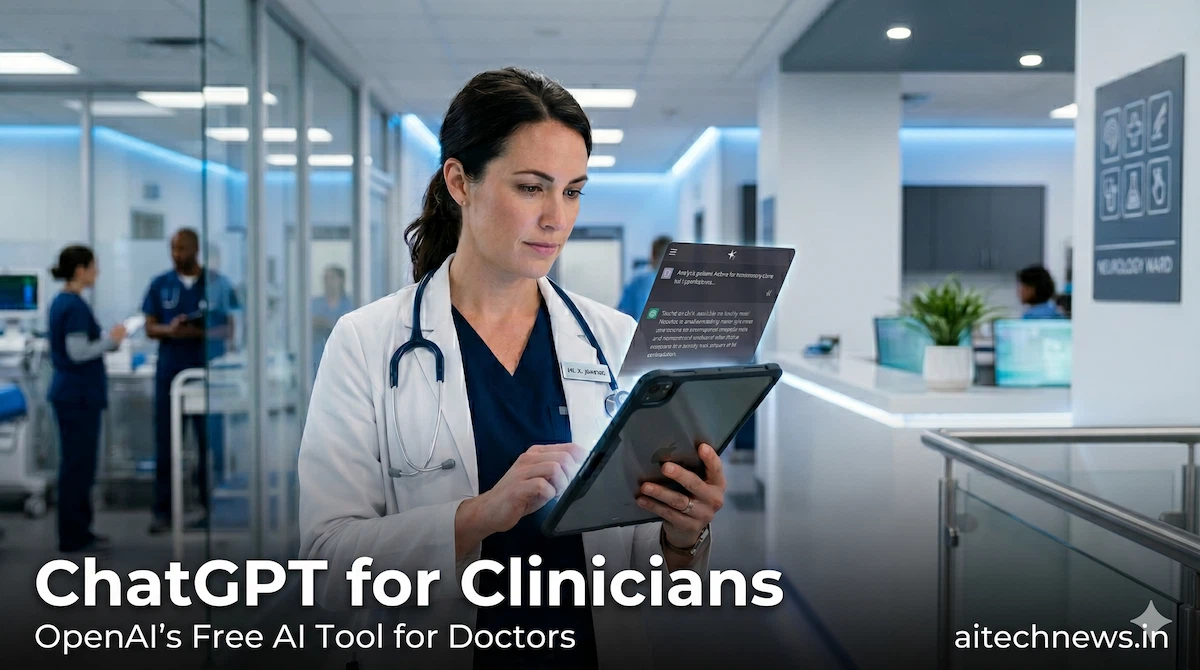
“ChatGPT for Clinicians” is now live in the United States, offering physicians a purpose-built AI tool to cut paperwork, access evidence-based guidance, and reclaim time with patients. For India’s overburdened healthcare system, the implications run even deeper.
The Launch
For years, doctors have been quietly using ChatGPT the way everyone else does — navigating around a general-purpose tool never designed with a stethoscope in mind. That changes today. OpenAI has officially launched ChatGPT for Clinicians, a free, dedicated AI tool built specifically for doctors, nurse practitioners, physician assistants, and pharmacists in the United States.
The announcement, confirmed on April 22, 2026, marks one of the most consequential moves OpenAI has made outside of its core consumer and enterprise products. It signals something the company has been quietly telegraphing for months: AI is no longer just a productivity layer — it is becoming infrastructure for professional medicine.
“Healthcare is under unprecedented strain. Demand is rising, clinicians are overwhelmed by administrative work, and critical medical knowledge is fragmented across countless sources.”
— OpenAIWhat It Actually Does
The tool is not a diagnostic engine, and OpenAI is emphatic on that point. What ChatGPT for Clinicians does — and does exceptionally well, according to early adopter institutions — is handle the mountain of cognitive labor that surrounds clinical care without being clinical care itself.
In practice, that means drafting referral letters and patient summaries, conducting literature reviews in seconds, synthesizing peer-reviewed evidence against institutional protocols, and translating dense medical information into language a patient can understand. The system is powered by GPT-5 models purpose-built for healthcare workflows and evaluated against two benchmarks: HealthBench and GDPval — both developed with input from practising physicians.
Several of America’s most prestigious health systems are already live on the platform: AdventHealth, HCA Healthcare, Boston Children’s Hospital, Cedars-Sinai Medical Center, Stanford Medicine Children’s Health, Memorial Sloan Kettering Cancer Center, Baylor Scott & White Health, and UCSF.
Two Years in the Making
The product’s credibility rests on an unusually rigorous foundation. Over two years, OpenAI worked with more than 260 licensed physicians across 60 countries and dozens of specialties. That group reviewed over 600,000 model outputs spanning 30 clinical focus areas — shaping not just what the model knows, but how it communicates: when to escalate urgency, how to signal uncertainty, and when to simply tell a clinician to call a specialist.
Privacy was a non-negotiable. Conversations within the tool are encrypted in transit and at rest, isolated from the main ChatGPT environment, and — critically — will not be used to train OpenAI’s foundational models. For HIPAA-compliant institutional deployments, the platform supports customer-managed encryption keys.
Not a Replacement — a Force Multiplier
OpenAI’s Nate Gross, Head of Health, has been direct in interviews: this tool is designed to give clinicians their time back, not to replace their judgment. The distinction matters enormously in a regulatory and ethical landscape where the line between clinical decision support and clinical decision-making carries real legal weight.
Fidji Simo, OpenAI’s CEO of Applications, put it plainly: AI is particularly well-suited to synthesizing large volumes of information — helping doctors consider full medical histories, overlapping conditions, medications and risk factors simultaneously. The final call, always, stays with the physician.
What This Means for India
The initial rollout is US-only for verified clinicians. But the global expansion that OpenAI has signalled puts India in an unusually compelling position — and not just as a large market.
India’s healthcare system carries one of the world’s most acute physician shortages. With a doctor-to-patient ratio that remains well below WHO recommendations and an administrative burden that consumes hours of every clinical day, the problem ChatGPT for Clinicians solves is not abstract here — it is daily, grinding reality. A tool that can draft discharge summaries, pull relevant clinical guidelines, and summarize a patient’s medication history in seconds is not a convenience for an Indian clinician. It is a lifeline — and AI tools already being used by doctors in India show just how ready the ecosystem already is.
The opportunity extends to rural and underserved areas, where a single doctor may serve thousands of patients and where access to specialist knowledge is nearly impossible — a gap that AI-powered healthcare startups in rural India are already beginning to close. AI-assisted clinical support, deployed thoughtfully, could meaningfully extend the reach of India’s existing medical workforce without waiting for the decade it would take to train enough new doctors.
India’s digital health infrastructure — anchored by the Ayushman Bharat Digital Mission — is also maturing rapidly, making the data interoperability that tools like this require increasingly achievable.
The Bigger Shift: Vertical AI Is Here
This launch is part of a broader and accelerating pattern. The era of general-purpose AI — one model doing everything adequately — is giving way to purpose-built vertical AI that does one domain extraordinarily well. Healthcare joins enterprise software, legal, cybersecurity, and developer tooling as sectors where OpenAI is no longer just a platform provider but an active product competitor.
The competitive implications are significant. Microsoft, Google, and a wave of well-funded health AI startups have been staking out this territory for years. OpenAI’s entry — backed by GPT-5 class models and a two-year head start on clinical evaluation — reshapes that landscape overnight.
The Bottom Line
ChatGPT for Clinicians is not a moonshot. It is a practical, carefully validated tool that addresses a painfully well-documented problem: doctors spend too much time on documentation and too little time on patients. The numbers back it up — clinician usage of ChatGPT has more than doubled in a year, with millions already using it weekly, largely without institutional support or purpose-built tooling.
That changes today. And if OpenAI’s global expansion follows the pace of its ambition, it may be changing for Indian clinicians sooner than most expect.
FAQs
What is ChatGPT for Clinicians?
ChatGPT for Clinicians is a free AI tool by OpenAI built specifically for doctors, nurses, and pharmacists to help with clinical documentation, medical research, and patient summaries — without replacing their judgment.
Is ChatGPT for Clinicians available in India?
Not yet. It is currently available only in the United States for verified healthcare professionals. OpenAI has indicated global expansion is planned, and India is expected to be a key future market.
Will AI replace doctors?
No. OpenAI has been explicit — ChatGPT for Clinicians is designed to support doctors, not replace them. All final medical decisions remain with the human clinician.
Is ChatGPT for Clinicians free?
Yes. OpenAI is offering ChatGPT for Clinicians free of charge to verified healthcare professionals in the United States during the current rollout phase.
How is ChatGPT for Clinicians different from regular ChatGPT?
Regular ChatGPT is a general-purpose tool. ChatGPT for Clinicians is purpose-built for medical workflows — powered by GPT-5 models trained on clinical data, evaluated by 260+ physicians, HIPAA-compliant, and with conversations that are never used to train OpenAI’s models.