
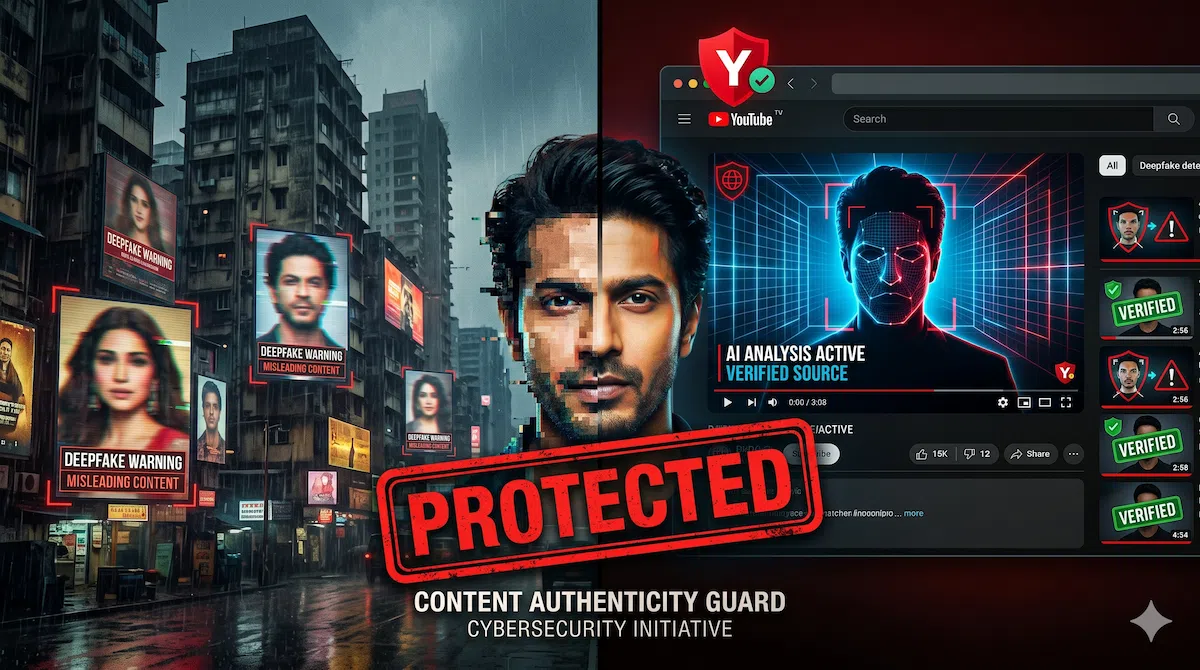
Google’s YouTube has opened its AI-powered “likeness detection” system to any actor, athlete, or musician on the planet — no YouTube channel required. For India, where deepfakes have already targeted Rashmika Mandanna, Sachin Tendulkar, and Virat Kohli, this changes everything.
What You Need to Know — Fast
- →YouTube’s AI “likeness detection” tool is now open to ALL celebrities globally, not just US stars
- →Works like Content ID — but for faces and voices, not just music or video copyright
- →No YouTube channel needed to enroll and request deepfake removals
- →Facial data is used only for identity verification — Google will NOT use it to train Gemini or any other AI
- →Talent agencies in India (think KWAN, Matrix, Cornerstone) should be enrolling clients immediately
- →Parody and satire are still protected — detection flags content, human reviewers decide takedown
MUMBAI, April 22, 2026 — Somewhere in a Mumbai editing suite right now, a content farm is probably rendering a hyper-realistic fake video of a Bollywood A-lister promoting a crypto scheme. By this time tomorrow, it could have ten million views. Until yesterday, the star’s team would have had two options: file a police complaint or submit a tedious manual takedown to YouTube that may take weeks. As of Tuesday, there is a third option — and it is significantly more powerful than either.
YouTube has officially expanded its AI-powered likeness detection system to the global entertainment industry. The announcement, made via the Google-owned platform’s official blog on April 21 and confirmed exclusively to The Hollywood Reporter, means that actors, athletes, musicians, and their management companies worldwide — including in India — can now enroll in a tool that automatically scans YouTube’s entire upload stream for deepfakes and AI-generated impersonations of their face and voice.
This is not a minor policy update. For India, a country that has been through a very public, very painful education in the dangers of celebrity deepfakes over the past two years, this is the most significant platform-level protection to arrive on the market.
India’s Deepfake Crisis: A Quick Recap for Context
The numbers are sobering. India is among the top five countries globally for AI-generated synthetic media incidents, according to multiple cybersecurity reports. But statistics rarely capture what actually happened to real people.
In late 2023, a manipulated video depicting actress Rashmika Mandanna went viral across WhatsApp groups and YouTube Shorts before anyone could stop it. The clip was convincing enough to alarm millions. It triggered an emergency response from the Ministry of Electronics and Information Technology (MeitY), a parliamentary debate, and eventually contributed to the government issuing formal advisories to social media platforms about deepfake removal timelines.
It did not stop there. Fake video advertisements featuring the digitally cloned faces of Sachin Tendulkar and Virat Kohli promoting fraudulent gaming and investment apps circulated widely on YouTube. Both celebrities were forced to publicly deny endorsing these schemes — humiliating, stressful, and financially damaging to their carefully built personal brands. Tendulkar called it “deeply disturbing.” Kohli’s management sent legal notices to multiple platforms.
| Celebrity | Nature of Deepfake | Platform | Prior Recourse |
|---|---|---|---|
| Rashmika Mandanna | Identity morphing (viral social clip) | Instagram, YouTube Shorts | MeitY advisory, manual report |
| Sachin Tendulkar | Fake gaming app endorsement ad | YouTube, Facebook | Public denial, legal notice |
| Virat Kohli | Fake investment scheme promo | YouTube Shorts | Management legal notice |
| Aamir Khan | Cloned voice for political messaging | WhatsApp (spread), YouTube | Public denial via team statement |
In each of these cases, the response was reactive, slow, and ultimately insufficient. The damage was done before the takedown. YouTube’s new tool is designed, specifically, to flip that dynamic — from reactive to proactive.
How YouTube’s Deepfake Removal Tool Actually Works
If you have ever uploaded a video to YouTube containing a song you did not license, you have already experienced the consequence of Content ID — the platform’s system that automatically detects copyrighted music and either mutes it, monetizes it for the rights-holder, or blocks the upload entirely. Likeness Detection is the same principle, applied to human faces and voices instead of music.
- Enrollment: A celebrity, their management company, or their talent agency submits their facial and voice data to YouTube through a verified enrollment process. The platform confirms identity before any data is stored.
- Continuous scanning: YouTube’s AI models monitor every new video uploaded to the platform, comparing content against the enrolled likeness profiles in real time.
- Flagging: When a potential match is detected — say, an AI-generated video of an enrolled star — it is flagged in a dashboard visible to the celebrity’s enrolled team.
- Human review and decision: The celebrity’s team reviews flagged content and decides whether to request removal or leave it. A removal request does not guarantee a takedown — YouTube’s human reviewers assess whether the content qualifies as parody or satire, which remains protected under its community guidelines.
- Data protection: Once a user opts out, YouTube deletes all enrolled data. The company has explicitly stated that none of this data is used to train Gemini or any other Google AI model.
“We’re excited that celebrities and entertainers are now eligible to access this tool, regardless of whether they have a YouTube channel.”
— YouTube, Official Blog Statement, April 21, 2026
That last point — no YouTube channel required — deserves extra emphasis. Many Bollywood actors and Indian cricketers maintain minimal or zero official YouTube presence, relying instead on Instagram and Twitter. Under the old system, that lack of a channel made platform-level protection essentially inaccessible. That barrier is now gone.
Why India Needs This YouTube Deepfake Removal Tool More Than Anyone
YouTube rolled out this tool in the US with the backing of major Hollywood agencies — CAA, UTA, WME, and Untitled Management were the launch partners. These agencies enrolled their top clients, helped YouTube stress-test the system, and are now positioned to offer “deepfake protection” as a genuine value-add service to talent.
Indian talent management is a maturing industry. Agencies like KWAN, Matrix, Cornerstone Sport and Entertainment, and Collective Artists Network manage some of the most valuable personal brands in the country — from IPL captains to OTT stars to national-level athletes. The question they need to be asking their legal teams this week is: how do we enroll our clients?
💡 Action item for Indian agencies: YouTube has not yet published a separate India-specific enrollment page, but the global access page is live. Management companies and agencies can apply directly through YouTube’s Help Center under “Likeness Detection.” Early enrollment means early protection — and early competitive advantage over agencies that wait.
There is also a “right of publicity” dimension here that Indian entertainment lawyers should flag. While India does not yet have a standalone statute protecting personality rights the way some US states do, courts have increasingly upheld injunctions against unauthorized commercial use of celebrity likenesses. YouTube’s tool creates an evidentiary paper trail — documented, timestamped records of deepfake incidents — that could significantly strengthen future legal claims.
What the Tool Won’t Do — and Why That Still Matters
No tool is perfect, and it is worth being honest about the limitations. YouTube has confirmed that a removal request is not a guaranteed takedown. Content that qualifies as parody, satire, or commentary — even if it uses a deepfake face — may be allowed to stay on the platform. YouTube has a long and deliberate history of protecting parody, and it does not intend to change that.
Additionally, the system only scans new uploads. It does not retroactively crawl the entire archive of videos already on YouTube before a celebrity enrolled. Older deepfake content that is already live will still require manual reporting.
And critically, this only covers YouTube. Instagram, Facebook, X (formerly Twitter), Telegram, and WhatsApp — where a significant number of Indian celebrity deepfakes actually spread — are outside its scope entirely. A coordinated response to India’s deepfake problem will still require separate pressure on Meta and others.
But here is the thing: YouTube is the world’s largest video platform, and it is where deepfake scam advertisements have historically run with the most monetization potential. Cutting off the YouTube pipeline is not the complete solution — but it is the most consequential single step available right now.
The Bigger Picture: YouTube Is Choosing a Side
It would be easy to read this announcement as a piece of corporate PR — Google doing the minimum to stay ahead of regulation. That reading underestimates what is actually happening.
YouTube spent over a year quietly building and testing this system. It launched first with a small group of creators, then expanded to politicians and journalists, and is now opening it to the full entertainment industry. That is a careful, deliberate rollout — not the behavior of a company doing the bare minimum. Meanwhile, rival platforms have largely been absent from this conversation.
Multiple governments, including India’s, are actively drafting India’s deepfake regulations around synthetic media disclosure and platform liability. YouTube is positioning itself ahead of that regulatory wave rather than waiting to be forced into compliance. For Indian celebrities and their teams, that alignment of corporate interest and public protection is, at this particular moment, a fortunate coincidence worth taking advantage of.
The tool is live. The enrollment is free. The protection it offers — imperfect as it is — is categorically better than anything that existed last week. For every talent manager, sports agency, and Bollywood PR firm reading this: the window to get ahead of the next deepfake crisis is open right now. It will not stay open forever.