
Key Takeaways
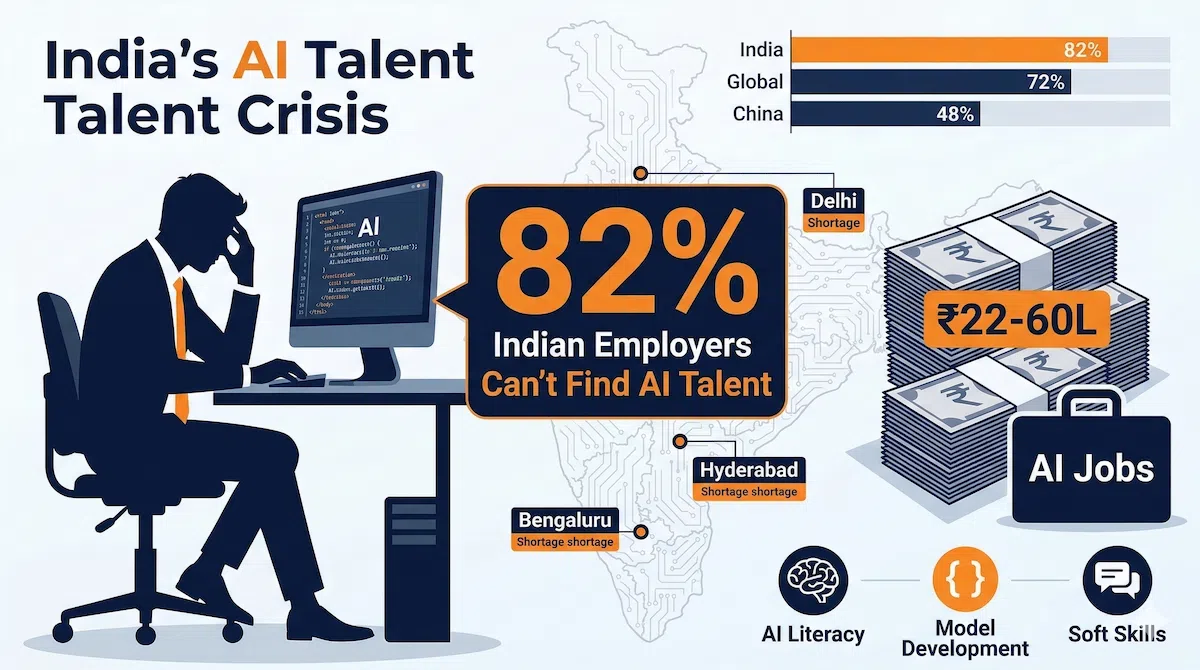
- 82% of Indian employers cannot find AI talent in 2026 — ManpowerGroup’s latest survey reveals India faces the world’s 2nd-worst talent shortage (tied with Japan), far exceeding the 72% global average, as AI literacy and model development skills overtake traditional engineering for the first time
- AI roles command ₹22-60 lakh annual salaries despite shortages — Mid-level AI professionals earn ₹22-35L while senior AI talent commands up to ₹60L, yet for every 10 GenAI positions, only 1 qualified engineer exists, creating a devastating 53% skills gap
- 2.3 million AI jobs needed by 2027, but only 1 million will be filled — India’s structural transformation requires immediate upskilling or 1.3 million critical AI roles will remain vacant, threatening the country’s $1.2 trillion digital economy ambitions and competitive edge against China
India AI talent shortage 2026 has escalated from a concerning trend to a full-blown crisis that threatens the country’s technology leadership ambitions.
On February 26, 2026, ManpowerGroup released its annual global talent shortage survey—and the findings for India were stark. More than eight out of every ten Indian employers (precisely 82%) now report severe difficulty finding skilled AI professionals, positioning India among the world’s most talent-constrained markets alongside Japan (84%) and well above the global average of 72%.
But here’s what makes this shortage unprecedented: for the first time in surveying history, artificial intelligence skills have dethroned traditional engineering and IT capabilities as the hardest competencies to find. AI literacy and AI model development now top the list of impossible-to-fill skills across India’s booming tech sector.
The implications extend far beyond hiring difficulties. With India targeting a $1.2 trillion digital economy by 2030 and positioning itself as a global AI powerhouse, the widening talent gap could derail these ambitions entirely—unless dramatic interventions happen immediately.
The Numbers Behind India’s AI Talent Crisis
The scale of India’s AI skills shortage becomes clearer when examining the specific data points from multiple authoritative sources.
ManpowerGroup’s 2026 survey, covering 3,051 Indian employers and 39,000 globally across 41 countries, reveals that India’s 82% shortage rate represents a significant jump from previous years and substantially exceeds competitors like the U.S. (69%) and even talent-tight markets like Germany (83%) and France (74%).
China—India’s primary technological rival—reports just 48% talent shortage, the lowest among major economies. This gap hands China a structural advantage in the AI race at precisely the moment when AI capabilities determine global competitiveness.
The sector-specific breakdown shows automotive manufacturing facing catastrophic 94% shortages, followed by information services and finance/insurance at 85%, and professional services struggling with similar constraints. Even traditionally talent-rich sectors can’t fill critical AI positions.
TeamLease Digital’s 2025-26 report quantifies the GenAI skills mismatch even more dramatically: for every 10 open generative AI positions in India, only 1 qualified engineer is available. This translates to a projected 53% skills shortfall in GenAI roles by 2026—meaning more than half of all GenAI positions will remain unfilled.
Cloud computing faces a 55-60% demand-supply gap, while cybersecurity shows 25-30% deficits at mid-to-senior levels. Combined, these three domains—AI, cloud, and cybersecurity—represent the foundational infrastructure of India’s digital transformation, yet all three suffer crippling talent constraints.
Perhaps most concerning: Bain & Company projects India will need 2.3 million AI-skilled professionals by 2027, but only 1 million roles will actually be filled under current trajectory. That leaves 1.3 million critical AI positions vacant—a gap large enough to significantly hamper India’s economic and technological aspirations.
What AI Skills Companies Are Desperately Seeking
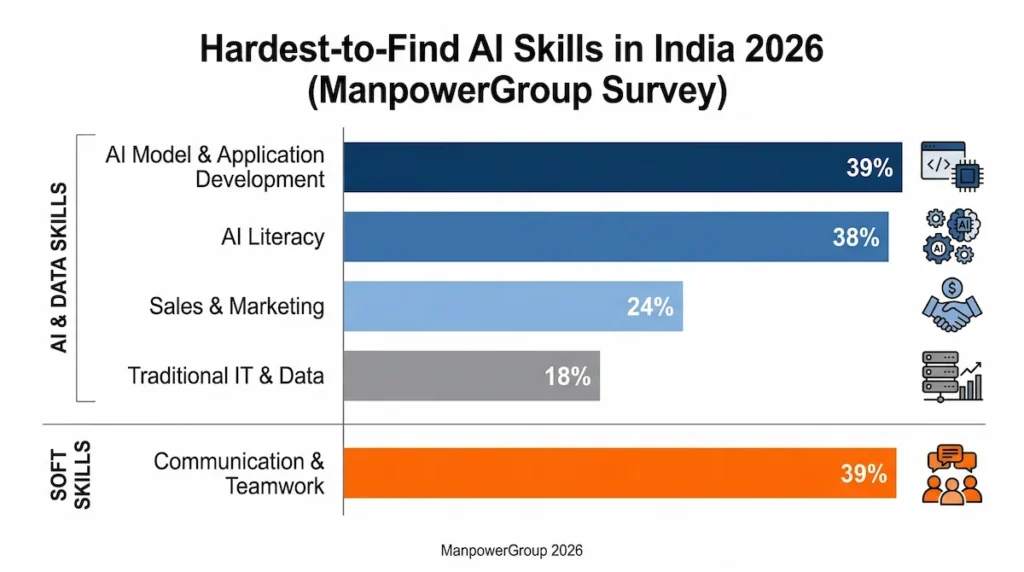
The specific skills employers cannot find reveal exactly which capabilities separate India’s AI haves from have-nots.
ManpowerGroup’s survey identifies the top hard-to-find AI competencies in India:
AI Model & Application Development (39% of employers cite this as hardest to find): The ability to design, train, and deploy machine learning models from scratch. This includes expertise in frameworks like TensorFlow and PyTorch, understanding of neural network architectures, and practical experience bringing models from research to production.
AI Literacy (38%): A broader foundational understanding of how AI systems work, their capabilities and limitations, ethical considerations, and how to identify appropriate use cases. This isn’t about building models but rather knowing when and how to leverage AI strategically across business functions.
These AI-specific skills have now surpassed traditional IT & Data capabilities (which rank sixth at just 18%), signaling a fundamental shift in what technical expertise means in 2026.
But the talent challenge isn’t purely technical. The survey reveals that even as AI skills dominate the shortage list, core human capabilities remain equally scarce:
Communication, Collaboration & Teamwork (39%) tops the soft skills shortage, followed by Critical Thinking and Problem-Solving (37%), Professionalism & Work Ethic (35%), and Adaptability & Willingness to Learn (34%).
This dual shortage—technical AI expertise plus interpersonal capabilities—creates a perfect storm. The ideal candidate possesses both deep AI technical knowledge and the communication skills to translate complex concepts for non-technical stakeholders, plus the adaptability to keep pace with AI’s blistering evolution.
Such candidates are extraordinarily rare. And expensive.
The Salary Reality: What AI Talent Actually Costs in India
Despite the shortage—or perhaps because of it—AI roles command some of India’s highest compensation packages.
According to TeamLease Digital’s 2025-26 salary data:
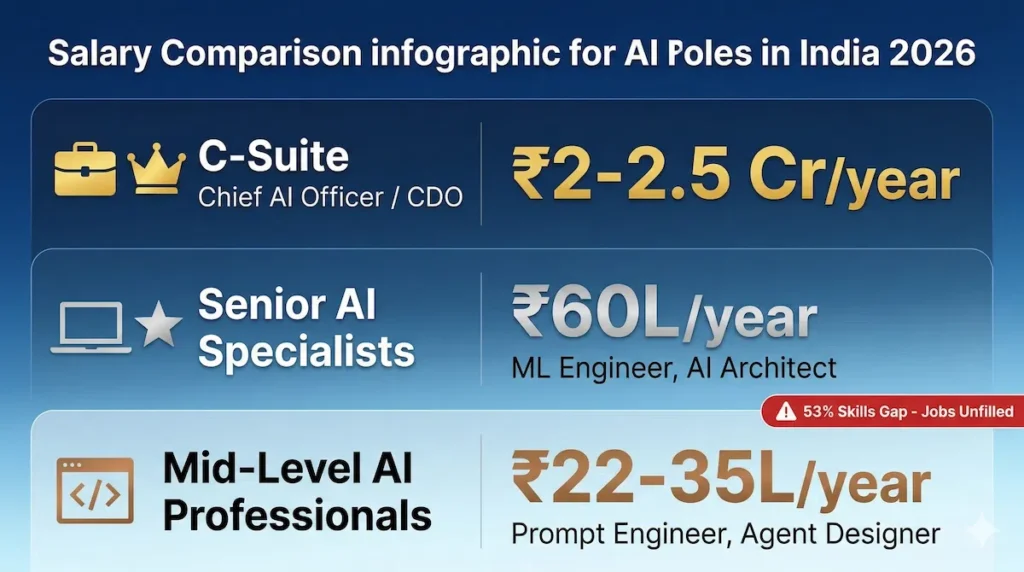
Senior AI specialists earn up to ₹60 lakh annually. This includes AI research scientists, principal machine learning engineers, and AI architects at large tech companies and Global Capability Centers (GCCs).
Mid-level AI professionals, including prompt engineers, AI agent designers, and orchestration specialists, earn ₹22-35 lakh depending on experience and specific expertise. Even these “mid-level” salaries significantly exceed traditional software engineering compensation at equivalent experience levels.
Leadership roles like Chief AI Officer (CAIO) and Chief Data Officer (CDO) command ₹2-2.5 crore annually in India’s 1,760+ Global Capability Centers, which employ 2.16 million people and are projected to reach 3 million by 2030.
The compensation premium reflects desperate demand. Companies aren’t just competing for scarce talent—they’re bidding against global competitors who can offer remote positions at even higher USD-denominated salaries.
Yet here’s the paradox: despite offering premium compensation, 82% of Indian employers still cannot fill their AI roles. The shortage isn’t primarily economic—it’s structural. The talent pipeline simply isn’t producing enough qualified professionals to meet exploding demand.
Why India’s Universities Are Failing the AI Generation
The root cause of India’s AI talent shortage lies in a fundamental mismatch between what educational institutions provide and what the AI economy demands.
Multiple reports identify the same structural failures:
Curriculum lag: Most Indian universities still don’t offer comprehensive AI-focused degree programs. Computer science curricula touch on machine learning and data science, but lack the depth in deep learning architectures, natural language processing, computer vision, and reinforcement learning that modern AI roles require.
Theoretical over practical: Even programs claiming AI specializations often emphasize theoretical foundations without hands-on experience deploying models in production environments, working with real-world messy data, or navigating the MLOps toolchain that industry demands.
Faculty shortage: Universities themselves can’t attract qualified AI professors when industry offers 3-5x academic salaries. The professors teaching “AI” often lack current industry experience with cutting-edge models and deployment practices.
Speed of obsolescence: By the time a four-year degree program incorporates new AI techniques, those techniques are already outdated. The field evolves far faster than academic curriculum revision cycles can accommodate.
The result: students graduate with computer science degrees believing they’re ready for AI roles, only to discover their knowledge is insufficient. Employers must invest 6-12 months in intensive training before new hires become productive—if they’re willing to make that investment at all.
Finance Minister Nirmala Sitharaman publicly acknowledged this crisis, emphasizing that “while industries are actively incorporating AI into operations, they are also struggling with a shortage of skilled talent pool capable of tackling these systems efficiently.”
NITI Aayog’s 2025 report warned that 35-40% of current jobs worldwide face AI-powered automation risk, with India particularly vulnerable given its service-heavy economy and concentration of workers performing “low-value-added tasks” in IT sectors.
The policy think tank called for “large-scale reskilling initiatives” and warned that India faces a “twofold challenge: preparing a workforce with advanced digital and AI skills to capture new opportunities, while simultaneously ensuring that those displaced are gainfully employed.”
Translation: India must simultaneously train millions in AI skills while retraining millions more whose jobs AI will eliminate. The scale is staggering.
How Companies Are Responding (And Why It’s Not Enough)
Faced with unprecedented talent constraints, Indian employers are adapting their strategies—but not quickly enough to close the gap.
ManpowerGroup’s survey reveals how companies are attempting to address shortages:
37% are prioritizing upskilling and reskilling existing employees—the most common response. Rather than compete for scarce external talent, organizations invest in training current staff to develop AI capabilities.
35% are targeting new talent pools beyond traditional tech hubs and IIT graduates, including bootcamp graduates, self-taught developers, and professionals transitioning from adjacent fields.
26% offer greater schedule flexibility including remote work options to attract talent unwilling to relocate to Bengaluru, Hyderabad, or other tech centers.
25% provide location flexibility, with many Global Capability Centers now expanding into tier-II and tier-III cities like Coimbatore, Indore, and Jaipur where competition for talent is less intense.
While these adaptations help at the margin, they don’t address the fundamental problem: India isn’t producing enough AI-literate professionals to meet demand, regardless of where companies look or how flexibly they structure roles.
Some organizations are turning to AI itself for help. Companies increasingly use AI-powered recruitment tools to identify “AI-enhanced candidates” who might not have traditional credentials but demonstrate learning potential and adaptability.
Others partner with online education platforms like upGrad, Coursera, and FACE Prep Campus to create custom AI training programs, essentially building their own talent pipelines when traditional sources fail.
But individual company efforts, however innovative, cannot solve a structural national challenge. The gap requires coordinated intervention across education, industry, and government.
The Geopolitical Stakes: India vs China in the AI Talent War
India’s AI talent shortage isn’t just an economic problem—it’s a geopolitical vulnerability.
China’s 48% talent shortage (versus India’s 82%) provides a decisive advantage in the global AI race. While Indian companies struggle to staff AI initiatives, Chinese competitors move faster, deploy more aggressively, and capture markets India hopes to serve.
The talent gap directly impacts India’s aspirations to become an AI product nation rather than just a services provider. Building sovereign AI models, developing AI-powered products for global markets, and establishing India as an AI innovation hub all require abundant AI talent. The shortage constrains these ambitions.
Consider the contrast: China produces approximately 1.5 million STEM graduates annually and has invested heavily in AI-specific degree programs at top universities. India produces more total engineers but far fewer with the specialized AI training industry demands.
International competition for AI talent further compounds India’s challenge. The U.S., Germany, Canada, and other developed nations actively recruit Indian AI professionals with significantly higher salaries and immigration pathways. India loses some of its best AI talent before they can contribute to domestic innovation.
The brain drain happens at both ends—students pursue AI degrees abroad and don’t return, while mid-career professionals accept lucrative overseas opportunities once they’ve developed expertise in India.
The Path Forward: Can India Close the Gap by 2027?
Closing India’s AI talent gap by 2027 requires interventions at multiple levels, implemented with urgency.
Educational reform: Universities must launch AI-specific undergraduate and postgraduate programs immediately, staffed by industry practitioners on teaching rotations. Curriculum must emphasize hands-on projects, real-world datasets, and production deployment skills alongside theoretical foundations.
Industry-academia partnerships: Tech companies should fund AI labs at universities, provide internship pipelines, and sponsor faculty development programs where professors spend sabbaticals working on industry AI problems.
Government-led reskilling at scale: Building on initiatives like the National AI Marketplace, government must coordinate massive reskilling programs targeting the million-plus workers whose jobs face AI displacement, converting them into the AI workforce rather than leaving them unemployed.
Immigration policy reform: India should create fast-track visas for global AI talent while simultaneously making it easier for Indian AI professionals working abroad to contribute remotely to domestic startups and projects.
Bootcamp ecosystem development: Support intensive 12-24 week AI bootcamps that produce job-ready practitioners faster than traditional four-year degrees, accepting that not all AI roles require deep theoretical knowledge.
The window for action is narrow. By 2027, the gap between India’s AI talent supply and demand could widen from 1.3 million to 2+ million unfilled roles if current trends continue.
But if India can mobilize effectively—treating AI skills development as the national priority it deserves—the crisis could transform into opportunity. The country that solves AI talent development at scale will lead the AI-powered global economy.
India has the population, the technical foundation, and the economic incentive. What remains to be seen is whether it has the institutional coordination and political will to act before the window closes.
For India’s students, professionals, and policymakers, the message is clear: AI literacy isn’t optional—it’s the foundational skill of the next economy. And that economy is already here.
FAQs
What is the AI talent shortage in India?
India faces an 82% AI talent shortage in 2026, meaning 8 out of 10 Indian employers cannot find qualified AI professionals—the second-worst globally after Slovakia (87%) and well above the 72% global average. ManpowerGroup’s survey of 3,051 Indian employers reveals AI literacy and AI model development now rank as the hardest skills to find, surpassing traditional engineering. Bain & Company projects India will need 2.3 million AI-skilled workers by 2027 but only 1 million roles will be filled, leaving 1.3 million positions vacant.
How much do AI jobs pay in India in 2026?
AI salaries in India range dramatically by role and experience level. Mid-level AI professionals including prompt engineers, AI agent designers, and orchestration specialists earn ₹22-35 lakh annually, while senior AI specialists (research scientists, principal ML engineers) command up to ₹60 lakh per year. C-suite AI leadership roles like Chief AI Officer (CAIO) and Chief Data Officer (CDO) earn ₹2-2.5 crore annually in Global Capability Centers. Despite these premium salaries, the 53% GenAI skills gap means many positions remain unfilled.
What AI skills are most in demand in India?
The top two hardest-to-find AI skills in India are AI Model & Application Development (39% of employers cite this) and AI Literacy (38%). AI Model Development includes expertise in TensorFlow, PyTorch, neural networks, and deploying models to production. AI Literacy means understanding AI capabilities, limitations, ethics, and strategic business applications. These technical skills must combine with soft skills including Communication & Teamwork (39% shortage), Critical Thinking (37%), and Adaptability (34%) to create complete AI professionals.
Why does India have such a severe AI talent shortage?
India’s AI talent shortage stems from multiple structural failures: universities lack comprehensive AI-focused programs and teaching staff who can’t compete with ₹22-60L industry salaries; curricula emphasize theory over practical deployment skills; AI field evolution outpaces academic revision cycles; and many computer science graduates lack the specialized deep learning, NLP, and production deployment expertise employers require. Finance Minister Nirmala Sitharaman publicly acknowledged industries are “struggling with a shortage of skilled talent pool capable of tackling these systems efficiently,” while NITI Aayog warns 35-40% of current jobs face automation, requiring massive reskilling programs India hasn’t yet implemented.