
Key Takeaways
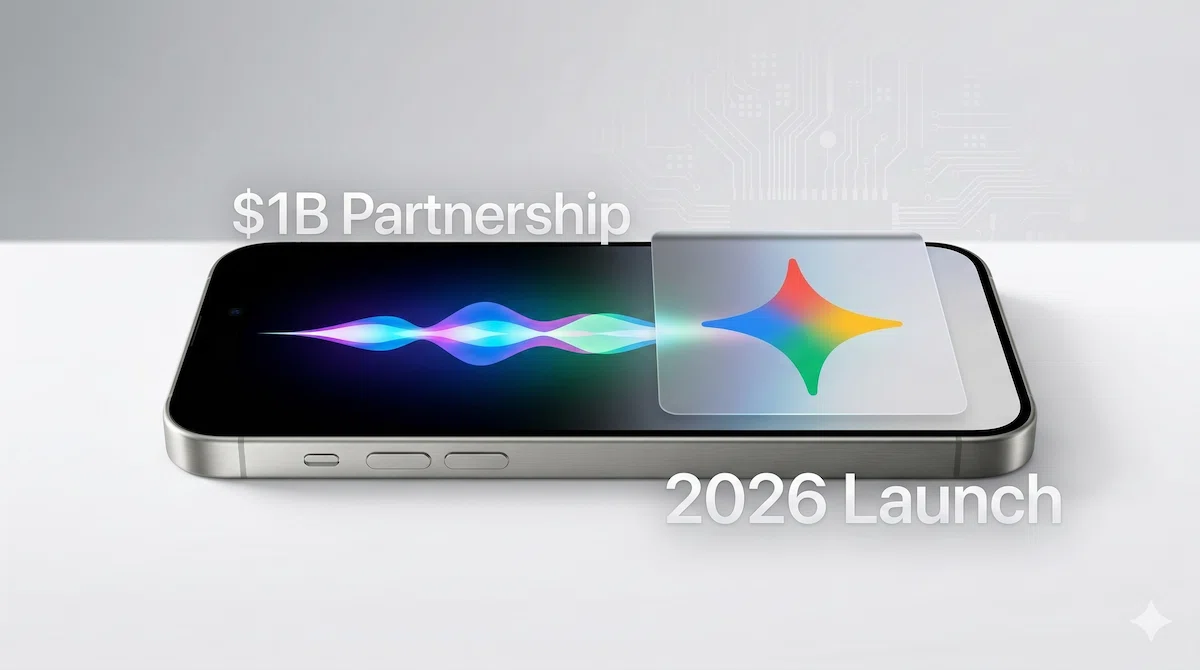
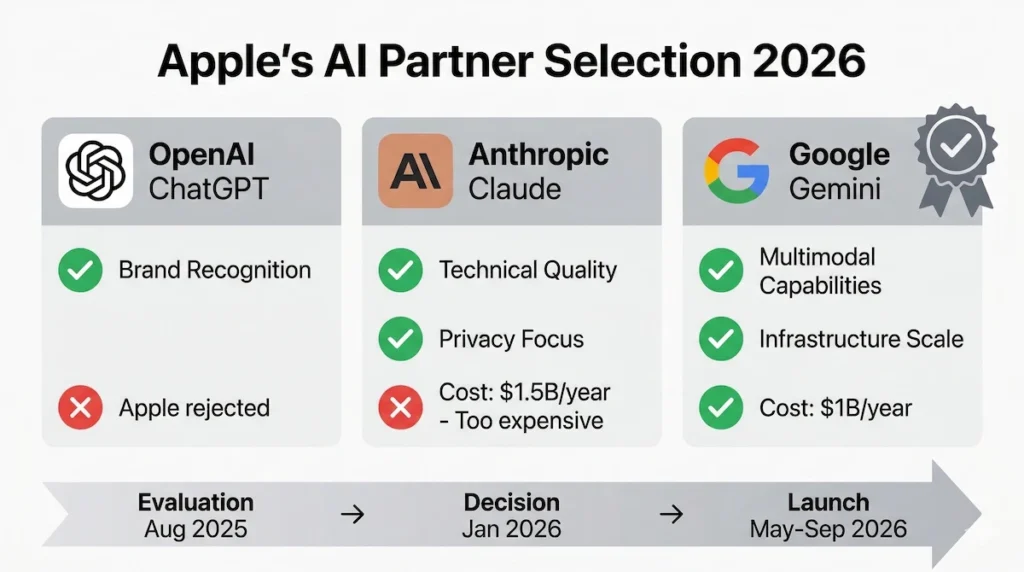
- Apple signed a $1 billion annual deal with Google — The multi-year partnership makes Gemini AI the foundation for Apple’s next-generation Siri, launching May-September 2026 after delays from the original March timeline
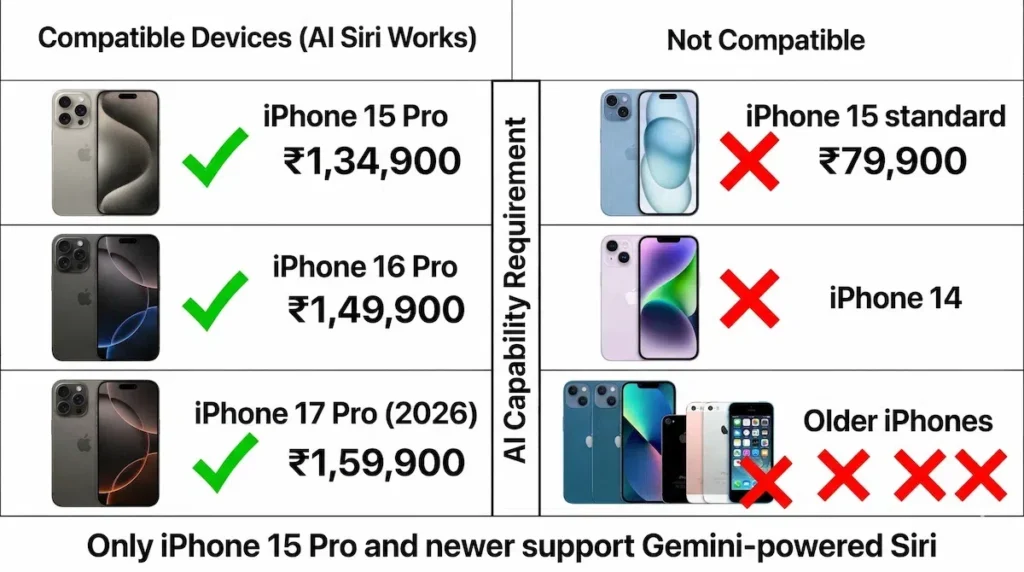
- Only iPhone 15 Pro and newer devices will support the upgrade — The AI-powered Siri requires significant processing power, limiting availability to iPhone 15 Pro, iPhone 16 series, and upcoming iPhone 17 models starting at ₹1.34 lakh in India
- Google’s Gemini beats OpenAI and Anthropic in Apple’s evaluation — After testing ChatGPT and Claude models, Apple chose Gemini for superior multimodal capabilities and more favorable economics, validating Google as the premier AI provider
Apple Siri AI 2026 represents the biggest shift in voice assistant history—and it wasn’t built by Apple at all. On January 12, 2026, Apple made an announcement that sent shockwaves through Silicon Valley.
After years of Siri falling embarrassingly behind ChatGPT, Google Assistant, and virtually every other voice assistant on the market, Apple finally admitted what users had known for half a decade: they needed help. Big help.
The company that prides itself on controlling every aspect of the user experience—the same Apple that ditched Google Maps just to build its own navigation app—announced it was handing over the keys to Siri’s future to its biggest competitor: Google.
The deal? A reported $1 billion annually for access to Google’s Gemini AI models and cloud infrastructure. The goal? Transform Siri from the assistant that can’t even set multiple timers into an AI powerhouse that rivals ChatGPT.
But there’s a catch. What Apple promised for March 2026 is now delayed until May at the earliest—and some features might not arrive until September. For India’s 100+ million iPhone users, this means the AI revolution they’ve been promised is still months away.
The $1 Billion Deal That Changes Everything
Apple’s partnership with Google represents a seismic shift in how the iPhone maker approaches artificial intelligence.
According to the joint statement released by both companies in January, the collaboration spans multiple years and positions Google’s Gemini models as “the foundation for Apple Foundation Models.” Translation: Google’s AI is now the brains behind Apple’s intelligence.
“After careful evaluation, we determined that Google’s technology provides the most capable foundation for Apple Foundation Models and we’re excited about the innovative new experiences it will unlock for our users,” Apple stated—a rare public admission that another company’s technology outperforms their own.
The selection process wasn’t casual. Apple put both OpenAI’s ChatGPT and Anthropic’s Claude through rigorous internal testing before landing on Gemini.
Why Gemini won:
Technical superiority: Google’s multimodal capabilities—handling text, voice, images, and video simultaneously—exceeded Apple’s requirements for a truly conversational assistant.
Financial viability: While Anthropic’s Claude models were technically impressive, the licensing costs reportedly exceeded $1.5 billion annually. Gemini’s $1 billion price tag, though massive, proved more sustainable for Apple’s economics.
Infrastructure advantage: Google’s cloud infrastructure relies on custom Tensor Processing Units (TPUs) specifically designed for large language models. These chips outperform the Mac-based servers Apple currently uses for its Private Cloud Compute system.
Scale and stability: Unlike OpenAI and Anthropic—startups that might not exist in their current form five years from now—Google offers the long-term stability Apple needs for a decade-long assistant strategy.
The deal validates Google’s position in the AI race at a critical moment. After Microsoft’s OpenAI partnership and Meta’s open-source Llama models dominated headlines for years, Google’s Gemini is now powering the voice assistant on the world’s most valuable smartphones.
What the New Siri Actually Does (And Doesn’t)
The Gemini-powered Siri isn’t just Siri with better answers. It’s a fundamental reimagining of what a voice assistant can accomplish.
New capabilities enabled by Gemini:
Contextual understanding across apps: The upgraded Siri can extract flight information from Mail, pull reservation details from Messages, and understand when you ask “remind me about my dinner plans” by automatically finding that restaurant booking you made via text last week.
Multi-step task execution: Instead of handling one request at a time, the new Siri can manage complex workflows. Ask it to “plan my weekend in Goa” and it could search flights, suggest hotels based on your budget, book restaurants, and add everything to your calendar—all from a single request.
Personalized responses: Gemini’s models understand your communication patterns, preferences, and habits. Over time, Siri learns whether you prefer detailed explanations or quick answers, formal language or casual conversation.
Multimodal interactions: The assistant can process images you show it, understand what you’re looking at on screen, and provide contextually relevant help—something the current Siri can’t do at all.
What won’t change (at least initially):
The Siri wake word, interface, and basic interaction model remain unchanged. Apple’s white-label arrangement means users won’t see Google branding anywhere. From a user’s perspective, this is still Siri—just dramatically smarter.
The assistant will continue running on Apple’s Private Cloud Compute infrastructure for privacy, though recent reports suggest Apple is exploring running some Gemini queries directly on Google’s servers to handle the expected surge in AI usage.
The India Angle: When Do 100 Million iPhone Users Get It?
India represents Apple’s fastest-growing major market, with iPhone shipments up 23% year-over-year in 2025. But the Gemini-powered Siri rollout raises questions about availability and accessibility for Indian users.
Device compatibility: Only iPhone 15 Pro (starting at ₹1,34,900 in India), iPhone 15 Pro Max (₹1,59,900), iPhone 16 series, and the upcoming iPhone 17 models will support the advanced AI features. This immediately excludes the majority of India’s iPhone user base, many of whom own iPhone 12, 13, and standard iPhone 15 models.
Language support: While Gemini supports multiple Indian languages including Hindi, Tamil, and Telugu, Apple hasn’t confirmed which languages will be available in Siri at launch. The initial rollout will likely prioritize English, with regional language support arriving in subsequent updates—a pattern Apple has followed with previous Siri features.
Launch timeline for India: Apple typically releases iOS updates simultaneously worldwide, meaning Indian users should get access to the Gemini-powered Siri the same day as users in the US and Europe. However, the delay from March to May-September 2026 means even that timeline is uncertain.
The bigger picture: The partnership could accelerate Apple’s push into India’s premium smartphone market. If Siri finally becomes competitive with Google Assistant—which dominates in India through Android’s 95% market share—it removes a key weakness that has prevented iPhone adoption among feature-conscious buyers.
India’s developers and startups also benefit. Apple’s shift toward Gemini could open opportunities for Indian AI companies to build integrations with the new assistant, particularly for India-specific use cases like UPI payments, railway bookings, and multilingual customer service.
Why This Deal Matters Beyond Siri
Apple’s reliance on Google for core AI capabilities signals a broader industry shift: the era of vertical integration is ending.
For decades, Apple’s competitive advantage came from controlling every layer of the technology stack—hardware, software, services, and increasingly, the chips inside. But AI’s complexity and resource requirements have forced even Apple to acknowledge they can’t build everything in-house.
Strategic implications:
For Apple: The partnership buys time while the company develops its own next-generation AI models, codenamed “Ferret-3,” planned for 2026-2027. Gemini serves as a bridge technology—powerful enough to keep Siri competitive while Apple builds proprietary alternatives.
For Google: Beyond the $1 billion annual revenue, the deal provides massive distribution. Apple’s 2 billion active devices globally become showcase platforms for Gemini’s capabilities, potentially converting users to Google’s broader AI ecosystem.
For the industry: If Apple, the most vertically integrated tech company in history, can’t go it alone in AI, who can? Expect more focused partnerships and fewer attempts to own every layer of the AI stack.
The collaboration also highlights AI’s winner-take-most dynamics. Only Google, OpenAI, Anthropic, and perhaps Meta have the compute resources, data access, and talent to build foundational models at the scale required for consumer products. Every other company—including Apple—must partner or fall behind.
The Delayed Launch: March Becomes May Becomes “Later”
Apple originally targeted a March 2026 launch alongside iOS 26.4 for the Gemini-powered Siri. That timeline has now slipped.
Bloomberg reported in late February that some features are being pushed to May, with others potentially delayed until September’s iOS 27 release alongside the iPhone 17. Apple hasn’t publicly confirmed the new timeline, leading to speculation about what’s causing the delays.
Possible reasons:
Technical integration: Merging Google’s AI with Apple’s privacy architecture proves more complex than anticipated. Apple’s requirement that user data never touches Google’s servers adds layers of complexity to the integration.
Feature scope: Apple may be expanding what it plans to deliver, preferring to wait and launch a complete experience rather than release a half-baked product.
Quality standards: Apple’s culture prioritizes polish over speed. If the AI produces inconsistent results or privacy concerns remain, the company will delay rather than ship.
Whatever the reason, the delay frustrates users who have watched Siri stagnate while competitors raced ahead. Every month of delay is another month where iPhone owners envy the capabilities available to ChatGPT and Gemini users.
For India’s price-conscious market, the delay could matter. If the feature arrives in September rather than May, it means buyers purchasing iPhones in the crucial festive season (Diwali 2026) might receive a significant software upgrade shortly after their purchase—potentially influencing buying decisions.
What Happens Next
Apple is expected to preview the Gemini-powered Siri at WWDC 2026 in June, giving developers and users their first official look at the new capabilities.
The May-September rollout window means we could see a staged release: basic improvements arrive in May with iOS 26.4, while more advanced features—like the conversational, ChatGPT-style interface rumored for iOS 27—arrive in September.
Beyond Siri, reports suggest Gemini integration will expand to Safari (for intelligent web search) and Spotlight (for system-wide contextual search), creating a unified AI experience across the iPhone.
The partnership also positions both companies for the next phase of AI competition: on-device intelligence. While current AI assistants rely heavily on cloud processing, the industry is shifting toward models that run locally on phones for better privacy and responsiveness. Apple and Google’s collaboration could accelerate this transition, particularly if Apple’s forthcoming chips gain AI-specific capabilities.
For Indian users, the question isn’t just when the new Siri arrives—it’s whether it finally makes the iPhone’s premium price feel justified. At ₹1.3-1.6 lakh for the devices that support advanced AI, Apple needs to deliver an experience that feels meaningfully better than the Google Assistant available on ₹15,000 Android phones.
Come May or September 2026, we’ll finally know if Apple’s billion-dollar bet on Google’s AI pays off—or if Siri remains the punchline it’s been for the past five years.
FAQs
When will the Google Gemini-powered Apple Siri launch in India?
The Gemini-powered Apple Siri was originally scheduled for March 2026 but has been delayed to May at the earliest, with some features potentially arriving in September 2026 alongside iOS 27. India will receive the update simultaneously with global markets when it launches, as Apple typically releases iOS updates worldwide on the same day. However, the exact launch date remains unconfirmed as Apple continues integration work.
Which iPhones will support the new Gemini AI Siri?
Only iPhone 15 Pro, iPhone 15 Pro Max, iPhone 16 series, and upcoming iPhone 17 models will support the advanced Gemini-powered Siri features. This hardware requirement is due to the significant processing power needed for on-device AI capabilities. In India, this means devices starting at ₹1,34,900 (iPhone 15 Pro) and above. Standard iPhone 15 and older models will not receive the advanced AI features.
How much is Apple paying Google for Gemini AI access?
Apple is reportedly paying Google approximately $1 billion annually under a multi-year contract to license Gemini AI models and cloud computing infrastructure for powering Siri and other Apple Intelligence features. This makes it one of the largest AI licensing deals in tech history. The agreement is non-exclusive, allowing Apple to continue partnerships with other AI providers like OpenAI for specific features.
Will the new Siri support Indian languages like Hindi, Tamil, and Telugu?
While Google’s Gemini models support multiple Indian languages including Hindi, Tamil, Telugu, Bengali, and Marathi, Apple has not officially confirmed which languages will be available in Siri at launch. Based on Apple’s historical rollout patterns, the initial release will likely prioritize English, with regional Indian language support added in subsequent updates throughout 2026-2027. Users should expect gradual language expansion rather than comprehensive Indian language support at launch.