

📌 Key Takeaways
- India is moving beyond AI usage toward building its own compute infrastructure, marking a deeper shift in its AI strategy.
- 100MW is the execution phase that will define real impact, while 1GW remains a long-term ambition.
- Local AI infrastructure could unlock enterprise adoption and sovereign AI capabilities, especially in regulated sectors.
India has quickly become one of the world’s largest AI user markets — but most of its AI still runs on infrastructure outside its borders. That gap is exactly what the Tata OpenAI India AI data center plan aims to address, starting with 100MW of local compute capacity and a long-term vision that stretches to 1GW.
That is why the Tata OpenAI India AI data center story deserves more attention than a standard partnership announcement. At first glance, it may look like just another high-profile AI tie-up. In reality, it points to something far more consequential. The proposed plan to begin with 100MW of AI-optimized data center capacity in India, with ambitions to scale toward 1GW, suggests India may finally be entering the next stage of its AI evolution — one where it starts building the infrastructure layer that serious AI deployment depends on.
And that matters because AI leadership is not decided only by who builds the best models or launches the most popular apps. Increasingly, it is also shaped by who controls the compute, energy, deployment environment, and compliance framework behind those systems.
What Tata and OpenAI Announced for India’s AI Infrastructure
The project also aligns with OpenAI’s broader OpenAI for India initiative, which reflects the company’s deeper push into India’s AI ecosystem.
The most important thing to understand about this announcement is that it is not simply about a commercial collaboration between two large organizations. The real significance lies in the nature of the partnership itself.
This is fundamentally an infrastructure story.
The plan centers on creating AI-optimized data center capacity in India, beginning at 100MW and designed to scale much further over time. That is an important distinction because AI workloads, especially those linked to large model inference, enterprise AI systems, and secure deployments, require a very different type of infrastructure than conventional cloud hosting or traditional enterprise IT environments.
This is not merely about giving companies another place to run software. It is about building the kind of compute environment that can support large-scale AI usage in a serious and sustained way.
That difference becomes especially important in India, where a large share of AI demand has historically depended on infrastructure outside the country. While that arrangement can work for lightweight or non-sensitive applications, it becomes much more complicated once AI starts moving into production environments across finance, telecom, healthcare, public administration, and other regulated sectors.
That is why this announcement should not be treated as a branding exercise or a symbolic AI partnership. It should be read as an early indication that India’s AI stack may finally be starting to localize at the infrastructure level.
Why 100MW Matters More Than the 1GW Headline
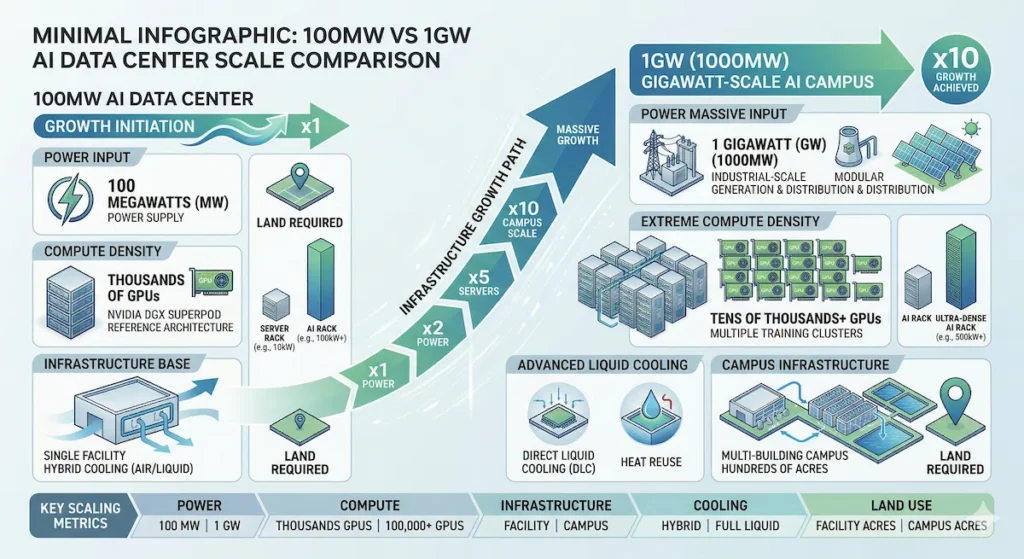
One of the biggest mistakes in covering this story would be to focus only on the 1GW ambition and overlook the significance of the 100MW starting point.
The 1GW figure is the one that naturally attracts headlines because it sounds dramatic, ambitious, and nationally significant. But from a practical infrastructure perspective, the 100MW figure is actually more meaningful today, because it reflects what can potentially be deployed, built, and operationalized in the nearer term.
And 100MW is not small.
In the context of AI-ready capacity, it already represents a serious infrastructure commitment. It suggests the project is not being framed as a symbolic pilot or a narrow experimental deployment. Instead, it points to a level of compute that could support meaningful enterprise AI workloads and form the base layer for broader AI services over time.
Just as importantly, beginning at 100MW reflects realism.
AI data centers are not simple to build. They require deep power planning, advanced cooling systems, dense networking, specialized hardware, and substantial capital. The most credible infrastructure projects are usually not the ones that promise the biggest numbers on day one. They are the ones that begin with a deployable first phase and then scale based on operational success.
That is the right way to read this story. The 100MW phase is the execution layer, while the 1GW target is the long-term strategic horizon.
That framing is much more useful than simply repeating that India is getting a 1GW AI data center.
What 1GW AI Data Center Scale Means for India
If Tata and OpenAI are eventually able to scale this effort anywhere close to 1GW, the implications for India’s AI infrastructure landscape would be significant.
At that level, the project would no longer be just a company-specific capacity buildout. It would start to resemble the kind of compute backbone that can influence an entire AI ecosystem.
The first implication is reduced dependence on offshore AI infrastructure. At present, a meaningful share of AI workloads used by Indian companies still rely on infrastructure located outside the country. That can create challenges around latency, governance, and deployment confidence, especially when AI systems move beyond experimentation and begin supporting operational workflows.
A larger domestic AI infrastructure base could help change that.
The second implication is market confidence. When substantial AI infrastructure is built locally, it changes how founders, enterprises, investors, and ecosystem participants think about the market. Startups become more willing to build for Indian enterprise use cases. Enterprises become more confident about deploying AI into production. Investors begin to see the market not just as a large user base, but as one with growing infrastructure depth.
And the third implication is strategic.
AI competitiveness is increasingly tied not just to models and applications, but to who controls the compute and deployment layer underneath them. If India wants to be seen as a serious AI economy rather than just a large AI demand center, this is the layer it has to build.
That is why the 1GW ambition matters, even if it remains a longer-term target rather than an immediate reality.
Why This Matters for Sovereign AI and Enterprise Adoption in India
For Indian enterprises, the significance of local AI infrastructure is not abstract or theoretical. It is highly practical.
That is where the Tata–OpenAI project becomes much more than a compute story. It becomes part of India’s sovereign AI ambitions — where local infrastructure, domestic deployment, and data control start becoming strategically important.
One of the biggest bottlenecks in enterprise AI adoption today is not lack of interest. It is trust, compliance, and operational control.
Large organizations across banking, insurance, healthcare, telecom, and government-linked services often move cautiously with AI because they need clarity around a few critical questions: Where is the data being processed? How are models being deployed? What compliance boundaries are being maintained?
Those are not small concerns. In many industries, they are the difference between a pilot and a production deployment.
That is where the Tata–OpenAI project becomes much more than a compute story. It becomes a sovereign AI infrastructure story.
If more AI workloads can be handled within India, enterprises and institutions gain a stronger basis for deploying generative AI into real operating environments. That could include internal copilots, customer support systems, domain-specific assistants, analytics workflows, or sector-specific AI applications that require tighter control over data and infrastructure.
In simple terms, local compute reduces deployment friction.
And in enterprise technology, reducing friction is often what turns curiosity into adoption.
What This Means for Indian Startups, Developers, and AI Builders
The long-term impact of this kind of infrastructure buildout will not be limited to large enterprises.
If India develops deeper domestic AI compute capacity, the benefits are likely to extend across the broader ecosystem, especially for startups, developers, and product builders trying to build for Indian conditions.
For startups, one of the biggest advantages could be infrastructure confidence. Founders building for enterprise customers often run into questions around deployment architecture, compliance, latency, and operational readiness. A stronger local AI infrastructure layer can make those conversations much easier and more commercially viable.
For developers and product teams, local infrastructure can also improve the quality of AI deployment itself. It can make India-first applications more responsive, easier to optimize, and better aligned with domestic enterprise needs.
And then there is the broader ecosystem effect.
When serious compute infrastructure arrives in a market, it often creates new demand beyond the infrastructure layer itself. That includes opportunities for AI tooling, deployment platforms, observability systems, optimization services, and sector-specific software built on top of the compute stack.
That is how ecosystems deepen. Not all value in AI is created at the model layer. A great deal of it is created around the infrastructure and deployment environment that makes AI usable at scale.
This is why the Tata–OpenAI story should matter not only to enterprise CIOs, but also to startup founders, AI engineers, and builders trying to create durable products in India.
The Real Challenges: Power, Cooling, Cost, and Execution
For all its promise, this project should not be treated as inevitable.
AI infrastructure at this scale is difficult to build, expensive to operate, and highly demanding from an execution standpoint.
The first challenge is power. AI data centers consume enormous amounts of electricity, and the leap from 100MW to 1GW is not simply a matter of adding more hardware. It requires long-term energy planning, stable supply, backup resilience, and potentially a serious conversation around renewable integration and sustainability.
The second challenge is cooling. AI workloads, especially those running on GPU-dense systems, generate significant heat. That makes thermal management a central operational issue rather than a technical side note. Cooling directly affects uptime, cost efficiency, and long-term system performance.
Then there is the question of capital intensity. This is a high-cost infrastructure play by any standard. The spending is not limited to land and construction. It extends into specialized hardware, networking, facility design, maintenance, operations, procurement, and long deployment cycles.
And finally, there is the challenge that defines almost every large infrastructure story: execution risk.
Big projects often look straightforward in press releases and far more complicated in reality. Timelines slip. Costs rise. Supply chains tighten. Policy and regulatory bottlenecks emerge.
That is exactly why the phased approach makes sense. It makes the project more believable.
And in infrastructure, credibility is usually more valuable than ambition.
Final Take
The biggest mistake would be to read this story only as another corporate announcement in a crowded AI cycle.
The bigger signal is structural.
India’s AI conversation is slowly moving beyond chatbots, copilots, and consumer usage growth. It is beginning to shift toward a much harder and more consequential question: who will build the infrastructure layer that AI actually depends on?
That is what makes the Tata–OpenAI plan worth paying attention to.
Not because 1GW makes for a dramatic headline.
But because 100MW of real, local, AI-ready infrastructure could mark the beginning of a much more serious Indian AI buildout.
And if that happens, the long-term winners may not just be Tata or OpenAI. It may be the broader Indian AI ecosystem itself.
India’s AI story has so far been dominated by adoption, a trend that reflects the broader state of AI in India — where user growth has often moved faster than local infrastructure buildout.
FAQs
What is the Tata and OpenAI India AI data center project?
It is a proposed infrastructure initiative focused on building AI-optimized data center capacity in India, beginning at 100MW and potentially scaling toward 1GW over time.
Why is the project starting at 100MW instead of 1GW?
Because 100MW is the realistic first deployment phase, while 1GW represents the long-term scale ambition. Starting smaller makes the project more executable and operationally credible.
What does sovereign AI infrastructure mean for India?
It refers to building local AI compute and deployment capacity so Indian enterprises and institutions can run AI workloads with greater control over data, compliance, and infrastructure environments.
How could this impact Indian startups and enterprises?
It could make AI deployment more practical by improving data residency options, latency, compliance readiness, and local infrastructure confidence.
Is this India’s biggest AI infrastructure move so far?
It is certainly one of the strongest signals yet that India is beginning to invest more seriously in AI compute infrastructure, which is essential for long-term AI competitiveness.
Disclaimer: This article is for informational and editorial purposes only and is based on publicly available information at the time of writing. It does not constitute legal, financial, or investment advice. Any company logos, brand names, trademarks, or images used in this article remain the property of their respective owners and are used only for identification, commentary, or editorial reference where applicable.