
Key Takeaways
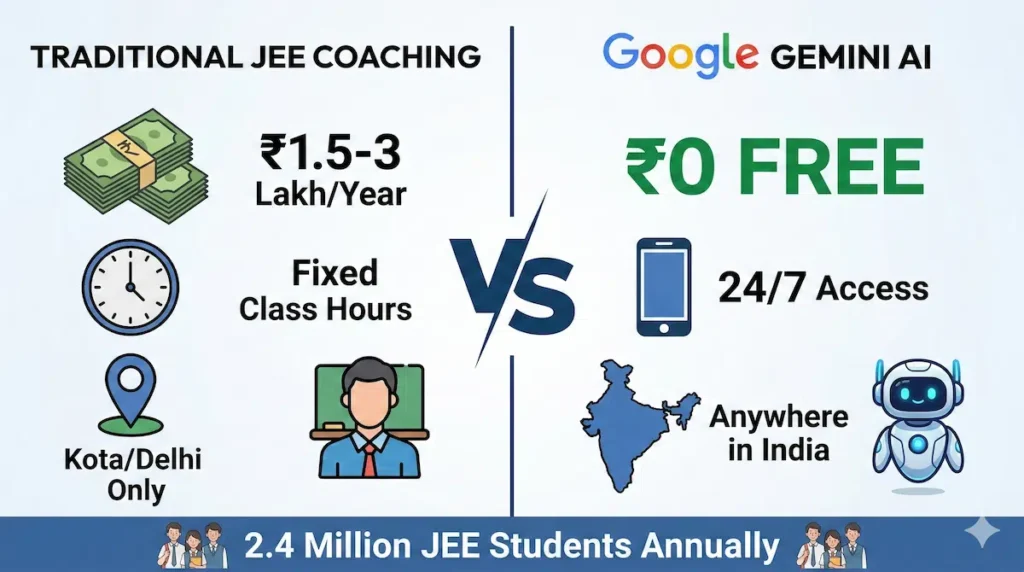
- Google launched free JEE Main mock tests in Gemini (January 28, 2026) via partnerships with Physics Wallah and Careers360—offering 2.4 million annual JEE aspirants what legacy coaching institutes charge ₹1.5-3 lakh for
- Physics Wallah’s strategic partnership signals defensive positioning against Google’s 1 billion+ Android distribution advantage and Gemini 2.0’s AI capabilities
- The hybrid future is certain: AI excels at instant feedback and personalized weak-area targeting but cannot replicate human mentorship, peer pressure, or the disciplined “Kota ecosystem” that produces top rankers
On January 28, 2026, Google didn’t just launch another AI feature. It declared war on India’s ₹58,000 crore test-preparation coaching industry.
The weapon? Free, AI-powered JEE Main mock tests embedded directly inside Gemini—Google’s conversational AI assistant that already sits in the pockets of over a billion Indian smartphone users.
The ammunition? Vetted content partnerships with Physics Wallah and Careers360, two giants in India’s competitive exam ecosystem.
The target? The 2.4 million students who appear annually for JEE Main, desperately seeking admission to IITs and NITs—students whose families collectively spend thousands of crores on coaching institutes concentrated in Kota, Delhi, Hyderabad, and dozens of tier-2 cities.
This isn’t incremental innovation. This is Google positioning AI as the ultimate democratizer of elite education—and potentially the executioner of traditional coaching’s business model.
The Direct Attack on Kota’s Coaching Empire
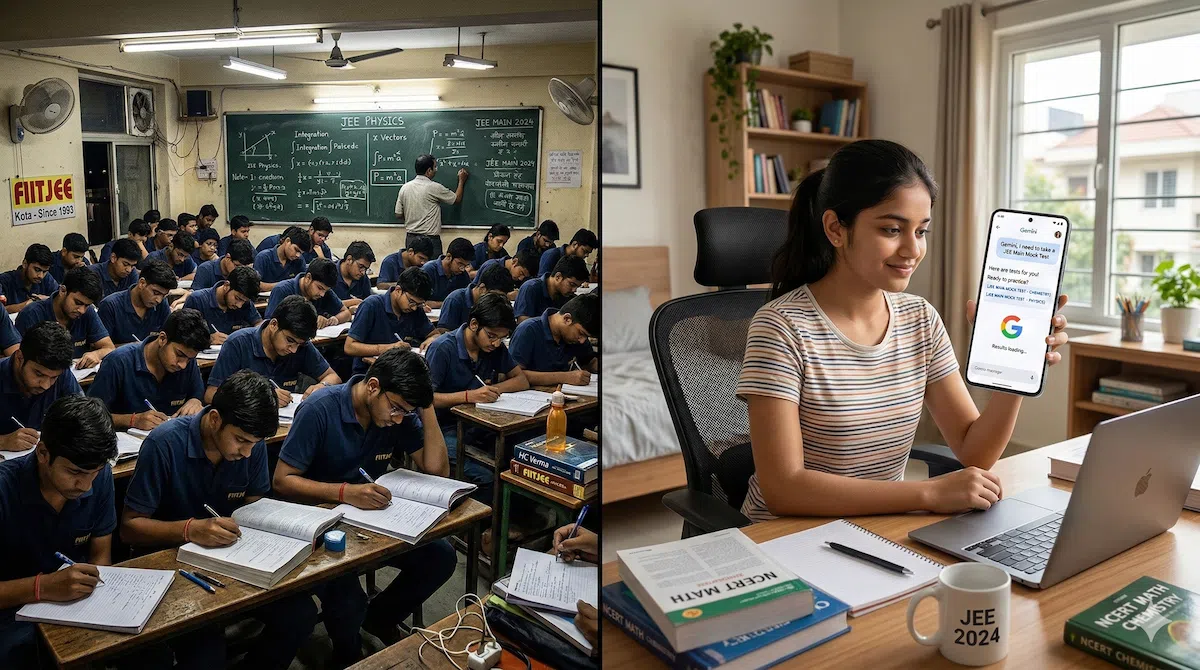
Walk into any ALLEN, Resonance, or Vibrant Academy classroom in Kota, Rajasthan—India’s undisputed coaching capital—and you’ll find students paying anywhere between ₹1.5 lakh to ₹3 lakh annually for structured JEE preparation.
What do they get for that money? Mock tests modeled on the National Testing Agency (NTA) exam pattern. Immediate performance analysis. Personalized study plans identifying weak topics. Access to expert-vetted question banks covering Physics, Chemistry, and Mathematics.
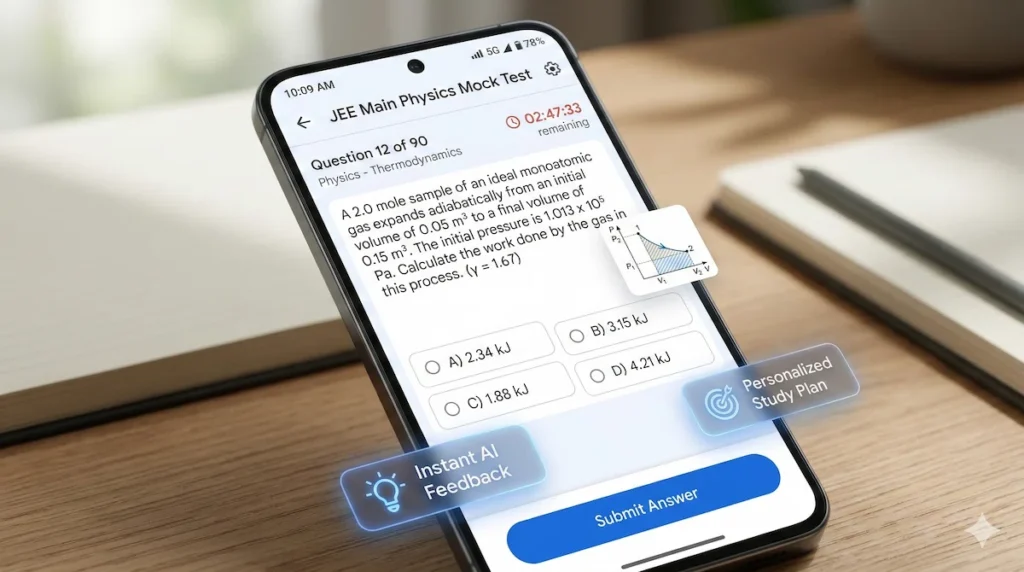
Now, as of February 2026, any student with a smartphone can type “I want to take a JEE Main mock test” into Gemini and receive exactly that—for free.
Google’s free AI JEE coaching via Gemini includes:
- Full-length mock exams mirroring the latest NTA patterns
- Instant AI feedback highlighting strengths and knowledge gaps
- Correct answer explanations with step-by-step breakdowns
- Customized 30-day study plans adapting to individual performance
- Canvas tool integration for building interactive study guides from personal class notes
- Availability in multiple Indian languages, 24/7 access
The brutal economics are impossible to ignore. India’s coaching industry, valued at $6.5 billion (₹54,000 crore) in 2024 and projected to hit $17.4 billion by 2033 according to IMARC Group research, has thrived on scarcity—limited access to quality teaching, expensive mock test series, and geographic concentration in coaching hubs.
Google Gemini for students obliterates that scarcity overnight.
A Physics Wallah two-year JEE program costs around ₹1.6 lakh. ALLEN’s classroom program runs ₹2.5-3 lakh. Smaller local institutes charge ₹80,000-1.2 lakh. These fees cover infrastructure, faculty salaries, printed materials—and yes, mock test series.
Google is offering the core product—AI test preparation India—at zero marginal cost.
The company isn’t even charging students. It’s not monetizing through ads plastered across mock exams. This is pure platform play: embed Gemini into the daily academic routine of millions of Indian students, making Google’s AI ecosystem indispensable before they even enter college.
Physics Wallah’s Calculated Gambit: Partnership or Survival?
The most revealing aspect of Google’s JEE launch isn’t the technology—it’s the partnership roster.
Alakh Pandey’s Physics Wallah, the EdTech unicorn that disrupted India’s coaching oligopoly by offering affordable online courses, chose to collaborate with Google rather than compete.
Why would an EdTech giant built on democratizing education partner with the very company threatening to make paid coaching obsolete?
The strategic calculus breaks down into three possibilities:
Scenario 1: Integration Play
Physics Wallah gains access to Google’s cutting-edge Gemini 2.0 Flash model and distribution infrastructure (1 billion+ Android users in India). In exchange, Google gets Physics Wallah’s meticulously curated JEE question banks and pedagogical expertise. This is symbiotic—Physics Wallah becomes the “official” content provider for Google AI vs coaching institutes comparison, lending credibility while maintaining brand presence.
Scenario 2: Defensive Positioning
Alakh Pandey recognized an existential threat. If Google entered independently, Physics Wallah—already competing with free YouTube content and pirated courses—would face an adversary with infinite resources and unmatched distribution. Better to be inside the tent than outside. The partnership ensures Physics Wallah’s content remains visible to millions of students using Gemini education India tools.
Scenario 3: Long-Term Customer Acquisition
Free mock tests in Gemini become the top-of-funnel marketing. Students experience Physics Wallah’s question quality, then upgrade to paid full-length courses, doubt-clearing sessions, and mentorship programs that AI cannot provide. Google handles acquisition; Physics Wallah handles conversion.
What this signals for the broader Indian EdTech landscape is stark.
Unacademy, Vedantu, Toppr—all struggled post-pandemic as students returned to physical classrooms and investor funding dried up. Byju’s spectacular implosion left a vacuum.
Physics Wallah survived by focusing on affordability and outcomes. Now, it’s hedging against an even bigger disruptor: free AI coaching that doesn’t need venture capital, doesn’t burn cash on marketing, and scales infinitely without hiring teachers.
For legacy coaching institutes—ALLEN, Resonance, Aakash—the Google Gemini JEE partnership exclusion is ominous. They’re stuck defending a high-cost, infrastructure-heavy model against an adversary offering comparable core services at zero price.
The EdTech industry’s phase one was “offline to online.” Phase two is “human teachers to AI agents.” And Google just accelerated that transition.
The Hybrid Future: AI Can’t Replace Everything… Yet
Before declaring coaching institutes extinct, consider what Gemini cannot do—at least not in 2026.
AI JEE coaching excels at:
- Delivering unlimited practice without fatigue
- Providing instant, judgment-free feedback on every answer
- Identifying weak topics through algorithmic pattern recognition
- Personalizing study intensity based on performance data
- Offering 24/7 availability, eliminating wait times for doubt resolution
AI JEE coaching fundamentally lacks:
- Human motivation during burnout: A JEE aspirant studies 10-14 hours daily for two years. When a student hits emotional rock bottom at 2 AM after failing their fifth consecutive mock test, an AI chatbot cannot provide the existential reassurance a mentor can.
- Peer pressure and competitive benchmarking: Kota’s ecosystem thrives on peer competition. Sitting in a classroom with 100 other brilliant students creates urgency. JEE mock tests AI generate individual scores, but they cannot replicate the psychological pressure of ranking 47th out of 50 in a weekend test series—a pressure that often drives students to improve.
- Discipline enforcement: Coaching institutes impose structure—mandatory attendance, fixed schedules, supervised study halls. A student using free JEE coaching AI at home faces infinite distractions: social media, family interruptions, the temptation to quit when things get hard.
- The “Kota effect”: Kota isn’t just about teaching. It’s about removing students from their comfort zones, placing them in a high-pressure academic bubble where every conversation, every meal, every waking moment revolves around JEE. That immersive environment is irreplicable via smartphone app.
Early adoption data from EdTech platforms shows a pattern: top performers use AI as supplementary tools, not primary resources. They attend physical or live online coaching for structure and mentorship, then use Google Gemini for students during off-hours to drill weak areas.
Marginal students—those scoring 40-60 percentile—often treat free AI tools as complete substitutes, avoiding costly coaching fees. But these same students frequently lack the self-discipline to sustain preparation without external accountability.
The future, therefore, isn’t “AI replaces coaching.” It’s “coaching redefines value proposition.”
Institutes that survive will be those offering what AI disrupting Indian coaching industry cannot: emotional scaffolding, enforced discipline, physical peer networks, and the intangible confidence boost of learning alongside India’s brightest minds.
The institutes that die will be those selling only what Google now offers for free: mock tests and answer explanations.
The Market Impact in India: A Trojan Horse Strategy
Google’s JEE play isn’t about conquering the ₹58,000 crore coaching market by extracting tuition fees. It’s about something far more valuable: embedding Gemini into the academic DNA of 100 million+ Indian students.
Consider the expansion roadmap Google has already confirmed:
- NEET medical entrance exam (2+ million annual test-takers)
- CAT management entrance (2.5 lakh+ MBA aspirants)
- UGC-NET doctoral studies exam
- UPSC civil services (India’s most prestigious and competitive exam series)
Add state board exams, CBSE board prep, IELTS/TOEFL for study-abroad aspirants, and banking/SSC exams for government job seekers. You’re looking at 50-100 million Indian students who could become daily Gemini users.
The monetization isn’t direct—it’s ecosystem lock-in:
- Students using Gemini for JEE 2026 preparation today become Google Workspace subscribers in college
- They default to Google Cloud services when building startups
- They purchase Android devices because Gemini integration is seamless
- They remain within Google’s advertising ecosystem for life
Google isn’t disrupting Indian test-prep. It’s colonizing India’s education-to-employment pipeline.
The ₹58,000 crore coaching industry revenue is a rounding error compared to Google’s $307 billion annual revenue. What Google wants is user acquisition at the most formative academic stage—locking in brand loyalty before students even choose career paths.
For Indian policymakers, this raises critical questions:
Is India comfortable with a foreign big-tech corporation becoming the default academic infrastructure for its youth? The government’s ₹85 crore ($10 million) Wadhwani AI partnership and “AI-enabled university” pilot with Chaudhary Charan Singh University suggest official enthusiasm for AI test preparation India adoption. But long-term digital sovereignty concerns remain.
For Indian EdTech startups and coaching institutes, the strategic options narrow:
- Verticalize: Focus on niche exams (CLAT for law, NIFT for design) where Google hasn’t yet built content partnerships
- Premiumize: Offer ultra-personalized, high-touch mentorship and mental wellness programs that AI cannot commoditize
- Integrate: Become Google’s content partners like Physics Wallah, sacrificing independence for survival
- Exit: Sell to larger players consolidating against the Google threat
The coaching institutes that will become obsolete by 2028 are those clinging to the old model: expensive infrastructure, generic teaching, mock tests as the primary value proposition, and zero technological differentiation.
The institutes that thrive will be those that recognize a fundamental truth: in the age of free AI, the only education worth paying for is the education that cannot be automated.
FAQs
Is Google Gemini JEE preparation completely free?
Yes. As of February 2026, Google Gemini offers full-length JEE Main mock tests, instant AI feedback, personalized study plans, and Canvas-based study tools at zero cost. Students only need a Google account and internet access. There are no hidden fees, subscription charges, or premium tiers for JEE-specific features.
Can Google Gemini replace traditional JEE coaching institutes?
Not entirely. While Gemini excels at unlimited practice, instant feedback, and personalized weak-area targeting, it cannot replicate human mentorship, enforced discipline, peer competition, or the immersive “Kota ecosystem” that drives top rankers. AI is best used as a supplementary tool alongside structured coaching, not as a complete replacement—especially for students who lack self-discipline.
Which other exams will Google Gemini support in India?
Google has confirmed plans to expand AI test preparation to NEET (medical entrance), CAT (management entrance), UGC-NET (doctoral studies), and UPSC (civil services). The company is also exploring state board exams, CBSE preparation, and study-abroad tests like IELTS and TOEFL, potentially reaching 50-100 million Indian students across all exam categories by 2027.
Why did Physics Wallah partner with Google instead of competing?
Physics Wallah likely recognized that competing against Google’s 1 billion+ Android user distribution and infinite AI compute resources would be futile. The partnership allows Physics Wallah to position itself as the “official” content provider for Gemini’s JEE tools, maintaining brand visibility while leveraging Google’s technology. It’s a defensive play that keeps Physics Wallah relevant as AI disrupts traditional coaching models.