

Walk into any broker’s office in Gurugram, Bengaluru, or Pune today and you’ll notice something that wasn’t there three years ago: nobody’s flipping through a printed rate card to price a flat anymore. A model does it in seconds. The photos on the listing weren’t shot with a stager’s furniture truck either — they were generated. This is AI in Indian real estate in 2026: not a future promise, but a working layer quietly sitting underneath India’s property search, pricing, and marketing stack.
This is not another “AI will transform everything” think-piece. It’s a grounded look at three things actually happening right now in Indian PropTech — automated valuation, AI virtual staging, and the broader tooling stack around them — who’s building it, what the real numbers say, and where the technology still can’t be trusted.
Why AI in Indian Real Estate Is Growing Faster Than the Rest of PropTech
India’s broader property-technology market is not a niche experiment anymore. Independent market research pegs the India PropTech market at roughly USD 1.72 billion in 2025, projected to reach nearly USD 6 billion by 2032 — a compound annual growth rate of about 19.5%. Software-based products, rather than services, account for the bulk of that market, roughly 72% by one estimate, largely because India’s real estate scale and fragmented, paper-heavy record-keeping favor repeatable, automated tools over manpower-heavy execution.
That last point matters more in India than almost anywhere else. Indian real estate has three structural problems that Western PropTech doesn’t deal with at the same scale: inconsistent circle-rate data, huge informal-market pricing gaps between tier-1 metros and tier-2/3 cities, and property records split across state-level registries with wildly different digitization levels. AI doesn’t fix these problems outright — but it’s the first technology layer capable of working around them at scale, which is exactly why valuation and staging tools have become the leading edge of adoption rather than a side feature.
AI Property Valuation in India: Inside the Automated Valuation Model (AVM)
An Automated Valuation Model, or AVM, is the engine behind “instant price estimate” features you now see on Indian property portals. Instead of a broker manually comparing five recent sales and eyeballing a number, an AVM ingests registered transaction data, locality-level price trends, rental yield patterns, and infrastructure signals (a new metro line, an upcoming expressway) to output a price estimate in real time.
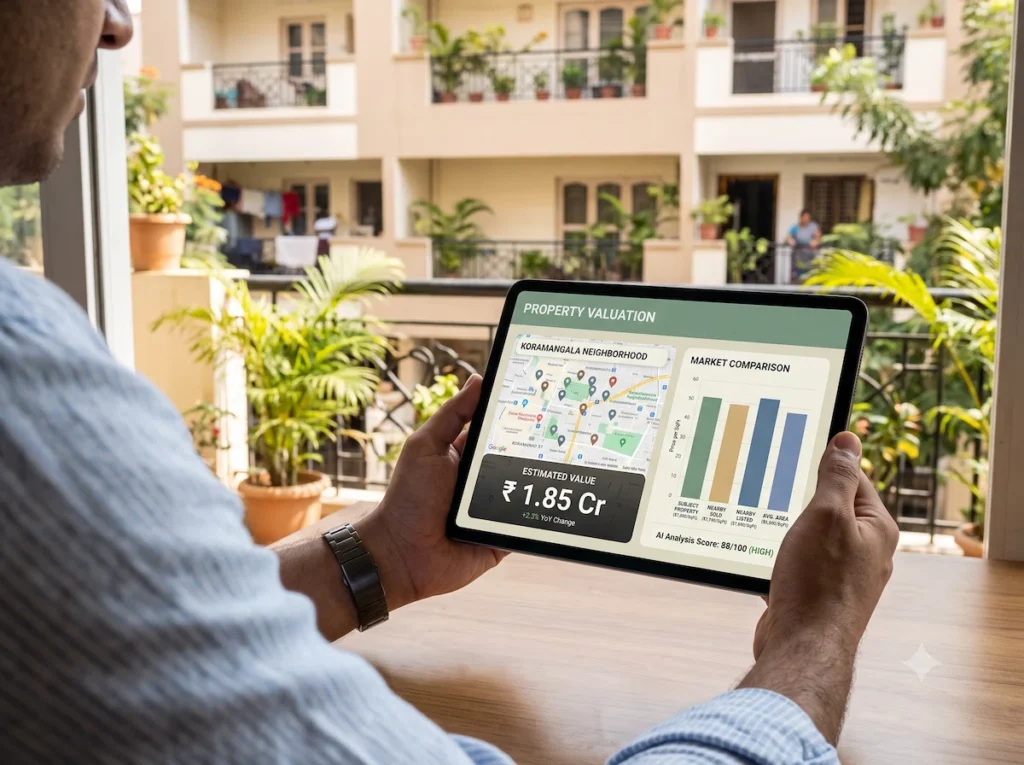
A few concrete examples of this working in the Indian market:
AI in Indian PropTech — who’s building it
Square Yards
Valuation & IP
Has disclosed filing multiple international patents covering AI, VR, and data analytics — underpinning its virtual tours, predictive pricing, and transaction-intelligence tools. One of the more IP-serious players in Indian PropTech.
Sigmavalue
AVM & Feasibility
An India-focused intelligence company built around a dedicated AVM valuation engine, a geospatial feasibility simulator, and a domain assistant called PropGPT — aimed at pricing and development decisions, not consumer browsing.
Housing.com
Portal & Pricing
Has layered predictive-pricing features on top of its listing search, moving valuation from a static “recently viewed comparable” list toward a continuously updated estimate.
Where AVMs genuinely help: speed and consistency. A lender or bulk investor evaluating dozens of properties can get a first-pass valuation in minutes instead of commissioning individual appraisals. A global pattern documented across valuation-technology patent filings shows this shift from occasional, expensive desk appraisals toward continuous, always-on estimation — the same shift is now visible in the Indian filings landscape, with several India-based institutions and firms filing valuation-technology patents between 2023 and 2026.
Where they still struggle, specifically in India: thin comparable data in smaller cities, undocumented or partially-informal transaction pricing that never enters official registries, and properties that don’t fit a standard template (heritage structures, agricultural-to-residential conversions, disputed-title land). Global valuation-technology practice — and this holds in India too — treats AVMs as a complement to a human valuer, not a replacement, precisely because of these edge cases.
Virtual Staging in India: From Empty Flat to Sold Listing in Under a Minute
Virtual staging is the more visible, more viral side of this trend — and it’s growing fast. The broader Asia-Pacific virtual-staging-for-real-estate market was valued at roughly USD 600 million in 2024 and is projected to more than double by the early 2030s, with India specifically flagged as one of the region’s fastest-adopting markets, driven by urbanization, rising middle-class housing demand, and expanding developer pipelines.
The mechanics are simple and that’s exactly why adoption has been so quick: a broker or developer uploads a photo of an empty room, and AI-driven rendering tools digitally remove clutter or existing furniture, then insert photorealistic furnishings, lighting, and décor — often in under a minute, at a fraction of the cost of physically renting and moving furniture for a staged shoot. Global tools like Paintit.ai and ApplyDesign have built exactly this workflow, and Indian-focused platforms such as RealEstateIndia.ai now bundle virtual staging together with AI valuations and even Vastu-compliance reports — a distinctly local product decision that shows how these tools are being localized rather than just imported wholesale.
For NRI buyers and remote investors — a genuinely large segment of the Indian property market — this matters beyond aesthetics. A well-staged, high-resolution virtual listing lets a buyer in Dubai or California evaluate a Pune or Hyderabad flat without a site visit, compressing a decision cycle that used to take weeks of coordinated travel into a single video call.
Beyond Valuation and Staging: The Rest of the India PropTech AI Stack
Valuation and staging get the headlines, but they sit inside a wider stack that’s arguably more mature in day-to-day usage:
The rest of the AI stack
Lead qualification and chatbots
Multilingual WhatsApp-based bots now handle first-round property queries, appointment scheduling, and lead scoring for brokers — turning what used to be slow phone-based triage into always-on conversion funnels.
Document verification and fraud detection
OCR and NLP pipelines increasingly parse title deeds, encumbrance certificates, and legacy state-registry records to flag mismatched names or inconsistent ownership chains before a deal proceeds — a meaningful risk-reduction layer given how often Indian property disputes trace back to unclear title history.
Predictive maintenance for commercial and residential complexes
IoT sensors paired with AI analytics are being piloted in office parks and large residential complexes to catch equipment failures before tenants notice them, and to optimize energy usage across common areas.
None of these individually make headlines the way a “15-second AI staging” demo does, but together they represent where PropTech AI spend in India is actually concentrated.
Reality Check: Where AI in Indian Real Estate Still Falls Short
This is the section most vendor blogs skip, and it’s the one worth taking seriously before you trust an AI-generated number or image:
AVM accuracy degrades outside well-documented micro-markets
A price estimate for a flat in a data-rich Gurugram sector is a very different confidence level than one for a plot in a tier-3 town with sparse registered transactions.
Virtual staging can mislead buyers about scale and finish quality
A digitally staged photo can make a room look larger or better-finished than it is in person — a problem serious enough that some markets have started pushing for mandatory “virtually staged” disclosure labels, and Indian buyers should expect similar scrutiny as adoption grows.
Data quality and governance remain the biggest blocker to scaling any of this
Industry surveys on AI adoption in Indian enterprises repeatedly flag poor data quality and weak governance as bigger obstacles than the AI models themselves — the technology is frequently ahead of the underlying data infrastructure it depends on.
Regulatory clarity is still developing
India’s evolving IT rules around synthetically generated content (aimed initially at deepfakes) don’t yet explicitly address AI-staged property photos, but the direction of travel — mandatory labeling of AI-modified media — suggests PropTech platforms should get ahead of disclosure norms rather than wait for enforcement.
None of this means the technology isn’t useful. It means “AI-verified” and “AI-generated” are not the same as “ground-truth accurate,” and that distinction matters most in a market where a single mispriced deal or misleading listing photo involves real money and, often, a family’s largest asset.
Who’s Building This: Companies to Watch
| Company | Focus | What’s distinctive |
|---|---|---|
| Square Yards | Valuation, virtual tours, transaction data | Multiple disclosed international AI/VR patent filings |
| Sigmavalue | AVM + geospatial feasibility + PropGPT | India-first, purpose-built for pricing and development decisions |
| Housing.com | Listings + predictive pricing | Large-scale consumer data feeding valuation models |
| RealEstateIndia.ai | Staging + valuation + Vastu reports | Localized product bundling not seen in global tools |
| NoBroker | Brokerless listings + AI-driven WhatsApp lead workflows | High-volume conversational AI adoption in lead handling |
What This Means If You’re a Developer or Founder
If you’re building in this space rather than just buying property, three things are worth knowing:
The valuation-model opportunity in India is a data problem before it’s a modeling problem. The hardest part of building a credible Indian AVM isn’t the ML architecture — it’s assembling clean, licensed access to registered transaction data across fragmented state registries.
Virtual staging is close to commoditized at the consumer-photo level, but there’s still real room in India-specific compliance features — Vastu overlays, RERA-linked disclosure labeling, and regional furnishing-style presets that global tools don’t localize well.
The biggest unclaimed layer is document verification and title-risk scoring. Given how much Indian real estate litigation traces back to unclear title chains, an AI tool that can reliably flag risk before a deal closes has a much clearer path to enterprise (bank, NBFC, developer) revenue than another consumer valuation widget.
Frequently Asked Questions
Does AI actually replace real estate agents in India?
No — current tools augment brokers by handling valuation estimates, lead scoring, and first-line customer queries, not full transaction negotiation, which still requires human judgment and local trust relationships.
How accurate are AI property valuation tools in India?
They’re strongest in data-rich urban micro-markets with plenty of registered transactions, and weakest in tier-2/3 cities or for non-standard properties — treat any AVM output as a starting estimate, not a final number.
Is AI virtual staging legal or does it need to be disclosed in India?
There’s no India-specific law mandating disclosure of virtually staged property photos yet, but given the direction of the country’s synthetic-media rules for other content categories, platforms adopting clear labeling now are ahead of likely future requirements.
Which Indian companies are leading in AI-powered PropTech?
Square Yards, Sigmavalue, Housing.com, RealEstateIndia.ai, and NoBroker are among the more visibly AI-invested platforms as of 2026, spanning valuation, staging, and lead-generation use cases respectively.
Article by the aitechnews.in editorial team. Facts verified against primary market research and company disclosures as of July 24, 2026. Have a correction? Reach out via our contact page.