
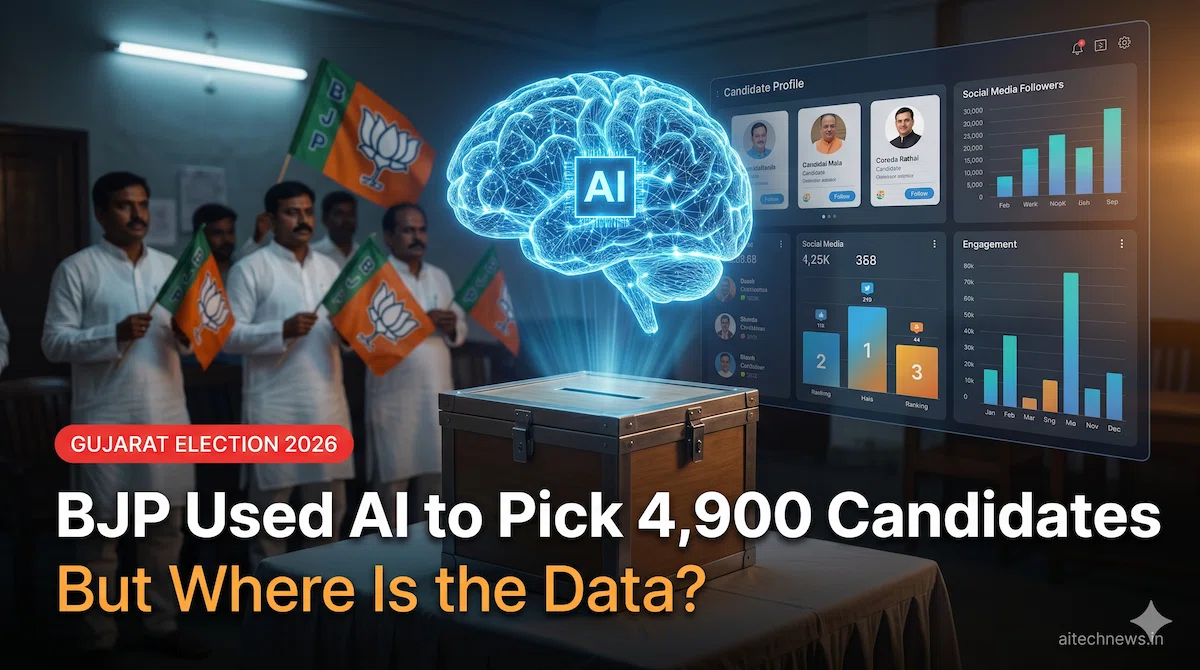
The BJP deployed an AI system to rank 4,900+ aspirants in Surat and Vadodara. As counting proceeds today, the bigger story isn’t who won — it’s what the party refuses to disclose about how the algorithm decided.
When the BJP quietly deployed an AI screening system for Gujarat’s municipal elections, party functionaries called it a revolution in candidate selection. On the morning of April 28, as vote-counting begins across 9,262 civic seats, the revolution’s results remain stubbornly classified.
The AI system — used for the first time in Indian electoral history at this scale — ranked aspirants across Surat’s 30 wards and Vadodara’s 19 wards. Its output guided, or at minimum informed, decisions on who received a ticket. Yet no list of AI rankings has been made public. No audit trail exists. And no official correlation between what the algorithm recommended and who actually won has been released.
India ran an AI election experiment and declined to tell anyone how it went.
How the system actually worked
The process began on April 5, when The Indian Express reported that the Gujarat BJP was using proprietary software to generate what a senior party leader described as “positive and negative images” of each candidate. Aspirants submitted forms that fed into the system alongside publicly available data.
The party was careful to frame AI as an “indicator” rather than a decision-maker. A senior BJP functionary told reporters that leadership retained the authority to field candidates who had not even submitted nomination forms in certain seats. In other words: the algorithm could be — and likely was — overridden.
“The AI-generated information is only an indicator to gauge the activities and popularity of the candidate. The final decision on handing out tickets will of course rest with the top leaders.”
What the AI actually measured
The inputs the system analyzed reveal something important about how political parties are beginning to think about electability in 2026. Traditional markers of political value — years of grassroots service, community relationships, seniority — were folded into the same scoring matrix as Instagram Reel views.
The implicit hierarchy matters. A veteran BJP worker from Surat — two decades in the party — reportedly told journalists he feared the model would penalise him for a limited social media footprint.
“I am not very accustomed to social media contacts and performance. I have been a ground-level worker… If AI is used to select candidates, I may suffer.”
This is not an isolated anxiety. It signals a structural fault line quietly opening inside Indian political organisations — between the ground worker who spent twenty years building ward-level trust, and the newcomer with 50,000 Instagram followers and a viral Reel from last Navratri. The AI system, whatever its intentions, places both on the same scoring matrix and produces a number. The number doesn’t know the difference.
That tension — between earned political capital and measurable digital presence — is now playing out in real time across Gujarat’s counting halls. And AI is at the center of it.
His concern points to a structural bias embedded in any such system: optimising for digital visibility does not necessarily correlate with electability, governance capacity, or community trust. Whether the BJP’s algorithm accounted for this is unknown — because the algorithm itself is undisclosed.
The accountability gap
- Which candidates received the highest AI rankings in Surat and Vadodara
- How many AI-recommended candidates were actually given tickets
- How frequently top leaders overrode AI rankings
- The name or origin of the software (Indian-built? Contracted? In-house?)
- What training data the model used, and whether it was audited for bias
- Any post-election correlation between AI scores and actual vote share
This is the black-box problem applied to democratic politics. When an algorithm influences who gets to stand for public office, the minimum standard of accountability should be a disclosure of inputs, methodology, and outcomes. None of that exists here.
The irony is sharp: even as votes are counted today across Gujarat’s civic bodies, the most consequential number in this story — how many AI-ranked candidates actually won — cannot be calculated. Because no one published the ranked list.
Live counting picture — as of 11:30 AM
The party had already secured 715 seats uncontested before a single ballot was cast — a figure that reflects both organisational dominance and the limited opposition presence in Gujarat’s civic landscape.
But electoral victory, when it comes, will tell us nothing about the AI system’s performance. A BJP win in Surat is consistent with their historical strength there. Attributing it to AI screening without a controlled comparison is attribution error — exactly the kind of narrative that will nonetheless circulate if results are strong.
Why this matters beyond Gujarat
The more significant question is what happens next. Gujarat has historically been a laboratory for political innovation in India — ideas tested here often scale nationally. If this model is deemed a success (by whoever controls the definition of success), it will likely appear in 2027 assembly election cycles across multiple states.
What accountability would look like
For any future deployment of AI in candidate selection to be taken seriously as a governance tool rather than a political instrument, minimum disclosure standards are necessary. At the most basic level, that means: a post-election release of AI rankings versus ticket allocations, a public statement on how often the algorithm was overridden and why, identification of the software provider, and an independent audit of whether the model introduced systemic bias against particular candidate profiles.
None of this is technically difficult. The data exists inside the party’s systems right now. The decision not to release it is a choice — not a limitation.
The Indian Express (April 5, 2026) · News18 Gujarat (April 3–6, 2026) · The New Indian Express (April 8, 2026) · Gujarat State Election Commission — live results feed (April 28, 2026).
Disclosure: Reporting is based on verified media accounts and official results data. No AI ranking data has been independently obtained. This article will be updated if the BJP releases transparency disclosures.