
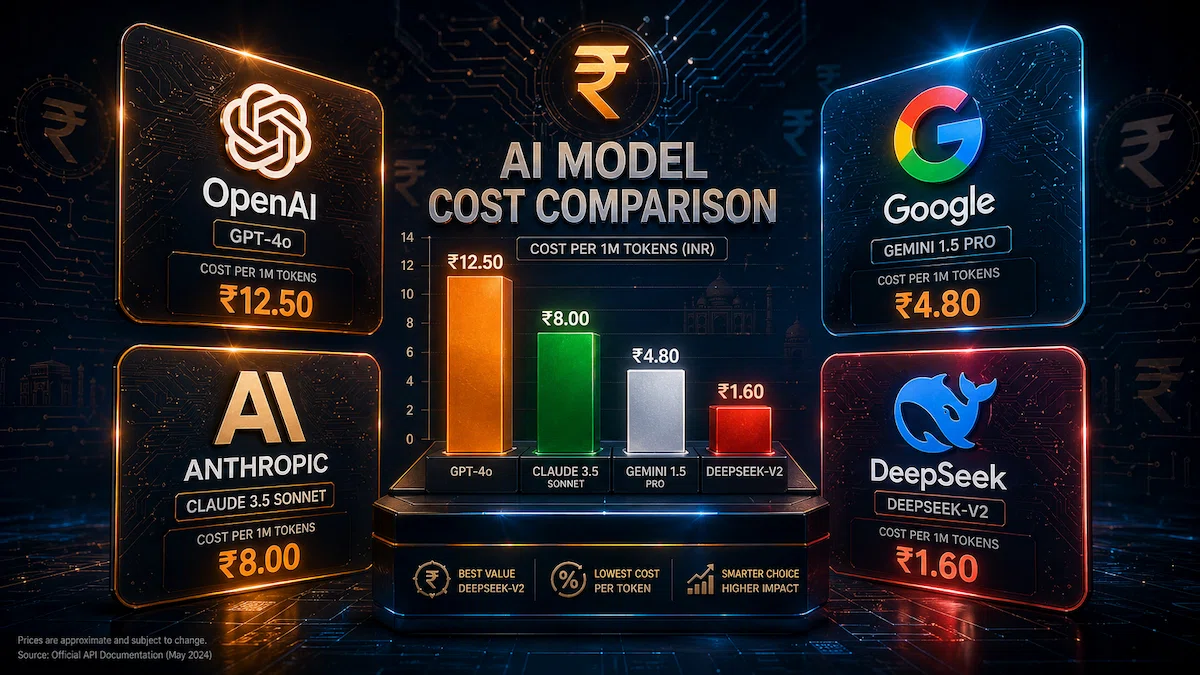
📌 Exchange Rate Notice — April 25, 2026
All rupee figures in this article are calculated at $1 = ₹94.25, the mid-market rate as of April 25, 2026 at 12:01 AM UTC (source: Morningstar via Google Finance). The dollar-rupee rate moves daily — sometimes by ₹0.50 to ₹1 in a single session. We update this article regularly, but always add a 3 to 5 percent buffer to your budget estimates. Dollar prices from AI providers do not adjust with the rupee — your rupee cost rises every time the rupee weakens.
AI API Pricing India 2026 has changed dramatically —and this guide converts every major model cost into rupees, with GST and forex fees included.
TL;DR — If You Are in a Hurry
Not everyone has time to read a full pricing guide. Here is the one-minute version.
The right model depends entirely on your workload, compliance requirements, and budget constraints. There is no single winner. The sections below help you understand the trade-offs for each.
Why AI API Pricing India 2026 Needs a Separate Guide
Most AI pricing articles list costs in dollars, assume a US credit card, and move on. For an Indian developer or startup, that picture is incomplete in three important ways.
The currency gap. You pay in dollars but earn in rupees. A model priced at $5 per million tokens is ₹471 at today’s rate — and that rate has moved from ₹83 to ₹94 within the past eighteen months. Budget in rupees, not dollars.
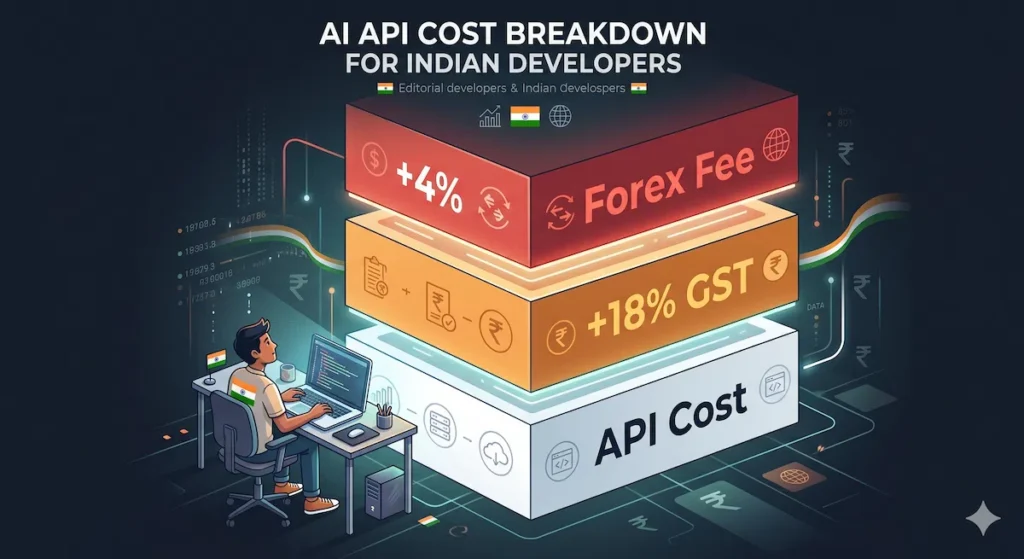
The GST layer. Indian businesses pay 18 percent GST on foreign digital services under the reverse charge mechanism — adding roughly ₹85 on every ₹471 spent. This is a real cost that no global pricing guide factors in.
The card markup. Most Indian debit cards and many credit cards add a foreign transaction fee of 3.5 to 5 percent on every international payment. This compounds quietly over months of API usage.
This guide accounts for all three.
The Complete Pricing Table in ₹ — April 25, 2026
All prices are per one million tokens. One million tokens is roughly 750,000 words — about 500 average blog posts. Dollar prices are from official provider websites. Rupee figures are at $1 = ₹94.25.
Premium Tier
| Model | Input (USD) | Output (USD) | Input (₹) | Output (₹) |
|---|---|---|---|---|
| GPT-5.5 | $5.00 | $30.00 | ~₹471 | ~₹2,827 |
| GPT-5.5 Pro | $30.00 | $180.00 | ~₹2,827 | ~₹16,965 |
| Claude Opus 4.7 | $5.00 | $25.00 | ~₹471 | ~₹2,356 |
| Gemini 3.1 Pro | $2.50 | $10.00 | ~₹236 | ~₹943 |
Mid Tier
| Model | Input (USD) | Output (USD) | Input (₹) | Output (₹) |
|---|---|---|---|---|
| Claude Sonnet 4.6 | $3.00 | $15.00 | ~₹283 | ~₹1,414 |
| GPT-5.4 | $2.50 | $15.00 | ~₹236 | ~₹1,414 |
| Grok 4.1 Fast | $0.20 | $0.50 | ~₹19 | ~₹47 |
Budget Tier
| Model | Input (USD) | Output (USD) | Input (₹) | Output (₹) |
|---|---|---|---|---|
| DeepSeek V4-Pro | $0.27 | $1.10 | ~₹25 | ~₹104 |
| DeepSeek V4-Flash | $0.10 | $0.28 | ~₹9 | ~₹26 |
| Gemini 3.1 Flash-Lite | $0.10 | $0.40 | ~₹9 | ~₹38 |
| Claude Haiku 4.5 | $0.25 | $1.25 | ~₹24 | ~₹118 |
🆓 Free and Self-Hosted
| Model | Cost | License |
|---|---|---|
| DeepSeek V4-Flash (self-hosted) | ₹0 API cost | Modified MIT |
| Llama 4 (self-hosted) | ₹0 API cost | Meta Community License |
| Gemini API Free Tier | ₹0 up to rate limits | Proprietary |
⚠️ A Note on Price Stability AI API pricing is one of the most volatile cost categories in tech right now. GPT-5.5 launched on April 23, 2026 — two days ago — and doubled its API price from GPT-5.4 overnight. In 2025 alone, OpenAI cut prices three times, Anthropic restructured its entire tier, and DeepSeek forced the entire market to reconsider its pricing floor. Treat all figures here as a starting point, not a final budget. Always verify current dollar prices on official provider pages before making any production commitment.
Real Monthly Cost Examples
Here are three realistic Indian startup scenarios at today’s rate of ₹94.25 per dollar. These are illustrative estimates — actual costs will vary based on your input-output token ratio and caching usage.
Scenario 1: Customer Support Chatbot — 10 Million Tokens Per Month
A small e-commerce startup handling approximately 5,000 daily customer queries.
| Model | Est. Total/Month | Notes |
|---|---|---|
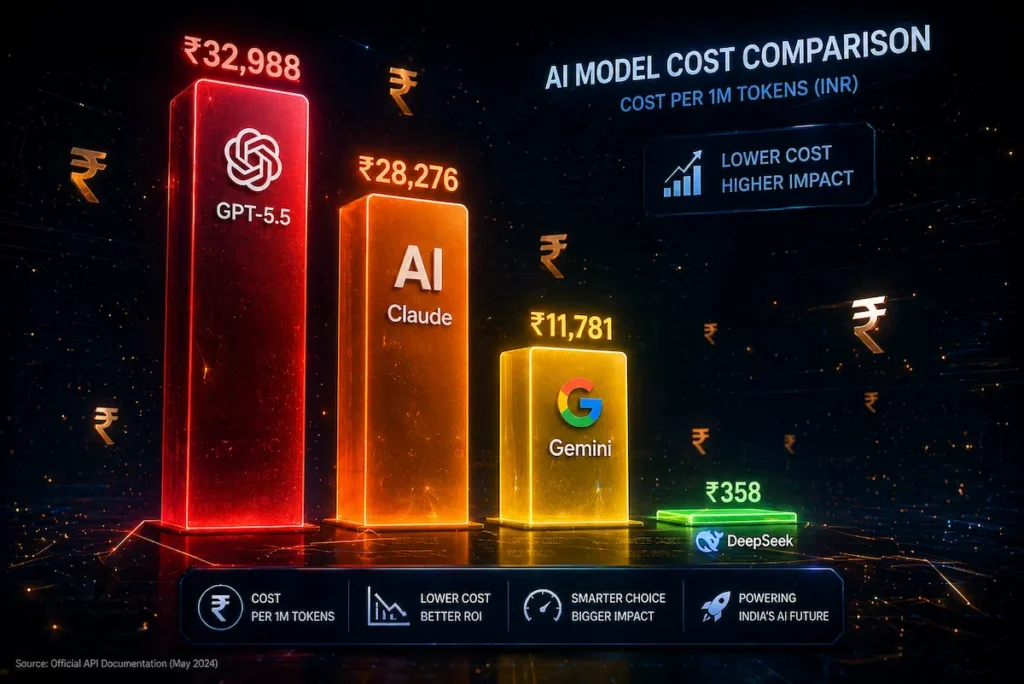
| GPT-5.5 | ~₹32,988 | Strongest agentic capability |
| Claude Opus 4.7 | ~₹28,276 | Strong long-context handling |
| Gemini 3.1 Pro | ~₹11,781 | Good balance of cost and quality |
| DeepSeek V4-Pro | ~₹1,293 | Competitive on coding; data routing through China |
| DeepSeek V4-Flash | ~₹358 | Lowest cost; suitable for simpler queries |
The gap between the most expensive and cheapest hosted option here is approximately ₹32,630 per month. Whether that gap is worth it depends entirely on the complexity of your queries and your compliance requirements.
Scenario 2: Content Generation Pipeline — 50 Million Tokens Per Month
A content agency automating blog posts, product descriptions, and social media content at scale.
| Model | Est. Total/Month |
|---|---|
| GPT-5.5 | ~₹1,64,938 |
| Claude Opus 4.7 | ~₹1,41,375 |
| Gemini 3.1 Pro | ~₹58,906 |
| DeepSeek V4-Pro | ~₹6,464 |
| Gemini 3.1 Flash-Lite | ~₹2,356 |
At this volume, model selection becomes a business and compliance decision as much as a technical one. For straightforward content tasks, a mid-tier or budget model may deliver acceptable quality at a fraction of the cost. For nuanced, high-stakes content, a premium model may justify the spend. The only way to know is to run your specific workload through multiple models and compare outputs — not just benchmarks.
Scenario 3: Coding Assistant — 5 Million Tokens Per Month
A small development team using AI for code review, debugging, and documentation.
| Model | Est. Total/Month | Codeforces Score |
|---|---|---|
| GPT-5.5 | ~₹16,494 | 3168 |
| Claude Opus 4.7 | ~₹14,138 | Not published |
| DeepSeek V4-Pro | ~₹647 | 3206 🏆 |
| DeepSeek V4-Flash | ~₹179 | 3052 |
For coding workloads specifically, DeepSeek V4-Pro scores competitively on benchmarks at a significantly lower price point. However, benchmark performance on Codeforces does not always translate directly to your specific codebase or workflow. Testing on your actual use case before committing to any model is strongly recommended.
The Hidden 18 Percent: GST on AI APIs
This is the section most Indian developers encounter the hard way — often when their CA raises a compliance question months into using a service.
When an Indian business purchases AI API services from a foreign company like OpenAI, Anthropic, or Google, GST at 18 percent applies under the reverse charge mechanism. This means the Indian buyer is responsible for calculating and depositing this tax — not the foreign company.
Practically speaking, if you spend ₹10,000 per month on API calls, you owe ₹1,800 in GST to the government. If your business is GST-registered and the API is used for business purposes, you can claim this as Input Tax Credit — making the transaction largely tax-neutral. If you are an unregistered individual developer or early-stage startup, that 18 percent is a real additional cost with no recovery mechanism.
One point that confuses many developers: OpenAI removes the GST line from your invoice when you add a valid Indian GST number to your account. This does not eliminate your liability — it means OpenAI is treating the transaction as B2B, and the responsibility for depositing the tax shifts to you under reverse charge.
If you are spending more than ₹20,000 per month on AI APIs, a conversation with a CA about GST registration is worth the time. The compliance overhead is manageable, and the ITC benefit compounds at any meaningful scale of usage.
The Foreign Transaction Fee Trap
Most Indian credit cards and almost all debit cards charge a foreign transaction fee of 3.5 to 5 percent on international payments, plus 18 percent GST on that fee.
On a ₹10,000 API bill, that works out to roughly ₹413 in extra charges. Over a year at ₹10,000 per month, that is approximately ₹5,000 lost to bank fees alone — before factoring in exchange rate movement.
Zero forex markup cards such as Niyo Global, Fi Money’s forex card, and IDFC First WOW eliminate this markup by processing international payments at the interbank rate. These are increasingly common among Indian developers who run regular API workloads. They are worth considering if your monthly API spend is consistent.
Understanding the Trade-offs: An Honest Model Guide
Rather than declaring any model the best, here is an honest summary of what each tier offers and where it falls short.
Premium Models — GPT-5.5 and Claude Opus 4.7 (₹471/million input)
These make sense when output quality directly affects revenue or reputation — legal document analysis, high-stakes customer interactions, complex research tasks, or agentic workflows that need to complete multi-step jobs reliably. At ₹471/million input, they are hard to justify for repetitive or high-volume tasks where a mid-tier model produces comparable results.
GPT-5.5 leads on agentic and terminal-heavy tasks. Claude Opus 4.7 leads on long-context retrieval and coding precision. Neither is universally better — the right choice depends on your specific workload.
Mid Tier — Gemini 3.1 Pro and Claude Sonnet 4.6 (₹236–₹283/million input)
For many Indian startups, this is the practical sweet spot. Gemini 3.1 Pro at ₹236/million input offers strong reasoning, a 2 million token context window, and reliable Google Cloud infrastructure with Indian billing support. Claude Sonnet 4.6 at ₹283/million offers near-Opus quality for most everyday tasks at roughly half the Opus price.
These models are a reasonable default for teams that need consistent quality without premium-tier spend.
Budget Tier — DeepSeek V4-Pro and Gemini Flash-Lite (₹9–₹25/million input)
For cost-sensitive workloads — high-volume classification, simple generation, routing queries, customer FAQs — budget-tier models can deliver acceptable quality at a fraction of the cost. DeepSeek V4-Pro scores competitively on coding benchmarks for many use cases at ₹25/million input. Gemini Flash-Lite at ₹9/million is among the cheapest proprietary options available.
The trade-off here is not primarily about quality — it is about compliance and infrastructure. See the data privacy section below before making a production decision.
Data Privacy and Compliance — The Section That Matters for Enterprises
This deserves more than a footnote, because for many Indian enterprises it is the most important factor in model selection — more important than price or benchmark scores.
DeepSeek is a Chinese company. Its hosted API routes user data through infrastructure based in China. For Indian startups building consumer apps with non-sensitive data, this may be an acceptable trade-off given the cost advantage. For Indian enterprises handling healthcare records, financial transactions, government data, or any personally identifiable information governed by India’s Digital Personal Data Protection Act 2023, this is a significant compliance risk that requires legal evaluation before adoption.
The open-weight nature of DeepSeek V4 provides a path around this concern — the Modified MIT license allows self-hosting on Indian cloud infrastructure such as AWS Mumbai, Azure India, or Google Cloud Mumbai. Self-hosting eliminates the China data routing issue entirely, though it introduces infrastructure management overhead and upfront server costs.
OpenAI and Anthropic are US companies subject to US data laws. For Indian enterprises, this means data may be stored or processed under US jurisdiction. Both providers offer enterprise agreements with data processing terms that many Indian enterprises find acceptable. Neither currently offers data residency within India, though Google Cloud’s Vertex AI platform (for Gemini) does support data residency options in Asia-Pacific regions.
Google Cloud for Gemini API offers the most straightforward compliance path for India-based enterprises, with established data processing agreements, regional infrastructure, and an existing enterprise sales and support presence in India.
The honest summary is this: there is no perfect compliance answer. Every major provider involves some cross-border data consideration. The right choice depends on your specific data classification, your customer contracts, and your legal team’s risk assessment — not on pricing alone.
The Multi-Model Routing Approach
One practical strategy that many teams overlook is that you are not required to choose a single model for everything.
Routing different query types to different models based on complexity can reduce total API spend by 40 to 60 percent for many workloads, with minimal impact on output quality for tasks that do not genuinely require frontier-level intelligence.
A common routing pattern looks something like this. Simple, repetitive tasks — classifications, FAQs, basic summarization — go to a budget-tier model at ₹9/million tokens. Moderate complexity tasks — content generation, code completion, standard analysis — go to a mid-tier model at ₹25 to ₹283/million tokens. Genuinely difficult tasks — complex reasoning, long document analysis, high-stakes outputs — go to a premium model at ₹471/million tokens.
All major providers support the OpenAI-compatible API format, so switching between models in a routing layer typically requires a single line of code change. The infrastructure overhead is low; the cost savings can be substantial.
Payment Methods That Work in India
OpenAI API accepts Indian Visa and Mastercard credit cards reliably. Most debit cards have a higher failure rate. UPI and Rupay are not accepted.
Anthropic API has had intermittent issues with Indian cards. A virtual international card from Wise or a zero-forex markup card is the most reliable approach.
Google Cloud works well with Indian credit cards, supports Indian billing addresses, and generates GST-compliant invoices — which simplifies tax documentation considerably.
DeepSeek API accepts major international credit cards. Some Indian corporate card policies block transactions to Chinese payment processors at the bank level. Verify with your finance team before depending on this for production workloads.
For any provider where your primary card fails, Wise’s virtual card is the most consistently recommended backup in the Indian developer community. It processes at the real exchange rate and generates invoices that most Indian accountants accept.
Quick Reference Summary
| Use Case | Suggested Model | Est. Monthly Cost (10M tokens) | Key Trade-off |
|---|---|---|---|
| Solo developer / prototyping | Gemini Free Tier | ₹0 | Rate limited |
| High-volume simple tasks | Gemini Flash-Lite | ~₹471 | Lower quality ceiling |
| Coding assistant (non-enterprise) | DeepSeek V4-Pro | ~₹1,293 | China data routing |
| Customer support chatbot | DeepSeek V4-Flash | ~₹358 | China data routing |
| Content generation | Gemini 3.1 Pro | ~₹11,781 | Good balance |
| Long document analysis | Claude Opus 4.7 | ~₹28,276 | Premium cost |
| Agentic / knowledge work | GPT-5.5 | ~₹32,988 | Highest cost |
| Enterprise with compliance needs | Gemini 3.1 Pro | ~₹11,781 | Best India compliance path |
| Zero API cost (technical teams) | Self-hosted DeepSeek V4-Flash | Server cost only | Infrastructure overhead |
Closing Thoughts
The AI API market in India in 2026 looks nothing like it did eighteen months ago. The pricing floor has dropped dramatically, the number of credible options has multiplied, and the decision is no longer simply about which model scores highest on a benchmark.
For Indian developers and startups, the real decision involves four questions: What does your workload actually require in terms of quality? What are your data privacy and compliance constraints? What is your realistic monthly token volume? And what payment infrastructure do you have access to?
The answers to those four questions will point you toward the right model — or more likely, the right combination of models — more reliably than any benchmark table will.
Prices in this space move quickly. We will update this guide as they do.
FAQs
Do Indian developers pay GST on OpenAI, Anthropic, and Google AI API charges?
Yes. Indian businesses pay 18% GST under the reverse charge mechanism on all foreign AI API services. If your business is GST-registered, you can claim this back as Input Tax Credit. Unregistered individual developers cannot — making the real cost 18% higher than the listed price.
Which AI API is cheapest for Indian developers in 2026?
DeepSeek V4-Flash is the cheapest hosted option at approximately ₹9 per million input tokens. For zero cost, Gemini API free tier works up to rate limits. However, cheapest is not always best — DeepSeek routes data through China, which may not be acceptable for enterprise or sensitive data workloads.
Why does my Indian credit card fail when paying for AI APIs?
Most Indian debit cards and some credit cards are blocked for international transactions by default, or get declined by foreign payment processors. The most reliable solution is a zero forex markup card like Niyo Global or Fi Money, or a Wise virtual card — both process international payments at the interbank rate with minimal failure rate.
📌 Dollar prices sourced from official provider pages — OpenAI, Anthropic, Google AI, DeepSeek — as of April 24–25, 2026. Rupee conversions at $1 = ₹94.25 (Morningstar via Google Finance, April 25, 2026). GST guidance based on Indian OIDAR regulations and reverse charge mechanism. AI API prices change frequently — verify before making budget decisions. Last updated: April 25, 2026.
Have questions about AI API costs for your specific use case? Drop them in the comments below.