
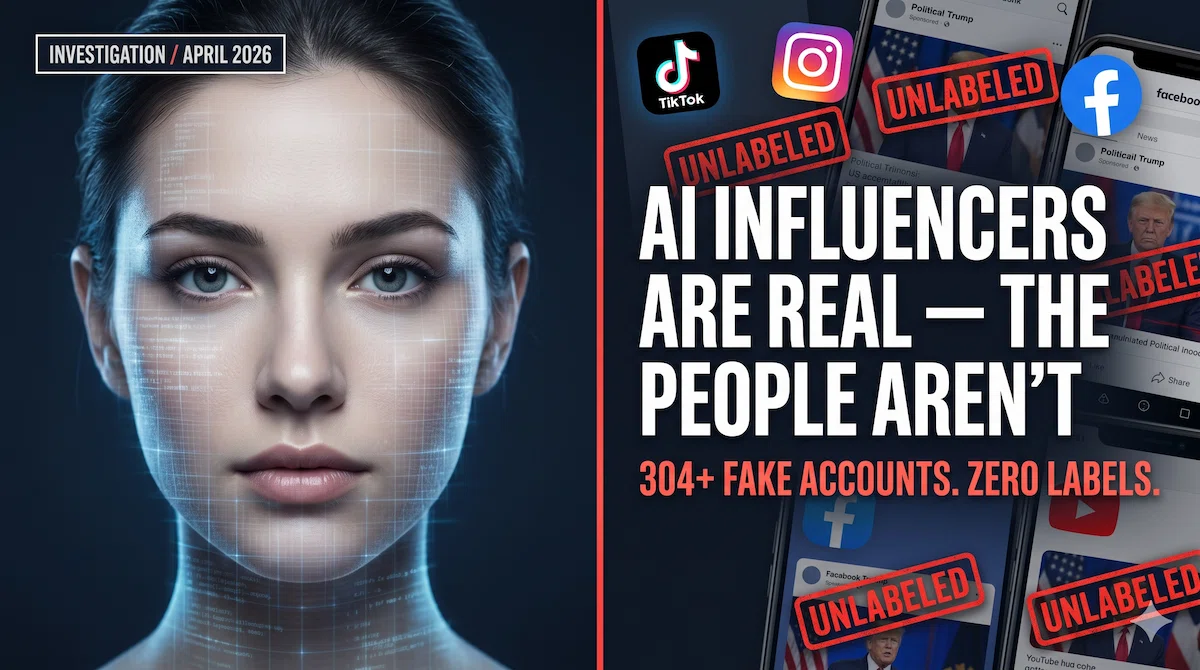
An investigation tracked hundreds of AI-generated avatar accounts across TikTok, Instagram, Facebook, and YouTube — all posting coordinated political content, none of them labeled as artificial intelligence. This is not a future threat. It is happening right now, and India needs to pay attention.
Open your phone right now. Scroll through TikTok or Instagram Reels for five minutes. There is a reasonable chance that at least one of the accounts you encounter — a good-looking young woman sharing her political opinions from inside a car, or a confident man speaking passionately to camera about national values — does not exist. Not in the sense of a bot. In the sense of a face, a voice, and a persona that was generated entirely by artificial intelligence, with no human behind it.
This is not a hypothetical from a think-tank paper. It is the finding of an ongoing investigation published by the New York Times on April 17, 2026 — and it represents one of the most significant shifts in how AI is being used to shape public opinion at scale.
This article breaks down what the investigation found, what is confirmed, what is still alleged, and why — for India in particular — this story matters more than almost anything else in AI right now.
📌 Framing Note
The core findings reported here come from investigative journalism published by the New York Times (April 17, 2026) and corroborated by researchers at Purdue University’s GRAIL lab and digital threat firm Alethea. Where findings are confirmed by multiple independent sources, we state them as such. Where they are alleged or under investigation, we use that language clearly. This story is still developing.
What the Investigation Found
The New York Times began tracking a pattern of AI-generated avatar accounts in January 2026. By April, journalists had identified at least 304 accounts across TikTok, Instagram, Facebook, and YouTube sharing coordinated political content — accounts featuring faces that do not belong to real people, voices generated by AI tools, and messaging that follows a strikingly repetitive playbook.
Researchers at Purdue University’s Governance and Responsible AI Lab (GRAIL) independently identified additional accounts across the same platforms. Digital threat mitigation firm Alethea found further accounts on YouTube. In total, the investigation covered accounts across four major platforms, all sharing similar characteristics.
304+
AI avatar accounts identified by NYT since Jan 2026
35,000+
Followers amassed by some individual accounts
500K+
Views on certain posts from these accounts
0
Accounts labeled as AI-generated content
The pattern across these accounts was consistent enough to suggest coordination: identical or near-identical captions posted across different avatar personas, the same political talking points repeated by accounts featuring visually different AI-generated faces, and a rapid posting frequency that would be unusual for a genuine individual. According to the New York Times, one account published 37 videos in the period it was monitored — beginning as a dark-haired avatar inside a car and posting continuously over several months.
Critically, none of the accounts reviewed by the newspaper or the researchers were labeled as AI-generated. On platforms where such labeling is now technically required — TikTok, for instance, implemented C2PA Content Credentials as part of its synthetic media policy — these accounts appear to have used creation methods that either bypassed detection metadata or were uploaded through workflows that did not embed it.
⚠️ What Is Not Yet Confirmed
The origin of these accounts — whether they represent a domestic content operation, a foreign influence campaign, or a commercially motivated network — has not been confirmed by the New York Times investigation or any other primary source as of this writing. The NYT noted two possibilities: a MAGA-aligned content farm, or a foreign influence operation. Neither has been verified. The investigation describes the accounts’ content and pattern. It does not conclusively identify who is behind them or their exact funding. This distinction matters. Report what is known; do not extrapolate what is not.
How These Accounts Work — The Technology Behind Them
Understanding why this phenomenon is growing requires understanding how inexpensive it has become to build a convincing AI persona at scale.
In 2026, creating a realistic AI avatar — a face, a voice, a posting persona — requires no specialized technical knowledge. Tools like HeyGen, D-ID, and Synthesia allow users to generate video of a photorealistic human speaking any script, in any language, in under thirty minutes. The generated face can be unique — never belonging to a real person — making it impossible to reverse-search or identify as stolen imagery. The voice can be cloned from a short audio sample or generated entirely from scratch.
An AI expert quoted by the New York Times described the goal of these kinds of operations plainly: to “give an illusion of consensus” and create “a false sense of a majority opinion.” When dozens of apparently different, apparently real people are all independently saying the same thing, social proof kicks in. Viewers who see many “ordinary people” expressing the same view are more likely to believe it reflects genuine public sentiment.
Why Detection Is Genuinely Hard
Platforms are not ignoring this problem. TikTok, for instance, has now labeled over 1.3 billion AI-generated videos using C2PA Content Credentials, watermarking, and its own detection models. Meta has implemented “Made with AI” labeling for synthetic content on Instagram and Facebook. The tools exist. But they have real limitations:
- Detection accuracy for high-quality AI voice cloning sits at roughly 40–50%, according to TikTok’s own published data — meaning more than half of sophisticated voice-generated content may not be caught automatically.
- C2PA metadata — the digital fingerprint that identifies AI-generated content — can be stripped when video is re-encoded, re-uploaded, or edited through third-party software, making cross-platform detection unreliable.
- Accounts that use AI generation tools which do not embed C2PA credentials — a growing category — produce content with no embedded metadata to detect at all.
The result is a detection gap that sophisticated operations can exploit. Platforms have policies. They have tools. The tools are imperfect, and the people running these operations know exactly where the gaps are.
This Is Not Isolated — A Global Pattern
The investigation in the United States is a high-profile example of a pattern that has been documented across multiple countries and political contexts. It would be a mistake to treat this as a US-specific problem.
| Country / Context | What Was Found | Source |
|---|---|---|
| United States (2026) | 304+ AI avatar accounts tracked by NYT on TikTok, Instagram, Facebook, YouTube pushing coordinated political messaging. No accounts labeled as AI. | New York Times, April 2026 |
| Hungary (2026) | Network of 34 anonymous TikTok accounts using AI-generated videos — including talking animals delivering political attacks — to influence the April 2026 parliamentary election. Approximately 10 million views. TikTok confirmed it was a covert influence operation. | NewsGuard, March 2026 |
| Poland (2025–2026) | AI-generated TikTok channels featuring fictitious young women advocating Polexit, targeting 15–25-year-olds. Nearly 200,000 views, 20,000+ likes. Polish fact-checkers confirmed faces were entirely generated. | Konkret 24 / Polish Radio, December 2025 |
| India (2024) | AI-cloned voices of political leaders used in campaigns. Deepfake videos of Bollywood actors appearing to criticize PM Modi circulated by opposition. ECI issued advisory but was criticised for insufficient enforcement. | Harvard Political Review / Asia Pacific Foundation |
The World Economic Forum, in a March 2026 analysis of disinformation trends, noted that deepfakes have “crossed a critical threshold” this year — glitches that previously made AI-generated content identifiable have been largely eliminated, and the tools are now accessible to anyone with a smartphone.
The India Connection: Why This Is Not Someone Else’s Problem
India has five state assembly elections running through April and May 2026 — Assam, Kerala, Tamil Nadu, West Bengal, and Puducherry — with 17.4 crore voters across 824 seats. The Election Commission of India has, to its credit, introduced its first comprehensive AI regulations for this election cycle, including mandatory disclosure for deepfakes and synthetic political content, and a 3-hour takedown window for misleading AI content after a complaint is filed.
But the regulation being implemented in India right now is reactive, not preventive. It assumes someone will spot AI content and report it. The entire lesson of the global investigations is that high-quality AI-generated political personas are increasingly difficult to spot — and are being deliberately designed not to be spotted.
🔴 India-Specific Risk Factors
Scale of exposure: India has over 462 million active social media users. TikTok, Instagram, and Facebook reach deep into Tier-2 and Tier-3 cities where media literacy around AI-generated content is still limited.
Language vulnerability: AI avatar tools now support Hindi, Tamil, Telugu, Gujarati, Bengali, and other Indian languages fluently. A synthetic influencer speaking in someone’s mother tongue, with a culturally familiar face and accent, is significantly more persuasive than a generic English-language account.
WhatsApp forwarding: Much political content in India does not stay on TikTok or Instagram. It gets screenshotted and forwarded on WhatsApp, where platform-level AI labels do not follow the content and detection is impossible.
Precedent already exists: AI-cloned voices of deceased political leaders were used for campaigning in the 2025 state elections, prompting calls for stricter disclosure. The infrastructure for synthetic political content in India is not hypothetical — it has already been deployed.
India’s IT Rules Amendment 2026 introduced a structured framework for synthetic content regulation, including a 3-hour mandatory removal window, labeling obligations for platforms, and the loss of safe-harbour protections for platforms that fail to act. On paper, this is among the more aggressive AI content regulations globally. In practice, enforcement across 462 million users posting across multiple platforms, in dozens of languages, across an election season — is an extraordinary challenge.
What Platforms Are Doing — And Where They Fall Short
It is worth being fair to the platforms here. The labeling infrastructure being built is real and meaningful. TikTok’s use of C2PA Content Credentials — making it the first major video platform to implement this at scale — represents genuine technical effort. Meta’s “Made with AI” labeling on Instagram and Facebook, while imperfect, moves in the right direction. None of the major platforms have adopted a permissive stance toward AI-generated political content.
The gap is not policy. It is execution.
When detection accuracy for high-quality AI voice content sits at 40–50%, and when the accounts identified by the New York Times investigation had already accumulated hundreds of thousands of views before being flagged, the system is working too slowly for the pace at which this content spreads. A video with 500,000 views that gets labeled a week later has already done its work.
✅ How to Spot AI Influencers — A Practical Guide for Readers
Overly perfect appearance: AI-generated faces are often symmetrically ideal in ways real faces are not. Look for skin that looks slightly plastic, or lighting that seems inconsistent with the surroundings.
Identical captions across different accounts: A coordinated AI network often reuses the exact same caption across multiple visually different personas. Search for the exact phrase in quotes to see if other accounts have used it.
No personal history: Genuine influencers accumulate a timeline — childhood photos, location tags, tagged friends, evolving content. AI persona accounts often appear fully formed with no past.
Repetitive scripts: Listen for identical or near-identical phrasing across videos on different accounts. Real people paraphrase; scripted networks repeat.
Missing AI label: On TikTok, check the top-left corner of the video for an AI label. On Instagram, look for “Made with AI” beneath the post. Absence of a label is not proof of authenticity — but presence of a label is a disclosure worth noting.
On WhatsApp: There is no platform-level detection. Treat political content forwarded without an original source link with the same scepticism you would apply to any anonymous claim.
The Larger Question: What Does This Mean for Trust?
There is a tendency in coverage of AI-generated disinformation to frame this primarily as a political problem — a problem of elections, propaganda, and influence campaigns. That framing is accurate but incomplete.
The deeper issue is what happens to baseline social trust when people cannot reliably tell whether the person they are watching is real. When AI-generated faces become common enough on social media, the rational response is to distrust video evidence more broadly. That distrust cuts both ways — it protects against being fooled by synthetic content, but it also makes it easier to dismiss genuine content as fake. A video of a real political event becomes easier to dispute when the surrounding environment is full of AI-generated noise.
This is the phenomenon researchers call the “liar’s dividend” — the benefit that accrues to bad actors not just from the fake content they produce, but from the general atmosphere of doubt that makes all video evidence less credible. In a country like India, with 1.4 billion people navigating a complex, multi-party democratic system across dozens of languages and regional media environments, that atmosphere of doubt is especially dangerous.
What Should You Do?
For readers of aitechnews.in — who are, by definition, more informed about AI than the average social media user — the responsibility is not just personal. It is social. Most of your family members, colleagues, and WhatsApp group contacts do not know what a C2PA credential is, have never heard of HeyGen, and have no reason to suspect that the passionate young woman talking to camera on their Instagram Reels is not a real person.
That is the gap worth closing. Not through panic, but through practical media literacy:
- Before forwarding any politically charged video on WhatsApp, spend 30 seconds searching for the original source.
- Check whether an account has any history before its current political content — genuine profiles accumulate a past.
- Use India’s cVIGIL app (the Election Commission’s reporting tool) to flag suspected synthetic political content during election periods.
- If you work in media, marketing, or communications: understand that the same tools being used to create fake political influencers are the same tools available for legitimate content creation. How your industry uses them — with or without disclosure — will shape public norms.
The Bottom Line
The New York Times investigation published on April 17, 2026 documents something that is genuinely new in scale, if not in kind: a network of AI-generated personas operating across four major social media platforms, posting coordinated political content, accumulating real followers, generating real engagement, and doing all of it without a single AI disclosure label.
Who is behind it remains unconfirmed. Whether it constitutes an illegal influence operation, a grey-area content farm, or something in between is still being examined. The investigation raises the questions. It does not yet answer all of them.
What is not in question is the capability demonstrated. If it has happened at this scale in the United States and in Hungary and in Poland, the question for India — with state elections running now and a general election cycle approaching — is not whether something similar could happen here. Based on what has already been documented in India’s own recent electoral history, the question is whether the systems in place are fast enough, accurate enough, and transparent enough to catch it when it does.
The answer, right now, is uncertain. And that uncertainty is worth taking seriously.
Primary sources: New York Times investigation “Hundreds of Fake Pro-Trump Avatars Emerge on Social Media” (April 17, 2026) · NewsGuard Hungary TikTok investigation (March 2026) · Purdue University GRAIL Lab · Alethea digital threat analysis · World Economic Forum disinformation report (March 2026) · IT Rules 2026 deepfake amendment (Mondaq / India Briefing) · ECI AI regulations for 2026 state elections (Medium / Indian media) · TikTok AI content labeling policy 2026 (TikTok Newsroom) · HypeAuditor influencer fraud audit 2026 · Polish Radio / Konkret 24 (Polexit TikTok investigation, December 2025).
Note: The origin and funding of the accounts identified in the NYT investigation have not been confirmed. All claims about coordination, intent, or affiliation are attributed to the investigation and to researchers quoted by the investigation — not stated as independently verified fact by this publication.