
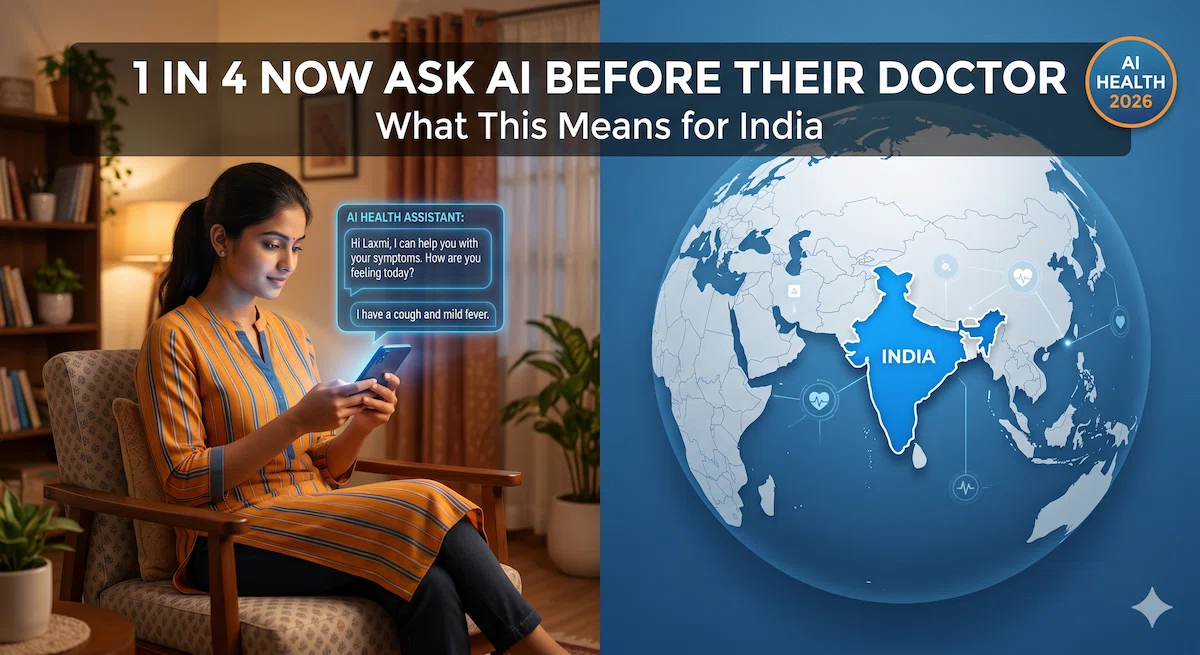
A major Gallup poll published on April 15, 2026 has found that roughly one in four American adults used an AI tool — such as ChatGPT or Microsoft Copilot — for health advice in the past 30 days. Three other independent surveys, including polls by KFF and Pew Research Center, back up the finding. The shift is happening fast, quietly, and with real consequences.
People are not just Googling symptoms anymore. They are having full conversations with AI — describing their pain, uploading lab reports, asking whether they need to see a doctor. For a country like the United States, where healthcare can cost thousands of dollars for a single visit, this makes some sense. But the trend carries lessons that India, with 1.4 billion people and its own deep gaps in healthcare access, cannot afford to ignore.
The Details
According to the Gallup survey, about 70% of recent AI health users said they wanted quick answers or were researching before or after a doctor visit. But a significant minority told a different story — around 30% said they used AI because they could not afford a doctor’s visit, and about 20% said they had no time to make an appointment. The KFF poll, conducted in late February 2026 among 1,343 U.S. adults, found that younger and lower-income users were most likely to use AI as a substitute for care they simply cannot access.
Trust, however, remains divided. Only one-third of AI health users said they “strongly” or “somewhat” trust the health information AI gives them. About 34% said they distrust it. And privacy is a real concern — three in four Americans told KFF they were worried about sharing personal medical data with chatbots. A separate SingleCare survey from April 13, 2026 found that 46% of respondents had already used AI to answer medication questions, and 49% of those users said it actually changed how they took their medicine.
What This Means for India
India has roughly 1 doctor for every 834 people — far below the WHO-recommended ratio. In rural areas, that gap widens dramatically. Millions of Indians already self-diagnose using YouTube videos or WhatsApp forwards. AI chatbots — available in Hindi, Tamil, Bengali, and other regional languages — are a natural next step. Startups like Tata 1mg, Practo, and Apollo 24|7 are already experimenting with AI-assisted health tools — but alongside the opportunity come serious risks that doctors and regulators are only beginning to map. As internet penetration crosses 900 million users, the conditions for a similar shift in India are not just possible — they are inevitable. The question is whether India builds guardrails before the wave hits, or after.
Key Details at a Glance
- Gallup poll (April 2026): 1 in 4 U.S. adults used AI for health info in the past 30 days.
- KFF poll: ~32% of Americans have consulted AI chatbots for physical or mental health advice in the past year.
- SingleCare survey (April 13, 2026): 46% used AI for medication questions; 49% said it changed how they took medicine.
- About 42% of AI health users in the U.S. never followed up with a doctor after consulting an AI tool.
- India has a doctor-to-patient ratio of 1:834, making AI health tools both a massive opportunity and a serious risk.
What Happens Next
Tech giants are already moving. Indian healthcare startups are already showing what responsible AI deployment can look like — from smart X-rays to rural diagnostics. OpenAI, Microsoft, and Amazon have each launched health-specific AI chatbots in early 2026, allowing users to connect their medical records for personalized answers. In India, regulators like the Central Drugs Standard Control Organisation (CDSCO) and the National Health Authority will likely need to step in — setting standards for AI health tools before misinformation spreads at scale. The next 12 to 18 months will define whether AI becomes India’s greatest healthcare equaliser or its newest health hazard.
FAQs
Is it safe to use AI like ChatGPT for health advice in India?
AI tools can be a useful starting point for understanding symptoms or preparing for a doctor visit, but they are not a replacement for professional medical care. Errors in AI-generated health advice can have serious consequences, and users should always verify information with a qualified doctor, especially for chronic conditions or medication changes.
Which AI health apps are available in India right now?
Several platforms already offer AI-assisted health features in India, including Apollo 24|7, Tata 1mg, and Practo. General-purpose chatbots like ChatGPT and Google Gemini are also widely used for health queries, though they are not medically certified tools in India.
Why are people using AI instead of doctors?
The main reasons, according to multiple 2026 polls, are cost, convenience, and access — particularly outside business hours. In India, long waiting times, high consultation fees in private hospitals, and a shortage of specialists in rural areas make AI an attractive — if imperfect — first stop for health questions.