
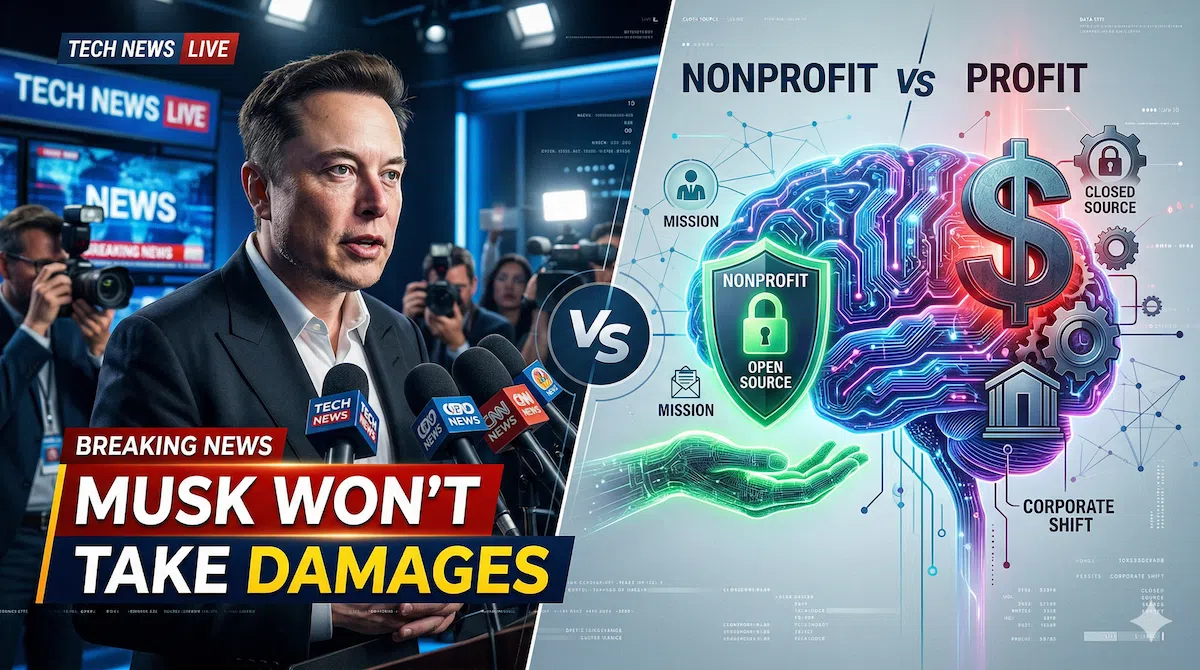
Elon Musk has made a fresh move in his ongoing legal fight with OpenAI, saying he does not want to personally receive any damages if he wins the case.
Instead, Musk now says any money awarded should go to OpenAI’s nonprofit arm, according to Engadget.
The update comes as the lawsuit moves closer to trial and keeps the spotlight on a bigger question that has followed OpenAI for years: should one of the world’s most influential AI companies still be operating under the nonprofit mission it was founded on?
What changed in Musk’s lawsuit?
Musk has long argued that OpenAI moved away from its original purpose after shifting toward a for-profit structure and deepening its partnership with Microsoft.
His broader complaint has focused on the idea that OpenAI was originally launched to build artificial intelligence for the benefit of humanity, not as a profit-first business.
Now, in a new update to the case, Musk is trying to make clear that his legal challenge is not about getting a personal payout. Instead, he says any damages should be directed back to OpenAI’s nonprofit side.
That change could help Musk strengthen his public argument that the case is about OpenAI’s mission and governance — not just money.
Why this matters for OpenAI
This is more than just another billionaire lawsuit.
The case touches on one of the biggest debates in artificial intelligence today: who should control advanced AI systems, and what happens when nonprofit research organizations evolve into powerful commercial players in the broader AI industry.
OpenAI began as a nonprofit research lab in 2015 and later adopted a more complex structure that allowed it to raise large amounts of capital. That shift helped the company grow quickly, especially after the success of ChatGPT, but it also sparked criticism from Musk and others who say the original mission has been diluted.
As a result, this lawsuit has become a much bigger story than a typical corporate dispute. It now sits at the center of a wider conversation about AI ethics, power, transparency, and control.
OpenAI’s side of the dispute
OpenAI has pushed back against Musk’s claims and has previously suggested that his legal attacks are not really about principle, but about competition and influence in the AI race.
The company has also defended its current structure as necessary to fund the enormous costs of AI research, infrastructure, and model development, even as OpenAI-related developments continue to attract close industry attention.
That response is important, because this case is not only about what OpenAI used to be — it is also about whether building frontier AI at scale is even possible without large commercial backing.
What happens next?
The lawsuit is expected to head toward trial later this month, which means this story could continue developing quickly.
If the case moves forward as expected, it could become one of the most important courtroom battles in the AI industry so far — especially as regulators, investors, and the public increasingly pay attention to how major AI companies are governed.
For now, Musk’s latest move appears designed to reinforce a simple message: he wants the case seen as a fight over OpenAI’s original mission, not a bid for personal financial gain.
Whether the court agrees is another matter entirely.
But one thing is clear — this is no longer just a feud between tech leaders. It is now a high-profile test of how the future of AI should be structured, funded, and controlled.