
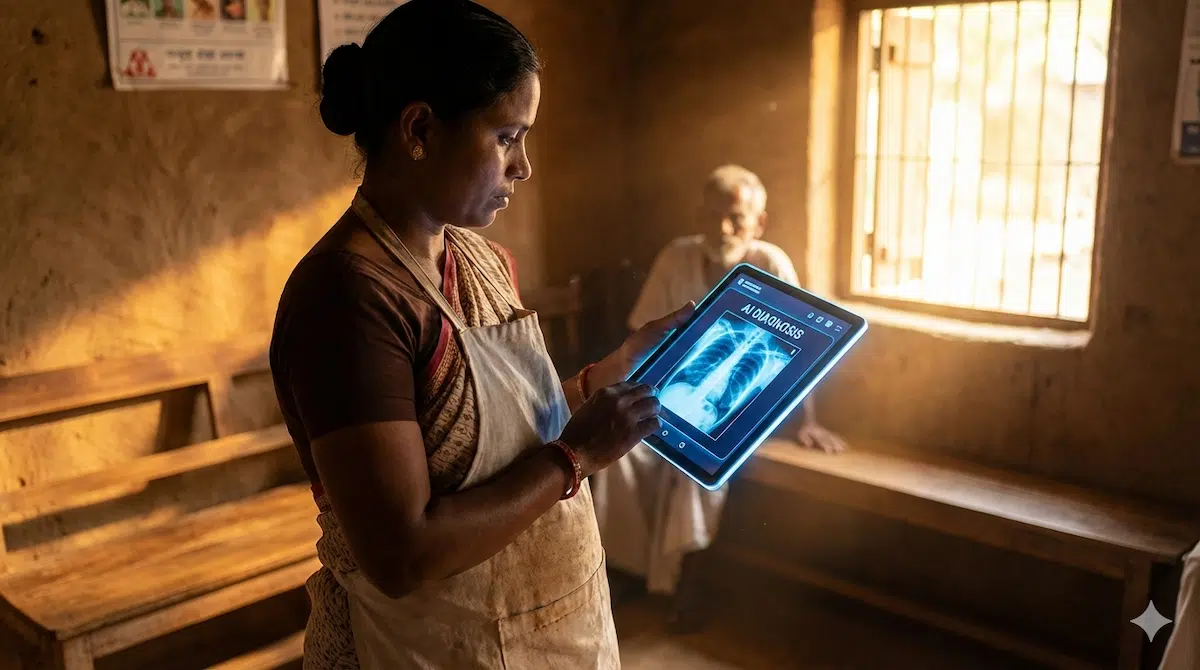
The adoption of AI in Indian healthcare is addressing a severe structural challenge: a massive shortage of specialized doctors. In the field of radiology, the ratio is particularly staggering, with roughly one radiologist for every 100,000 citizens. For patients in rural villages and tier-3 cities, this often means waiting over 48 hours just to get a basic X-ray report.
However, a new wave of innovation is actively bridging this gap. The integration of AI in Indian healthcare is moving diagnosis out of overloaded urban hospitals and directly into remote communities. Led by domestic health-tech startups, artificial intelligence is now being used to instantly analyze medical imagery, detect life-threatening diseases, and ensure that critical healthcare is no longer lost in transit.
The Radiologist Shortage: Why AI in Indian Healthcare is the Solution
When a patient in a rural health camp gets an X-ray for a persistent cough, the physical image often has to be transported to a city specialist, leading to dangerous delays in treatment. Indian AI startups are solving this by turning the diagnostic process into a software solution.
Companies are training deep learning algorithms on millions of anonymized medical images from government and private hospitals. These AI models learn to recognize the subtle patterns of respiratory diseases, fractures, and early-stage cancers with an accuracy that rivals expert human radiologists. Instead of waiting days, an AI-powered co-pilot can analyze a scan and flag critical abnormalities in less than three minutes.
Eradicating TB: The Impact of Qure.ai and DeepTek
One of the most profound applications of this technology is the fight against Tuberculosis (TB)—a disease where delayed diagnosis directly fuels transmission. Startups like Mumbai-based Qure.ai and Pune-based DeepTek have developed AI software specifically tailored to India’s disease patterns.
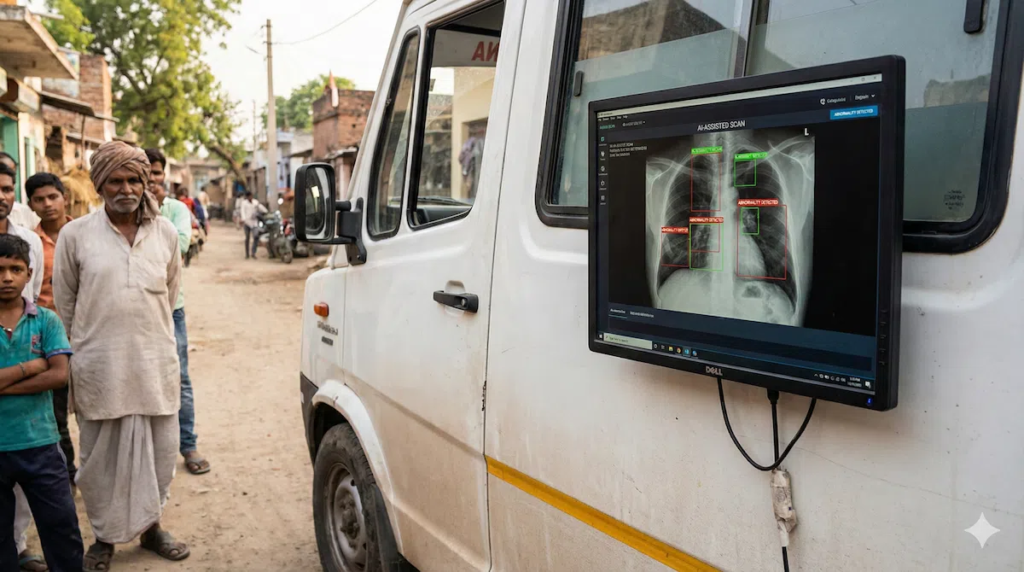
Qure.ai’s “qXR” platform uses deep learning to interpret chest X-rays in minutes, bringing the cost of a digital scan down to less than a single dollar. Similarly, DeepTek’s AI software, “Genki,” recently made headlines when it was integrated into Tamil Nadu’s mobile diagnostic units.
These mobile vans travel to rural communities equipped with digital X-ray machines. The moment a scan is taken, the AI processes the image instantly. In a recent initiative, out of over 66,000 individuals screened, the AI successfully flagged thousands of scans showing signs of TB, allowing medical professionals to intervene immediately.
Edge Computing: Healthcare Without the Internet
Perhaps the most impressive technical achievement of these health-tech startups is how they deploy their models. Rural India often suffers from inconsistent or entirely absent internet connectivity. Relying on massive cloud servers to process an X-ray is simply not feasible.
To counter this, startups are deploying “edge-based” AI. The AI algorithms are compressed to run locally on the X-ray machines or offline mobile devices themselves. The system instantly processes the image, generates a diagnostic report, and assigns a criticality score—all without needing an internet connection. By pushing the computing power to the “edge,” India is setting a global benchmark for how AI can democratize access to life-saving medical care.
FAQs
How is AI used in Indian healthcare? AI is being heavily utilized to analyze medical images (like X-rays, CT scans, and MRIs), automate pathology reports, and monitor patient vitals remotely. This helps doctors make faster decisions and brings diagnostic capabilities to rural areas.
How do health-tech startups detect TB using AI? Startups have trained AI algorithms on vast datasets of lung scans. When a new chest X-ray is taken, the AI instantly scans the image for specific lung abnormalities and moisture patterns associated with Tuberculosis, flagging the disease in minutes instead of days.
Can AI medical imaging work without the internet? Yes. Many Indian AI startups use “edge computing,” allowing the deep learning models to process X-rays and generate diagnostic reports directly on local hardware or mobile devices, bypassing the need for an internet connection in remote villages.