
📌 Key Takeaways
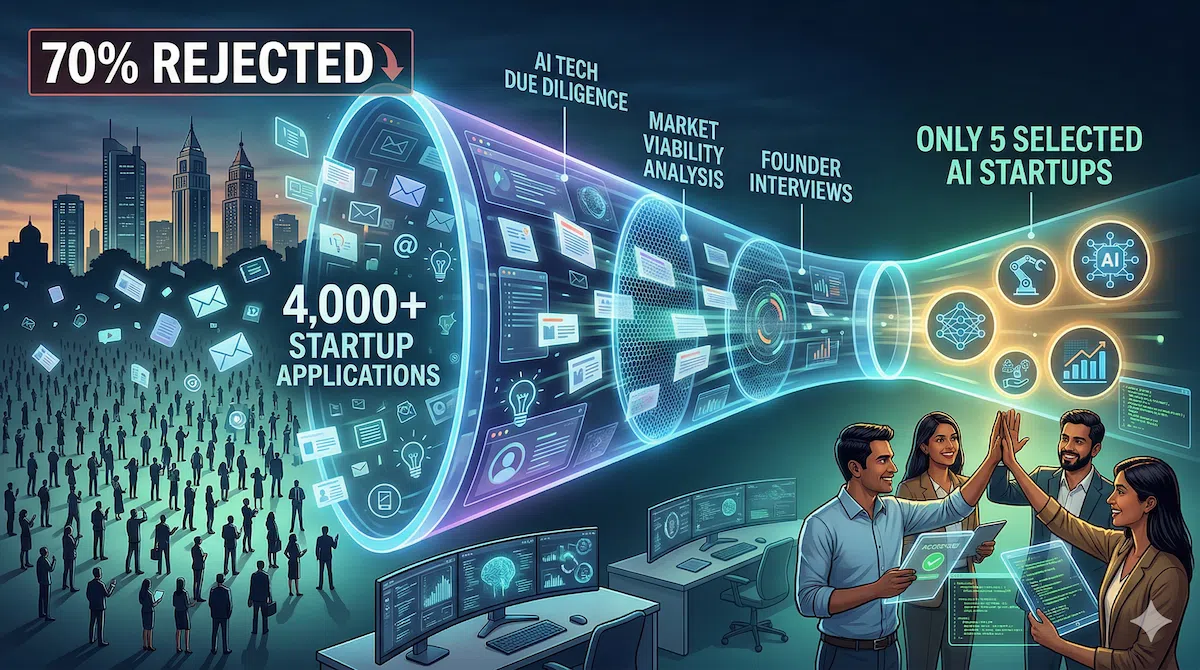
- Only 5 of 4,000+ Indian AI startup applications were selected — Google and Accel’s Atoms program shows how sharply investor standards are rising in 2026.
- Around 70% of rejected startups were reportedly AI wrappers — simply layering chatbots onto existing tools is no longer enough to stand out.
- The winning signal is clear: depth beats hype — investors now appear to favor startups solving real workflows, not generic AI productivity ideas.
Google Accel AI startups are suddenly facing a much tougher quality bar in India. Out of more than 4,000 applications to the Atoms program, only five startups were selected, while roughly 70% were reportedly rejected as “AI wrappers.”
That should worry a lot of founders. Because this is no longer just about who made one accelerator cohort — it’s about how quickly investor expectations are changing in India’s AI market.
The signal is hard to miss: startup hype is cheap, but defensible AI products are getting harder to fake. And that shift could define which Indian AI startups still look fundable in 2026.
For India’s startup ecosystem, that’s not bad news. It’s a quality reset.
What Google and Accel’s Atoms Program Reveals About Indian AI Startups
At first glance, the Atoms selection looks like a standard accelerator story: strong pipeline, elite selection, funding upside, cloud credits, founder visibility.
But the real value of this story lies in what it reveals about how startup quality is being judged in 2026.
The bar has moved. Investors and accelerator operators are no longer impressed by a product just because it has an AI layer. The question now is much tougher: Does this startup fundamentally improve how work gets done?
That shift matters because India has seen an explosion of AI startup activity over the past 12–18 months. Many of those companies emerged quickly, often built around accessible foundation models and fast shipping. That was enough to get attention early on. It’s not enough anymore.
This is where the Atoms signal becomes useful: AI novelty is fading, product depth is rising.
Why AI Wrappers Are Losing Favor With Investors
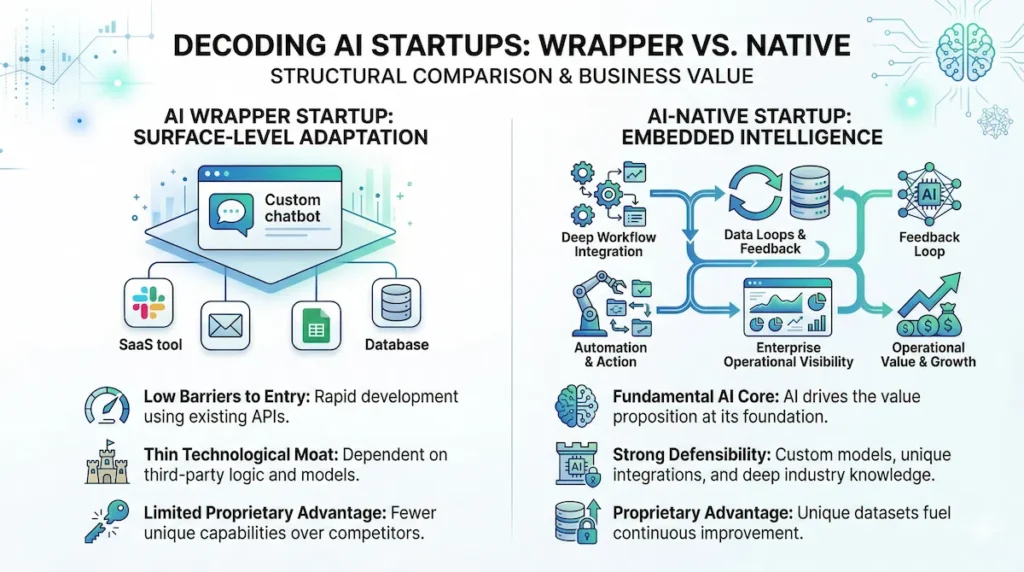
“AI wrapper” has become one of the most overused terms in startup discourse, but the idea behind it is simple.
A wrapper startup typically takes an existing foundation model or AI capability and places a lightweight interface, assistant, or automation layer on top of it — without deeply rethinking the underlying workflow, customer problem, or defensibility.
That doesn’t automatically make it a bad business. Some wrappers can become strong products if they:
- own a valuable workflow
- build sticky distribution
- capture proprietary user behavior or domain data
- solve a painful problem better than incumbents
But most weak wrappers fail one test: if the model provider or a larger SaaS company adds the same feature, the startup loses its edge overnight.
That’s likely what Google and Accel were filtering for.
If 70% of rejected applications were wrappers, it suggests many founders are still building “AI-added software” instead of “AI-native products.” That distinction matters more than ever in enterprise AI startups, where customers are paying for measurable outcomes — not just flashy copilots.
What the 5 Selected AI Startups Have in Common
The selected startups are interesting not just because they won, but because of what they imply about investor conviction.
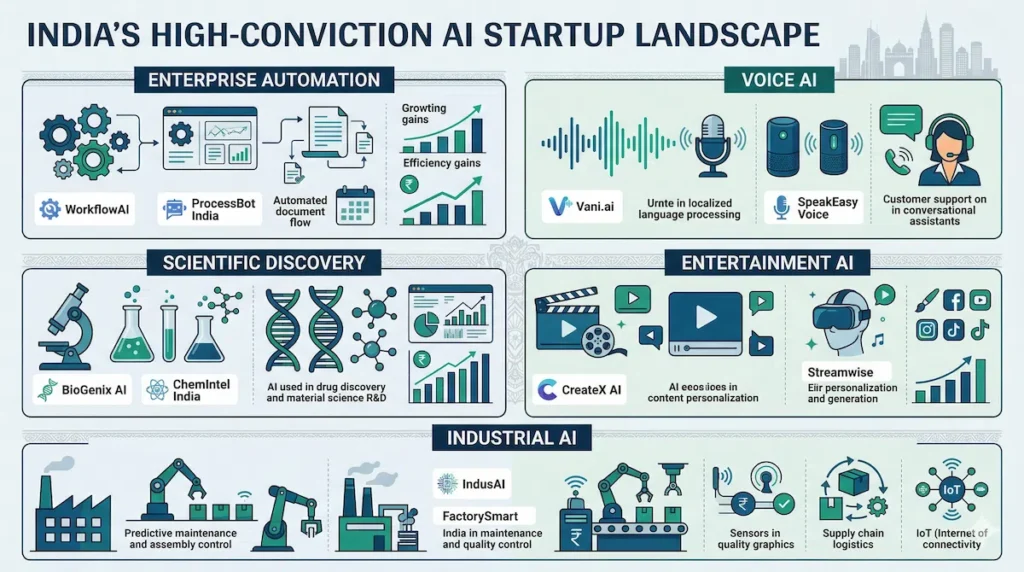
The five selected startups — K-Dense (AI for scientific research), Dodge.ai (enterprise ERP automation), Persistence Labs (voice AI for call centers), Zingroll (AI-generated media), and LevelPlane (industrial automation) — offer a clear signal about investor priorities.
They are not competing in generic AI productivity categories. Instead, they are targeting complex, domain-specific workflows where AI can drive measurable outcomes — a much harder but more defensible approach.
Even across different categories, the common thread appears to be this: they are trying to solve domain-specific problems where AI can change execution, not just interface.
That’s a much more defensible startup thesis.
This matters because the strongest Indian AI startups are unlikely to win by competing head-on with global model labs. They’re more likely to win by doing one of three things exceptionally well:
- owning a difficult industry workflow
- embedding AI into high-friction business operations
- building trust in sectors where accuracy, speed, or automation has real economic value
That’s where Indian founders may have a real opportunity. Not in building the next generic chatbot for everyone — but in building AI products that become indispensable inside a specific workflow.
In other words, depth is becoming more investable than breadth.
What Indian AI Founders Should Build Instead
The clearest lesson from this story is not “don’t build with LLMs.” It’s this:
Don’t stop at the model layer.
The real opportunity now lies in products that combine AI with:
- workflow ownership
- domain understanding
- operational integration
- outcome-based value
That could mean:
- AI systems that reduce factory downtime
- voice AI tools built for Indian language-heavy support workflows
- enterprise copilots embedded into real business processes
- research or automation tools that improve decision-making, not just content generation
This is where many Indian AI founders still have room to differentiate.
India has long been strong at software adaptation — taking powerful technologies and packaging them into scalable, commercially viable products. But AI startup selection is now demanding something more: original product thinking around where AI creates lasting advantage.
That means founders should start asking harder questions:
- What painful workflow are we actually fixing?
- What data, usage loop, or integration makes us hard to replace?
- Would this still be valuable if OpenAI, Google, or Microsoft added similar features tomorrow?
If the answer is no, the moat probably isn’t there yet.
The stronger AI opportunities in India may come from products rooted in local workflows and infrastructure, much like recent moves in voice AI in India
Why This Matters for India’s Next AI Startup Cycle
This is why the Google-Accel Atoms story matters beyond one accelerator batch.
It’s an early signal of how the next phase of India’s AI startup ecosystem may evolve.
The first wave was driven by excitement: AI demos, copilots, wrappers, quick launches, and founder FOMO. That phase was inevitable — and useful. It got people building.
The filtering of weak AI startup ideas is also part of a broader shift across the State of AI in India, where capital is increasingly flowing toward more defensible products.
The next wave will be harder and more valuable.
It will likely favor startups that are:
- less flashy but more useful
- narrower but more defensible
- harder to explain in one sentence, but much harder to replace in the real world
That is good for the ecosystem.
Because if Indian AI founders take this signal seriously, the market could shift away from surface-level AI hype and toward companies that actually deserve enterprise adoption, long-term funding, and strategic trust.
And that’s a much healthier place for the ecosystem to go.
FAQs
What is an AI wrapper startup?
An AI wrapper startup typically builds a product on top of existing AI models without deeply changing the underlying workflow or creating a strong moat. Some wrappers can still become good businesses, but weak ones are easy to copy or replace.
Why did Google and Accel reject so many AI startups?
The likely reason is quality and defensibility. If a startup only adds a chatbot or AI layer without solving a meaningful workflow problem, investors may see it as shallow or easily replaceable.
What should Indian AI founders build instead in 2026?
Founders should focus on workflow-native AI products with clear business value, stronger domain depth, and some form of defensibility — whether through integration, proprietary usage loops, or problem-specific execution.
Disclaimer: This article is for informational and editorial purposes only and is based on publicly available information at the time of writing. It does not constitute legal, financial, or investment advice. Any company logos, brand names, trademarks, or images used in this article remain the property of their respective owners and are used only for identification, commentary, or editorial reference where applicable.
Pingback: Lightspeed India AI Fund: Inside the $250M Bengaluru Bet