
Key Takeaways
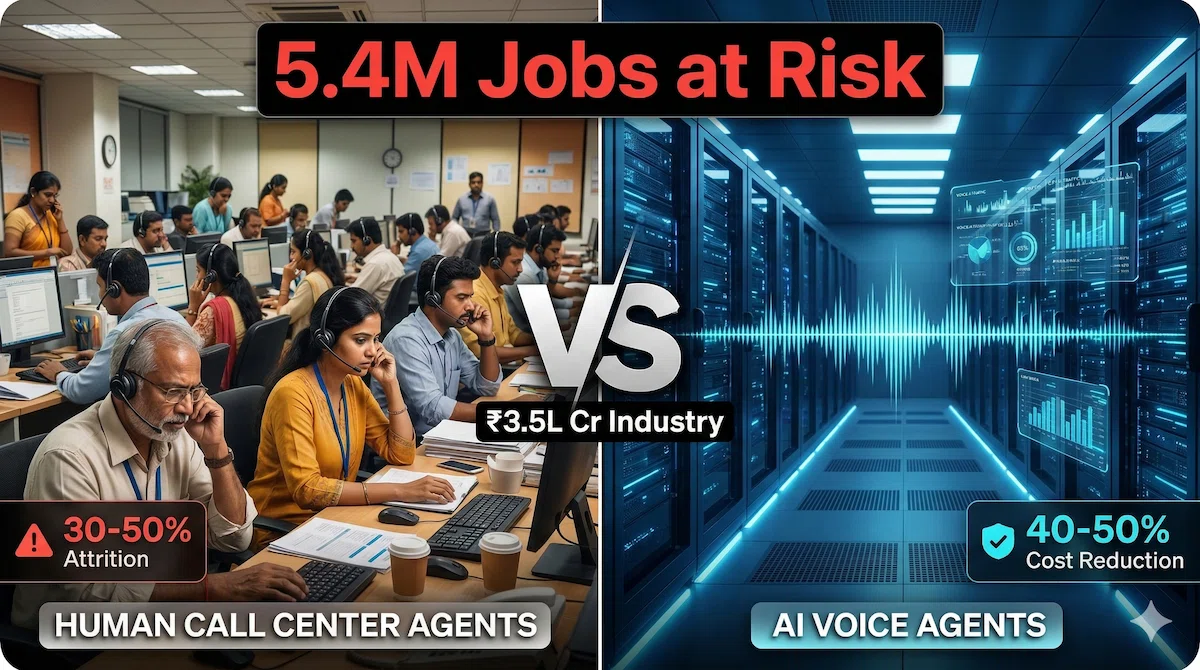
- India’s ₹3.5 lakh crore BPO industry employs 5.4 million workers—but AI voice agents now handle routine calls at 40-50% lower cost — Major banks like HDFC and ICICI have already deployed voice bots for customer queries and onboarding, while e-commerce giants automate support journeys, signaling the beginning of a structural transformation that could eliminate 2-2.7 million BPO jobs by 2027
- Lead qualification costs collapsed from ₹800 to ₹120 per lead with AI voice agents — One AI agent handles thousands of simultaneous calls without breaks, night shifts, or attrition, while traditional call centers face 30-50% annual employee turnover and rising labor costs, creating brutal economics that favor automation
- AI voice systems already process 50-100 million calls monthly in India — Platforms like SquadStack, Skit.ai, and Ori deploy conversational AI trained on 600M+ minutes of real Indian sales calls across BFSI, healthcare, and e-commerce sectors, with customers reporting 75-90% connectivity rates and 50-70% cost savings
AI voice agents vs Indian BPOs isn’t a future debate—it’s a present crisis that 5.4 million call center employees are experiencing right now.
India’s Business Process Outsourcing industry, valued at ₹3.5 lakh crore ($42 billion) in 2024 and projected to reach ₹4.7 lakh crore ($56.53 billion) by 2034, has long been the country’s outsourcing success story. From Bengaluru to Gurgaon, massive call centers employ millions handling customer support, sales, collections, and technical assistance for companies worldwide.
But in 2026, that model is collapsing under the weight of AI-powered voice agents that can conduct thousands of natural-sounding conversations simultaneously—without salaries, without breaks, and without ever quitting.
The numbers tell a story of technological displacement happening in real-time. AI voice platforms now handle an estimated 50-100 million calls every month in India. Banks like HDFC and ICICI Bank deploy voice bots for account onboarding and customer queries. NBFCs use AI for lead qualification and loan collections. E-commerce platforms automate entire customer support workflows.
Industry analysts project that 40-50% of current BPO roles could be automated by 2027, putting 2-2.7 million jobs at immediate risk. For an industry that employs more people than India’s entire IT services sector, this represents an economic and social disruption on a scale India has rarely confronted.
The Economics That Make AI Voice Agents Inevitable
The shift from human call centers to AI voice agents isn’t driven by technological novelty—it’s driven by economics so compelling that resisting becomes financially impossible.
Traditional BPO cost structure presents multiple pain points that AI eliminates entirely. Attrition rates of 30-50% annually plague Indian call centers, particularly in night-shift operations serving Western markets. Every departed agent requires recruiting, training, and ramping a replacement—a cycle that costs ₹50,000-80,000 per employee and never stops. Labor cost inflation averaging 8-12% yearly erodes the cost advantage that made India attractive for outsourcing in the first place.
AI voice agents eliminate these expenses while delivering superior operational metrics.
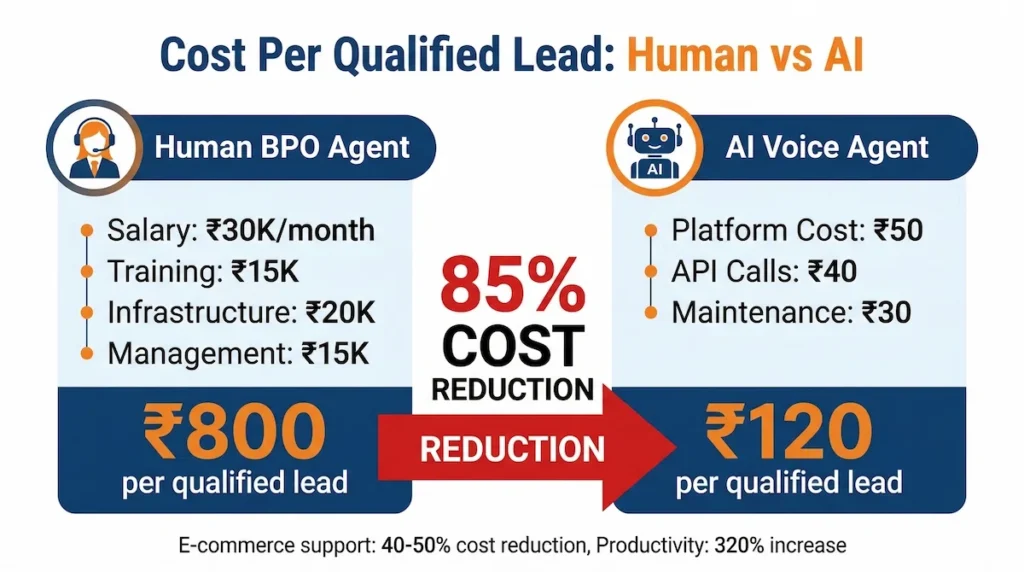
E-commerce customer support: AI reduces costs by 40-50% compared to human agents, while handling 10-20x more concurrent conversations. A traditional call center might staff 100 agents to handle peak loads; one AI system manages the same volume for ₹15-25 lakh monthly versus ₹50-80 lakh for human teams.
Lead qualification for lending: Human agents cost ₹800 per qualified lead when accounting for salary, training, supervision, and conversion rates. AI voice agents deliver the same output for ₹120 per lead—an 85% cost reduction that makes human-powered operations financially untenable.
BFSI customer query resolution: AI improves resolution rates by up to 80% compared to human agents by eliminating wait times, ensuring consistent responses, and accessing customer data instantly without navigating multiple systems.
Productivity gains reach 320% in some implementations, as AI agents never need breaks, handle multiple conversations simultaneously, and operate 24/7 without overtime or shift differentials.
Perhaps most damaging to the human workforce: customer satisfaction scores improve by 12+ points with AI voice agents in many deployments. Contrary to the assumption that customers prefer humans, they often prefer AI’s instant responses, zero wait times, and consistent quality over frustrated human agents juggling too many calls.
The economic logic is inescapable. Every CFO reviewing these numbers asks the same question: “Why are we still paying for humans?”
What AI Voice Agents Actually Do (And Where Humans Still Win)
Understanding the competitive landscape requires examining capabilities with brutal honesty.
AI voice agents excel at structured, high-volume, repetitive interactions: Call routing and basic inquiry handling, lead qualification and data collection, appointment scheduling and confirmations, payment reminders and collections (early stage), and account onboarding and verification. These capabilities cover an estimated 60-70% of current BPO call volume across industries—representing the portion of the workforce most immediately at risk.
But AI voice agents still fail spectacularly at emotionally complex, ambiguous, or creative interactions: Crisis handling and upset customers, complex problem-solving requiring judgment, relationship-building and trust development, navigating cultural and linguistic nuance, and negotiation and persuasion in high-value contexts.
The most sophisticated BPO organizations in 2026 aren’t choosing between AI and humans. They’re implementing hybrid models where AI handles the 70% of routine work, allowing humans to focus exclusively on the 30% of complex, high-value interactions where they maintain competitive advantage.
But this hybrid approach still means eliminating 60-70% of current headcount. The math is unavoidable.
Who’s Building India’s BPO Replacement
India isn’t just experiencing AI voice agent disruption—Indian startups are building the technology that’s disrupting their own country’s largest employment sector.
SquadStack positions itself as outcome-focused AI for actual sales conversions. Their platform is trained on 600+ million minutes of real Indian sales calls, giving it cultural nuance and buying-intent understanding. They claim 75-90% connectivity rates, 50-70% cost savings, and sub-0.8 second latency. Major clients include Upstox (reaching 2 crore+ customers) and Kissht (82% conversion boost, 50% lower customer acquisition costs).
Skit.ai specializes in banking and financial services voice automation. Their conversational AI handles account queries, loan processing, and collections across Hindi, Tamil, Telugu, and other Indian languages. HDFC Bank and ICICI Bank deploy Skit’s technology for customer-facing conversations.
Ori focuses on multilingual voice AI for enterprise customer support, handling verification, onboarding, and routine query resolution with voice biometric security features meeting banking compliance requirements.
These platforms share common technical capabilities: latency under 1 second for natural conversation flow, support for 10-20+ Indian languages and regional dialects, integration with existing CRMs and business systems, and compliance with data residency and privacy regulations.
The voice AI market in India hit $1.58 billion in 2024 and is growing at 37.3% CAGR through 2030. This isn’t experimental technology—it’s a rapidly scaling industry adopted by India’s largest enterprises.
What Happens to 5.4 Million BPO Employees?
The human cost of AI voice agents displacing traditional call centers will unfold over the next 24-36 months, creating ripple effects across India’s economy.
Job losses will concentrate in specific segments first: Entry-level customer support agents handling FAQs and basic troubleshooting (40-50% of current employment), lead qualification and sales development representatives, collections agents for early-stage debt recovery, and technical support Tier 1 for password resets and basic troubleshooting.
Roles with greater job security include: Customer retention and relationship management specialists handling at-risk high-value accounts, sales closers and complex deal negotiators in B2B contexts, quality assurance and AI training specialists who monitor voice agent performance, and escalation specialists who handle situations where AI fails.
The optimistic scenario paints AI as a tool that augments rather than replaces humans, allowing BPO workers to upskill into higher-value roles managing AI systems. The pessimistic scenario—and the one current economics support—suggests that for every 10 entry-level agents displaced, perhaps 2-3 upskill into AI oversight roles, while 7-8 exit the industry entirely.
If 40-50% of India’s 5.4 million BPO jobs disappear by 2027, that’s 2.1-2.7 million people needing to find new employment in an economy where job creation already struggles to keep pace with workforce growth.
BPO jobs have provided economic mobility for millions of young Indians from tier-2 and tier-3 cities, offering salaries of ₹2.5-4 lakh annually for roles requiring basic English and computer skills but not advanced degrees. They’ve enabled women’s workforce participation in environments more flexible than traditional office jobs, and created regional economic engines in cities like Pune, Jaipur, and Chandigarh where BPO centers are major employers.
Displacing 2+ million workers from this ecosystem doesn’t just impact those individuals—it ripples through families, communities, and regional economies dependent on BPO salaries.
What BPO Workers Should Do Right Now
For the 5.4 million Indians currently working in call centers, the window to adapt is narrowing rapidly.
Develop AI-resistant skills: Master complex problem-solving, emotional intelligence, relationship-building, and creative thinking—capabilities AI struggles to replicate. Focus on becoming the agent AI escalates to, not the one AI replaces.
Specialize in high-value verticals: Move from generic customer support to specialized domains like healthcare, legal services, or technical sales where deep knowledge and human judgment remain essential.
Learn to manage AI: Positions monitoring voice agent performance, training conversational models, and handling AI failures will grow as automation scales. Acquire basic understanding of how AI works, even if you’re not building it—though competition for these roles is fierce given India’s severe AI talent shortage affecting 82% of employers
Pursue roles in AI-native companies: Startups building voice agents need human quality assurance testers, conversation designers, and customer success managers who understand both AI capabilities and human customer needs.
Acquire credentials beyond BPO: Use current BPO salary to fund education in nursing, digital marketing, data analysis, project management, or other growing fields before automation eliminates your income.
The advice sounds simple. The execution is brutally hard for workers earning ₹2.5-4 lakh annually with families to support, limited savings, and education systems not designed for rapid adult reskilling.
Government intervention will be necessary but likely insufficient. India’s current workforce development programs cannot retrain 2 million displaced workers in 24-36 months. The uncomfortable truth: many BPO workers will lose their jobs to AI, struggle to find equivalent employment, and experience downward economic mobility.
India’s Disappearing Competitive Advantage
India’s dominance in global BPO services was built on a simple arbitrage: educated English-speaking labor at 1/3 to 1/5 the cost of Western markets. AI voice agents collapse that arbitrage entirely.
A voice agent deployed in Mumbai costs the same as one deployed in Manila, Warsaw, or San Francisco—which is to say, it costs almost nothing relative to human labor anywhere. When geography no longer determines cost, India loses its competitive edge.
The BPO industry has been a major employment generator absorbing millions of educated youth, a services export powerhouse contributing billions in foreign exchange earnings, and a training ground for professional skills that prepare workers for higher-value careers.
If AI decimates this sector, India doesn’t just lose 2-3 million jobs. It loses a critical rung on the economic ladder that helped millions climb from poverty to middle class. The path forward requires India to stop being the world’s call center and become a nation that builds the AI replacing call centers—part of India’s broader transformation into an AI-first economy across manufacturing, healthcare, and enterprise sectors
Whether India can execute that transformation before AI voice agents eliminate millions of jobs remains the defining economic question of the next three years.
FAQs
Will AI voice agents completely replace call center jobs in India?
AI voice agents will not completely eliminate all call center jobs, but industry projections suggest 40-50% of India’s 5.4 million BPO employees (2.1-2.7 million workers) face displacement by 2027. Entry-level customer support, lead qualification, and Tier 1 technical support roles face highest risk as AI handles routine queries at 40-50% lower cost. However, complex problem-solving, emotional de-escalation, relationship management, and AI oversight roles will still require humans. The shift isn’t complete replacement but rather a hybrid model that requires far fewer workers—often 85-90% fewer agents for equivalent call volume.
How much do AI voice agents cost compared to human call center employees in India?
AI voice agents reduce operational costs by 40-50% compared to traditional BPO operations. For lead qualification, human agents cost approximately ₹800 per qualified lead when accounting for salaries, training, and overhead, while AI agents deliver the same outcome for ₹120 per lead—an 85% reduction. For customer support, a traditional 100-agent call center costs ₹50-80 lakh monthly including salaries, infrastructure, and management, while AI systems handling equivalent volume cost ₹15-25 lakh monthly. One AI agent can handle thousands of simultaneous calls without breaks, eliminating costs associated with 30-50% annual attrition, night shift premiums, and physical infrastructure.
Which Indian banks and companies are already using AI voice agents?
Major Indian financial institutions actively deploying AI voice agents include HDFC Bank and ICICI Bank, which use conversational AI for account onboarding, customer queries, and verification processes. NBFCs leverage AI for lead qualification and loan collections. Large e-commerce platforms automate customer support journeys end-to-end. Companies like Upstox report reaching 2 crore+ customers with AI voice systems achieving 75-90% connectivity. Kissht achieved an 82% conversion boost and 50% lower customer acquisition costs through SquadStack’s AI agents. The technology is no longer experimental—it’s in production handling 50-100 million calls monthly across Indian enterprises.
What skills should BPO employees learn to survive AI automation?
BPO employees should focus on developing AI-resistant capabilities including complex problem-solving, emotional intelligence, relationship-building, and creative thinking—skills where humans maintain advantages over AI. Specialize in high-value verticals like healthcare, legal services, or enterprise sales requiring deep domain knowledge. Learn to manage and monitor AI systems by understanding conversational AI basics, quality assurance for voice agents, and AI training workflows. Acquire credentials beyond call center work through courses in nursing, digital marketing, data analysis, or project management. Move into roles at AI-native companies as conversation designers, quality testers, or escalation specialists who handle cases where AI fails. The key is becoming the person AI escalates to, not the one AI replaces.