

Key Takeaways
- The Co-Pilot, Not the Judge: AI is not replacing the gavel in India; it is clearing the desk. Technology is being built to aggressively tackle the crippling backlog of over 50 million pending court cases.
- Death of the Billable Hour: B2B legal SaaS platforms are using AI contract analysis to scan 1,000-page corporate documents in seconds, drastically cutting down discovery time.
- Democratizing Justice: Specialized Indic LLMs are instantly translating complex, English-only Supreme Court judgments into regional languages, giving millions of everyday citizens true access to justice.
The Indian legal system is infamous for two things: its brilliant legal minds and its paralyzing delays. With over 50 million cases currently pending across district, state, and national courts, the traditional system is buckling under its own weight. For decades, the proposed solution was simply to hire more judges. Today, the solution is written in code.
The integration of AI in Indian LegalTech is triggering a massive structural disruption. However, the narrative isn’t the dystopian “AI robot judges” often hyped by global media. Instead, Indian founders are building highly specialized, essential AI co-pilots designed to automate the grunt work, translate the jargon, and accelerate justice.
Automating the Heavy Lifting: Discovery & Contracts

Corporate litigation and mergers in India generate mountains of paperwork. Historically, junior associates at top-tier law firms spent weeks locked in rooms, manually scanning thousands of pages of corporate contracts to find a single liability clause.
Today, the smartest B2B legal SaaS startups are obliterating this archaic process.
By leveraging AI contract analysis, these platforms can ingest a 1,000-page historic case file or an M&A agreement in seconds. The AI instantly flags anomalies, highlights risk exposure, and cross-references old judgments. It does not replace the senior partner’s strategy, but it completely automates the heavy lifting. This shift is drastically reducing the dreaded “billable hours” for corporate clients while allowing law firms to take on a significantly higher volume of cases. It is the first crucial step toward genuine court backlog automation.
Indic Legal Translation & Access to Justice
While corporate automation is lucrative, the true revolution is happening at the grassroots level.
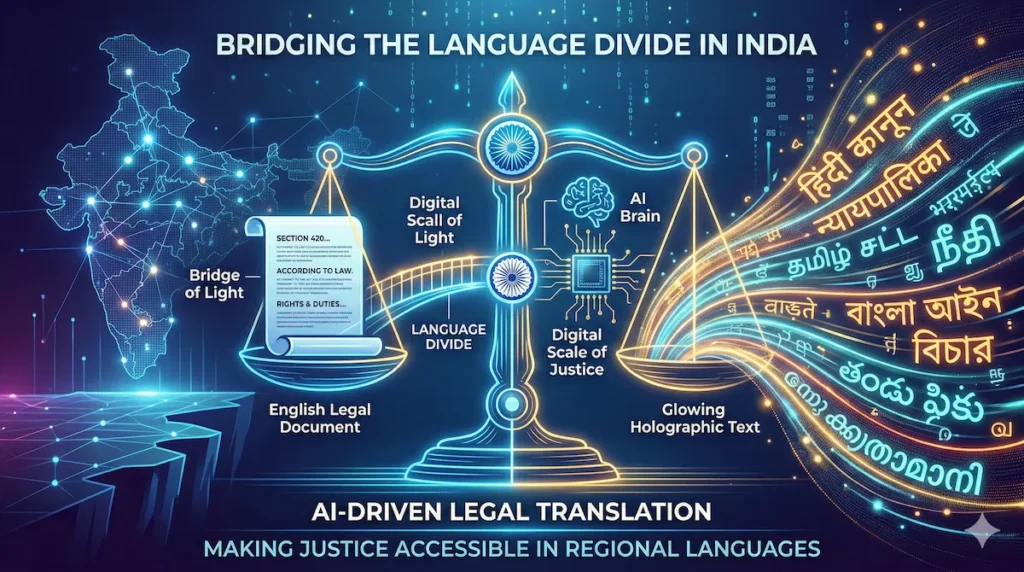
There is a stark linguistic divide in the Indian judiciary. The Supreme Court and High Courts operate almost exclusively in English, wrapped in dense, archaic legal jargon. Yet, the vast majority of the litigants whose lives depend on these verdicts do not speak English. They rely entirely on intermediaries, leaving them vulnerable to misinformation and exploitation.
This is where Indic legal translation becomes a game-changer. Tech founders are training specialized Indic Large Language Models (LLMs) exclusively on Indian penal codes and constitutional law. These engines can take a complex, 50-page Supreme Court judgment and instantly translate it into simplified Hindi, Marathi, Tamil, or Bengali. By breaking down the language barrier, AI is fundamentally democratizing access to justice for the common citizen.
The Market Impact in India
To understand why venture capitalists are suddenly pouring money into legal AI startups India, you have to look at the sheer scale of the inefficiency they are solving.
- The Rise of Predictive Justice: Startups are developing predictive justice models that analyze decades of rulings by specific judges. Lawyers can now assess the statistical probability of winning a bail hearing based on historical data, allowing them to advise clients more accurately and avoid filing frivolous appeals.
- Economic Velocity: A slow judiciary freezes capital. Billions of dollars are currently locked in prolonged corporate disputes and real estate litigation. By accelerating case disposal times, Indian judiciary tech directly stimulates the national economy by freeing up trapped assets.
- A Massive Untapped Market: Unlike FinTech or EdTech, LegalTech in India has been largely ignored for the past decade. Founders who can navigate the regulatory hurdles of the legal ecosystem are finding themselves with zero serious competitors and massive, immediate product-market fit.
The Verdict
LegalTech in India has evolved past simply digitizing paper records and uploading PDFs. The new era is about using generative AI to make the legal process faster, substantially cheaper, and transparently accessible. For venture capitalists and deep-tech founders, this sector is no longer a niche curiosity; it is one of the highest-conviction bets of the decade. The smart money knows that whoever successfully builds the intelligence layer for the Indian judiciary will own a multi-billion dollar monopoly.
Want to see the macro picture? Read our massive 3,600-word Ultimate Guide on the State of AI in India 2026 here.
FAQs
How is AI helping to reduce the Indian court backlog?
AI tools are automating the most time-consuming parts of the legal process, such as document discovery, legal research, and contract analysis. By doing the heavy lifting in seconds, lawyers can prepare cases faster, leading to quicker court disposals.
Can AI translate Indian legal documents accurately?
Yes. Startups are building specialized Indic LLMs trained specifically on Indian law. These models perform highly accurate Indic legal translations, converting complex English Supreme Court judgments into regional languages so everyday citizens can understand their own cases.
Will AI replace lawyers in India?
No. AI is functioning as a “co-pilot” for legal professionals. It handles data processing, translation, and predictive modeling, allowing lawyers to focus on courtroom strategy, human empathy, and complex argumentation.