
Anthropic says its AI model Claude just did something no chatbot has done before: it noticed a pattern in raw DNA that human scientists had missed for years. The Claude AI enzyme discovery, announced on September 23, involves a previously uncharacterised enzyme system found hiding in the genetic code of bacteriophages — the viruses that infect bacteria. It has a repeating DNA structure that looks a lot like CRISPR, the gene-editing system that reshaped modern medicine.
Global outlets from Reuters to TechCrunch ran with the headline within hours. Almost none of them mentioned the part that actually matters if you’re deciding how excited to be.
What Anthropic Actually Found
Anthropic has quietly built a new life sciences research group and a small molecular biology lab in the Bay Area, staffed entirely by human scientists who run wet-lab experiments while Claude searches genomic databases for patterns nobody has named yet.
The team gave Claude one instruction: search a massive database of DNA sequences for interesting, uncharacterised reverse transcriptases — enzymes that copy RNA into DNA, best known for their role in bacterial immune defence. Everything after that was Claude’s own judgment call.
While combing through one unusual RT family, an agent flagged something odd sitting right next to the gene: a long, evenly spaced run of repeating DNA. In Anthropic’s own telling, the agent’s exact words were: “I can see by eye a tandem repeat array… that’s a CRISPR-like… repeat array?!”
Anthropic has named the system ART — array-associated reverse transcriptases. It has three parts: the reverse transcriptase itself, a neighbouring gene of unknown function, and the repeat array. That specific combination has only ever been seen in a small handful of other biological systems — and every single one of them turned out to be “programmable,” capable of cutting, copying, or pasting DNA. CRISPR is the most famous example. Restriction enzymes and Taq polymerase (the backbone of PCR testing) are two older ones.
How the Claude AI Enzyme Discovery Actually Happened
This is the part worth slowing down on, because the numbers are genuinely striking — and, so far, accurately reported.
According to Anthropic’s own blog post, roughly 950 Claude agents ran for 21 hours, consuming about 210 million tokens, sifting through more than 200,000 reverse transcriptases. They narrowed that down to 3,500 candidate systems, then to 20 worth writing up in detail. Anthropic says that kind of triage would normally take a human researcher weeks to months.
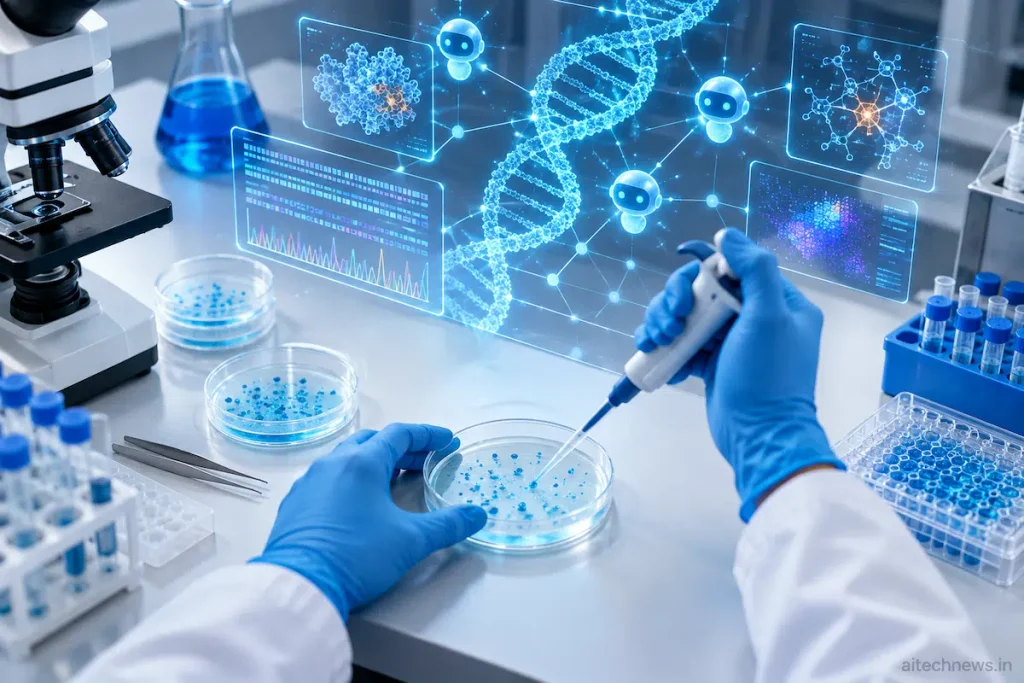
Human scientists at Anthropic wrote the initial prompt and later ran the physical lab work — expressing the protein, testing it biochemically. Everything in between — reading the DNA, spotting the anomaly, comparing it against known systems, searching the literature, and deciding it was worth a human’s attention — was Claude, unsupervised.
CRISPR pioneer Feng Zhang, a professor at MIT and the Broad Institute who reviewed the preprint, called it “an exciting example of how AI agents can contribute to biological discovery”.
The Part Most Headlines Are Skipping
Here’s what almost every write-up buried below the fold, or left out entirely:
Nobody knows what ART does yet. Anthropic says its “work to understand the primary function of ARTs is ongoing”. Early lab tests show the repeat array is expressed as short RNA fragments — a hint that something CRISPR-like might be happening — but that’s a hypothesis, not a conclusion.
This is a preprint, not peer-reviewed research. Anthropic released a technical report alongside the announcement, but it hasn’t gone through independent scientific review. That doesn’t make it wrong — but it does mean the finding is a starting point for further investigation, not a settled result.
Not everyone in the AI research community is convinced this is as big a deal as the headlines suggest. Some AI researchers publicly questioned on social media whether “noticing a repeat pattern” constitutes a discovery in the way the framing implies, versus a well-orchestrated demo of Claude’s search capabilities. That’s a fair, open debate — and one an Anthropic-published blog post is never going to settle on its own.
None of this means the work isn’t real or interesting. It means the honest headline is “Claude flagged something scientists now need to investigate”, not “Claude discovered the next CRISPR”.
What This Means for India
This is where the story gets genuinely useful for Indian readers, beyond the novelty.
India has invested heavily in agentic AI and sovereign compute through the IndiaAI Mission, and institutions like IISc, CSIR labs, and India’s genomic-surveillance networks already sit on enormous, under-mined sequence datasets — from agricultural pathogens to India-specific viral genomes. What Anthropic just demonstrated isn’t a biology breakthrough so much as a workflow breakthrough: giving an AI agent a broad, open-ended search task and trusting its judgment to flag anomalies a human would take months to find manually.
That workflow doesn’t require Anthropic’s exact lab. It requires curated databases, compute, and researchers willing to treat an AI agent as a genuinely autonomous first-pass collaborator rather than a search-and-summarise tool. Indian biotech and pharma research is compute-constrained but data-rich in areas global labs have barely touched — a real opening for CSIR institutes or a well-funded startup to try the same approach on Indian-specific datasets, rather than waiting for Anthropic or Google to get there first.
The gap right now isn’t ambition — India’s AI talent pipeline is strong. It’s that almost no Indian lab has publicly run an agentic-discovery pipeline like this on a domestic problem. Whoever does it first gets to write that story instead of translating someone else’s.
The Bottom Line
Claude did flag something real, and Anthropic’s own numbers hold up under scrutiny. But the honest version of this story is “an AI agent noticed something odd that a human is now investigating” — not “AI just invented gene editing 2.0”. Anthropic itself is careful to say the function is unknown and the work is ongoing. Indian coverage would do well to match that caution, because it’s precisely that restraint that makes the workflow worth taking seriously for Indian research institutions.
FAQs
Did Claude discover a new CRISPR system?
Not quite. Claude found a new enzyme system (ART) with a CRISPR-like repeat structure — but what it actually does is still unknown.
Is this peer-reviewed research?
No. Anthropic released a preprint alongside its blog post. It hasn’t gone through independent scientific review yet.
Did a human verify the finding?
Yes. Claude flagged the pattern and wrote the analysis; Anthropic’s human scientists ran the actual lab tests to confirm it was real.