
Four Indian organisations working on satellite farming data, carbon verification, and AI-powered drones have just made the cut for one of Google’s most exclusive climate-tech programmes — and almost nobody in India is talking about it yet.
Google DeepMind on Sunday announced the inaugural cohort of its AI for the Planet Accelerator, a three-month, equity-free programme for organisations across Asia-Pacific using frontier AI to tackle climate, agriculture, and biodiversity problems. Out of 16 organisations selected region-wide, four are Indian — one of the strongest single-country showings in the cohort, ahead of Japan, Australia, and South Korea.
The announcement, posted on Google’s official blog by Spencer Low, Head of Regional Sustainability for APAC, and Sami Kizilbash, Head of Developer Ecosystems for APAC, kicked off this week with an in-person bootcamp in Singapore.
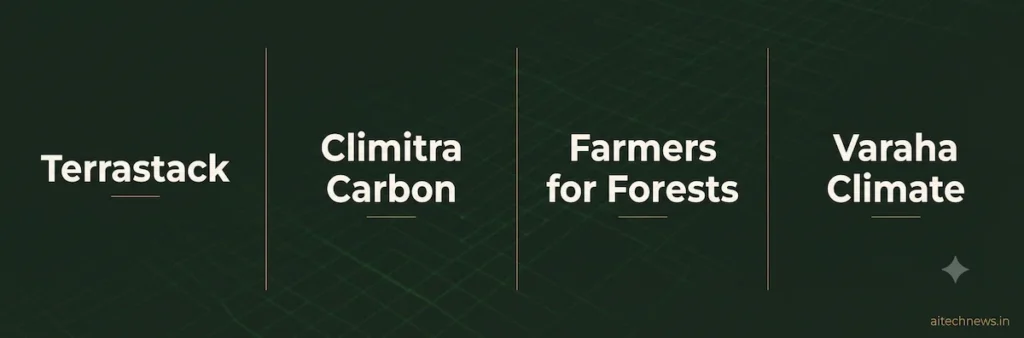
The Four Indian Startups Selected
Terrastack
Plot-level land intelligence for smallholder farmers
Combines satellite imagery with agronomic data to give smallholder farmers plot-level intelligence about their land — turning a farmer’s individual field into a data point Google’s models can actually reason about, rather than lumping entire districts together the way older agri-tech tools do.
Climitra Carbon
Geo-AI for invasive species removal and biochar
Tackles a problem most climate conversations skip past: invasive plant species. Uses Geo-AI to verify when invasive species are removed from land and converts that biomass into biochar, a carbon-storing byproduct increasingly used in soil restoration.
Farmers for Forests
AI-drones for verifiable agroforestry carbon credits
Works at the intersection of agroforestry and carbon markets, using AI-powered drones to turn smallholder tree-planting into measurable, verifiable carbon and biodiversity outcomes — the kind of hard proof that carbon credit buyers demand before they’ll pay.
Varaha Climate
Remote-sensing verification for regenerative farming
Helps smallholder farmers earn carbon credits by verifying regenerative farming practices through remote sensing — effectively acting as an AI auditor that can confirm a farmer really did what they claim, at a scale no human inspection team could manage.
What the Startups Actually Get
This isn’t a cash grant. Over the next three months, the selected teams get access to Google’s frontier AI stack, hands-on technical mentorship from Google engineers, and product-development support to help them scale. The models on offer include AlphaEarth Foundations, Google DeepMind’s planetary mapping model; SpeciesNet, used for identifying wildlife from camera-trap images; Perch, a bioacoustics model for detecting species by sound; and two lesser-known additions — ForestCast, for predicting deforestation risk, and AnthroKrishi.
That last one is worth pausing on. AnthroKrishi isn’t a Silicon Valley import — it’s a Google agricultural-AI research effort that originated in India, built specifically to model how farming decisions ripple through Indian agricultural ecosystems. Four Indian climate startups are now getting mentored using a Google AI model that itself grew out of Indian farm data. That’s not a detail Google’s own announcement made much of, but it’s arguably the most India-relevant part of the whole story.
Why This Matters Beyond the Headline
India’s climate-tech sector has spent the last two years hearing that AI compute is expensive, frontier models are hard to access, and most cutting-edge AI research happens somewhere else. This accelerator quietly complicates that narrative.
It’s also not Google’s first bet on Indian AI talent — the company has run an earlier AI accelerator in India and has backed Indian AI startups before through similar programs.
Four early-stage Indian teams — not IIT research labs, not big corporate sustainability arms — just got picked to sit alongside startups from Singapore, Japan, and Australia and use the same models Google’s own scientists use to map the planet.
For India’s broader AI-for-agriculture push — which already includes government-backed efforts under the IndiaAI Mission — this is a signal that Indian climate-AI founders are being taken seriously on a regional stage, without a compute subsidy or a government grant attached.
How to Apply for the Next Cohort
Google hasn’t announced dates for a second intake yet, but interested startups, nonprofits, and research teams can register interest through Google’s accelerator page to be notified when the next application window opens.
FAQs
What is Google DeepMind’s AI for the Planet Accelerator?
It’s a three-month, equity-free programme that gives startups, nonprofits, and research teams across Asia-Pacific access to Google’s frontier AI models, mentorship, and technical support to build climate and environmental solutions.
Which Indian startups were selected?
Four: Terrastack, Climitra Carbon, Farmers for Forests, and Varaha Climate — working on land intelligence, invasive-species biochar, agroforestry carbon credits, and regenerative-farming verification.
Can other Indian startups apply for the next cohort?
Yes. Google hasn’t announced dates yet, but interested teams can register on the accelerator’s official page to be notified when applications reopen.
Disclaimer: This article is based on details published by Google DeepMind and is intended for informational purposes. All facts, company names, and programme details have been sourced from the original announcement. Read the official post here: Backing 16 green AI projects in Asia-Pacific — Google Blog.