
Moonshot AI’s Kimi K3 open weights are scheduled to publish on Hugging Face at 00:00 UTC on July 27, 2026 — roughly 5:30 AM IST — making the 2.8-trillion-parameter model the largest open-weight AI release in history. Every global outlet is going to tell you this happened. What almost none of them will tell you is whether it actually changes anything for a developer or startup CTO sitting in Bengaluru, Pune, or Gurugram today. That’s the question this article answers.
We’ve read through Moonshot’s own technical blog, cross-checked hardware and licensing claims against independent trackers, and worked out the real rupee math — not the marketing math — of what self-hosting a model this size would cost an Indian team. If you’re deciding whether to get excited or get skeptical, start here.
What Kimi K3 Open Weights Actually Mean for India
Kimi K3 has technically been usable since July 16, 2026, when Moonshot AI launched it at the World AI Conference in Shanghai on Kimi.com, the Kimi Code CLI, Kimi Work, and a pay-as-you-go API. What’s new on July 27 is the release of the actual downloadable model weights — the files an organization would need to run K3 on its own servers instead of renting access from Moonshot.
That distinction matters more in India than almost anywhere else. India is currently the single largest geography by weekly Claude usage after the US, and ChatGPT usage in India has crossed 100 million weekly active users — meaning Indian developers and enterprises are already deeply dependent on foreign-hosted AI infrastructure. A frontier-class open-weight model gives Indian teams, for the first time, a credible option to run a genuinely capable model inside their own infrastructure, inside Indian borders, without being locked into a single provider’s servers.
That’s the opportunity. It comes with real caveats, which is where most coverage stops short.
What’s Actually Confirmed vs What’s Still an Assumption
Before you plan around this release, separate the facts from the hype:
✓ Confirmed by Moonshot AI directly
- 2.8 trillion total parameters — mixture-of-experts (MoE) architecture with 896 experts, only 16 active per token (~50B active parameters).
- 1-million-token context window with native multimodal (vision) capability.
- Two new architecture components — Kimi Delta Attention (KDA) and Attention Residuals — which Moonshot says deliver faster decoding on long-context tasks and ~25% higher training efficiency.
- Open weights scheduled for July 27, 2026 on Moonshot’s official Hugging Face org (huggingface.co/moonshotai), alongside a full technical report.
! Not Yet Confirmed as of Publishing
- The exact commercial license. K2 shipped Modified MIT, and K3 is expected to follow — but the real license text only ships with the weights. Don’t commit a production roadmap until you’ve read it yourself.
- The final file size and quantization format at launch — independent estimates range from ~594 GB to 1.4 TB depending on precision.
- Independent, reproduced benchmark numbers. All performance claims so far are Moonshot’s own; no outside lab has verified them on hardware the company doesn’t control.
A note on scale, since “largest ever” gets repeated without context: 2.8 trillion parameters is a measure of capacity, not necessarily of output quality. On public leaderboards, Kimi K3 currently ranks close to, but not ahead of, the strongest closed models from Anthropic and OpenAI — it’s the closest an open model has come to the frontier, not a new frontier itself.
The Hardware Reality: Can an Indian Startup Actually Self-Host This?
This is the part that gets glossed over in the “biggest open model ever, download it free” headlines. Free refers to the license, not the infrastructure.
Even using 4-bit MXFP4 quantization, Kimi K3’s weights need roughly 1.4 terabytes of fast GPU memory resident at once, before you even load a context window. Moonshot itself recommends a minimum of 64 accelerators for serving the model at production quality. As a reference point, running the smaller 1-trillion-parameter Kimi K2.7 Code model already requires around 577 GB of VRAM at INT4 — K3 needs considerably more.
In practical terms:
The Hardware Reality Check
- A single high-end workstation, a Mac Studio, or a consumer GPU (even an RTX 4090) cannot run full Kimi K3 at any precision.
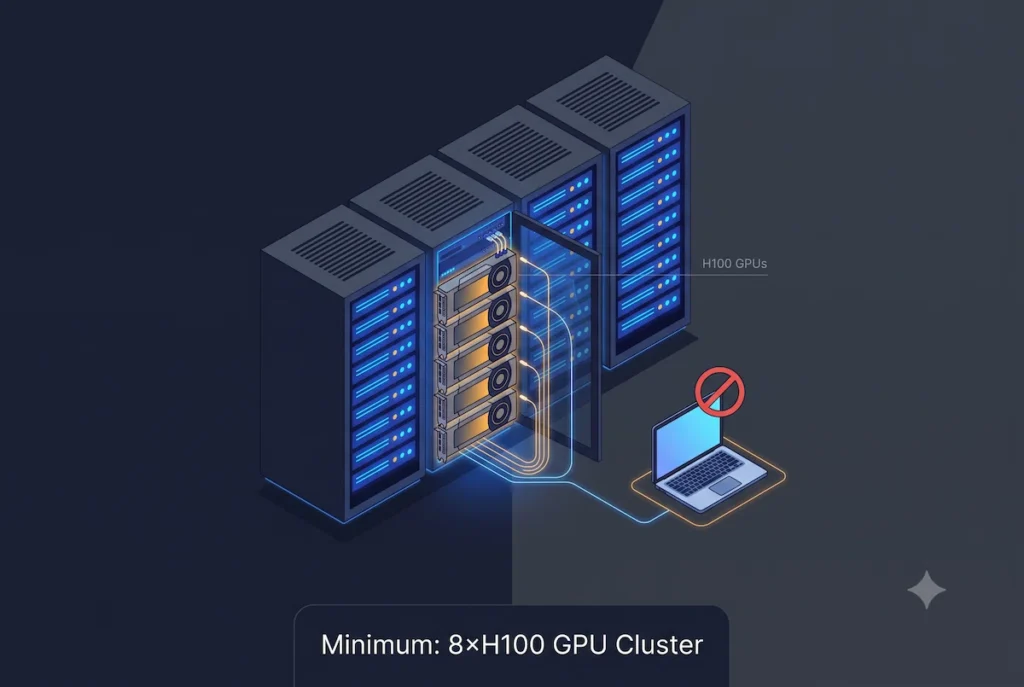
- The realistic minimum is an 8×H100 80GB server just to load the model — and Moonshot’s own recommendation of 64+ accelerators implies most real deployments will need a multi-node cluster.
- For almost every Indian startup outside of the largest AI-infrastructure players (think Yotta, E2E Networks, or similar GPU-cloud operators), this rules out on-premise self-hosting entirely.
The honest options for an Indian team are: (1) keep using Moonshot’s hosted API, (2) rent capacity from an Indian or international GPU cloud that hosts K3 for you, or (3) skip K3 for your workload and use a smaller open model you can actually run.
Hosted API vs Self-Hosting: The ₹ Math Nobody’s Doing for India
Moonshot’s hosted API for K3 is priced at roughly $3 per million input tokens and $15 per million output tokens — translating to approximately ₹258 per million input tokens at current exchange rates. That is not the “cheap open-source” story that DeepSeek created earlier this year; K3 is priced closer to a premium frontier model than a budget alternative.
That reframes the real decision for Indian teams:
The Data Sovereignty Angle: Why This Matters More in India Than It Sounds
Here’s the detail that gets buried under the benchmark charts. When you use Moonshot’s hosted API or the Kimi.com web app, your prompts and data are processed on infrastructure that falls under China’s National Intelligence Law — a legal framework that can compel Chinese companies to share data with state authorities on request.
For Indian teams working with anything covered by the Digital Personal Data Protection Act (DPDPA), 2023, or handling regulated data in fintech, healthcare, or government-linked projects, routing that data through a China-hosted API is a real compliance question, not a hypothetical one.
Self-hosting the open weights — on your own servers or through an Indian GPU cloud provider — inverts that risk. Once you’re running the weights yourself, your prompts never leave your infrastructure, and Moonshot never sees your data at all. This is the single strongest argument for Indian enterprises to care about the July 27 weights release, even though very few teams will have the infrastructure to act on it immediately. It’s also why India’s own sovereign-AI push — through players like Sarvam AI and the IndiaAI Mission — has taken on new urgency as capable open models increasingly originate from China.
The Geopolitical Backdrop You Should Know Before You Adopt This
Before routing anything through Kimi K3, Indian teams should be aware of an unresolved controversy: on July 22, 2026, White House Office of Science and Technology Policy Director Michael Kratsios publicly accused Moonshot AI of large-scale covert distillation of Anthropic’s Fable model to help build K3, and separately alleged Moonshot accessed export-restricted Nvidia GB300 chips through Thailand-based infrastructure.
Reality check: these are allegations from a US government official, not findings from an independent audit, and Moonshot has not issued a public response as of this writing. We’re flagging it because it’s directly relevant to any organization evaluating K3’s provenance and long-term trustworthiness — not because it’s been proven. Treat it as an open question to monitor, not a settled fact either way.
Separately, Moonshot disclosed a cross-user data isolation failure in April 2026, where one user’s resume was mistakenly shown to a different user during a document-translation task — an incident the OECD’s AI Incidents Monitor catalogued, and one Moonshot did not publicly address at the time. This is a genuine track record data point for any team weighing self-hosting (which would eliminate this specific risk) against continued use of the hosted platform.
The Verdict: What Should Your Indian Startup Actually Do Today?
Cutting through the hype cycle, here’s a practical framework:
Use the hosted API to evaluate K3 for hard coding or long-context tasks. Don’t attempt to self-host — the hardware requirement makes it impractical below enterprise scale.
Wait for the license file to publish alongside the weights before making any roadmap commitments, and benchmark K3 against your actual workloads — not published leaderboard numbers.
The self-hosting-for-sovereignty argument is real and worth exploring through an Indian GPU cloud partner — but budget for a genuine multi-GPU deployment, not a weekend project.
Know that K3’s API pricing is premium-tier, not budget-tier. The savings case is about avoiding long-term dependency, not cheap tokens.
- If you’re a solo developer or small team: use the hosted API to evaluate K3 for hard coding or long-context tasks. Don’t attempt to self-host — the hardware requirement makes it impractical below enterprise scale.
- If you’re a mid-size startup with real infrastructure budget: wait for the license file to publish alongside the weights before making any roadmap commitments, and benchmark K3 against your actual workloads rather than published leaderboard numbers.
- If you handle regulated or sensitive Indian user data: the self-hosting-for-sovereignty argument is real and worth exploring through an Indian GPU cloud partner — but budget for a genuine multi-GPU deployment, not a weekend project.
- If you’re evaluating this purely for cost savings: know that K3’s API pricing is premium-tier, not budget-tier. The savings case is about avoiding long-term dependency, not cheap tokens.
Frequently Asked Questions
Is Kimi K3 actually free to use?
The open weights are free to download once released, but “free” only covers the license — running the model at production scale requires significant GPU infrastructure that is not free.
Can I run Kimi K3 on my laptop or a single GPU?
No. Even in its most compressed 4-bit format, K3 needs roughly 1.4 TB of fast memory resident, requiring a multi-GPU server at minimum.
Is Kimi K3 safe for Indian businesses to use?
Through Moonshot’s hosted API, your data is processed under Chinese jurisdiction, which may not suit regulated Indian data. Self-hosting the open weights removes that specific risk, provided you have the infrastructure to do so.
How does Kimi K3 compare to DeepSeek V4 or Claude for Indian developers?
K3 currently ranks near, but not ahead of, the strongest closed frontier models on public benchmarks. It’s priced closer to a premium API than DeepSeek’s budget positioning, so the choice should be based on your specific workload, not headlines calling it “the biggest.”