
Key Takeaways
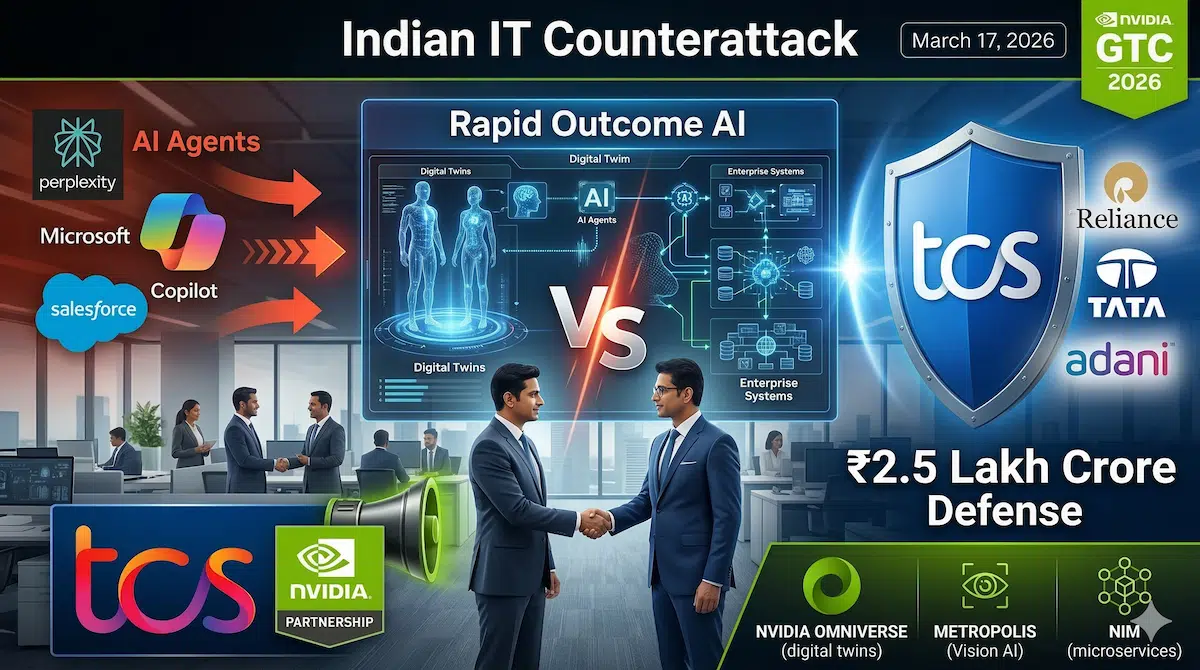
- TCS launched Rapid Outcome AI platform powered by NVIDIA on March 17, 2026—direct counterattack to AI agent threats from Perplexity Computer and Microsoft Copilot that endangered Indian IT services margins — Platform showcased at NVIDIA GTC 2026 conference positions TCS not as AI victim but as critical enterprise deployment infrastructure layer, selling implementation services rather than competing with AI agents directly, defending ₹2.5 lakh crore Indian IT services industry from automation-driven margin collapse predicted at 40% by Morgan Stanley analysts
- TCS strategy separates AI tool creation from AI production deployment—capturing the implementation gap enterprises face moving from experimentation to scale — While Perplexity and Microsoft sell AI agents, TCS positions itself as the systems integrator connecting those agents to legacy enterprise infrastructure, regulatory compliance frameworks, and industry-specific workflows that AI vendors don’t address, creating defensible margin in the orchestration layer rather than competing in commoditized AI agent market
- NVIDIA partnership provides technical credibility through digital twin simulation, Vision AI agents via Metropolis, and persona-based assistants using NIM microservices — TCS gains access to NVIDIA Omniverse for pre-deployment digital twins allowing enterprises to test AI implementations virtually before risking production systems, NVIDIA Metropolis computer vision for operational monitoring, and NVIDIA NIM inference microservices enabling deployment at scale, differentiating from pure software consultancies lacking infrastructure partnership validation
On March 10, 2026, Perplexity announced Computer Enterprise—an AI agent that autonomously handles complex business workflows, threatening to automate precisely the tasks Indian IT services companies charge hundreds of thousands of dollars to perform. The announcement sent shockwaves through India’s ₹2.5 lakh crore IT services industry. TCS, Infosys, Wipro, and Tech Mahindra faced an existential question: if AI agents can automate software development, data analysis, customer service, and business process management, what margins remain for human-delivered IT services?
Seven days later, on March 17, 2026, Tata Consultancy Services fired back. At NVIDIA’s GTC 2026 conference in San Jose—the industry’s premier AI infrastructure showcase—TCS unveiled Rapid Outcome AI, a comprehensive platform powered by NVIDIA’s latest AI infrastructure designed to move enterprises from AI experimentation to production deployment at scale. The announcement represents TCS’s strategic answer to the AI automation threat: don’t compete with AI agents, become the infrastructure layer enterprises need to actually use them.
The distinction matters critically. Perplexity, Microsoft Copilot, Salesforce Agentforce, and dozens of other AI vendors sell capabilities—what AI can theoretically accomplish in controlled demonstrations. TCS is betting enterprises will pay for implementation—the unglamorous work of integrating AI into existing systems, navigating regulatory compliance, training employees, managing change resistance, and ensuring AI operates reliably in production environments where mistakes cost millions.
Why Enterprises Can’t Deploy AI Themselves
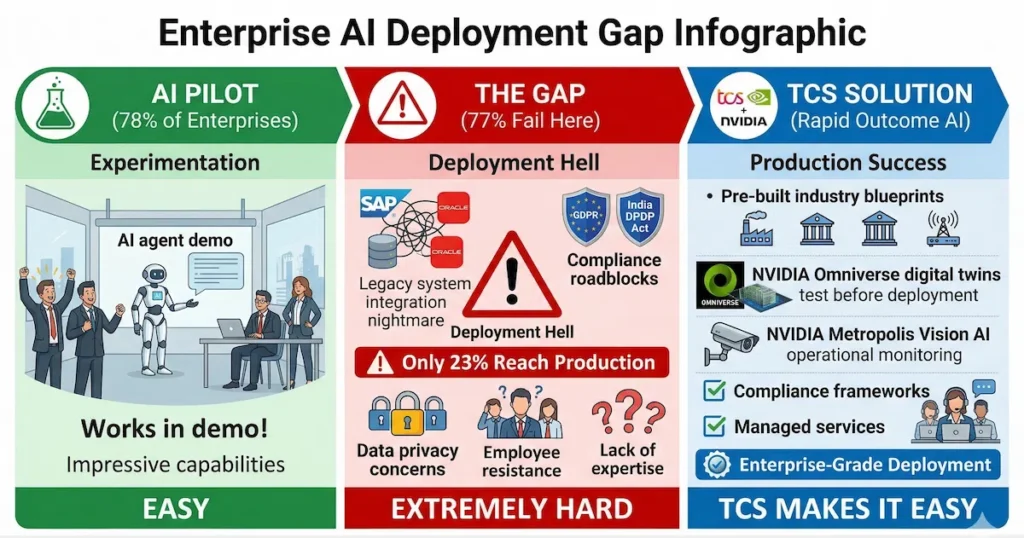
The gap between AI pilot projects and production deployment remains vast despite three years of generative AI hype. Gartner’s 2026 CIO Survey found 78% of enterprises ran AI pilot projects in 2025, but only 23% successfully moved those pilots to production serving actual business operations. The failure modes are predictable: AI models trained on generic data don’t understand company-specific processes, integration with 20-year-old legacy systems requires custom middleware nobody wants to build, compliance teams block deployment due to data privacy concerns, and IT departments lack personnel who understand both AI capabilities and enterprise infrastructure.
TCS identified this implementation gap as defensible territory. While AI agents automate individual tasks brilliantly in demonstrations, enterprises need those agents integrated into SAP systems processing procurement, connected to Salesforce managing customer relationships, compliant with GDPR and India’s Digital Personal Data Protection Act, monitored for accuracy and bias, and supported by teams who can troubleshoot when AI produces incorrect outputs. This integration work doesn’t scale automatically the way software does—it requires human expertise understanding both the AI capabilities and the client’s specific business context.
Rapid Outcome AI provides pre-built blueprints for common enterprise scenarios across manufacturing, telecommunications, banking, retail, life sciences, and engineering. Rather than starting from scratch with each client, TCS offers industry-specific templates demonstrating how AI deploys in factory operations, network optimization, fraud detection, inventory management, drug discovery, or product design. The templates leverage NVIDIA infrastructure—compute clusters for training and inference, Omniverse for digital twin simulation, Metropolis for computer vision, and NIM microservices for deploying models at scale.
The NVIDIA Advantage: Technical Credibility Beyond Consulting
TCS’s partnership with NVIDIA differentiates Rapid Outcome AI from pure software consulting offerings. NVIDIA doesn’t just provide chips—it supplies the full infrastructure stack enterprises need for AI deployment. This includes hardware (GPUs, networking, servers), software frameworks (CUDA, TensorRT, Triton Inference Server), and pre-trained foundation models enterprises can customize for specific use cases.
The digital twin capability via NVIDIA Omniverse particularly addresses enterprise risk aversion. Before deploying AI agents in actual production environments—where mistakes might halt manufacturing lines, trigger compliance violations, or cause customer service disasters—enterprises can simulate the deployment in a virtual twin of their infrastructure. This allows testing how AI agents interact with existing systems, identifying failure modes, and training employees in a risk-free environment. Only after simulation validates the approach does deployment proceed to production.
NVIDIA Metropolis computer vision brings AI monitoring to physical operations. Manufacturing clients can deploy Vision AI agents that monitor production lines for defects, safety violations, or efficiency bottlenecks—use cases where Perplexity’s software agents lack relevance because they can’t process video feeds from factory floors. This expands TCS’s addressable market beyond software automation into industrial AI where physical world integration matters.
The NIM microservices framework solves deployment scalability. Running AI models efficiently in production requires optimizing inference performance, managing memory usage, load balancing requests, and updating models without downtime. NVIDIA NIM packages these capabilities as ready-to-deploy microservices, reducing the custom engineering each enterprise deployment previously required.
The Margin Defense Mathematics
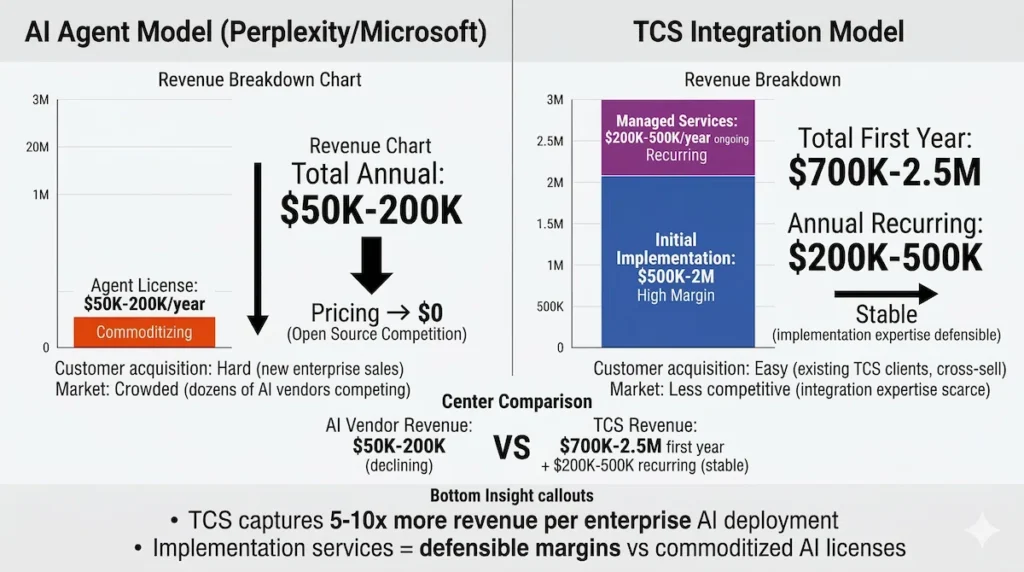
TCS’s strategy bets that implementation services command higher margins than commoditized AI agent licenses. Consider a typical enterprise AI deployment: the AI agent license might cost $50,000-200,000 annually, but implementation requires 6-12 months of integration work costing $500,000-2,000,000 in consulting fees, plus ongoing managed services generating $200,000-500,000 annually. TCS captures the larger implementation and managed services revenue while AI vendors compete on agent pricing that trends toward zero as open-source models commoditize capabilities.
This model works if—and only if—enterprises actually need implementation help at scale. If AI agents become sufficiently easy to deploy that enterprises handle integration internally, TCS’s margin defense collapses. The race is whether TCS can establish itself as the standard enterprise AI deployment layer before AI vendors simplify implementation enough to eliminate the integration gap.
Early indicators suggest TCS positioned correctly. The platform targets TCS’s existing enterprise clients—companies already paying TCS for IT services who trust TCS with business-critical systems. Cross-selling AI implementation to current clients requires less sales effort than Perplexity acquiring enterprise customers from scratch. TCS also benefits from incumbency: enterprises resist switching vendors managing critical infrastructure, creating switching costs that protect TCS relationships even as AI capabilities commoditize.
What This Means for India’s IT Services Industry
TCS’s Rapid Outcome AI launch provides a template other Indian IT giants will likely follow. Infosys, Wipro, and Tech Mahindra face identical threats from AI automation and possess similar enterprise client relationships where they could sell implementation services. If the model succeeds, India’s IT services industry transforms from selling labor arbitrage—cheaper Indian engineers performing tasks Western companies outsource—to selling AI integration expertise that Western enterprises lack regardless of geography.
The employment implications shift significantly. Rather than 5.4 million Indians writing code, analyzing data, and managing business processes that AI increasingly automates, Indian IT firms would employ AI integration specialists, industry experts who understand client business contexts, and managed services teams monitoring AI systems. These roles require different skills—less pure programming, more understanding of AI capabilities, enterprise systems, and industry-specific requirements.
The success of this transition determines whether Indian IT services thrives or contracts through the 2020s. If TCS proves enterprises will pay premium margins for AI implementation, the industry survives automation by moving up the value chain. If AI deployment simplifies enough that enterprises handle it internally, the margin defense fails and Indian IT faces the contraction Morgan Stanley warned about. TCS just made its bet. The market will judge within 12-18 months whether the empire struck back successfully or merely delayed the inevitable.
FAQs
How does TCS Rapid Outcome AI differ from using Perplexity Computer or Microsoft Copilot directly?
TCS Rapid Outcome AI doesn’t compete with Perplexity or Microsoft Copilot—it solves the integration problem those tools create. Perplexity Computer provides AI agents that automate tasks, but enterprises face a deployment gap: how do these agents access our legacy SAP systems? How do we ensure compliance with industry regulations? How do we train employees to work alongside AI? How do we monitor for errors? TCS positions Rapid Outcome AI as the infrastructure layer connecting AI agents to enterprise reality. The platform includes pre-built industry blueprints showing how AI deploys in manufacturing, banking, telecom, and retail; NVIDIA Omniverse digital twins for testing deployments before risking production systems; NVIDIA Metropolis computer vision for physical operations monitoring; and managed services ensuring AI operates reliably long-term. Enterprises could theoretically handle this integration themselves, but Gartner data shows 77% of AI pilots fail to reach production—TCS bets companies will pay for implementation expertise rather than learning through expensive failures.
Why did TCS partner with NVIDIA instead of building their own AI infrastructure?
NVIDIA partnership provides technical credibility and infrastructure TCS couldn’t replicate independently. NVIDIA dominates AI compute with 80%+ market share in AI training chips and comprehensive software ecosystem (CUDA, TensorRT, Triton). Enterprises trust NVIDIA-certified infrastructure more than TCS-built alternatives because NVIDIA invests $8+ billion annually in R&D developing cutting-edge AI capabilities. The partnership also accelerates TCS’s go-to-market—instead of spending years developing digital twin simulation, computer vision frameworks, and inference optimization, TCS leverages existing NVIDIA Omniverse, Metropolis, and NIM technologies with instant credibility. Additionally, many TCS enterprise clients already use NVIDIA infrastructure for AI experimentation, so TCS offering NVIDIA-powered production deployment creates natural progression from client pilot projects to TCS-managed scaled deployment. Building proprietary infrastructure would position TCS competing against NVIDIA rather than leveraging NVIDIA’s market dominance to capture the implementation services layer.
Will TCS Rapid Outcome AI protect Indian IT services jobs from AI automation?
Partially, but with significant workforce transformation required. TCS’s strategy shifts Indian IT from labor arbitrage to AI integration expertise. Traditional roles—software developers writing routine code, data analysts producing standard reports, customer service agents answering common questions—face automation by AI agents regardless of TCS’s platform. However, TCS creates new role categories: AI integration specialists configuring agents for enterprise environments, industry experts who understand client business contexts AI doesn’t grasp, compliance specialists ensuring AI meets regulatory requirements, and managed services teams monitoring AI systems and troubleshooting failures. These roles require different skills than traditional IT work—less pure coding ability, more understanding of AI capabilities, enterprise architecture, and specific industry domains. If TCS successfully transitions its 616,000 employees toward these integration roles, Indian IT employment stabilizes at lower headcount but higher value per employee. If the transition fails because AI deployment simplifies faster than TCS builds new capabilities, job losses accelerate. The 12-18 month window determines outcome—TCS must prove enterprises will pay premium margins for AI implementation before AI vendors eliminate the integration gap through better tooling.
Can smaller Indian IT companies like Infosys and Wipro replicate TCS’s NVIDIA partnership strategy?
Yes, and they likely will within 3-6 months if TCS shows early traction. NVIDIA partners with multiple systems integrators—Accenture, Deloitte, IBM all announced similar AI infrastructure partnerships in 2025-2026. Infosys already partners with NVIDIA on AI-powered chip design services and could expand into broader enterprise AI deployment. Wipro and Tech Mahindra possess equivalent enterprise client relationships where they could cross-sell implementation services. The defensibility for TCS comes from execution speed rather than exclusive access—being first to market with comprehensive enterprise AI deployment blueprints, training their workforce on NVIDIA infrastructure before competitors, and securing long-term managed services contracts with existing clients before Infosys/Wipro launch competing offerings. However, the total addressable market for enterprise AI deployment likely supports multiple large integrators, so Infosys and Wipro copying TCS’s strategy doesn’t necessarily kill TCS’s opportunity. The real competitive threat comes from AI vendors simplifying deployment enough to eliminate the integration gap entirely, making all systems integrators obsolete regardless of NVIDIA partnerships.