
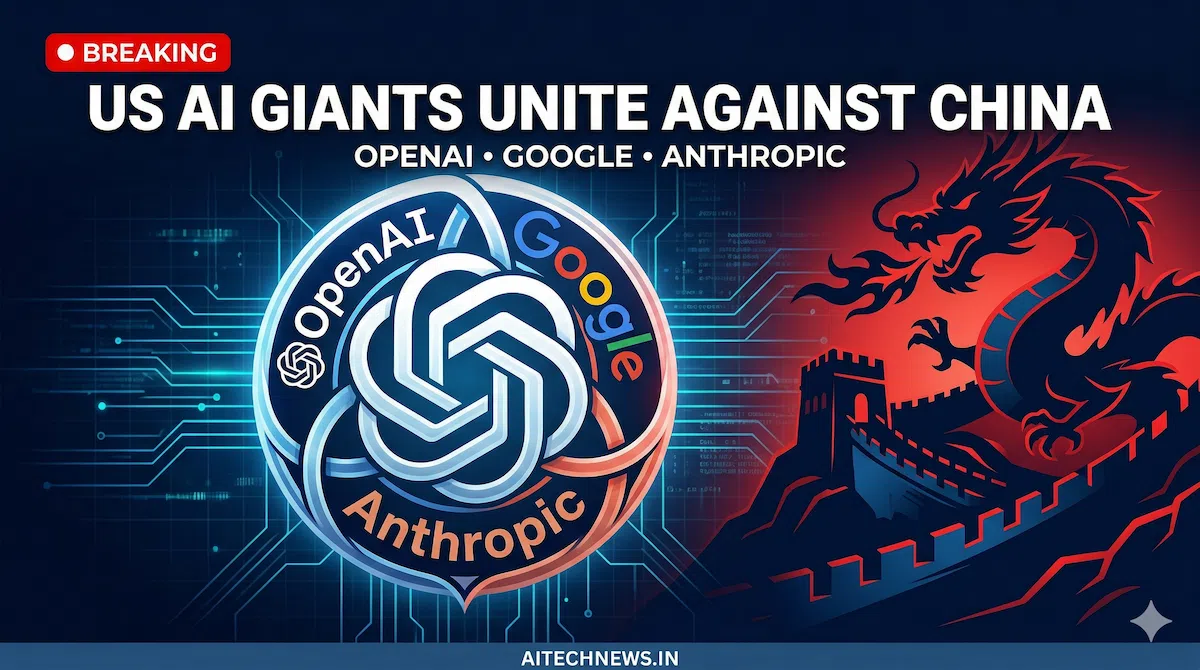
For the first time in the history of Silicon Valley’s AI wars, the three biggest names in artificial intelligence — OpenAI, Google, and Anthropic — stopped competing long enough to fight a common enemy.
On April 7, 2026, Bloomberg and The Japan Times confirmed that the three companies have started sharing threat intelligence through the Frontier Model Forum to stop Chinese AI firms from secretly copying their most powerful AI models.
The collaboration, described as rare by people familiar with the matter, is happening right now — and the ripple effects will reach every developer and startup in India building on top of these platforms.
This is not a vague policy disagreement. Since at least early 2026, Chinese AI companies — specifically DeepSeek, a model Indian developers have been actively comparing to ChatGPT, along with Moonshot AI and MiniMax — have been accused of running what Anthropic called “industrial-scale campaigns” to steal knowledge from American AI models.
The method is called adversarial distillation: flood a powerful AI model with millions of specially crafted prompts, collect its responses, and use those to train a cheaper copycat model — at a fraction of the original cost. Anthropic estimated the three firms collectively ran over 16 million exchanges with Claude through approximately 24,000 fraudulently created accounts, all while Claude is officially unavailable in China.
The companies allegedly bypassed geographic restrictions using commercial proxy services. OpenAI separately told the U.S. House Select Committee on China that DeepSeek was developing new, obfuscated methods to disguise what it was doing.
What This Means for India
India has over 3,000 AI startups and a developer community that overwhelmingly builds on ChatGPT, Claude, and Gemini APIs. For a country of 1.4 billion people racing to lead in AI, this story is not just geopolitics — it is a practical warning. Stricter API monitoring, tighter KYC verification, and account throttling are already rolling out across American AI platforms. Indian developers who run high-volume API queries — for legitimate reasons like AI product development, research, or automation — may start facing tighter rate limits and additional compliance checks.
Enterprises in India using these APIs for production workloads should review their usage patterns and ensure they are clearly operating within platform terms of service. At a time when India is trying to position itself as a trusted global AI partner, being caught in a dragnet of suspicious activity — even accidentally — is a risk no Indian startup can afford to take.
Key Details at a Glance
- Who: OpenAI, Anthropic, and Google (all three co-founders of the Frontier Model Forum, along with Microsoft, which launched it in July 2023)
- What: The three rivals are now sharing intelligence to detect “adversarial distillation” attacks — where Chinese firms secretly extract AI capabilities from American models in violation of terms of service
- Accused firms: DeepSeek, Moonshot AI, and MiniMax — all China-based AI companies
- Scale of attack: Over 16 million exchanges extracted through approximately 24,000 fraudulent accounts, according to Anthropic’s February 2026 disclosures
- Money at stake: OpenAI and Anthropic alone have spent over $18 billion cumulatively on R&D compute since 2024, per data from EpochAI — the investment these distillation attacks are accused of undermining
What Happens Next
Anthropic has already been at the center of a major U.S. government controversy over AI usage in defense, making this new collaboration all the more significant.
The U.S. government is already moving. The Institute for AI Policy and Strategy has recommended adding distillation-attack companies to the BIS Entity List and exploring PAIP Act sanctions — the first PAIP Act designations were made on February 24, 2026. A NIST-led AI Distillation Defense Framework covering the broader ecosystem is also under discussion. Meanwhile, Anthropic has said it has built real-time detection measures but warned that no single company can solve this problem alone — which is exactly why the Frontier Model Forum collaboration matters.
Expect tighter API access controls, mandatory usage disclosures, and stricter account verification to become the new normal across all major AI platforms in the coming months.
FAQs
Q1: What is adversarial distillation, and why is it illegal?
Adversarial distillation is when someone runs millions of queries through a frontier AI model — like ChatGPT or Claude — collects those responses, and uses them to train a competing model, essentially copying the original’s capabilities at a fraction of the development cost. It becomes a violation when done without permission and in breach of the platform’s terms of service, which all major American AI providers explicitly prohibit. The key distinction from normal distillation is intent and scale — legitimate distillation is done by the same company on its own models.
Q2: How does the OpenAI-Google-Anthropic collaboration actually work?
The three companies are sharing threat intelligence through the Frontier Model Forum — a nonprofit they co-founded with Microsoft in July 2023 originally for AI safety research. They are now using the Forum’s trusted information-sharing mechanisms to flag suspicious usage patterns, account clusters, and extraction techniques to one another in real time. Think of it as a shared security operations center, but for AI model protection across three competing companies.
Q3: Should Indian developers using ChatGPT or Claude APIs be worried?
Legitimate users operating within platform terms of service have nothing to worry about from a legal standpoint. However, Indian developers should expect practical changes: tighter rate limits, stricter KYC requirements, and more aggressive flagging of unusual traffic patterns are already rolling out. If your product runs high-volume, automated API calls — which many Indian AI startups do — it is worth reviewing your integration to ensure it looks clearly legitimate to automated monitoring systems.
Sources: Bloomberg (April 7, 2026), The Japan Times (April 7, 2026), CNBC (February 24, 2026), Euronews (February 26, 2026), Institute for AI Policy and Strategy, Microsoft Blog (July 26, 2023)