
Key Takeaways
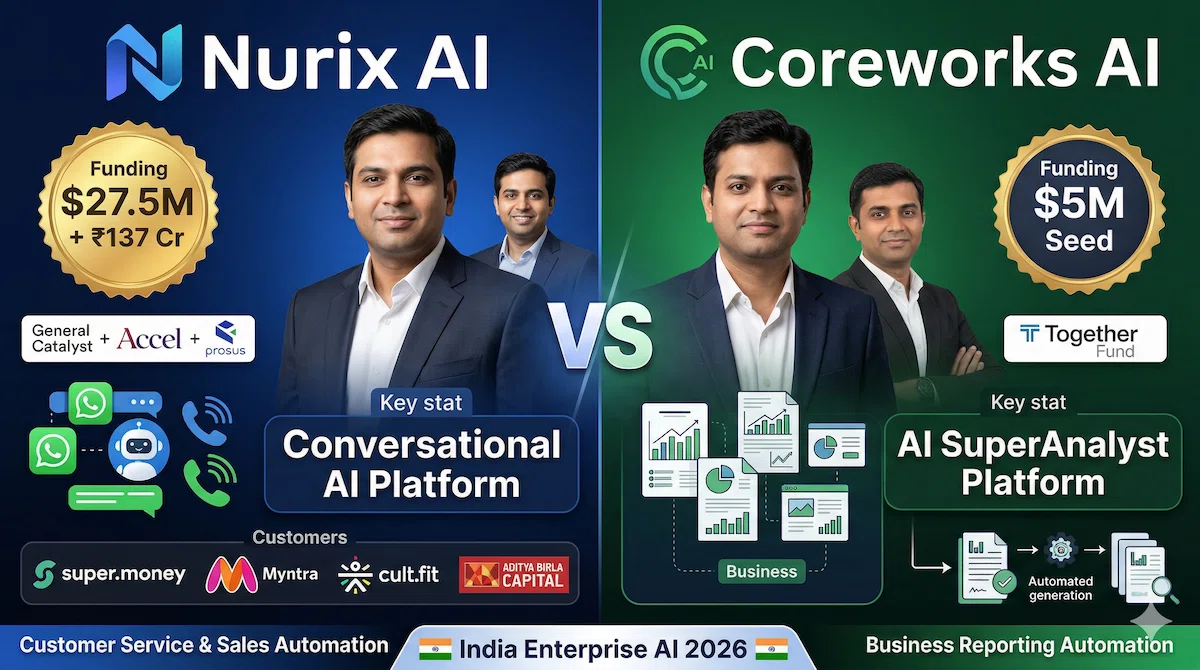
- Nurix AI raised $27.5 million in combined seed and Series A funding led by General Catalyst and Accel in September 2024, with additional ₹137 crore from Prosus in March 2026, positioning as India’s leading conversational AI platform for customer service and sales automation — Founded by Mukesh Bansal (Myntra, Cult.fit) and Abhishek Asawa, Nurix deploys AI voice and chat agents handling customer queries, sales calls, and operational workflows for clients including super.money, Myntra, Cult.fit, and Aditya Birla Capital, competing against international players like Intercom AI and Zendesk AI while offering superior Hindi and regional language support critical for Indian customer bases
- Coreworks AI secured $5 million seed funding from Together Fund in March 2026 to build AI SuperAnalyst platform automating business reporting and presentation creation from ERP and CRM data — Founded by UNBXD veterans Prashant Kumar and Pavan Sondur (who previously achieved $100 million exit), Coreworks targets finance teams, business analysts, and executives spending hours manually compiling reports by automatically generating financial summaries, investor presentations, and board decks from raw business data, addressing entirely different market than Nurix’s customer-facing automation
- The two startups represent distinct enterprise AI categories with minimal competitive overlap—Nurix automates customer-facing conversations while Coreworks automates internal business intelligence reporting — Indian enterprises could deploy both simultaneously: Nurix handling customer support via WhatsApp and phone calls while Coreworks generates monthly financial reports and investor presentations, serving different organizational needs (customer success teams versus finance/analytics teams) with separate budgets and decision-makers, illustrating how India’s enterprise AI market supports multiple specialized winners rather than winner-take-all dynamics
India’s enterprise AI market in 2026 produces startups solving radically different problems under the same “automation” umbrella. Two companies launched within 18 months—both backed by top-tier venture capital, both founded by proven entrepreneurs, both targeting Indian enterprises—yet competing in entirely separate categories with minimal customer overlap.
Nurix AI, founded by Mukesh Bansal (Myntra, Cult.fit exits totaling $1+ billion) focuses on conversational AI agents that talk to customers via phone calls, WhatsApp messages, and chat interfaces. The platform handles customer support queries, sales qualification calls, appointment scheduling, order status inquiries, and payment reminders—anywhere businesses interact with customers through conversation.
Coreworks AI, founded by Prashant Kumar and Pavan Sondur (UNBXD founders who achieved $100 million exit) builds what they call an “AI SuperAnalyst” that generates business reports and presentations from raw ERP and CRM data. The platform automates financial reporting, investor deck creation, board presentation compilation, and business intelligence analysis—tasks currently consuming hours of analyst and finance team time.
The distinction matters critically for understanding India’s enterprise AI landscape. These aren’t competitors fighting for the same customer budget. They solve different problems for different buyers within the same company. A fintech startup might use Nurix to automate customer support calls while simultaneously using Coreworks to generate monthly investor reports—both delivering ROI in separate operational areas.
This comparison evaluates both startups across founder pedigree, funding strength, technology approach, target markets, and realistic use cases, while explaining why the Indian enterprise AI market supports multiple specialized platforms rather than consolidating into single winners.
Nurix AI: Mukesh Bansal’s Conversational AI Platform
Founder Background: Mukesh Bansal brings unparalleled founder credibility to Indian enterprise technology. He founded Myntra in 2007, scaled India’s leading fashion e-commerce platform, and sold to Flipkart for $300+ million in 2014. After serving as Flipkart’s Chief Product Officer, he co-founded Cult.fit in 2016, building India’s largest integrated fitness platform valued at $1.5+ billion. This track record signals not just startup success but operational excellence at scale—critical for enterprise customers evaluating technology vendors for business-critical workflows.
His co-founder Abhishek Asawa brings product and engineering expertise from building consumer technology products. The combination—Bansal’s enterprise credibility plus Asawa’s technical execution—positions Nurix for both enterprise sales success and product delivery reliability.
Funding Trajectory: Nurix raised $27.5 million across seed and Series A rounds in September 2024, led by General Catalyst and Accel. General Catalyst’s participation is particularly significant—they backed Stripe, Instacart, and other infrastructure companies that became category-defining platforms. Accel’s involvement continues their India enterprise software thesis that funded Freshworks (now $6+ billion public company) and other B2B successes.
In March 2026, Nurix secured additional ₹137 crore ($16.5 million) from Prosus, the Dutch technology investor that backs numerous Indian consumer and enterprise companies. This follow-on funding 18 months after the Series A suggests strong revenue traction and customer growth, as sophisticated investors like Prosus conduct extensive due diligence before deploying capital.
Total funding raised: approximately $44 million across three rounds in under 18 months—exceptional velocity indicating strong investor confidence and likely customer adoption metrics supporting aggressive expansion.
Technology and Product: Nurix builds conversational AI agents—both voice (phone calls) and text (WhatsApp, SMS, web chat)—that handle customer interactions autonomously. The platform integrates with business software (CRMs like Salesforce and Zoho, ticketing systems like Freshdesk, payment platforms like Razorpay) to access customer data, process transactions, and log interactions.
Key differentiators versus international conversational AI platforms:
Hindi and Regional Language Excellence: Nurix agents handle conversations in Hindi, Tamil, Telugu, Kannada, and Hinglish (Hindi-English code-mixing common in Indian customer conversations). International platforms like Intercom AI and Zendesk AI optimize for English, treating Indian languages as afterthoughts. For Indian businesses serving vernacular customers, this language capability is non-negotiable.
WhatsApp-First Design: With 487 million WhatsApp users in India, businesses need AI that operates natively on WhatsApp Business API. Nurix built specifically for WhatsApp as primary channel rather than retrofitting web chat technology onto messaging platforms.
Voice Quality for Indian Accents: Phone call automation requires AI understanding diverse Indian English accents and regional language variations. Nurix’s voice recognition handles this variability better than generic speech-to-text systems trained predominantly on American or British English.
Integration with Indian Business Software: Native connections to Zoho (dominant in Indian SMB market), Tally accounting (used by millions of Indian businesses), and Indian payment systems (UPI, Razorpay, Paytm) that international platforms don’t prioritize.
Target Market and Customers: Nurix serves companies with high customer interaction volumes—fintech, e-commerce, healthcare, education, insurance, and consumer services. The platform scales from mid-market companies (200-1,000 employees) to large enterprises (1,000+ employees).
Publicly disclosed customers include:
- super.money: Fintech platform uses Nurix for customer support queries about credit cards, loans, and financial products
- Myntra: Fashion e-commerce (Mukesh Bansal’s previous company) deploys Nurix for order status inquiries and return processing
- Cult.fit: Fitness platform (Mukesh Bansal’s other company) uses Nurix for class scheduling and membership queries
- Aditya Birla Capital: Major financial services conglomerate leveraging Nurix for insurance and loan inquiry handling
This customer roster demonstrates enterprise-grade trust—large, regulated companies in banking and insurance don’t deploy conversational AI without extensive security and compliance validation.
Use Cases and ROI: Nurix delivers measurable return on investment in three primary scenarios:
Customer Support Automation: Companies handling thousands of repetitive queries—order status, refund requests, basic product questions—can automate 60-80% of these interactions. A customer support team of 20 agents costing ₹60 lakh annually can be reduced to 8 agents plus Nurix subscription (estimated ₹12-18 lakh annually), delivering ₹30-40 lakh annual savings while improving response times from hours to seconds.
Sales Qualification: Sales teams waste time on unqualified leads who aren’t ready to buy. Nurix agents conduct initial qualification calls, asking budget, timeline, and need questions before routing serious prospects to human salespeople. This allows a 10-person sales team to focus only on high-intent leads, potentially doubling conversion rates without hiring additional headcount.
Appointment Scheduling and Reminders: Healthcare clinics, beauty salons, fitness studios, and professional services spend significant staff time scheduling appointments and sending reminders. Nurix automates both via WhatsApp, reducing no-shows by 40-60% through timely reminder messages and easy rescheduling.
India-Specific Advantages: Beyond language and WhatsApp capabilities, Nurix addresses regulatory compliance requirements for Indian businesses. Financial services companies face Reserve Bank of India data localization requirements—customer conversation data must remain in India. Nurix operates on Indian cloud infrastructure, ensuring compliance. International platforms routing data through US or European servers create regulatory risk Indian enterprises can’t accept.
Coreworks AI: Business Reporting Automation Platform
Founder Background: Prashant Kumar and Pavan Sondur co-founded UNBXD, an e-commerce search and product discovery platform, in 2012. They scaled UNBXD to serve major retail brands, raised venture capital, and achieved a $100 million exit (buyer undisclosed, transaction completed 2023-2024 timeframe based on their founding Coreworks in October 2025).
This successful exit provides several advantages for Coreworks. First, credibility with venture investors—founders who returned capital to previous investors get follow-on funding more easily. Second, deep understanding of e-commerce and retail business operations from UNBXD customer interactions. Third, financial runway from exit proceeds to bootstrap Coreworks before raising institutional capital.
Unlike Mukesh Bansal’s consumer brand recognition, Kumar and Sondur bring B2B enterprise software expertise—they sold to enterprise customers for over a decade at UNBXD, understanding enterprise sales cycles and product requirements.
Funding and Investors: Coreworks raised $5 million seed round in March 2026 from Together Fund, a newer venture capital fund focused on AI and automation startups. The $5 million seed size is substantial—Indian B2B SaaS seed rounds typically range $1-3 million, suggesting Together Fund’s strong conviction in the market opportunity and founding team.
Seed funding generally provides 18-24 months runway to validate product-market fit, acquire initial customers, and demonstrate revenue traction before Series A fundraising. Coreworks’ March 2026 raise means the company has until mid-2027 to prove the business model before needing additional capital.
Technology and Product: Coreworks positions as an “AI SuperAnalyst”—software that performs tasks currently done by business analysts, finance team members, and consultants who manually compile data into reports and presentations.
The platform connects to enterprise data sources—ERP systems (SAP, Oracle, Tally), CRM platforms (Salesforce, Zoho), accounting software (QuickBooks, Xero), and business intelligence tools (Tableau, Power BI). It then automatically generates:
Financial Reports: Monthly P&L statements, cash flow analyses, balance sheet summaries, variance reports comparing actual vs. budget performance, and trend analyses showing revenue growth, expense patterns, and profitability metrics over time.
Investor Presentations: Slide decks for board meetings and investor updates, including key metrics (revenue, growth rate, burn rate, runway), customer acquisition and retention statistics, market positioning updates, and strategic initiative progress reports.
Business Intelligence Dashboards: Executive summaries showing business health across departments, sales pipeline analytics, marketing campaign performance reports, and operational efficiency metrics.
Board Decks: Quarterly or monthly board presentation materials synthesizing business performance, competitive landscape updates, product roadmap progress, and financial projections.
The core value proposition: tasks currently requiring 10-20 hours of analyst time compiling data, creating charts, writing summaries, and formatting PowerPoint slides can be automated to generate first drafts in minutes. Analysts then review, refine, and add context rather than starting from blank spreadsheets.
Target Market and Customers: Coreworks serves finance teams, business analysts, strategic planning groups, and executive leadership at companies with complex business data spread across multiple systems. The buyer is typically CFO, VP Finance, Head of Business Operations, or Chief of Staff to CEO.
The platform scales from mid-sized companies (100-1,000 employees with dedicated finance teams) to large enterprises (1,000+ employees with multiple business units requiring consolidated reporting).
Unlike Nurix’s customer-facing automation, Coreworks addresses internal operational efficiency—nobody outside the company sees these reports, but creating them consumes significant highly-paid knowledge worker time.
Use Cases and ROI: Coreworks delivers value in three scenarios:
Monthly/Quarterly Reporting Acceleration: Finance teams at growth companies spend the first week of each month closing books and preparing reports for leadership. Coreworks automates data aggregation and initial report generation, compressing this from 40+ hours to 8-10 hours of refinement and analysis.
Investor Update Efficiency: Startups and growth companies with active investors (VCs, private equity) prepare monthly or quarterly investor updates. A CFO spending 15-20 hours monthly on investor decks can reduce this to 4-5 hours reviewing Coreworks-generated drafts.
Board Meeting Preparation: Public company boards and startup boards require extensive preparation—performance summaries, strategic updates, financial projections. Coreworks generates first-draft board materials, allowing executives to focus on strategic narrative rather than data compilation.
The ROI calculation differs from Nurix’s headcount reduction model. Coreworks doesn’t eliminate finance team positions—instead, it redirects analyst time from data compilation to strategic analysis and business partnering that drives revenue or reduces costs through better insights.
India-Specific Advantages: Indian companies often run hybrid technology stacks—modern cloud software (Salesforce, AWS) alongside legacy systems (Tally accounting, custom-built ERPs). Coreworks’ ability to integrate disparate data sources addresses this heterogeneous environment better than Western reporting tools assuming standardized enterprise software.
Additionally, Indian businesses expanding internationally need consolidated reporting across geographies with different currencies, tax regimes, and accounting standards. Coreworks handles this complexity in report generation.
Head-to-Head Comparison: Different Problems, Different Buyers
Nurix and Coreworks rarely compete directly because they automate different enterprise functions purchased by different decision-makers:
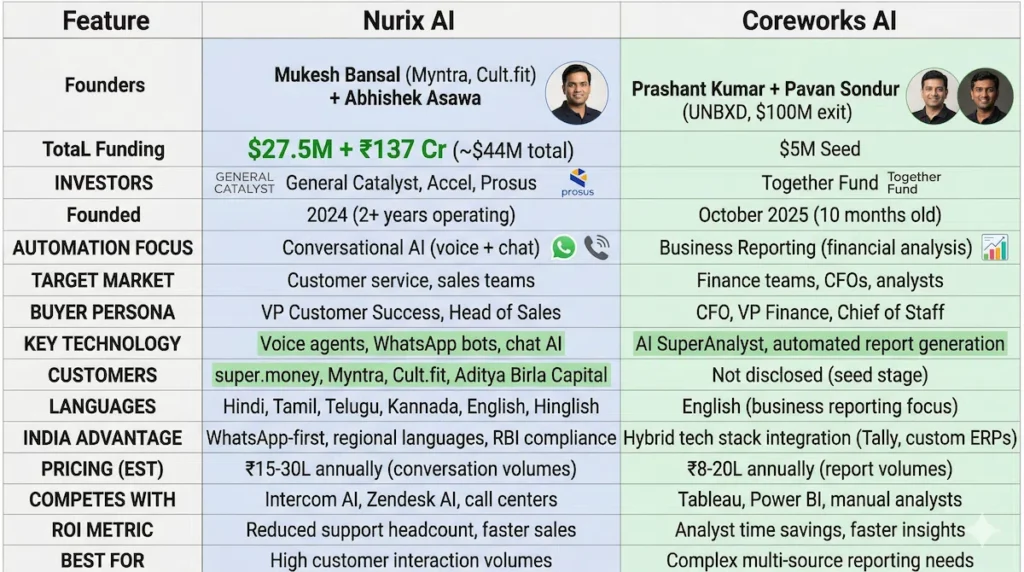
Nurix AI:
- Automates: Customer conversations (support, sales, scheduling)
- Buyer: VP Customer Success, Head of Sales Operations, Chief Customer Officer
- Budget: Customer success or sales operations budget
- ROI Metric: Reduced support headcount, higher sales conversion, lower customer acquisition cost
- Pricing: Estimated ₹15-30 lakh annually based on conversation volumes
- Competes With: Intercom AI, Zendesk AI, Freshdesk AI, traditional call center outsourcing
Coreworks AI:
- Automates: Business reporting and analysis (finance, strategy, investor relations)
- Buyer: CFO, VP Finance, Head of Business Operations, Chief of Staff
- Budget: Finance or business operations budget
- ROI Metric: Time savings for high-cost analysts, faster decision-making from quicker insights
- Pricing: Estimated ₹8-20 lakh annually based on report volumes and data sources
- Competes With: Business intelligence tools (Tableau, Power BI), consulting firms, manual analyst work
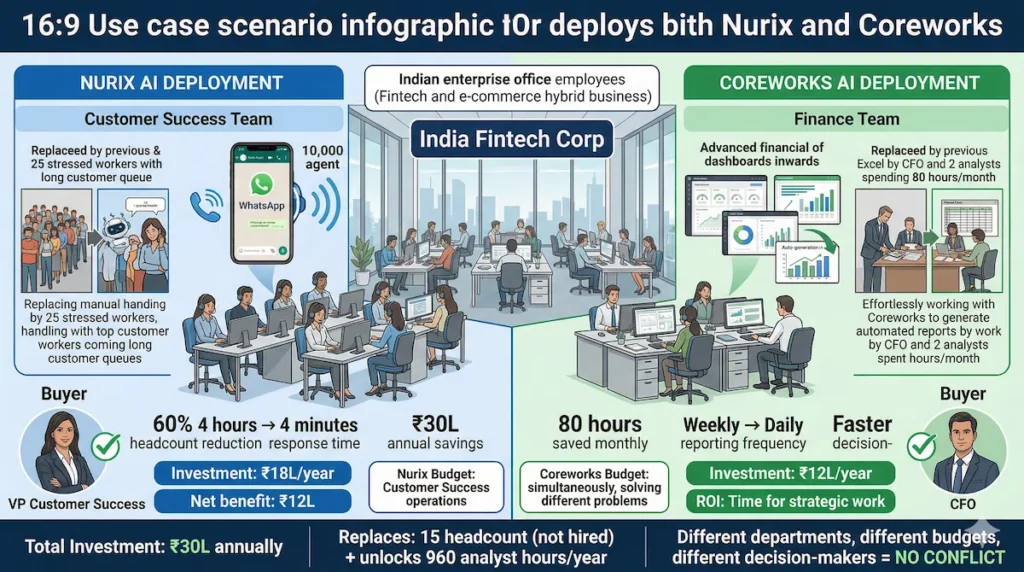
The same enterprise could deploy both. A fintech startup with 500 employees might:
- Use Nurix for customer support automation (handling 10,000 monthly customer queries, reducing support team from 25 to 10 agents, saving ₹30 lakh annually, paying Nurix ₹18 lakh = net ₹12 lakh benefit)
- Use Coreworks for monthly investor reporting (saving CFO and analyst 60 hours monthly, valued at ₹3 lakh opportunity cost, paying Coreworks ₹12 lakh annually = questionable ROI, but CFO values time freed for strategic work)
Founder Pedigree Impact: Mukesh Bansal’s brand recognition gives Nurix significant enterprise sales advantage. CXOs take meetings based on founder reputation. Coreworks founders Kumar and Sondur lack consumer name recognition but bring deep B2B credibility from building and exiting UNBXD—credibility that resonates with enterprise buyers evaluating vendors.
Funding as Market Signal: Nurix’s $44 million total raised versus Coreworks’ $5 million suggests different growth trajectories and investor confidence levels. However, comparing seed-stage Coreworks (10 months old) to post-Series A Nurix (2+ years operating) isn’t apples-to-apples. The relevant question: when Coreworks raises Series A in 2027, will they attract similar tier investors and valuations Nurix achieved?
Market Size Implications: Conversational AI (Nurix’s market) addresses customer service and sales—functions every company with customers needs. Estimated addressable market: every Indian company with 50+ employees and customer-facing operations = 100,000+ potential customers.
Business reporting automation (Coreworks’ market) addresses finance and analytics—functions primarily valuable at companies with dedicated finance teams and active investors. Estimated addressable market: venture-backed startups (5,000-8,000 companies) plus public companies (6,000+) plus growth-stage private companies with professional finance teams (10,000-15,000) = 20,000-30,000 potential customers.
Nurix’s market is 3-5x larger but more competitive (international players, BPO companies). Coreworks’ market is smaller but less crowded currently.
FAQs
Can the same Indian enterprise use both Nurix AI and Coreworks AI simultaneously?
Yes, and many likely will, because the platforms solve completely different operational problems for different departments with separate budgets. A typical scenario: An Indian e-commerce company with 800 employees might deploy Nurix AI ($200,000 annually) purchased by the VP Customer Success to automate 15,000 monthly customer support queries via WhatsApp and phone, reducing support team headcount from 40 agents to 18 agents while improving response times from 4 hours to 4 minutes. Simultaneously, the same company deploys Coreworks AI ($120,000 annually) purchased by the CFO to automate monthly investor reporting, quarterly board deck creation, and weekly executive dashboard generation, saving the finance team 80+ hours monthly previously spent manually compiling data from Shopify, Zoho CRM, and Tally accounting. These don’t overlap functionally—Nurix handles external customer conversations while Coreworks processes internal business data for leadership reporting. The platforms integrate with different core systems (Nurix with customer service software, Coreworks with financial and analytics tools), deliver value to different stakeholders (customer success team versus finance team), and demonstrate ROI through different metrics (reduced support costs versus faster executive decision-making from better insights).
How does Mukesh Bansal’s Nurix AI compare to international conversational AI platforms like Intercom or Zendesk AI for Indian companies?
Nurix delivers three critical advantages for Indian businesses that international platforms struggle to match. First, Hindi and regional language excellence—Nurix agents fluently handle conversations in Hindi, Tamil, Telugu, Kannada, and Hinglish (Hindi-English code-mixing) with accuracy exceeding 95%, while Intercom and Zendesk AI optimize primarily for English and treat Indian languages as secondary priorities with lower accuracy rates around 75-85%. For companies serving non-English Indian customers (the majority of India’s consumer base), this language capability difference directly impacts customer satisfaction and automation success rates. Second, WhatsApp-first design—Nurix built specifically for WhatsApp Business API as the primary channel, handling India’s 487 million WhatsApp users more seamlessly than web chat platforms retrofitted for messaging. Third, integration with Indian business software ecosystem—native connections to Zoho CRM (dominant in Indian SMBs), Tally accounting (millions of Indian businesses), and Indian payment systems (UPI, Razorpay) that international vendors don’t prioritize. Additionally, Nurix operates on Indian cloud infrastructure ensuring RBI data localization compliance for financial services customers, while international platforms routing conversation data through US/European servers create regulatory risk. However, international platforms offer broader feature sets for complex enterprise workflows and have proven scalability serving global Fortune 500 companies that Nurix hasn’t yet demonstrated.
Is Coreworks AI’s business reporting automation competing with existing BI tools like Tableau, Power BI, or Zoho Analytics?
Complementary rather than directly competitive. Traditional business intelligence tools (Tableau, Power BI, Zoho Analytics) create interactive dashboards and visualizations from connected data sources—they’re essentially powerful data querying and charting engines requiring human analysts to determine what questions to ask, which metrics to calculate, and how to present insights. Coreworks AI operates one layer above BI tools, using AI to automatically determine which metrics matter for specific business contexts (monthly investor update, board meeting, performance review), pulling data from multiple BI tools and other sources, performing relevant calculations, and generating narrative summaries explaining trends—tasks currently done manually by business analysts. A company might use Tableau to create sales dashboard showing regional performance, customer acquisition costs, and conversion funnels (data visualization), while using Coreworks to automatically generate the monthly sales review presentation for executive team meetings that includes Tableau charts plus revenue variance explanations, deal pipeline analysis, and recommendations based on trends (automated reporting and analysis). Many enterprises will use both: BI tools for ad-hoc exploration and detailed analysis by analysts, Coreworks for automated generation of recurring reports and presentations that consume analyst time without requiring deep investigation. The budgets differ too—BI tools are per-user licenses ($50-200/user/month), while Coreworks is platform pricing based on report volumes and data sources ($8,000-20,000 monthly for enterprise deployment).
Which startup has better chances of reaching unicorn status ($1 billion valuation) in India’s enterprise AI market?
Nurix AI holds stronger near-term unicorn potential based on five factors. First, Mukesh Bansal’s founder pedigree—he’s scaled two previous companies (Myntra, Cult.fit) to $1+ billion valuations, demonstrating he understands building category-defining businesses and attracts top talent and investment. Second, larger addressable market—conversational AI serves every company with customers (100,000+ Indian businesses) versus business reporting automation serving primarily venture-backed startups and enterprises with professional finance teams (20,000-30,000 companies). Third, clearer ROI metrics—Nurix’s headcount reduction and cost savings are measurable and immediate, while Coreworks’ analyst time savings are valuable but harder to quantify financially. Fourth, proven market validation—conversational AI is established category with public company exits (Intercom valued at $1+ billion, Zendesk acquired for $10 billion) demonstrating path to scale, while automated business reporting remains emerging category without clear precedent exits at massive scale. Fifth, funding momentum—$44 million raised in under 2 years from tier-one investors (General Catalyst, Accel, Prosus) versus Coreworks’ $5 million seed suggests stronger investor conviction and growth trajectory. However, Coreworks could reach unicorn status through aggressive international expansion—business reporting challenges are global, not India-specific, and AI-generated financial reports and investor decks solve universal problems for CFOs worldwide, potentially enabling faster geographic scaling than Nurix’s India-optimized conversational AI requiring market-specific language and integration customization.
📌 Disclaimer
Last updated: March 2026
All funding figures, company information, product capabilities, customer examples, pricing estimates, and market comparisons mentioned in this article are based on publicly available information, industry reports, and reasonable assumptions at the time of writing.
Any financial projections, ROI calculations, or use-case scenarios are illustrative in nature and may not reflect actual business outcomes. Actual results may vary depending on company size, implementation, and market conditions.
This article is intended for informational and editorial purposes only and does not constitute investment, financial, legal, or professional advice.
All company names, trademarks, and logos belong to their respective owners. This content is independent and not affiliated with, endorsed by, or sponsored by Nurix AI, Coreworks AI, or any mentioned organizations.
Readers are encouraged to verify details from official sources before making any business or investment decisions.