
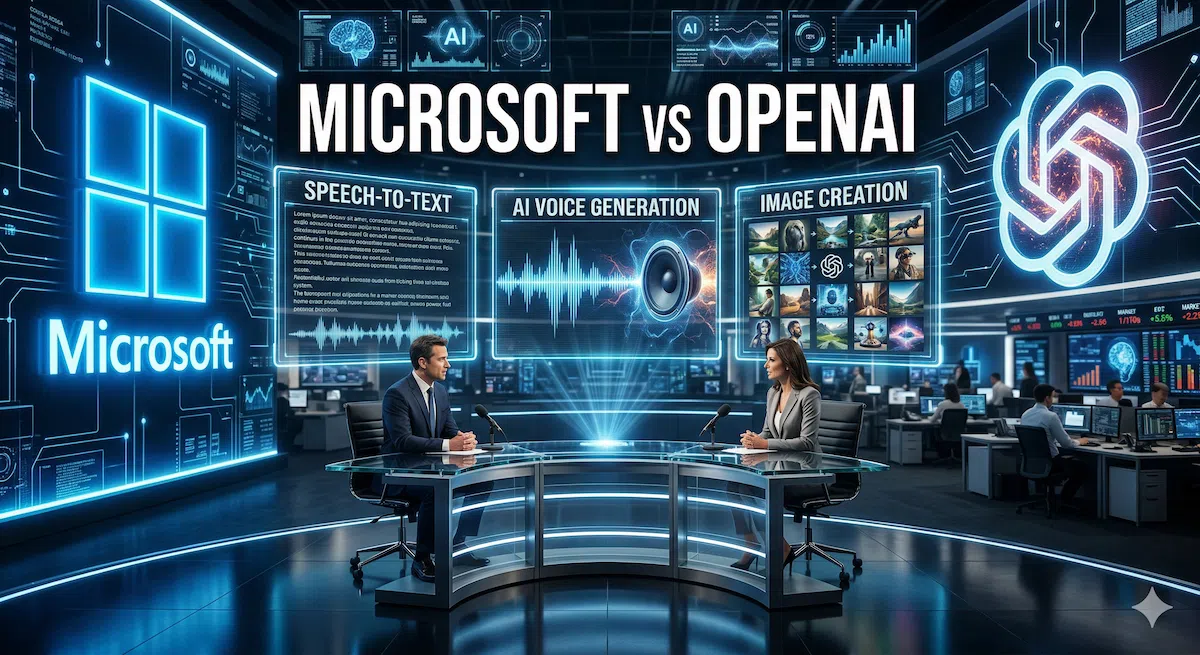
In a significant move that signals growing independence from OpenAI, Microsoft has unveiled three new artificial intelligence models designed for speech, voice, and visual generation. The announcement highlights Microsoft’s accelerating effort to build its own in-house AI ecosystem as competition intensifies across the industry.
The newly introduced models — MAI-Transcribe-1, MAI-Voice-1, and MAI-Image-2 — mark Microsoft’s deeper push into multimodal AI, covering text, audio, and visual capabilities within a unified strategy.
MAI-Transcribe-1 focuses on speech-to-text conversion, enabling accurate transcription across multiple languages. Early reports suggest the model supports more than 25 languages, positioning it as a strong competitor in enterprise transcription and real-time communication tools.
MAI-Voice-1, on the other hand, is designed for high-speed voice generation. The model can reportedly generate up to one minute of audio in just a second, while also allowing custom voice creation. This capability could reshape applications in content creation, virtual assistants, and automated customer service.
The third model, MAI-Image-2, is Microsoft’s visual generation system, built to create images and potentially other visual outputs. While some early reports have described overlapping capabilities with video generation, Microsoft has primarily positioned it as part of its broader visual AI stack.
This launch reflects a broader shift inside Microsoft. While the company remains a key partner and investor in OpenAI, it is increasingly developing its own foundational models to reduce reliance on external providers and gain tighter control over its AI infrastructure.
The company is increasingly investing in its own ecosystem, as seen on Microsoft’s official AI platform, which highlights its growing focus on multimodal AI capabilities.
Microsoft’s latest model launch also reflects a larger industry trend where companies are racing to control their own AI stack, much like OpenAI’s growing AI infrastructure push in India.
The timing is critical. As companies race to dominate the next phase of AI, control over core models — rather than just applications — is becoming the defining competitive advantage. Microsoft’s latest move places it in more direct competition not only with OpenAI but also with other major players investing heavily in multimodal AI systems.
For developers and businesses, the announcement signals more choice — and potentially more competition-driven innovation — across AI tools for speech, voice, and visual content.
With MAI-Transcribe-1, MAI-Voice-1, and MAI-Image-2, Microsoft is no longer just a platform for AI — it is rapidly becoming a full-stack AI builder.