
Key Takeaways
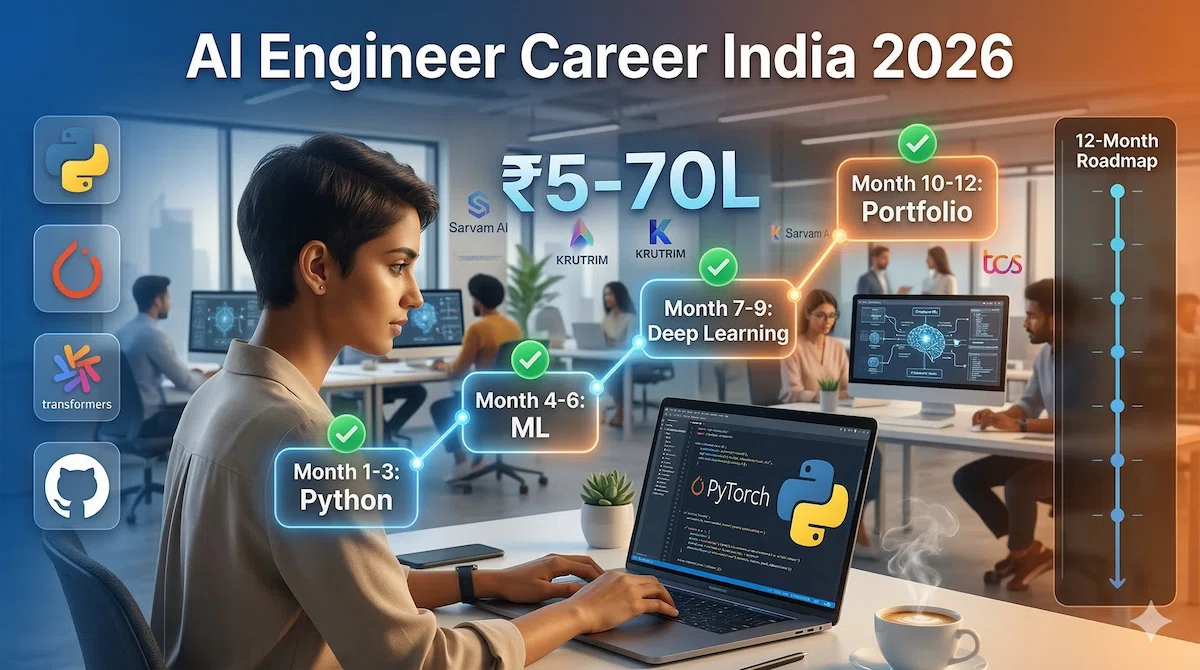
- AI engineering roles in India pay ₹5-70 lakh annually across experience levels, with GenAI engineers commanding highest salaries — Entry-level machine learning engineers start ₹5-12 lakh, mid-level specialists earn ₹15-35 lakh, and senior GenAI/LLM engineers at startups like Sarvam AI and Krutrim reach ₹50-70 lakh as 82% of Indian employers face AI talent shortages creating sustained demand through 2027
- 12-month structured roadmap from zero to job-ready requires Python fundamentals, classical ML, deep learning, and portfolio projects—not CS degree — Successful career switchers spend months 1-3 on Python and math, months 4-6 on scikit-learn and pandas, months 7-9 on PyTorch and transformer models, months 10-12 on MLOps and 3-5 portfolio projects demonstrating real-world problem-solving that employers value over academic credentials
- Indian AI job market shifted from TCS/Infosys mass hiring to startup specialization and portfolio-first evaluation in 2026 — Traditional IT giants reduced AI hiring 40% as automation threatens margins, while Sarvam AI, Krutrim, Gnani.ai, and 482 funded AI startups actively recruit with ₹200-400 interview-to-offer ratios prioritizing GitHub contributions, Kaggle rankings, and deployed projects over Coursera certificates or college degrees
India’s AI job market in 2026 presents a paradox. Employers desperately need AI talent—82% report they cannot find qualified candidates according to ManpowerGroup’s February survey. Yet millions of engineering graduates and working professionals struggle to break into AI roles despite completing online courses and earning certificates.
The disconnect isn’t about credential availability. Coursera alone reports 4 million Indians enrolled in AI and GenAI courses. The gap lies in what employers actually hire for versus what learners assume will get them hired. Companies don’t need certificate collectors. They need engineers who can deploy models to production, debug training failures, optimize inference costs, and ship AI features users actually use.
This guide cuts through the noise. It explains exactly what Indian AI employers hire for in 2026, provides a realistic 12-month roadmap from zero coding experience to job offers, breaks down which roles pay what salaries, and identifies where to learn efficiently without wasting time on outdated curricula or expensive bootcamps that overpromise results.
If you’re a final-year engineering student facing placement season, a working professional in a non-AI role wanting to transition, or someone who tried learning AI before but got overwhelmed and quit—this roadmap works regardless of starting point. The only requirements: consistent daily effort for 12 months and willingness to build projects rather than just watch tutorial videos.
The AI Job Market Reality in India: March 2026
Start with ground truth. As of March 2026, Glassdoor India lists 7,265 active AI-related job postings. LinkedIn shows 12,400+ openings tagged “artificial intelligence” or “machine learning” for India locations. Wellfound (formerly AngelList Talent) displays 1,847 AI roles at funded Indian startups.
These numbers represent real hiring intent from companies with budgets and open requisitions. They’re not aspirational job descriptions posted to build talent pipelines. Indian AI companies are hiring now because they’re building products customers pay for, raising venture capital, or deploying AI internally to cut costs.
The salary distribution breaks down predictably by role and experience. Entry-level positions—machine learning engineer, junior data scientist, AI software engineer—typically offer ₹5-12 lakh annually. These roles involve implementing existing models, running experiments designed by senior engineers, and maintaining inference pipelines. They require solid Python skills, understanding of scikit-learn and basic neural networks, and ability to work with data.
Mid-level specialists commanding ₹15-35 lakh possess deeper expertise in specific domains. Natural language processing engineers working on Indic language models, computer vision engineers deploying real-time object detection, or MLOps engineers managing model serving infrastructure fall into this bracket. These roles demand 2-4 years experience, production deployment track record, and ability to make architectural decisions.
Senior and specialized positions paying ₹35-70 lakh concentrate in three areas. First, large language model engineers building or fine-tuning models like those powering Sarvam AI’s voice assistants or Krutrim’s conversational AI. Second, AI research scientists at companies like Gnani.ai or Mad Street Den working on novel architectures or techniques. Third, AI product managers at startups translating business needs into AI capabilities and managing engineering teams. These roles require 5+ years experience, published research or significant open-source contributions, and track record of shipping AI products.
The shift from 2025 to 2026 shows traditional IT services companies reducing AI hiring while startups and product companies accelerate. TCS, Infosys, Wipro, and Tech Mahindra collectively posted 40% fewer AI job openings in Q1 2026 versus Q1 2025. These companies face margin pressure as clients demand AI-augmented services at lower costs. They’re hiring fewer humans and deploying more AI agents.
Simultaneously, India’s 482 funded AI startups raised $3.4 billion cumulatively and are hiring aggressively. Sarvam AI’s expansion following ₹246 crore IndiaAI Mission funding created 50+ engineering positions. Krutrim’s deployment plans require 100+ AI engineers through 2026. Dozens of smaller startups building voice AI, healthcare AI, agricultural AI, and fintech AI solutions compete for the same constrained talent pool.
This creates opportunity for people entering the field. Unlike 2020-2022 when Infosys and TCS hired thousands of freshers into “AI roles” that turned out to be basic automation scripting, 2026’s AI jobs involve real AI work. The trade-off: companies evaluate candidates much more rigorously. Portfolio and practical skills matter infinitely more than degrees or certificates.
Do You Need a Computer Science Degree?
No, but the path without one requires stronger portfolio evidence.
Indian AI companies in 2026 care about three things when evaluating candidates: Can you code well enough to implement and debug models? Do you understand the math underlying algorithms you’re using? Can you demonstrate you’ve solved real problems with AI, not just completed tutorials?
A computer science degree from IIT, BITS, or top-tier engineering college provides social proof of the first two. Employers assume IIT graduates can code and understand algorithms. This lowers the bar for portfolio requirements—maybe two solid projects suffice where a non-CS candidate needs four.
But the assumption isn’t always valid. Plenty of CS graduates can’t implement a neural network from scratch, don’t understand backpropagation math, and have only completed assigned coursework rather than building self-directed projects. Meanwhile, candidates from mechanical engineering, biology, commerce, or arts backgrounds who spent 12 months intensely learning often demonstrate stronger practical skills than CS graduates who coasted through college.
What matters for non-CS candidates: overcompensating through portfolio depth. If an IIT CS graduate needs two impressive projects to get interviews, a mechanical engineer needs four. If a BITS CS grad can get away with theoretical knowledge gaps, a biology major needs to demonstrate rock-solid fundamentals through clear documentation and explained code.
The math prerequisite is real but surmountable. AI engineering requires linear algebra (vectors, matrices, matrix multiplication), calculus (derivatives, gradients, chain rule), probability and statistics (distributions, expectation, variance), and basic optimization theory. Most Indian engineering curriculums cover this for mechanical, electrical, and electronics branches. Science graduates typically learned calculus and linear algebra. Commerce and arts backgrounds need to acquire these skills, but Khan Academy, 3Blue1Brown YouTube videos, and MIT OpenCourseWare make it achievable in 2-3 months of focused study.
The real filter isn’t educational background—it’s perseverance through the frustrating middle months when nothing works, models won’t train, and you question whether you’re smart enough for this field. People who push through that phase and emerge with working projects get hired regardless of their undergraduate major.
The 12-Month Roadmap: Zero to Job-Ready
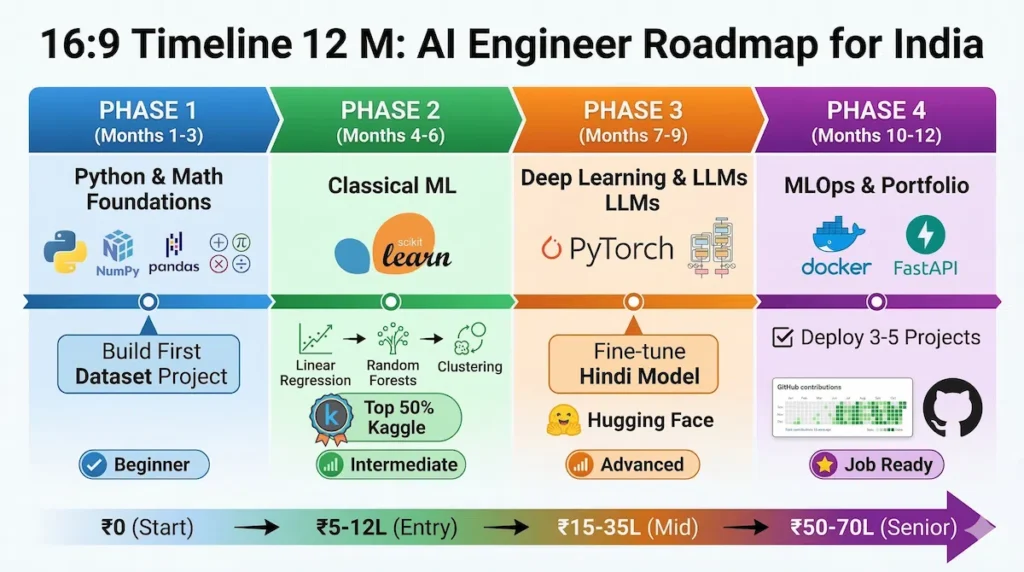
This roadmap assumes you’re starting from minimal programming knowledge and can dedicate 2-3 hours daily. Working professionals may need 15-18 months at 1-2 hours daily. Full-time learners can compress to 8-10 months at 6-8 hours daily. Adjust timeline based on your capacity, but don’t skip phases—each builds on the previous.
Months 1-3: Python Fundamentals and Math Foundations
Start with Python because it’s the lingua franca of AI in 2026. Every major framework—PyTorch, scikit-learn, Hugging Face, LangChain—expects Python proficiency. Spend month one working through Python Crash Course by Eric Matthes or Automate the Boring Stuff by Al Sweigart. Focus on data structures (lists, dictionaries, sets), control flow (loops, conditionals), functions, and object-oriented programming basics.
Month two introduces NumPy for array operations and pandas for data manipulation. These libraries underpin everything in AI. Complete the pandas documentation tutorials and solve 20-30 problems on LeetCode’s array manipulation section. Build a small project analyzing a Kaggle dataset—Indian COVID-19 data, IPL cricket statistics, or Bangalore real estate prices work well.
Month three covers math essentials. Linear algebra: understand vectors, matrices, dot products, matrix multiplication, eigenvalues. Use 3Blue1Brown’s “Essence of Linear Algebra” YouTube series. Calculus: grasp derivatives, partial derivatives, gradients, and chain rule. Khan Academy’s calculus courses suffice. Statistics: learn mean, variance, standard deviation, normal distribution, hypothesis testing. Apply concepts to the dataset from month two.
Months 4-6: Classical Machine Learning with Scikit-learn
Classical ML remains foundational even in the transformer era. Month four introduces supervised learning: linear regression, logistic regression, decision trees, random forests. Use scikit-learn exclusively. Build three projects: predicting house prices (regression), classifying loan defaults (classification), and customer segmentation (clustering using K-means).
Month five focuses on model evaluation and improvement. Learn train-test splits, cross-validation, confusion matrices, precision/recall, ROC curves, and hyperparameter tuning with GridSearchCV. Understanding why models fail matters more than making them work initially. Debug underfitting and overfitting scenarios deliberately.
Month six tackles feature engineering and real-world messiness. Learn handling missing data, encoding categorical variables, scaling features, and dealing with imbalanced datasets. Enter your first Kaggle competition—not to win, but to experience real data challenges and read others’ solutions. Aim for top 50% finish, which demonstrates competence.
Months 7-9: Deep Learning and Large Language Models
Month seven introduces neural networks using PyTorch (preferred over TensorFlow in 2026 for research and startups). Implement feedforward networks from scratch to understand backpropagation viscerally. Build a handwritten digit classifier (MNIST), then tackle a real problem like classifying Indian food images or identifying crop diseases from photos.
Month eight covers convolutional neural networks for computer vision and recurrent networks for sequences. Implement CNN architectures (ResNet, EfficientNet) using transfer learning on Indian-specific datasets—identifying vehicle types from traffic camera footage, classifying medical scans, or detecting defects in manufacturing. Add one project to your portfolio.
Month nine focuses on transformer models and large language models—the hottest area in 2026. Learn attention mechanisms, BERT architecture, and GPT-style models. Use Hugging Face transformers library extensively. Fine-tune a pre-trained model on an Indian language task: Hindi sentiment analysis, Tamil text summarization, or Telugu question answering. This project differentiates you from candidates who only work with English data.
Months 10-12: MLOps, Productionization, and Portfolio Projects
Month ten introduces MLOps: deploying models to production, monitoring performance, and managing model versions. Learn Docker for containerization, FastAPI for serving predictions, and basic cloud deployment on AWS or Google Cloud (both offer free tiers). Take one of your previous projects and deploy it as a working API others can query.
Month eleven focuses on building your signature portfolio piece—a substantial project showcasing end-to-end skills. Examples: a voice assistant for a regional Indian language using Sarvam-style architecture, an AI tool helping farmers identify crop diseases from phone photos with recommendations in Hindi, or a customer service chatbot for Indian e-commerce handling product queries. Make it solve a real Indian problem, not a generic Kaggle task.
Month twelve involves polish and job preparation. Clean up your GitHub repositories with clear README files, documentation, and example usage. Create a personal website showcasing your projects. Write blog posts explaining your project architectures and decisions. Practice coding interviews with LeetCode medium-level problems. Prepare to explain your projects in technical depth—interviewers will probe how you made decisions and handled failures.
Top 10 AI Roles in India: Salaries and Requirements
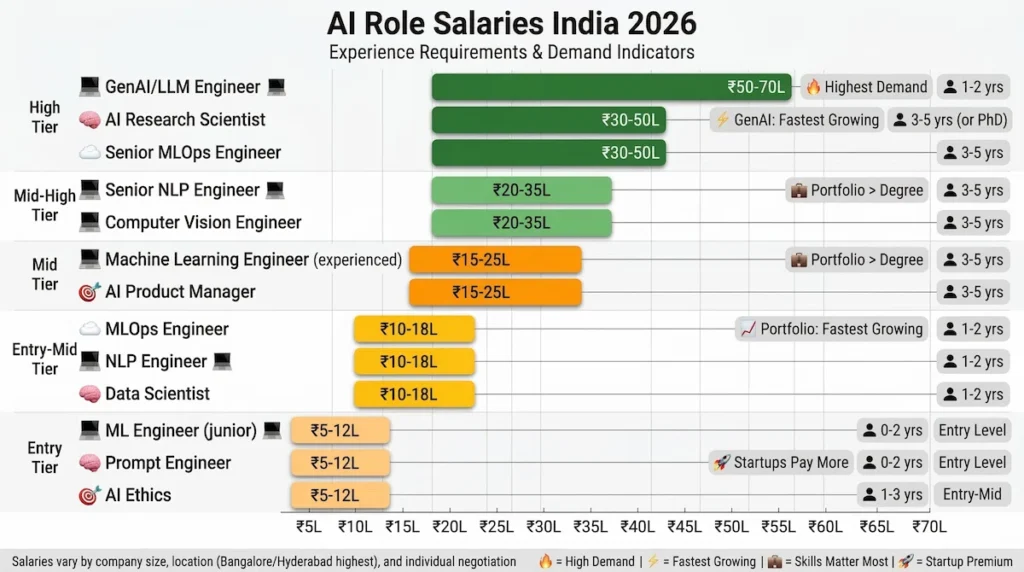
1. Machine Learning Engineer (₹7-25 lakh) Core role implementing ML models and deploying them to production. Entry-level starts ₹7-12 lakh at service companies, reaches ₹18-25 lakh at product startups with 3-4 years experience. Requires Python, scikit-learn, PyTorch, and cloud deployment skills. Most common entry point.
2. GenAI/LLM Engineer (₹12-70 lakh) Fastest-growing and highest-paying role in 2026. Building applications on top of large language models or fine-tuning models for specific use cases. Entry positions at ₹12-18 lakh, senior roles at Sarvam AI or Krutrim reach ₹50-70 lakh. Requires deep understanding of transformers, prompt engineering, RAG (retrieval-augmented generation), and vector databases.
3. Data Scientist (₹6-20 lakh) Overlaps heavily with ML engineer but emphasizes statistical analysis and business insights. Entry-level ₹6-10 lakh at mid-sized companies, senior roles ₹15-20 lakh. Requires statistics expertise, SQL, Python, and communication skills to present findings to non-technical stakeholders.
4. Natural Language Processing Engineer (₹7-22 lakh) Specialists in text processing, especially valuable for companies building Indic language AI. Entry-level ₹7-12 lakh, experienced ₹18-22 lakh. Requires linguistics knowledge, transformers expertise, and familiarity with libraries like spaCy and Hugging Face.
5. MLOps Engineer (₹10-30 lakh) Manages infrastructure for training and deploying AI models at scale. Higher starting salary (₹10-15 lakh) due to DevOps overlap. Senior roles ₹22-30 lakh. Requires Docker, Kubernetes, CI/CD pipelines, and cloud platforms expertise. Less competitive than pure ML roles.
6. Computer Vision Engineer (₹8-24 lakh) Builds systems processing images and videos. Common in manufacturing (quality control), healthcare (medical imaging), and autonomous vehicles. Entry ₹8-13 lakh, senior ₹18-24 lakh. Requires CNN architectures, OpenCV, and real-time processing optimization.
7. AI Product Manager (₹15-45 lakh) Non-coding role managing AI product development and strategy. Requires technical understanding to communicate with engineers but focuses on user needs and business value. Entry-level rare (companies want experienced PMs), mid-level ₹15-25 lakh, senior ₹30-45 lakh.
8. AI Research Scientist (₹12-50 lakh) Academic-style role publishing papers and developing novel techniques. Primarily at research-focused companies or labs. Entry ₹12-18 lakh (often requires PhD), senior ₹30-50 lakh. Requires publication track record, strong math skills, and expertise in specific research areas.
9. AI Ethics/Safety Specialist (₹8-18 lakh) Emerging role ensuring AI systems operate fairly and safely. Currently niche in India but growing. Entry ₹8-12 lakh, experienced ₹15-18 lakh. Requires technical AI knowledge plus understanding of ethics, policy, and social impact.
10. Prompt Engineer (₹6-15 lakh) Newest role optimizing interactions with large language models. Entry-level ₹6-9 lakh, senior ₹12-15 lakh. Lower barrier to entry—requires LLM understanding and creativity more than deep technical skills. May be absorbed into other roles as the field matures.
Where to Learn: Free and Paid Resources
Free Resources (Start Here)
Fast.ai offers the best free deep learning course. Their “Practical Deep Learning for Coders” teaches PyTorch and modern techniques through hands-on projects. Designed for people with basic Python knowledge, not PhD mathematicians. Completely free, no certificates needed.
Hugging Face maintains excellent tutorials and documentation for working with transformer models and LLMs. Their NLP course and transformers documentation teach state-of-the-art techniques free. Ideal for months 9-10 when focusing on language models.
YouTube channels provide strong supplementary learning. Sentdex covers Python and ML fundamentals. 3Blue1Brown explains math concepts with incredible visualizations. Yannic Kilcher analyzes recent AI research papers, helping you stay current with techniques companies actually use in 2026.
Andrew Ng’s Machine Learning Specialization on Coursera can be audited free (pay only if you want certificates, which don’t matter much for hiring). Covers fundamentals clearly, though uses older TensorFlow instead of current PyTorch standard.
Kaggle offers free datasets, notebooks showing how others solved problems, and competitions for practice. The community aspect helps—reading others’ code teaches techniques textbooks miss.
Paid Courses (If You Have Budget)
Scaler Academy’s Data Science and Machine Learning program costs ₹2.5-3 lakh for 8 months with placement support. Includes live classes, mentorship, and interview preparation. Worth considering if you struggle with self-directed learning or want structured guidance.
upGrad’s Machine Learning and AI program runs ₹1.5-2 lakh for 11 months. Less intensive than Scaler but includes industry projects and career services. Suitable for working professionals who need flexible schedules.
Great Learning offers various AI programs from ₹80,000-2 lakh depending on duration. Partners with universities for branded certificates, though employers care more about skills than course completion certificates.
Masai School and Newton School operate income-share agreement models—pay nothing upfront, give 15-17% of salary for 2-3 years after getting job. Risky for the school, which incentivizes strong placement support, but expensive over time. Only consider if you absolutely cannot self-learn.
DeepLearning.AI specializations on Coursera (₹3,000-5,000 monthly subscription) provide current content from Andrew Ng and team. More affordable than bootcamps while maintaining quality.
University Options
IIT Madras offers online BS in Data Science and Applications for ₹50,000-60,000 annually over 3 years. Provides recognized degree for those lacking engineering background. Worth considering if degree absence limits opportunities, though portfolio matters more.
IIT Roorkee, IIIT Bangalore, and other IITs offer executive programs in AI/ML for ₹1.5-3 lakh. Suitable for working professionals wanting IIT credential, though curriculum often lags industry practice.
Getting Hired: Companies, Platforms, and Interview Preparation
Where Indian AI Companies Actually Hire
LinkedIn remains the primary platform for mid-to-senior roles. Set your profile to “open to work,” list relevant skills (Python, PyTorch, transformers, MLOps), and apply actively. Recruiter InMails come to candidates with strong portfolios visible on LinkedIn.
Wellfound (AngelList) concentrates startup opportunities. Create profile, showcase GitHub projects, and apply directly. Startups respond faster than large companies and prioritize portfolio over pedigree. Sarvam AI, Krutrim, Gnani.ai, Bolna, and hundreds of others recruit here.
Turing.com and Toptal connect Indian engineers with international remote opportunities paying $40,000-100,000 annually (₹33-83 lakh). Requires passing technical assessments, but salary premium over Indian companies makes it attractive for experienced engineers.
HuntingCube and Skillenza target AI-specific roles in India. Smaller candidate pools mean better visibility for strong portfolios. Both platforms emphasize skills testing and portfolio review over resume screening.
Company career pages for AI-focused startups often list roles not posted elsewhere. Directly visit Fractal Analytics, Mad Street Den, Haptik, Active.ai, SigTuple, and other Indian AI product companies. Cold emailing founders or engineering leads with portfolio links sometimes works for startups.
Interview Preparation Strategy
Technical interviews for AI roles test three areas: coding fundamentals, ML concepts, and system design.
Coding assessments use platforms like HackerRank or LeetCode. Practice 100-150 medium-difficulty problems focusing on arrays, strings, dynamic programming, and graph algorithms. Python-specific syntax mastery helps—know list comprehensions, lambda functions, and standard library thoroughly.
ML concept interviews ask you to explain algorithms, debug model failures, and discuss trade-offs. Be prepared to explain: How does backpropagation work? What causes overfitting and how do you prevent it? When would you use a decision tree versus neural network? How do transformers differ from RNNs? What is attention mechanism? Practice explaining these concepts clearly to non-experts.
System design for ML asks you to architect solutions: How would you build a recommendation system for an Indian e-commerce site with 10 million users? How would you deploy a real-time fraud detection model? What infrastructure handles model training for multilingual sentiment analysis? These questions test production thinking beyond notebooks.
Portfolio projects discussed in interviews require deep knowledge. Interviewers probe decisions: Why did you choose this architecture? How did you handle class imbalance? What was your data preprocessing pipeline? Why this loss function? Be ready to explain every line of code you wrote and defend your choices.
For startups, culture fit and communication skills matter immensely. Small teams need engineers who can work independently, communicate clearly with non-technical colleagues, and take ownership beyond assigned tasks. Demonstrate these qualities through how you present your projects and discuss collaboration.
Salary Negotiation and Offers
Indian AI job market in 2026 favors candidates at entry and senior levels. Entry-level sees many offers clustered ₹7-12 lakh—negotiate based on competing offers and cost of living. Senior roles with GenAI expertise have wide ranges (₹35-70 lakh) due to talent scarcity—negotiate aggressively using competing offers and equity considerations.
Equity matters more at startups than cash salary. A ₹15 lakh cash offer with 0.1% equity at a Series A company potentially outweighs ₹22 lakh cash with no equity at a services company. Ask about vesting schedules, valuation, and exit scenarios.
Remote work flexibility adds significant value for candidates outside Bangalore, Hyderabad, or Pune. Negotiate remote-first or hybrid arrangements if relocating creates financial burden. Many startups, especially post-pandemic, accept remote employees.
Learning opportunities and role growth paths matter for career trajectory. A slightly lower salary at a company where you’ll work directly with experienced AI researchers and ship real products outweighs higher pay at a company where you’ll maintain legacy systems.
FAQs
Can I become an AI engineer without an engineering degree from IIT or top college?
Yes, though it requires stronger portfolio compensation. Indian AI companies in 2026 evaluate three factors: coding ability, AI/ML understanding, and demonstrated problem-solving through projects. Top college degrees provide assumed credibility for the first two, lowering portfolio expectations. Candidates from tier-2/3 colleges or non-engineering backgrounds need 4-5 substantial portfolio projects versus 2-3 for IIT graduates to get equivalent interview consideration. The projects must solve real problems—not just tutorial implementations—and demonstrate skills through public GitHub code, deployed demos, or Kaggle competition results. Many successful AI engineers at Sarvam AI, Krutrim, and other startups entered from mechanical engineering, biology, or even commerce backgrounds by building exceptional portfolios over 12-18 months of focused learning.
What’s better: learning Python first or starting directly with AI/ML concepts?
Learn Python first. Every AI/ML framework in 2026—PyTorch, scikit-learn, Hugging Face transformers, LangChain—requires Python fluency. Attempting to learn AI concepts simultaneously with basic Python syntax creates cognitive overload that causes most beginners to quit. Spend 4-6 weeks mastering Python fundamentals: data structures (lists, dictionaries, sets), control flow (loops, conditionals), functions, and file I/O. Then add NumPy and pandas for 2-3 weeks. Only after you can comfortably manipulate arrays and dataframes should you start ML concepts. This foundation prevents debugging nightmares where you can’t tell if your error stems from incorrect algorithm understanding or basic Python syntax mistakes. Fast.ai’s course assumes Python knowledge for this reason—it teaches AI, not programming.
How long does it realistically take to get an AI job offer starting from zero coding experience?
12-15 months for most people dedicating 2-3 hours daily. Full-time learners (6-8 hours daily) can compress to 8-10 months. Working professionals at 1-2 hours daily need 18-24 months. The timeline breaks into: 3 months Python and math fundamentals, 3 months classical ML with scikit-learn, 3 months deep learning and transformers, 3-4 months MLOps and portfolio building, then 1-2 months active job hunting with interview preparation. The variance comes from prior math knowledge (engineers move faster than arts graduates) and portfolio quality required based on educational background. First job offer timing also depends on market conditions—2026’s 82% employer shortage means faster hiring than during 2020 oversupply. Realistic expectation: Apply after month 10-11 once you have 3-4 solid projects, expect 20-50 applications before first offer, interview-to-offer ratio around 20-30%.
Which is better for learning AI: paid bootcamps like Scaler/upGrad or self-learning with free resources?
Self-learning with free resources works for disciplined learners who can structure their own curriculum and push through frustration without external motivation. Free path costs only time (₹0) versus bootcamp fees (₹1.5-3 lakh). Quality difference is minimal—bootcamps teach same PyTorch and scikit-learn as free Fast.ai and YouTube tutorials. Bootcamps provide three advantages: structured curriculum (no decision paralysis about what to learn next), peer cohorts (motivation and networking), and placement assistance (job referrals and interview prep). If you have ₹2-3 lakh disposable and struggle with self-discipline, bootcamps justify cost. If budget-constrained or self-motivated, free resources plus ₹20-30K for Kaggle competitions, cloud computing credits, and domain name for portfolio site delivers equivalent results. Hybrid approach: free learning for months 1-9, consider short paid MLOps or interview prep bootcamps months 10-12 only if needed.
📌 Disclaimer
Last updated: March 2026
All salary ranges, hiring statistics, timelines, and career outcomes mentioned in this article are approximate and based on industry trends, publicly available data, and illustrative scenarios. Actual results may vary depending on individual skills, experience, location, company, and market conditions.
This article is intended for informational and educational purposes only and does not guarantee job placement, salary outcomes, or career progression.
Readers are advised to conduct their own research and consult with mentors, industry professionals, or career advisors before making any career decisions.
Product names, company references, and trademarks belong to their respective owners.