

📌 Key Takeaways
- Agentic commerce is already live in India: Razorpay, NPCI, OpenAI, and Anthropic are actively running pilot programs with Zomato, Swiggy, and Zepto.
- Authentication shifts, it doesn’t vanish: Security relies on protocols like Visa’s Trusted Agent Protocol and India’s UPI Reserve Pay to pre-authorize spending upfront.
- India has a massive first-mover advantage: UPI’s programmable architecture is perfectly built for the delegated, AI-initiated transactions this new economy requires.
You tell your AI assistant: “Order my usual snacks from Zepto.” No app switching. No OTP. No checkout screen. The groceries are on their way. That’s not a product roadmap slide. That’s a live pilot running in India today.
This is agentic commerce — and it marks the most consequential shift in how money moves since UPI itself launched a decade ago. The question isn’t whether AI agents will make purchases on your behalf. They already are. The more important questions are: how does a payment actually clear without a human authorizing it in real time, who is responsible when something goes wrong, and what does this mean for every Indian bank, fintech, and e-commerce platform still assuming a human is at the end of every transaction?
This article breaks all of it down.
From Chatbot to Checkout: What “Agentic” Actually Means
Most people have encountered generative AI as a content machine — a tool that writes, summarizes, explains, and recommends. Ask it a question, get an answer. The interaction ends there. The AI talks; you do.
Agentic AI is a different category entirely. An AI agent doesn’t just respond — it acts. It can browse the web, call APIs, compare options across platforms, make decisions, and execute tasks end-to-end, including financial ones. The shift from generative to agentic is the shift from a very smart research assistant to a fully autonomous proxy that operates in the world on your behalf.
Agentic commerce is what happens when that autonomous capability intersects with real money. The agent doesn’t recommend a product — it buys it. It doesn’t surface a flight option — it books and pays for it. The human sets a goal and a boundary; the AI closes the loop.
This distinction matters enormously for fintech, because every existing payment system was designed with one assumption baked in: a human being is always in the loop at the moment of authorization. Agentic commerce breaks that assumption. And the industry is scrambling to rebuild around it.
How Agentic Commerce Works: AI-Initiated Transactions Explained
The mechanics of an agent-initiated payment are more layered than they appear. Here’s what actually happens when your AI completes a purchase:
1. Intent capture. The user expresses a goal — “order the same groceries as last Tuesday” — in natural language. The AI agent interprets this as an actionable instruction.
2. Catalog lookup and decision. The agent queries the merchant’s catalog via an API or MCP (Model Context Protocol) connection, identifies the right items, checks prices and availability, and applies any user-defined preferences (brand, budget ceiling, delivery time).
3. Pre-authorization check. Before executing, the agent verifies that the transaction falls within the user’s pre-set spending mandate. In the Indian pilots, this is handled by UPI Reserve Pay — a mechanism where the user sets a one-time spending ceiling for a specific merchant, and the bank blocks that amount upfront. The underlying mechanism is NPCI’s Single Block Multi Debit (SBMD) framework, which allows multiple deductions from a single pre-authorized block without requiring a PIN each time.
4. Payment execution. The agent transmits a cryptographically signed payment request to the merchant. The processor — Razorpay in India’s case — validates the agent’s credentials, confirms the mandate is active, and settles the payment in real time via UPI rails.
5. Confirmation and logging. The user receives a confirmation within the chat. Full transaction history is available for review or revocation at any time.
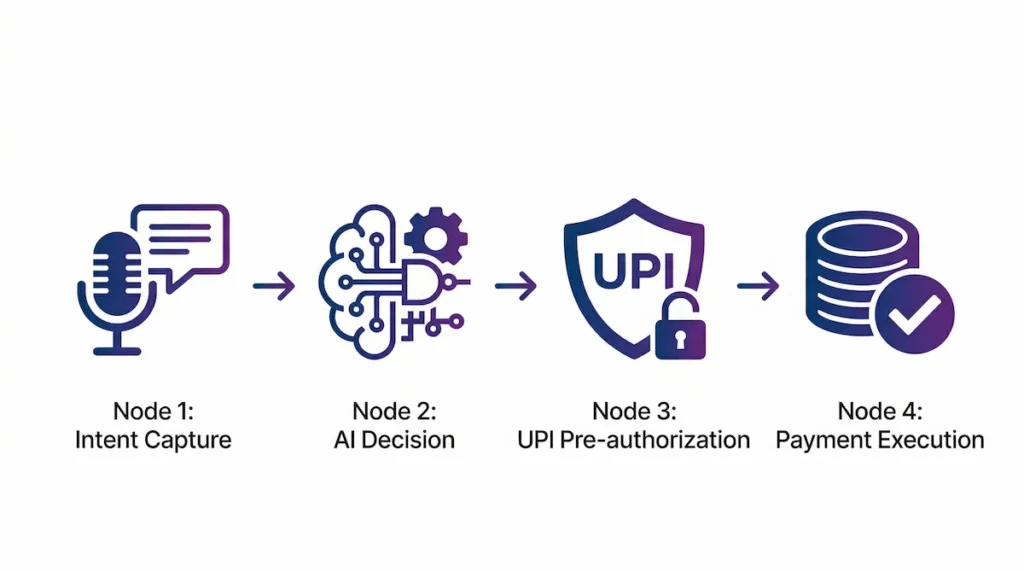
The key insight: authentication doesn’t disappear — it moves. Instead of entering a PIN at checkout, the user authenticates once at the start, when setting up the spending mandate. Everything after that is delegation, not blind automation.
AI Payment Authentication: Securing Transactions Without Humans
The biggest concern with agentic commerce — legitimate and urgent — is security. If an AI agent can complete purchases autonomously, what stops a malicious bot from doing the same? What stops the agent from being hijacked, manipulated, or simply making an expensive mistake?
Globally, the answer is being built in real time. Visa’s response is the Trusted Agent Protocol, introduced in October 2025 in collaboration with Cloudflare and over ten payment partners including Adyen, Stripe, Fiserv, and Worldpay. The protocol uses agent-specific cryptographic signatures to verify that the entity initiating a transaction is a legitimate AI agent acting with consumer consent — not a fraudulent bot. It incorporates features like tokenization, authentication, payment instructions, and transaction signals, allowing AI agents to operate transparently and securely.
Akamai subsequently joined the initiative, adding edge-based behavioural intelligence on top. Their integration enables merchants to differentiate trusted AI agents from malicious bots and link each verified agent back to the underlying consumer, preserving the account context and trust signals merchants rely on for fraud detection.
The numbers justify the urgency. AI-powered bot traffic surged 300% over the past year, with the commerce industry alone experiencing more than 25 billion AI bot requests during a two-month period. Without a verified identity layer for agents, merchants can’t tell a legitimate purchase from an attack.
In India, the architecture works differently but achieves the same outcome. UPI Reserve Pay doesn’t skip authentication — it shifts it to the beginning of the journey. The user sets a mandate upfront, entering their PIN once. After that, the SBMD framework handles multiple deductions securely without requiring repeated authentication. The spending limit, merchant specificity, and revocability provide the guardrails that replace per-transaction authorization.
India’s UPI Advantage: The World’s Best Agentic Payment Rail Was Already Built
Here’s the part most global analysts miss: India didn’t need to build agentic payment infrastructure from scratch. NPCI built it before anyone called it “agentic.”
UPI Circle, which allows one UPI user to delegate transaction authority to another, and UPI Reserve Pay, which enables pre-authorized spending mandates with defined limits, together constitute exactly what agentic commerce requires: delegated, mandate-based, real-time payment execution with built-in user control and revocability.
The practical result of this alignment is visible in what has already shipped. In October 2025, Razorpay, NPCI, and OpenAI announced the pilot launch of Agentic Payments on ChatGPT — India’s first AI-powered conversational payment experience — with BigBasket as the first merchant and Axis Bank and Airtel Payments Bank as banking partners. A user could ask ChatGPT to order recipe ingredients; the AI would search BigBasket’s catalog, present options, and complete the purchase via Razorpay’s payment stack — all within the chat.
Then, in February 2026, Razorpay and NPCI extended the same capability to Claude at the India AI Impact Summit in New Delhi, enabling users to order food, groceries, and daily essentials from Zomato, Swiggy, and Zepto directly within the AI interface.
Most recently, as of March 26, Razorpay CEO Harshil Mathur announced the rollout of agentic payments across 20+ partners, inviting developers building AI agents to sign up for early access. The pilot has crossed into production territory.
India has quickly become one of the largest AI-native markets in the world, and UPI’s real-time, mandate-enabled framework provides exactly what agentic commerce requires: speed, security, transparency, and consent-driven control. The alignment between technology, regulation, and consumer behavior here is rare. Indians are already habituated to UPI. They already trust quick-commerce apps. Agentic commerce doesn’t need to change Indian behavior — it slides directly into existing habits.
The Unresolved Questions: Liability, Regulation, and Who Pays When the Agent Gets It Wrong
For all the genuine progress, agentic commerce has a regulatory vacuum at its centre. The existing dispute resolution framework in payments assumes four parties: the consumer, the issuing bank, the acquiring bank, and the merchant. An AI agent adds a fifth — and nobody has cleanly resolved who it answers to when something goes wrong.
Razorpay has staked out a position: “The introduction of agentic shopping does not rewrite the rules of commercial liability.” If the agent orders the wrong item, the merchant — Swiggy or Zepto — handles the dispute and refund. Razorpay bears liability for payment security. The AI platform bears no financial liability.
That framework works for a Zepto grocery order. It breaks down fast for higher-value or lower-reversibility transactions. A flight booking made by an agent for the wrong date. An insurance top-up triggered in error. A B2B purchase of significant size. Reversibility is the key factor — a food order is reversible; higher-value transactions may not be.
RBI has not yet issued formal guidelines on AI-initiated transactions, and NPCI’s current frameworks don’t explicitly address agentic responsibility chains. The KYC and AML standards that govern who is allowed to transact, and how, were written for human principals. The emerging “Know Your Agent” (KYA) compliance framework — which would require verifiable agent identity and audit trails — is being discussed but has no regulatory force yet in India.
This isn’t a reason to dismiss agentic commerce. It’s a reason to watch the regulatory calendar closely and build compliance infrastructure now rather than reactively.
What This Means for Indian Fintech, Banks, and E-Commerce Brands
The window to build agent-compatible infrastructure is open now. By the time agentic commerce reaches mass adoption — which Visa pegs at the 2026 holiday season globally — the platforms that haven’t adapted will simply be invisible to AI-driven demand.
For Indian e-commerce brands, the implication is immediate. An AI agent browsing your catalog needs machine-readable product data, clean APIs, and integration with Razorpay’s agentic payments stack. A checkout flow optimized for humans — with multiple redirects, modal popups, and manual confirmations — will be abandoned by an agent in milliseconds.
For banks and NBFCs, the question is whether their authorization systems can handle mandate-based delegation at scale. UPI Reserve Pay and SBMD are the mechanisms, but the underlying bank infrastructure needs to support them reliably without latency penalties.
For fintech platforms, the opportunity is in the agent enablement layer itself — building the tools, APIs, and trust infrastructure that let merchants plug into AI-native commerce without reengineering their entire stack. Razorpay has moved first. The rest of the market will follow.
The stakes are not abstract. Visa predicts that millions of consumers will use AI agents to complete purchases by the 2026 holiday season driven by the fact that nearly half of US shoppers already use AI tools for at least one part of their shopping journey. India’s numbers, given UPI penetration and AI adoption curves, are likely comparable or higher.
The conversation economy — where AI replaces the browser as the starting point for commerce — is not arriving. It’s here. The only question is whether Indian fintech infrastructure will be ready when it fully lands.
FAQs
What is agentic commerce, and how is it different from regular AI shopping assistants?
A regular AI shopping assistant helps you discover products, compare prices, and make recommendations — but the human still clicks “Buy” and enters a PIN. Agentic commerce goes further: the AI agent completes the entire transaction, including payment execution, on the user’s behalf. The distinction is between a tool that informs and a system that acts.
How does an AI agent authenticate and complete a payment without the user entering a PIN or OTP?
Authentication doesn’t disappear — it shifts. The user sets up a pre-authorized spending mandate at the start, entering their PIN once to create a spending ceiling for specific merchants. After that, the agent operates within those limits using UPI Reserve Pay’s Single Block Multi Debit (SBMD) framework, which allows multiple deductions from a pre-authorized block without requiring repeated PIN entry. On Visa’s global rails, agent-specific cryptographic tokens serve a similar function.
What is UPI Reserve Pay and why is it central to India’s agentic payment pilots?
UPI Reserve Pay lets a user pre-authorize a specific spending limit for a designated merchant, blocking that amount in their bank account upfront. It’s the mechanism that allows an AI agent to complete multiple purchases within defined parameters without asking for manual authentication each time. Combined with UPI Circle — which enables delegation of UPI authority from one user to another — it forms the native Indian infrastructure for agentic payments.
What happens if an AI agent buys the wrong product — who is liable?
Currently, liability is distributed but not formally governed. Razorpay’s position is that the merchant handles product disputes and refunds, while Razorpay covers payment security failures. The AI platform bears no financial liability. This works for low-value, reversible transactions like grocery orders, but remains contested for higher-value purchases. India’s RBI has not yet issued formal guidelines on AI-initiated transaction liability — a regulatory gap that the industry is watching closely.
Which Indian companies are already live with agentic commerce pilots?
As of early 2026, the most advanced live pilots are the Razorpay-NPCI-OpenAI collaboration on ChatGPT (with BigBasket as a merchant partner) and the Razorpay-NPCI-Anthropic collaboration on Claude (with Zomato, Swiggy, and Zepto). Razorpay CEO Harshil Mathur announced in March 2026 that agentic payments are rolling out across 20+ partners, with a developer early-access program now open at razorpay.com/agentic-payments.
What is the difference between generative AI and agentic AI in e-commerce?
In short, generative AI gives you information, while agentic AI takes action. In the agentic AI vs generative AI debate, generative tools act like digital assistants that recommend products or summarize reviews. Agentic AI goes further by operating as an autonomous economic proxy—it evaluates options, applies your budget rules, and actually executes the payment without you needing to click “Buy.”
Is Visa ready for agentic commerce?
Yes. Visa is actively building the global infrastructure for AI-initiated transactions through initiatives like the Visa Agentic Ready program and the Trusted Agent Protocol (launched in late 2025 with Cloudflare). These frameworks use cryptographic signatures to verify that an AI agent is legitimate, ensuring merchants can securely accept autonomous payments while blocking malicious bots.
Disclaimer: This article is for informational and editorial purposes only and is based on publicly available information at the time of writing. It does not constitute legal, financial, or investment advice. Any company logos, brand names, trademarks, or images used in this article remain the property of their respective owners and are used only for identification, commentary, or editorial reference where applicable.