
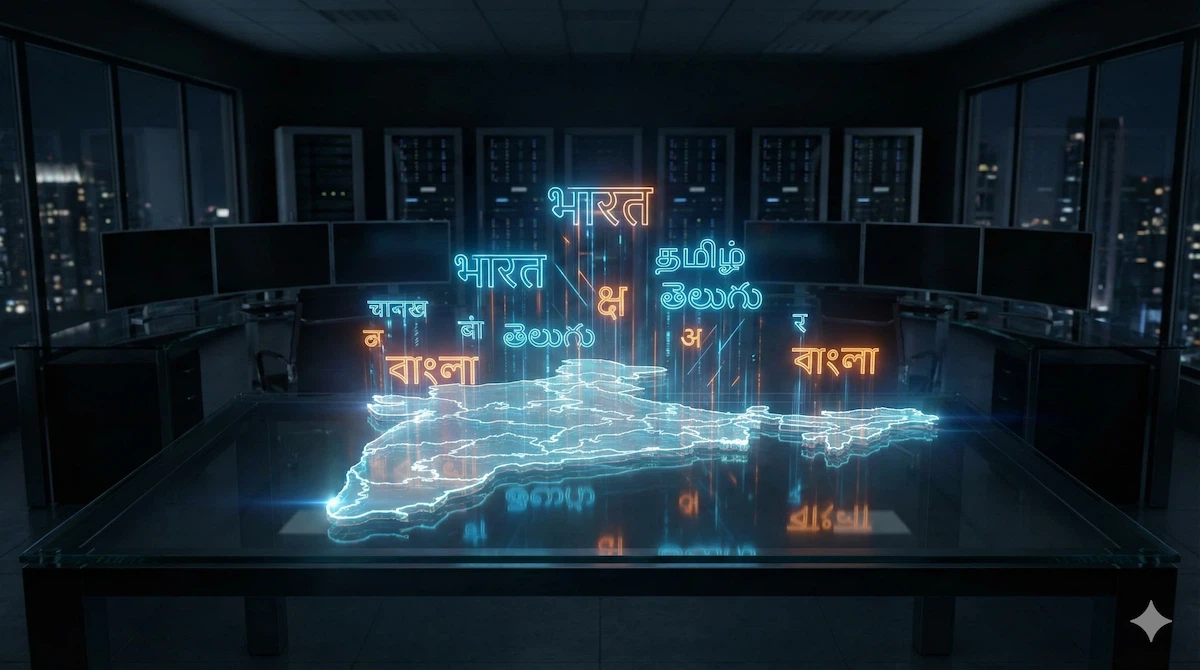
The artificial intelligence revolution has largely been an English-first phenomenon, leaving millions of global citizens behind. However, the rapid development of Indic language AI models is fundamentally changing this narrative. Led by domestic health-tech and AI startups, India is aggressively pushing for “Sovereign AI”—building indigenous large language models (LLMs) trained specifically to understand the deep cultural nuances and linguistic diversity of the subcontinent.
For years, global frontier models like ChatGPT, Gemini, or Claude have struggled with low-resource regional languages. They are often computationally expensive and fail to capture the complexities of mixed scripts (like Devanagari combined with Latin) or regional slang. By shifting the focus to localized computing and specialized tokenizers, Indian developers are ensuring that the next billion internet users can interact with cutting-edge technology in their native tongues.
Why Global LLMs Fail: The Need for Indic Language AI Models
When an Indian user asks a question in Tamil or Marathi, foreign AI models often have to translate the query into English, process the answer, and translate it back. This clunky process drastically increases the “token count” (the amount of data the AI has to process), which drives up the cost of inference.
To solve this, developers are building Indic language AI models from the ground up. By creating custom tokenizers designed specifically for Indian languages, these domestic models can process text up to four times more efficiently than leading English-centric systems. This dramatic reduction in computing cost allows startups to deploy AI on “edge” devices—meaning voice assistants and translation apps can run on cheap smartphones without needing a massive, cloud-based server.
Homegrown Heroes: Sarvam AI and Gnani.AI

The push for sovereign AI was recently highlighted at the India AI Impact Summit 2026, where several groundbreaking models were officially launched.
- Sarvam AI: Backed by the government’s IndiaAI Mission, Bengaluru-based Sarvam AI unveiled a massive 105-billion parameter model alongside a 30-billion parameter version. Built entirely within India, these models are designed for complex reasoning and agent-based tasks across all 22 scheduled Indian languages. Sarvam also launched “Sarvam Edge,” a compact model that processes offline speech recognition and translation directly on a user’s device.
- Gnani.AI: Focusing heavily on voice-first interactions, Gnani.AI introduced “Vachana TTS,” a highly advanced text-to-speech system. It can seamlessly replicate human voices across 12 Indian languages using less than ten seconds of reference audio, making it a game-changer for digital customer support and government service helplines.
The Government’s Role: Amplifying with Bhashini
Private startups are not fighting this battle alone. The Indian government is actively fueling the creation of these models through the Bhashini initiative (Bhasha Interface for India). Operating under the Ministry of Electronics and Information Technology, Bhashini acts as a National Language Translation Mission.
It provides startups with access to massive, crowdsourced datasets of open-source Indian language data. By offering an ecosystem where companies like Sarvam AI and Gnani.AI can train their algorithms on high-quality, culturally accurate text and voice recordings, Bhashini is effectively democratizing AI development. As we track in our continuous coverage of Indian startups, public infrastructure and private innovation are ensuring that language is no longer a barrier to digital empowerment.
FAQs
What is an Indic language AI model?
It is an artificial intelligence system (like a Large Language Model) specifically trained on massive datasets of Indian languages, allowing it to understand, generate, and process text and voice in languages like Hindi, Tamil, Bengali, and Marathi with high accuracy.
Why are global models like ChatGPT expensive for Indian languages?
Global models are optimized for English. When they process Indian languages, they often break the text down into many more “tokens” than necessary, requiring more computing power and making the service slower and more expensive for local developers.
What is the Bhashini initiative?
Bhashini is an Indian government project that uses AI and Natural Language Processing to build a public digital platform. It provides translation tools and open-source language datasets to help startups build localized technology for Indian citizens.
Pingback: AI Training Data: The Next Infrastructure Race, India's Shot