
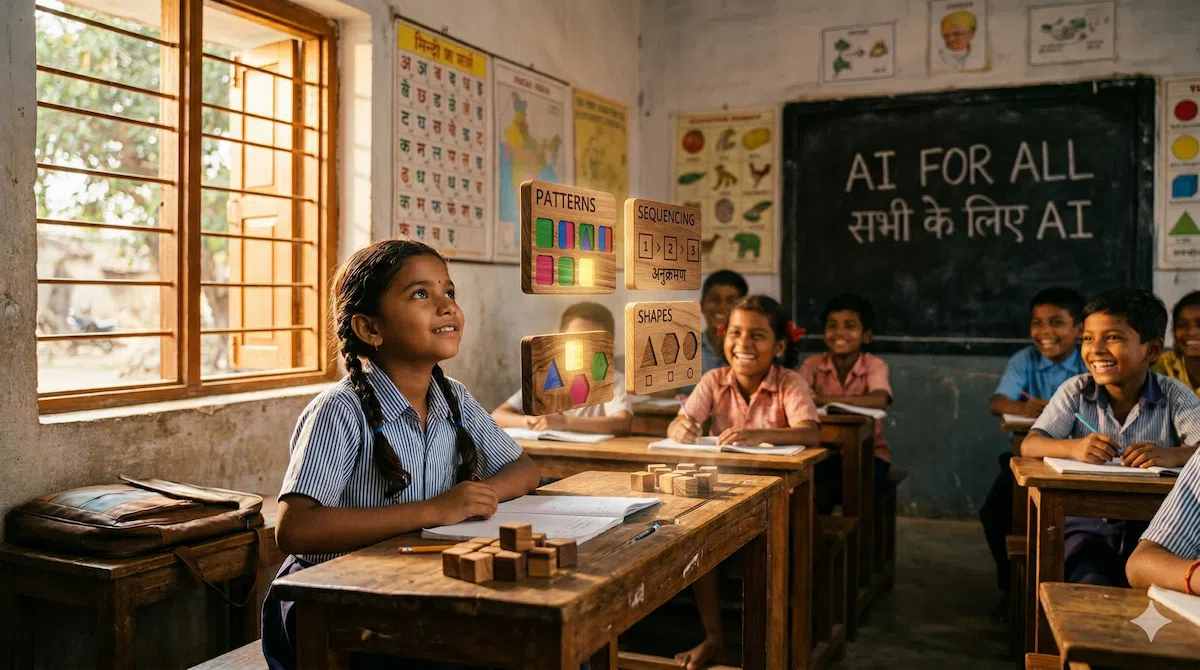
New Delhi, April 3: India’s school education system is taking a major step toward early-stage AI literacy after the Central Board of Secondary Education (CBSE) formally introduced a new Computational Thinking and Artificial Intelligence (CT-AI) curriculum for students from Classes 3 to 8, beginning with the 2026–27 academic session.
The move, announced through Circular Acad-15/2026, dated April 1, 2026, signals a broader push to bring AI awareness, logical reasoning and problem-solving into mainstream school learning at an earlier age. CBSE followed up on April 9, 2026 with Circular Acad-18/2026, confirming that Student and Teacher Resource Books for the curriculum are now live on cbseacademic.nic.in.
Rather than treating AI as a narrow technical subject reserved for older students, the new framework aims to expose children to the foundations of how machines process information, how patterns are recognized, and how structured thinking can be applied to real-world problems. CBSE said the curriculum has been designed in a way that supports conceptual understanding while remaining aligned with the learning levels of students in the primary and middle school years.
The curriculum was developed by a 10-member expert committee led by Prof. Karthik Raman of IIT Madras, with contributions from IIT Gandhinagar’s Centre for Creative Learning, Azim Premji University, NITTTR Bhopal, and subject experts including mathematics and computer science teachers and principals from CBSE-affiliated schools. It has since been approved by the National Council of Educational Research and Training (NCERT), with three official documents released: the curriculum itself, a Teachers’ Handbook for Classes 3 to 8, and accompanying Teaching Learning Material.
The official rollout follows the public launch of the curriculum by Union Education Minister Dharmendra Pradhan, who positioned the initiative as part of India’s broader education modernization effort under the goals of the National Education Policy (NEP) 2020. Early AI exposure in schools has increasingly become a policy focus as governments and education boards worldwide look to prepare students for an economy shaped by automation, data systems and machine learning tools.
Under the framework, students are expected to be introduced to foundational areas such as logical reasoning, pattern recognition, algorithmic thinking, decomposition and structured problem-solving. These are not only core concepts in AI education, but also transferable skills linked to mathematics, coding, digital literacy and analytical learning. The curriculum is expected to be implemented in a way that integrates these skills into school-level teaching rather than presenting AI only as an abstract or futuristic concept.
CBSE has specified a suggested time allocation for the curriculum: 50 hours a year for Classes 3 to 5, delivered as Computational Thinking embedded within Mathematics and The World Around Us (EVS/TWAU), using worksheets, puzzles and activity-based learning with no dedicated computer lab or devices required. For Classes 6 to 8, the load rises to 100 hours a year, split roughly across 40 hours of advanced computational thinking, 20 hours of foundational AI literacy, and 40 hours of interdisciplinary, project-based learning. The circular describes these hours as suggested and flexible rather than a fixed, penalty-backed mandate, leaving implementation timing to individual schools.
However, one important clarification remains essential: this is not a standalone compulsory subject with its own textbook, marks, or board examination. For Classes 3 to 5, Computational Thinking is assessed as part of existing Mathematics and TWAU coursework. For Classes 6 to 8, assessment is through projects and classroom activities rather than a dedicated exam. CBSE has since confirmed this distinction directly, clarifying that AI and Computational Thinking are being woven into subjects students already study — similar to how reading or basic arithmetic are taught — rather than added as a new, separately graded subject.
That said, the policy significance is still substantial. By formally introducing AI and computational thinking at the school level, CBSE is effectively signaling that these skills are no longer optional future add-ons but part of the educational foundation India wants students to develop from a much younger age. For parents, this could mean classrooms gradually shifting from rote digital familiarity to more structured technology understanding. For schools and teachers, it points to the need for training, resources and curriculum adaptation over the coming academic cycle.
The rollout also reflects India’s AI education shift, as schools, edtech companies and digital learning platforms move more aggressively toward AI-enabled teaching and future-ready classroom models.
The rollout could also have wider implications for India’s education technology ecosystem. As AI becomes more deeply embedded in school learning, demand is likely to rise for teacher training modules, student-friendly AI tools, multilingual learning resources and curriculum-support platforms. This could create new opportunities for edtech companies, content developers and classroom technology providers that are able to align with school-board standards rather than just consumer learning trends. It also echoes a broader pattern already visible in India’s education sector — AI tools are beginning to disrupt even the country’s massive coaching and exam-prep industry, well before school curricula caught up.
For India, the bigger message is strategic. At a time when countries are racing to build domestic AI capability, introducing AI-linked thinking at the school level helps create a longer-term pipeline of digitally fluent learners. The real test, however, will not be in the announcement itself but in implementation: how well schools outside major urban centres can adopt the framework, how teachers are prepared, and whether the curriculum remains practical rather than symbolic.
With the 2026–27 academic session now marked as the starting point, CBSE’s AI push may become one of the most closely watched education reforms in India’s technology policy landscape this year. For context, CBSE’s Secretary of School Education noted at the curriculum’s launch that India joins a small group of countries — including China, South Korea, Finland, Estonia and Singapore — that have introduced structured AI education at the school level.
This article was updated on 19/Aug/2026 to reflect confirmed curriculum details, including time allocation and the expert committee behind the framework.