
Key Takeaways
- Delhi-NCR is emerging as a serious deep-tech contender, with growing relevance in semiconductor design, embedded systems, and AI-led enterprise innovation.
- The bigger opportunity may lie in practical AI adoption, especially as MSMEs and startups look for tools that improve efficiency, automation, and business productivity.
- Delhi’s long-term success will depend on execution, not ambition — including infrastructure, startup support, policy continuity, and real industry adoption.
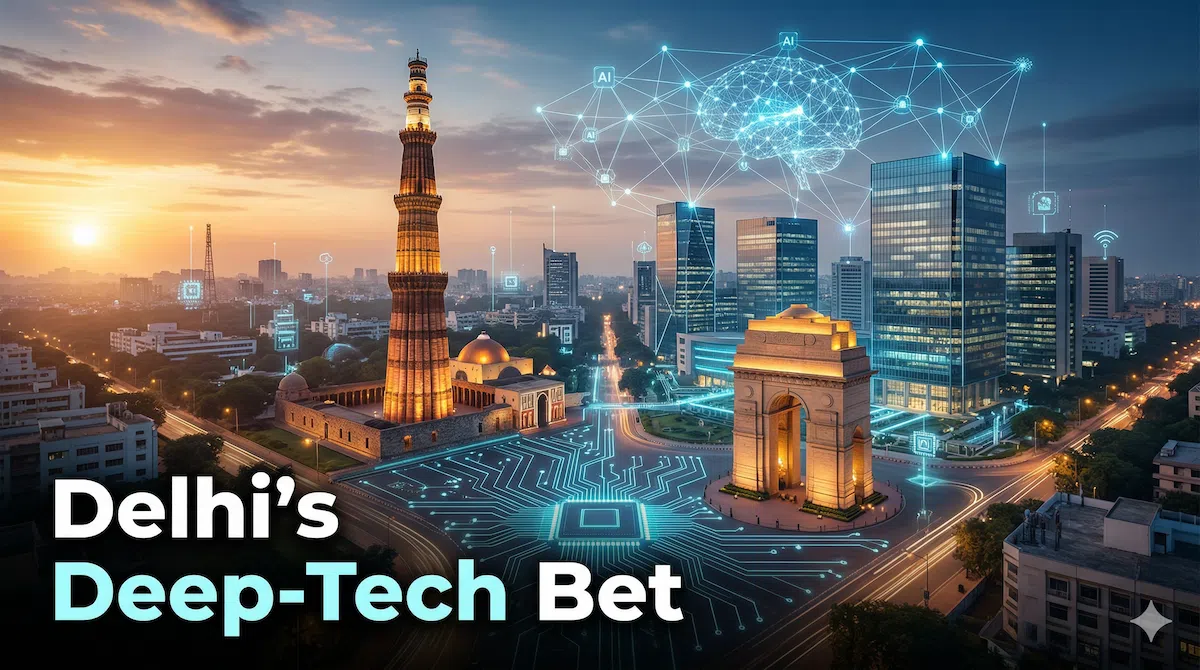
Delhi may never become India’s chip fabrication capital — but that does not mean it will miss the deep-tech boom.
As India accelerates its ambitions around semiconductors, artificial intelligence, and digital infrastructure, the national capital is beginning to attract attention for a different reason. Not for large-scale manufacturing, but for its potential role in the higher-value layers of the technology stack.
Industry observers increasingly see Delhi-NCR as a region that could contribute meaningfully to semiconductor design, embedded systems, and AI-driven enterprise solutions — areas where talent, software capability, and proximity to markets matter more than land and heavy industrial capacity.
A Different Kind of Semiconductor Opportunity
India’s semiconductor push has largely been associated with fabrication plants and large industrial investments. But the ecosystem extends far beyond factories.
A significant part of long-term value lies in chip design, system engineering, and intellectual property development. This is where Delhi-NCR may have a more realistic entry point.
The region is better aligned with the design and engineering side of semiconductors — including architecture, verification, and integration with software systems — rather than water- and capital-intensive fabrication.
This positioning is becoming more relevant as the Union Government continues to push the Semicon India Programme / India Semiconductor Mission, aimed at strengthening the country’s capabilities across the semiconductor value chain.
AI Adoption Could Be the Bigger Story
While semiconductors dominate headlines, the more immediate opportunity for Delhi may lie in artificial intelligence adoption among businesses — particularly MSMEs.
The capital region has a dense base of small and mid-sized enterprises operating across manufacturing, logistics, trading, and services. Many of these businesses are under pressure to improve efficiency, reduce operational costs, and adapt to increasingly competitive markets.
In this context, AI is less about experimentation and more about application.
The real impact is likely to come from practical use cases — improving inventory visibility, speeding up quality checks, enabling better demand forecasting, and automating routine processes. For many businesses, even incremental gains in these areas can translate into meaningful cost savings and productivity improvements.
That makes AI adoption not just a technology shift, but a business necessity.
Why Delhi-NCR Has Structural Advantages
Delhi’s growing relevance in deep tech is tied to its unique combination of resources.
Few regions in India bring together startup founders, engineering talent, enterprise demand, academic institutions, and policy proximity in the same way. This concentration creates a more connected ecosystem where ideas can move faster from development to deployment.
Equally important is access to customers.
Startups in Delhi-NCR are often building close to the industries they serve — from logistics operators and industrial suppliers to service businesses and mid-sized enterprises. This proximity allows founders to develop solutions based on real operational challenges rather than abstract use cases.
As a result, the region is particularly well suited for building practical AI products, enterprise software, and hardware-software systems that address real market needs.
From Policy Capital to Innovation Layer
For years, Delhi has been seen primarily as a centre for governance and policy. But that identity may be evolving.
As India’s technology ambitions expand, there is growing space for regions that can contribute to research, design, and deployment — even if they are not manufacturing hubs.
Delhi’s advantage lies in this middle layer, where policy, talent, startups, and enterprise demand intersect.
If leveraged effectively, this positioning could allow the capital to play a meaningful role in India’s deep-tech ecosystem — not by competing with fabrication-focused states, but by complementing them.
What This Means for Startups and Investors
For startups, the opportunity is becoming clearer.
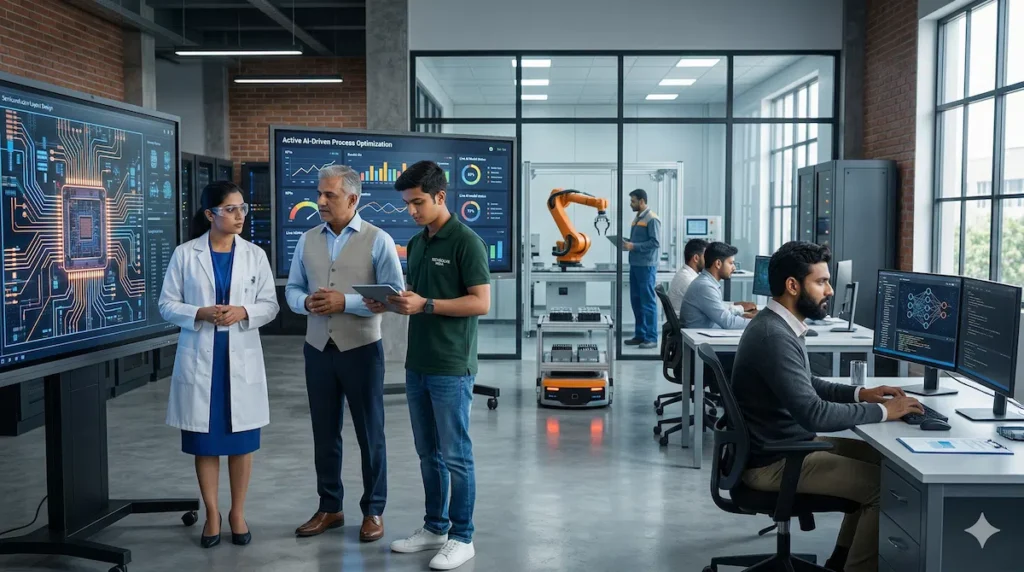
The next wave of growth is likely to come from companies building at the intersection of AI, enterprise software, and hardware integration — particularly those focused on industrial use cases and business productivity.
For investors, this signals a shift in where value may emerge.
After a decade dominated by consumer internet and fintech, attention is gradually moving toward deeper, more infrastructure-driven categories. These may be harder to build and scale, but they also offer stronger long-term defensibility.
Delhi-NCR’s ecosystem could become increasingly relevant in this context, especially if it can support startups working on real-world applications rather than purely experimental technologies.
Execution Will Be the Real Test
Despite its advantages, Delhi’s deep-tech potential is far from guaranteed.
Building a durable ecosystem will require more than talent and proximity. It will depend on consistent policy support, stronger collaboration between academia and industry, access to infrastructure, and clear pathways for startups to deploy their solutions at scale.
Without execution, the region risks remaining a place where deep-tech is discussed more than it is built.
With execution, it could emerge as a key node in India’s evolving technology landscape.
The Bottom Line
India’s AI and semiconductor future will not be shaped by one city alone.
Some regions will lead in manufacturing. Others will dominate in packaging, design, or enterprise deployment.
Delhi’s strongest opportunity lies in the layer that connects them — where ideas are designed, systems are built, and technologies are applied to real business problems.
If that layer grows, the capital’s role in India’s deep-tech story could become far more significant than it appears today.
FAQs
Why is Delhi relevant to India’s semiconductor story?
Delhi-NCR is unlikely to become a major fabrication base, but it is well-positioned for semiconductor design, embedded systems, enterprise software, and applied AI innovation.
How does AI fit into Delhi’s business ecosystem?
AI is most relevant to Delhi through practical business use cases, especially among MSMEs looking to improve efficiency, automate workflows, and reduce operational friction.
What kind of startups could benefit most?
Startups working in industrial AI, computer vision, embedded systems, enterprise automation, and semiconductor design could benefit the most if ecosystem support improves.
What will determine whether Delhi succeeds in deep tech?
Long-term success will depend on execution — including policy continuity, startup infrastructure, research-industry collaboration, and real business adoption.