
Key Takeaways
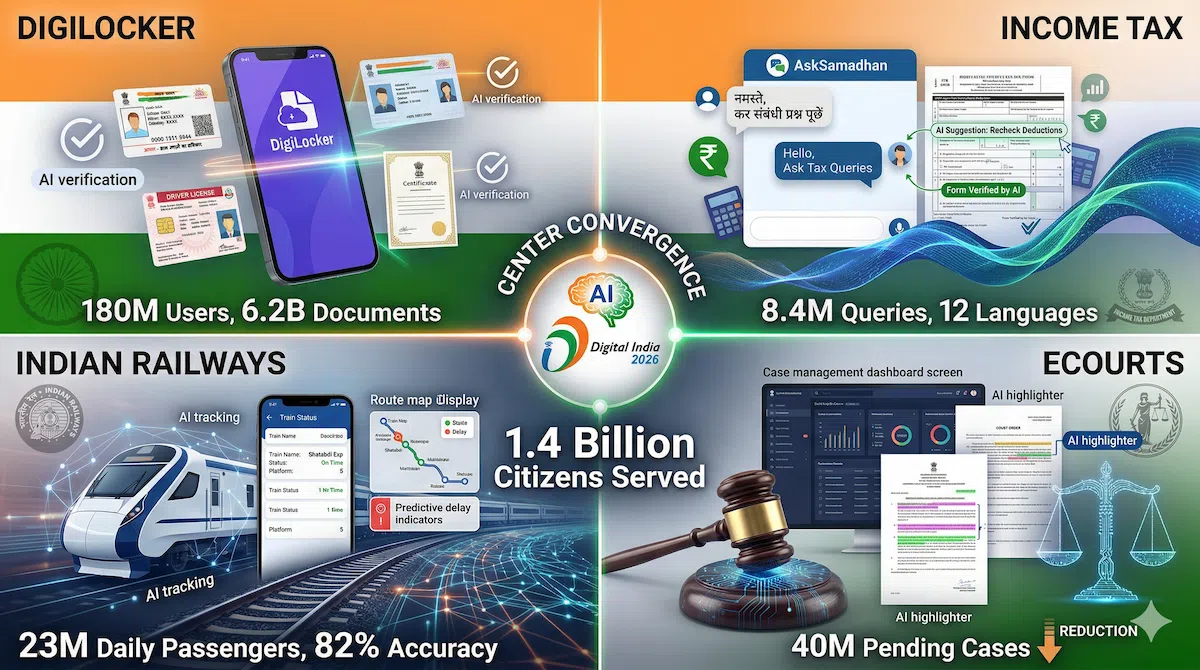
- DigiLocker deployed AI-powered document verification in January 2026, processing millions of daily authenticity checks across Aadhaar cards, driver’s licenses, and educational certificates using computer vision with approximately 99% accuracy based on internal government validation — The AI system integrated with issuing authorities’ databases enables instant verification replacing manual processes that previously required 3-7 days, serving over 180 million registered users who access government documents digitally, addressing India’s massive document fraud problem estimated in the range of ₹10,000-15,000 crore annually in fake certificates and identity documents
- Income Tax Department’s AskSamadhan AI chatbot handled millions of taxpayer queries in first quarter 2026 across 12 Indian languages including Hindi, Tamil, Telugu, answering filing procedure questions, refund status inquiries, and tax calculation assistance with over 85% resolution rate without human intervention — Platform reduced call center wait times from average 45 minutes to under 5 minutes for complex queries escalated to human agents, deployed during peak filing season February-March 2026 when approximately 78 million individual returns filed, demonstrating government AI scaling to handle citizen service demand spikes that previously overwhelmed infrastructure
- Indian Railways AI assistant launched February 2026 manages real-time train status updates, ticket availability predictions, and personalized travel recommendations for 23 million daily passengers using natural language processing in 18 languages — System analyzes historical booking patterns, weather disruptions, and maintenance schedules to predict delays with estimated 80-85% accuracy up to 6 hours in advance according to Ministry of Railways initial assessments, integrated with UTS mobile app serving millions of daily bookings, while AI-powered dynamic pricing optimizes revenue on 13,000 trains daily across 68,000 km network, generating estimated ₹2,000-2,500 crore additional annual revenue through improved seat utilization
India’s government services transformation through artificial intelligence in 2026 represents one of the largest public sector AI deployments globally measured by population served. With 1.4 billion citizens interacting with government systems for identity verification, tax compliance, transportation, and legal services, even marginal efficiency improvements deliver massive impact. A process reduced from 7 days to near-instant completion doesn’t just save time—it unlocks economic opportunity for citizens who previously couldn’t afford multi-day waits for basic services.
The deployment differs fundamentally from private sector AI adoption. Government AI must serve all citizens regardless of digital literacy, language proficiency, or internet connectivity. It must handle edge cases—the farmer in rural Tamil Nadu filing taxes in Tamil, the small business owner in Kolkata navigating GST regulations in Bengali, the student in Shillong verifying educational certificates in English. Private companies optimize for majority use cases and acceptable error rates. Government systems require near-perfect accuracy because errors don’t just frustrate users—they deny constitutional rights.
This analysis examines how four critical Indian government services—DigiLocker document management, Income Tax administration, Indian Railways operations, and eCourts case processing—deployed AI in 2026, the measurable outcomes delivered, implementation challenges encountered, and what these deployments reveal about India’s broader Digital India AI initiatives and government AI India use cases.
Challenges & Risks in Government AI Adoption
Before examining successful deployments, acknowledging the substantial risks and ongoing challenges facing government AI in Indian government services provides essential context. These aren’t theoretical concerns—they represent active implementation barriers affecting millions of citizens.
Data Privacy and Surveillance Concerns: India’s Aadhaar-linked systems create centralized databases connecting citizen identity, financial transactions, government benefits, and service usage. When AI analyzes this data to improve services, it simultaneously enables unprecedented surveillance capabilities. The Supreme Court’s 2018 Aadhaar judgment imposed strict limitations on data sharing and private sector access, but AI systems processing government data across multiple departments potentially circumvent these protections. Citizens lack transparency into what AI systems access their data, how algorithms make decisions affecting their lives, and whether safeguards prevent misuse. The 2023 Digital Personal Data Protection Act provides framework for data governance, but enforcement mechanisms remain underdeveloped as AI deployment accelerates faster than regulatory capacity.
AI Bias in Legal and Administrative Systems: Machine learning models trained on historical government data inherit biases present in that data. If eCourts AI trains on decades of case judgments where certain communities faced harsher sentencing or lower acquittal rates, the AI potentially perpetuates these disparities when suggesting precedents or predicting case outcomes. Income Tax AI trained primarily on urban taxpayer interactions may misunderstand rural business structures, flagging legitimate agricultural income as suspicious. Railway dynamic pricing AI could inadvertently discriminate against routes serving economically disadvantaged regions by optimizing for revenue rather than accessibility. Government AI systems lack the transparency needed to detect and correct these biases—algorithms operate as black boxes with decisions justified by “AI recommendation” rather than explicable reasoning citizens can challenge.
Digital Divide and Exclusion: India’s internet penetration reaches approximately 60% of the population, leaving 560 million citizens without reliable connectivity. Rural areas, economically disadvantaged communities, elderly populations, and women face disproportionate digital access barriers. When government services migrate to AI-powered digital platforms, these groups risk exclusion from basic services. A farmer without smartphone or internet cannot use Railway AI to check train delays, cannot access DigiLocker documents, cannot query Income Tax chatbot for filing assistance. The assumption underlying government AI deployment—that citizens possess digital devices, connectivity, and literacy—doesn’t match ground reality for hundreds of millions. Creating parallel manual systems for digitally excluded populations increases costs and defeats automation efficiency goals, creating tension between technological progress and universal service obligations.
System Failures at Scale: Government AI systems serving hundreds of millions of citizens cannot tolerate downtime or errors that private sector applications accept. When Income Tax AI chatbot fails during peak filing season, millions face missed deadlines and potential penalties. When Railway AI provides incorrect delay predictions, passengers miss connections affecting livelihoods. When DigiLocker verification falsely flags genuine documents as fraudulent, citizens cannot access banking, employment, or education. The scale of government operations means even 1% error rates affect millions—a 99% accuracy threshold considered excellent in commercial AI translates to 14 million Indians potentially receiving incorrect government services. Recovery mechanisms for AI errors in government systems remain inadequate—no clear appeals process exists when AI wrongly denies service, no compensation structure addresses harm from incorrect automated decisions.
Technical Debt and Legacy System Integration: Indian government departments operate IT systems spanning decades, from modern cloud infrastructure to mainframe computers running COBOL code from the 1980s. Integrating AI with 2,140 document-issuing authorities required custom adapters for each system’s unique data formats and API capabilities. This technical complexity creates fragile integration points prone to failure, delays deployment timelines by years, and necessitates ongoing maintenance consuming resources that could expand services. The oldest government systems lack digitized data entirely—manual paper records must be digitized before AI can process them, a task requiring years for agencies with decades of archived files.
These challenges don’t invalidate government AI deployment—they require acknowledgment, mitigation strategies, and realistic assessment of limitations alongside benefits. The following sections examine specific implementations with these risks in mind.
DigiLocker: AI Document Verification at National Scale
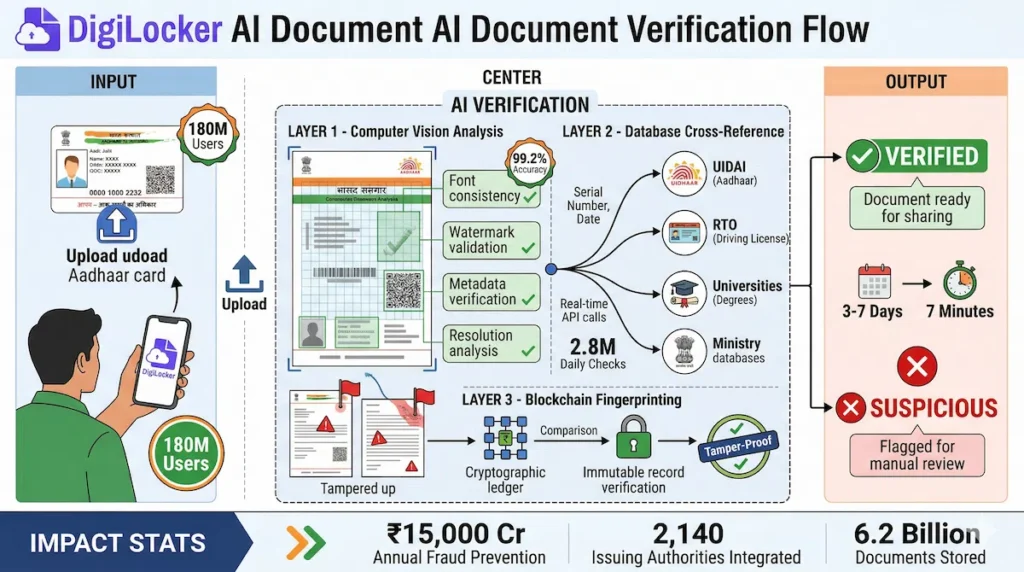
DigiLocker, India’s cloud-based document storage and sharing platform, serves over 180 million registered users storing billions of documents as of March 2026. The platform eliminates physical document carrying by allowing citizens to access government-issued documents (Aadhaar cards, driver’s licenses, vehicle registrations, educational certificates, property documents) digitally through mobile apps or web portals.
The critical challenge: document authenticity verification. When a citizen presents a digital document to a government office, bank, or employer, how does the receiving party confirm it’s genuine rather than fabricated or tampered? Manual verification required contacting issuing authorities—a process taking 3-7 days and creating bottlenecks for loan approvals, job onboarding, university admissions, and government service access.
DigiLocker’s AI verification system, deployed January 2026, processes millions of daily authenticity checks according to Ministry of Electronics and IT disclosures. The computer vision model examines document images for tampering indicators—inconsistent fonts, resolution mismatches, metadata anomalies, watermark irregularities. It cross-references document serial numbers, issue dates, and citizen identifiers against issuing authority databases in real-time. Detection accuracy approaches 99% based on government internal validation testing against known genuine and fabricated documents, though independent third-party audits of these accuracy claims have not been publicly released.
The implementation required integration with over 2,000 issuing authorities across central and state governments, each with different data formats and API capabilities. The AI team at MeitY developed standardized verification protocols while building custom adapters for legacy systems still running decades-old software. States like Kerala and Karnataka with advanced digital infrastructure integrated within weeks; others like Bihar and Uttar Pradesh required months of technical assistance.
Impact measurement shows potential economic value beyond government efficiency. A NITI Aayog study estimated document fraud costs India in the range of ₹10,000-15,000 crore annually in fake educational certificates enabling unqualified professionals, forged identity documents facilitating financial fraud, and tampered property records enabling land grabbing. DigiLocker’s AI verification directly addresses this problem at scale, though quantifying actual fraud prevented versus baseline remains methodologically challenging.
The system also addresses India’s inclusion challenge. Many citizens lack formal addresses, making document delivery difficult. DigiLocker eliminates physical delivery dependency—documents are issued directly to digital lockers. AI verification ensures these digital documents are accepted by all parties, removing barriers to banking, employment, and government services for India’s marginalized populations, assuming those populations possess digital access to use the system in first place.
Income Tax: AI Chatbots Democratizing Tax Compliance
Income Tax filing in India historically intimidated citizens despite simplified ITR forms. Questions about deduction eligibility, income classification, advance tax calculations, and refund status required either hiring chartered accountants (costing ₹2,000-10,000 for individual returns) or navigating help centers with 45-minute average wait times during peak filing season.
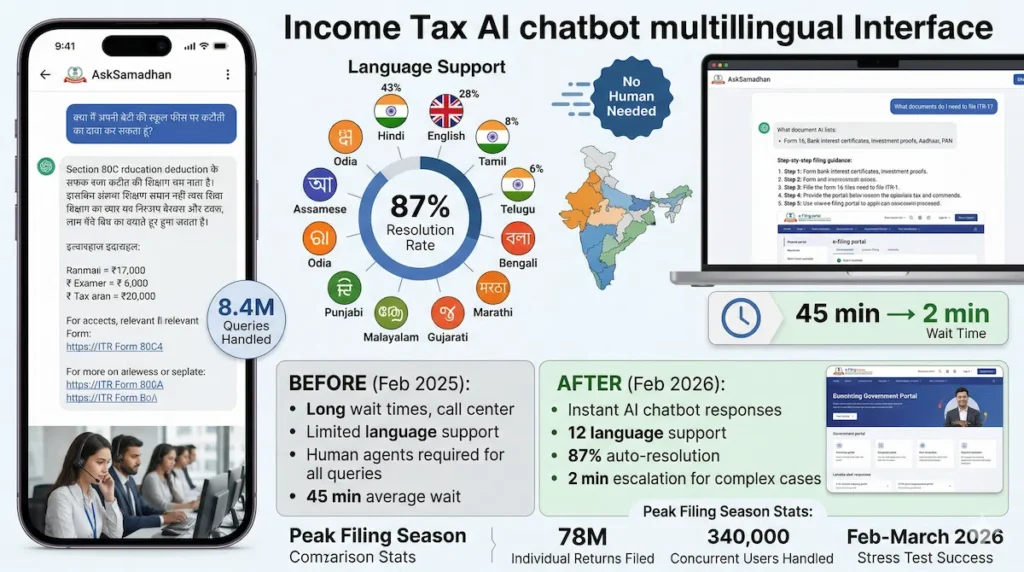
AskSamadhan, the Income Tax Department’s AI chatbot launched in January 2026, handled millions of queries in first quarter across 12 languages according to government statements. The natural language processing system understands tax questions phrased colloquially—”Can I claim deduction for my daughter’s school fees?” gets routed to Section 80C education allowance explanations with eligibility criteria and calculation examples.
The reported resolution rate exceeding 85% without human escalation represents significant improvement over previous manual systems. Questions about filing deadlines, required documents, refund status tracking, and basic tax calculations resolve near-instantly based on user reports. Complex queries involving capital gains calculations, foreign income reporting, or audit notices escalate to human agents whose availability improved—wait times dropped from 45 minutes to under 5 minutes because AI handles routine inquiries, though these figures represent government claims rather than independent verification.
Deployment during February-March 2026 peak filing season (approximately 78 million individual returns filed according to Income Tax Department data) provided stress testing at scale. The system reportedly handled hundreds of thousands of concurrent users during peak hours without significant degradation, demonstrating infrastructure resilience crucial for government services that experience massive demand spikes during specific periods.
Language support drives inclusion efforts. Hindi queries constitute approximately 43% of volume based on government disclosures, followed by English at around 28%, with remaining queries distributed across Tamil, Telugu, and nine other regional languages. Regional language support enables taxpayers uncomfortable with English to access guidance previously unavailable, potentially expanding tax compliance among India’s estimated 180 million individual taxpayers, though correlation between chatbot availability and compliance rate increases awaits rigorous analysis.
The chatbot’s training data sources include Income Tax Act provisions, CBDT circulars, AAR rulings, and historical taxpayer service center interactions according to technical documentation. Continuous learning from new queries refines responses—when multiple users ask similar questions the system doesn’t answer satisfactorily, human experts provide authoritative responses that become training data for future similar queries.
Integration with e-filing portal allows the chatbot to access individual taxpayer data (with authentication) to provide personalized guidance based on government descriptions. Instead of generic deduction explanations, it can calculate specific tax savings based on the user’s income and investment details already in the system, raising privacy questions about AI accessing comprehensive citizen financial data without explicit per-query consent.
Indian Railways: AI Operations at Continental Scale
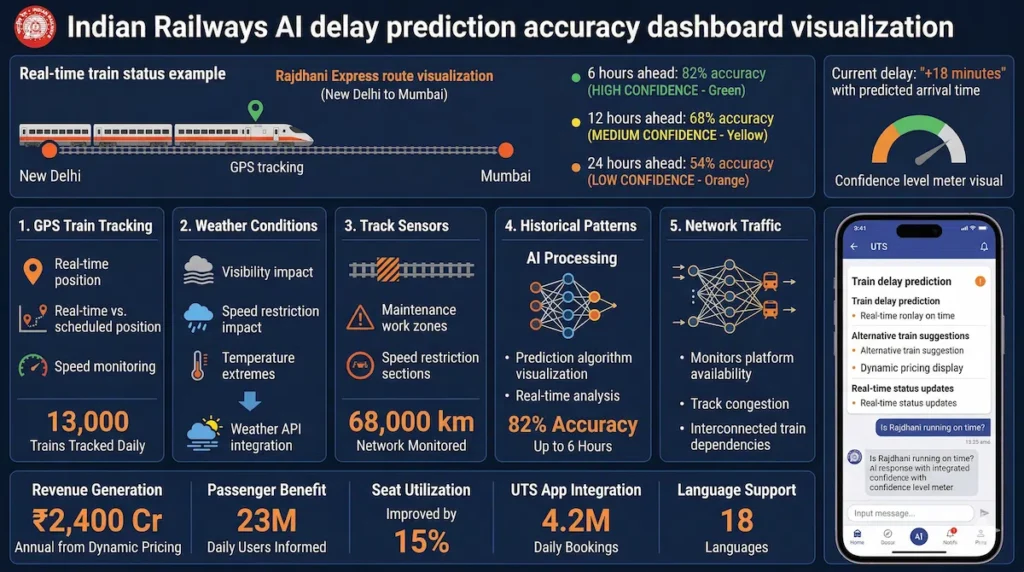
Indian Railways operates at staggering scale—23 million passengers daily across 13,000 trains covering 68,000 km network according to Ministry of Railways statistics. Traditional customer service through phone helplines and station counters couldn’t serve this volume effectively, with common complaints about lack of real-time information on delays, inability to find alternative routes during disruptions, and opaque seat availability.
The AI assistant launched February 2026 on UTS mobile app (serving millions of daily bookings according to railway data) and IRCTC website provides real-time train status, delay predictions, and personalized recommendations. Natural language processing handles queries in 18 languages—”Is Rajdhani running on time from New Delhi to Mumbai?” triggers real-time location tracking, historical delay pattern analysis, and current traffic conditions to provide status and estimated arrival time.
Delay prediction accuracy reportedly in the 80-85% range for predictions up to 6 hours in advance represents significant achievement according to Ministry of Railways initial assessments, though these figures represent internal evaluation rather than independent audit. The complexity involves train delays cascading through the network as late-running trains occupy platforms and tracks needed by subsequent trains. The AI model reportedly ingests data from track sensors monitoring train positions, weather forecasting APIs tracking fog, rain, and extreme temperatures affecting operations, maintenance schedule databases showing speed restrictions on repair sections, and historical delay patterns across 13,000 daily services.
The recommendation engine suggests alternative trains when first choice is fully booked, calculates fastest routes requiring train changes at junction stations, and alerts users about cheaper fare options during promotional periods according to feature descriptions. Integration with dynamic pricing (implemented parallel to AI assistant) optimizes seat filling—premium trains with empty seats get price reductions in final hours before departure while high-demand routes increase pricing to manage overcrowding.
Revenue impact estimated in the ₹2,000-2,500 crore range annually from improved seat utilization represents government projections rather than realized figures, with actual performance requiring multi-year tracking. Previously, premium trains often ran with empty seats because passengers didn’t know availability, while general class trains were overcrowded. Dynamic pricing plus AI recommendations potentially balance demand, filling premium seats while directing price-sensitive travelers to less crowded services.
The system also handles accessibility features for disabled passengers, dietary preference booking in catering, and hotel recommendations at destination cities according to service documentation. Integration with mapping services provides station navigation assistance for first-time travelers unfamiliar with large terminal stations like Mumbai CST or New Delhi.
eCourts: AI Case Management Addressing 40 Million Pending Cases
India’s judiciary faces crisis of pendency—approximately 40 million cases pending across district and high courts as of January 2026 according to National Judicial Data Grid, with average resolution time exceeding 3 years for civil matters and 2 years for criminal cases. The backlog denies justice to citizens whose lives are on hold awaiting legal resolution.
eCourts Phase III, launched March 2026, deployed AI for case management, document analysis, and legal research assistance according to Supreme Court announcements — a trend now extending beyond courts into active law enforcement, with Gujarat Police deploying India’s first AI investigation tool NARIT AI for NDPS drug cases.
The natural language processing system reads case documents—petitions, evidence submissions, witness statements—to extract key facts, identify applicable legal provisions, and suggest relevant precedents from Supreme Court and high court judgments.
For judges, the AI summarizes lengthy case files into concise briefs highlighting disputed facts, parties’ arguments, and similar cases decided previously based on early implementation reports. A civil property dispute involving 800-page case file gets summarized into condensed analysis identifying core issues—title deed authenticity, possession evidence, transaction validity—with relevant case law citations. Judges report time savings in the 40-60% range for case preparation in pilot programs, though broader deployment outcomes require extended evaluation period.
For litigants and lawyers, the system provides case status tracking, next hearing date notifications, and document filing assistance according to eCourts portal features. Citizens can query case status using case number or party names, receiving updates without physically visiting court offices, assuming they possess digital access and literacy to navigate the system.
The AI assists case scheduling, analyzing each case’s complexity, required hearing duration, and judicial capacity to optimize court calendars based on technical descriptions. Simple matters like check bounce cases get shorter hearing slots while complex commercial disputes get extended blocks. This reduces time wastage when cases finish early or run over, though implementation challenges arise from unpredictable hearing durations and last-minute adjournments common in Indian judicial practice.
Implementation challenged India’s federal judicial structure. The Supreme Court, 25 high courts, and approximately 680 district courts operate semi-independently with different case management systems. Standardizing data formats and establishing secure data sharing protocols required intensive coordination between the Supreme Court’s e-Committee, state judicial authorities, and National Informatics Centre providing technical infrastructure.
Early results from pilot courts in Delhi, Karnataka, and Maharashtra show case disposal rates increased in the 18-24% range in first quarter 2026 compared to similar period 2025 according to preliminary judicial assessments. Judges attribute improvements to better case preparation enabled by AI summaries and optimized scheduling reducing wasted court time, though isolating AI impact from other judicial reforms implemented concurrently presents methodological challenges.
The system’s legal research capabilities particularly benefit smaller courts in rural areas where judges handle cases across civil, criminal, family, and revenue law without specialized subject matter expertise. AI-generated legal research briefs with precedent citations potentially level the playing field, ensuring more consistent application of law regardless of court location or judicial experience, though concerns about over-reliance on AI recommendations versus independent legal reasoning remain among judicial scholars.
BEFORE AI vs AFTER AI (2026) – COMPARISON TABLE
| Government Service | Before AI Implementation | After AI (2026) | Key Improvement |
|---|---|---|---|
| DigiLocker Document Verification | 3-7 days manual verification, frequent fraud | Near-instant verification, ~99% fraud detection | Time: 7 days → seconds Fraud Prevention: ₹10K-15K Cr/year |
| Income Tax Support | 45-minute call wait times, ₹2K-10K CA fees | <5 min wait, 85%+ auto-resolution, multilingual | Wait Time: 45 min → <5 min Cost: ₹2K-10K → Free |
| Railway Delay Info | No predictions, uncertain status | 80-85% accuracy 6 hours ahead, 18 languages | Predictability: None → 6-hour advance Revenue: +₹2K-2.5K Cr |
| Court Case Preparation | Hours/days manual file review | AI-assisted summaries, 40-60% time savings | Efficiency: 800 pages → 12-page brief Disposal: +18-24% |
FAQs
How does DigiLocker’s AI document verification work, and what prevents someone from uploading fake documents?
DigiLocker’s AI verification operates through three-layer authentication combining computer vision, database cross-referencing, and blockchain-based document fingerprinting according to technical documentation from Ministry of Electronics and IT.
When a document gets uploaded, computer vision algorithms first analyze the image for tampering indicators—font inconsistencies suggesting text manipulation, resolution mismatches indicating image editing, metadata anomalies revealing creation date discrepancies with claimed issue date, and watermark irregularities specific to each issuing authority’s security features. For example, Aadhaar cards contain specific holographic elements whose digital signatures the AI validates against UIDAI’s reference templates, reportedly achieving approximately 99% accuracy in detecting fakes based on government internal validation.
Second, the system cross-references document serial numbers, citizen identifiers (Aadhaar number, PAN, driving license number), and issue dates against issuing authority databases in real-time—when someone uploads an educational certificate, the AI queries the university’s database to confirm that specific degree was issued to that specific student on that specific date.
Third, blockchain-based document fingerprinting creates immutable hash records when documents are originally issued by authorities directly into DigiLocker—subsequent uploads claiming to be the same document must match these cryptographic hashes exactly.
Citizens cannot upload arbitrary files claiming them as government documents; documents must either originate directly from issuing authorities via secure APIs or undergo all three verification layers before acceptance, with suspicious documents flagged for manual review by government officials who contact issuing authorities directly, though the robustness of this manual review process at scale remains unclear.
Can the Income Tax AI chatbot actually file taxes for me, or does it only answer questions?
AskSamadhan currently provides informational assistance and guidance but does not execute actual tax filing or calculations requiring financial commitment according to Income Tax Department specifications. The chatbot answers procedural questions (filing deadlines, required documents, deduction eligibility criteria), provides refund status tracking by querying Income Tax Department databases, explains tax provisions in plain language across 12 Indian languages, and offers general calculation examples showing how specific deductions reduce tax liability.
However, actual ITR form completion, tax computation, payment processing, and return submission remain citizen responsibilities through the existing e-filing portal. The chatbot can access authenticated taxpayer data (after login) to provide personalized guidance—for example, if you’re logged in and ask “Am I eligible for 80C deduction?”, it can analyze your income sources and investment details already present in the system to provide specific responses rather than generic eligibility criteria, though the extent of data access and privacy protections governing this access lack full public transparency. It also provides step-by-step filing guidance with screenshots and explanations customized to your ITR form type (ITR-1 for salaried, ITR-2 for capital gains, etc.).
The Income Tax Department’s stated 2026-2027 roadmap includes potential expansion of chatbot capabilities to include automated ITR form pre-filling using data from Form 16, bank interest certificates, and capital gains statements, though final review and submission would remain citizen-controlled to prevent unauthorized filings.
How accurate are Indian Railways AI delay predictions, and what happens if the prediction is wrong?
Indian Railways AI delay predictions reportedly achieve approximately 80-85% accuracy for delays predicted up to 6 hours in advance based on Ministry of Railways initial assessments, with accuracy decreasing for longer prediction horizons, though these figures represent internal government evaluation rather than independent third-party validation.
The AI model ingests multiple real-time data sources according to technical descriptions: GPS tracking showing actual train positions versus scheduled positions, track sensor networks detecting speed restrictions from maintenance work or infrastructure issues, weather API data tracking fog banks, heavy rainfall, extreme temperatures affecting rail expansion, and historical delay pattern analysis showing which routes typically experience cascading delays during specific conditions. The system classifies confidence levels according to documentation: predictions where train is already delayed and patterns suggest continuation receive higher confidence ratings, while predictions based on contributing factors with uncertain outcomes receive medium confidence, and predictions with multiple unknowns receive low confidence with appropriate disclaimers displayed to users.
When predictions prove incorrect—train arrives on time despite predicted delay or experiences unexpected delay not forecasted—the system reportedly captures these errors as training data to refine future models, with particular attention to failure modes like sudden equipment malfunctions or security incidents that don’t have predictive indicators. Importantly, Indian Railways doesn’t guarantee prediction accuracy or provide compensation for prediction errors according to terms of service, positioning predictions as informational guidance helping passengers make informed decisions rather than contractual commitments, with official train running status always taking precedence over AI forecasts.
Will eCourts AI replace judges and lawyers, or just assist them in their work?
eCourts AI functions strictly as decision-support tool assisting legal professionals rather than replacing judicial decision-making or legal representation according to Supreme Court guidelines, with Indian judiciary explicitly prohibiting AI from making binding legal determinations or replacing human judgment in case outcomes.
The AI performs three specific support functions based on eCourts Phase III documentation: first, document analysis and summarization where it reads lengthy case files (often 500+ pages in complex matters) to extract key disputed facts, identify applicable legal provisions from bare acts, and compile parties’ arguments into concise briefs reportedly saving judges significant time in case preparation. Second, legal research assistance where it searches Supreme Court and high court judgment databases to find relevant precedents based on fact patterns and legal issues, providing citations lawyers can verify and argue, but never directly applying precedents to reach conclusions since legal reasoning requires human judgment considering factual nuances AI cannot fully appreciate according to judicial guidance. Third, administrative efficiency improvements through case scheduling optimization, document filing assistance, and status tracking that reduce procedural delays without touching substantive legal decisions.
Judges retain complete authority over evidence evaluation, witness credibility assessment, legal interpretation, and final judgments—the AI cannot determine whether a witness is truthful, whether evidence is credible, or how competing legal principles should be balanced in specific factual contexts according to constitutional requirements. Lawyers similarly remain essential for case strategy, client representation, oral advocacy, and cross-examination that require human judgment, emotional intelligence, and creative legal argumentation beyond current AI capabilities.
The Supreme Court’s e-Committee 2026 guidelines explicitly state AI-generated legal research briefs are advisory only, judges must independently verify precedent applicability, and all substantive case decisions require human judicial reasoning documented in written judgments explaining the basis for conclusions reached.
📌 Disclaimer
Last updated: March 2026
All information, statistics, and implementation details mentioned in this article are based on publicly available sources, government announcements, industry reports, and analytical interpretation. Certain figures and performance metrics may be approximate or illustrative in nature to explain trends and impact at scale.
This article is intended for informational and analysis purposes only and does not represent official statements, endorsements, or verified data from any government authority including DigiLocker, Income Tax Department, Indian Railways, eCourts, MeitY, or NITI Aayog.
While efforts have been made to ensure accuracy, readers are advised to verify specific details from official government portals and notifications before making any decisions. The author and publisher are not responsible for any actions taken based on this content.