
Key Takeaways
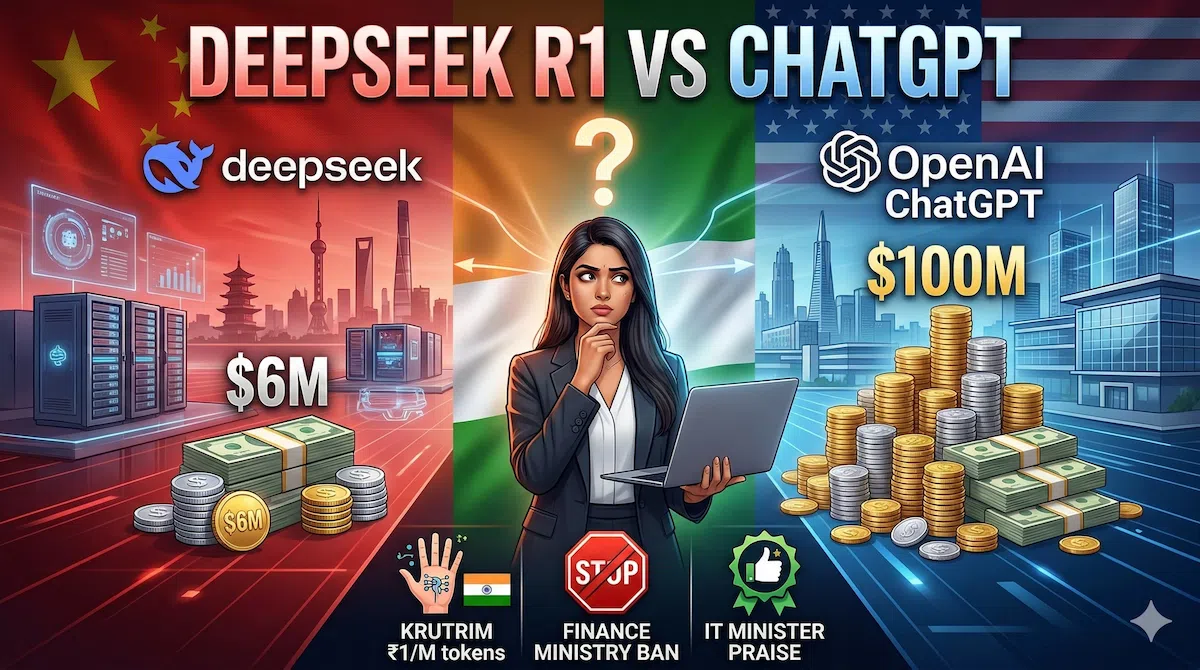
- DeepSeek R1 cost $5.5-6 million to train vs ChatGPT’s estimated $100 million — The Chinese AI startup achieved comparable performance to OpenAI’s flagship models using just 6% of the compute budget, triggering a “Sputnik moment” that wiped $600 billion off Nvidia’s market value in a single day and forced Silicon Valley to question its massive AI spending assumptions
- Krutrim deployed DeepSeek in India at ₹1 per million tokens while government ministries banned it — Bhavish Aggarwal’s AI platform offers Indian developers access to the open-source model for February 2026 at unprecedented pricing, even as India’s Finance Ministry prohibits government officers from using it due to data privacy concerns, creating a split-screen policy response
- India’s IT Minister praised DeepSeek while planning local hosting on 18,693 GPUs — Ashwini Vaishnaw publicly lauded the $5.5M achievement and announced India will host DeepSeek models on domestic servers with 42-47% compute discounts, positioning India to leverage Chinese AI efficiency while controlling data sovereignty—a pragmatic middle path between banning and unrestricted adoption
On January 20, 2026, a Chinese AI startup most people had never heard of released a reasoning model that sent shockwaves through Silicon Valley, wiped hundreds of billions off tech valuations, and forced a fundamental reckoning about how AI should be built.
DeepSeek R1 didn’t just match OpenAI’s ChatGPT and GPT-4o on mathematical reasoning, coding, and logical inference benchmarks. It did so having been trained for approximately $5.5-6 million—a fraction of the estimated $100 million OpenAI spent on GPT-4, and far below the hundreds of millions Meta invested in Llama 3.
The model’s release triggered what observers called a “Sputnik moment” for American AI. Nvidia’s stock plummeted 18% in a single trading session, erasing $600 billion in market value—the largest single-day loss for any company in U.S. stock market history. The message was brutal: China had built comparable AI capabilities for 6% of the cost, using weaker chips under U.S. export restrictions.
For India, DeepSeek’s emergence presents a fascinating dilemma. Within days of the R1 launch, two contradictory responses emerged from the Indian government. The Finance Ministry banned its officers from using DeepSeek, citing data privacy concerns. Simultaneously, IT Minister Ashwini Vaishnaw publicly praised DeepSeek’s achievement and announced plans to host the Chinese model on Indian government servers.
This split perfectly captures India’s AI contradiction: Should the country emulate China’s cost-efficient, pragmatic approach to building AI capabilities, or should it ban Chinese technology outright regardless of its technical merits?
The answer matters enormously. India invested ₹10,372 crore in its IndiaAI Mission but faces criticism that this pales compared to China’s massive AI spending. If DeepSeek proves that smarter training methods matter more than raw compute budgets, India’s path forward looks very different than simply trying to match U.S. and Chinese spending.
The David vs Goliath Numbers That Shocked Silicon Valley
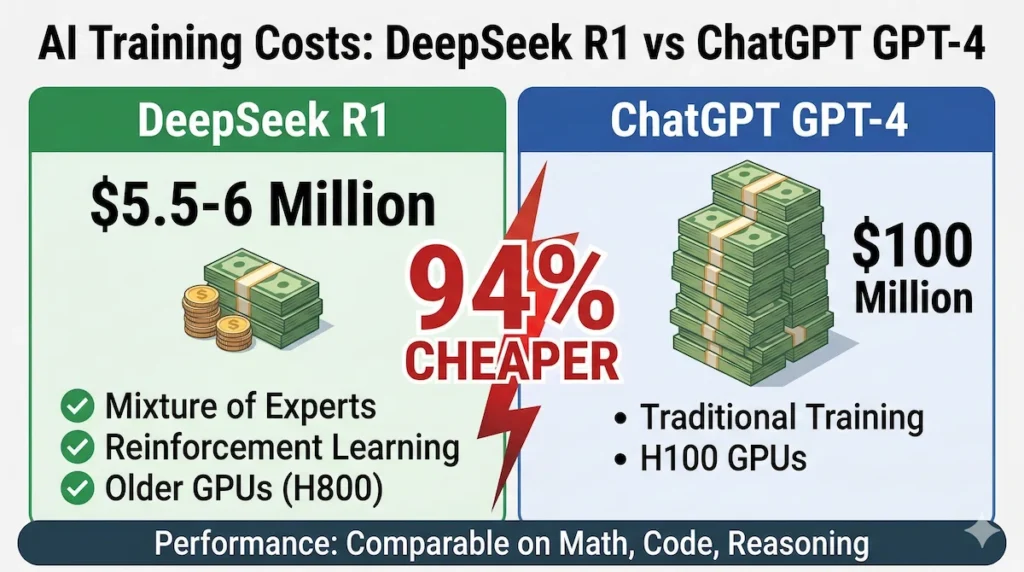
DeepSeek R1’s performance relative to its training cost represents one of the most dramatic efficiency breakthroughs in AI history.
Training costs compared:
- DeepSeek R1: $5.5-6 million
- GPT-4 (OpenAI): ~$100 million (estimated)
- Llama 3.1 (Meta): Significantly higher than DeepSeek, using 10x the compute
API pricing compared:
- DeepSeek: $0.14 per million input tokens, $0.28 per million output tokens
- ChatGPT (GPT-4o): $2.50 per million input tokens, $10 per million output tokens
- Difference: DeepSeek is 94-97% cheaper at API level
Benchmark performance (selected tasks):
- Math reasoning (AIME 2024): DeepSeek R1 79.8%, OpenAI o1 79.2%
- Coding (Codeforces): DeepSeek R1 96.3 percentile, similar to o1
- Graduate-level science (GPQA Diamond): DeepSeek R1 71.5%, competitive with o1
The technical achievement centers on DeepSeek’s innovative use of reinforcement learning without initial supervised fine-tuning, allowing the model to develop chain-of-thought reasoning organically. Combined with a Mixture of Experts (MoE) architecture that activates only 37 billion parameters out of a total 671 billion, DeepSeek achieves efficiency that renders the conventional “bigger is better” AI scaling philosophy obsolete.
Perhaps most significantly, DeepSeek accomplished this while operating under U.S. export restrictions that limited its access to cutting-edge Nvidia chips. The company trained R1 using older, less powerful GPUs that were export-approved—chips that American companies largely ignored in favor of the latest hardware. This constraint forced DeepSeek to innovate on algorithms and training methodology rather than simply throwing more compute at the problem.
The implications terrified Silicon Valley. If a relatively unknown Chinese startup could match OpenAI’s flagship models for 6% of the cost using inferior hardware, what does that say about the $100+ billion being poured into AI infrastructure by American hyperscalers?
Nvidia’s $600 billion market cap evaporation reflected investor panic that DeepSeek’s efficiency gains might reduce demand for cutting-edge AI chips. If better algorithms can substitute for raw compute power, the frenzied GPU procurement driving Nvidia’s valuation suddenly looks far less certain.
India’s Split Personality: Praise and Ban Simultaneously
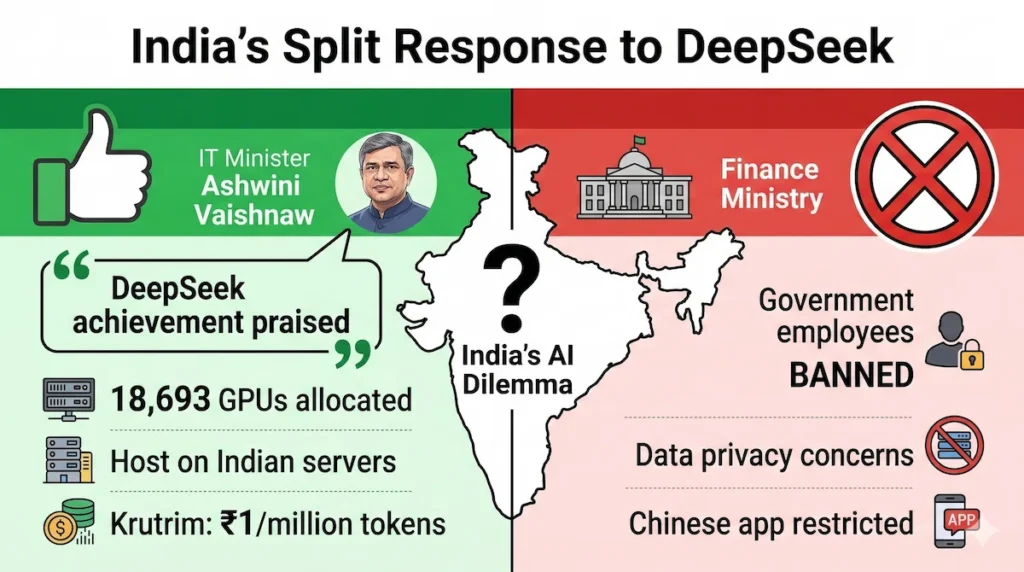
India’s response to DeepSeek perfectly encapsulates the country’s confused AI strategy—caught between pragmatic adoption of superior foreign technology and nationalist concerns about data sovereignty and geopolitical alignment.
On January 30, 2026, IT Minister Ashwini Vaishnaw publicly lauded DeepSeek at an industry conference. “You have seen what DeepSeek has done—$5.5 million and a very, very powerful model,” Vaishnaw stated, explicitly contrasting DeepSeek’s efficiency with criticism that India’s own AI investments have been inadequate.
Vaishnaw announced that India would host DeepSeek models on the country’s new AI Compute Facility, powered by 18,693 GPUs (13,000 Nvidia H100s, 1,500 H200s). The facility would offer AI computing at 42% discount for standard workloads and 47% discount for high-precision computing—making DeepSeek accessible to Indian developers at government-subsidized rates.
“Data privacy issues regarding DeepSeek can be addressed by hosting open source models on Indian servers,” Vaishnaw explained, articulating a pragmatic middle path: leverage DeepSeek’s technical achievements while ensuring Indian data never touches Chinese servers.
Yet simultaneously, India’s Finance Ministry issued a directive prohibiting its officers from using AI tools including both ChatGPT and DeepSeek for official purposes, citing data privacy and security concerns. The ban applied specifically to the DeepSeek consumer app, which processes queries on Chinese servers and raised questions about data handling under Chinese jurisdiction.
This contradiction—government servers hosting DeepSeek while government employees are banned from using it—reveals India’s struggle to balance three competing priorities:
Technical pragmatism: DeepSeek works, costs less, and Indian developers want access.
Data sovereignty: Chinese apps processing Indian data create security vulnerabilities.
Geopolitical positioning: India’s alignment with the U.S. and Quad partners complicates embrace of Chinese technology, even open-source Chinese technology.
The private sector moved faster. Bhavish Aggarwal’s Krutrim deployed DeepSeek R1 on Indian infrastructure in early February 2026, offering access at ₹1 per million tokens for the month—essentially free for experimentation. Mumbai-based Yotta Data Services launched a consumer-facing GenAI chatbot based on DeepSeek, emphasizing local data processing to address privacy concerns.
These moves position Indian companies to learn from DeepSeek’s technical innovations without depending on Chinese infrastructure. If India’s AI startups can reverse-engineer DeepSeek’s training methodologies while applying them to Indian language models and datasets, the country gains efficiency breakthroughs without the geopolitical baggage.
Should India Copy China’s Cost-Efficient AI Approach?
DeepSeek’s success poses an uncomfortable question for Indian policymakers: Is India pursuing the wrong AI strategy?
India’s IndiaAI Mission allocates ₹10,372 crore ($1.25 billion) to AI development over multiple years. This includes funding for AI compute infrastructure, datasets, research centers, and startup support. Critics argue this investment pales compared to China’s estimated $8.4 billion deployed into practical AI startups in early 2026 alone, not counting the massive state support for foundational AI research.
Yet DeepSeek suggests that raw spending comparisons miss the point. The Chinese startup achieved world-class results spending just $6 million on model training. If smarter algorithms and training methods matter more than brute-force compute, India’s strategy should emphasize AI research talent, novel architectures, and efficient deployment rather than trying to match Chinese and American infrastructure spending.
India’s advantages if pursuing a DeepSeek-inspired approach:
Talent availability: India produces hundreds of thousands of engineering graduates annually, many with strong mathematical and algorithmic foundations. DeepSeek’s innovation centered on novel reinforcement learning techniques—exactly the kind of algorithmic creativity Indian ML researchers excel at.
Cost sensitivity: Indian startups and government projects operate under budget constraints that force efficiency. This aligns perfectly with DeepSeek’s philosophy of maximizing performance per dollar rather than raw performance regardless of cost.
Open-source culture: DeepSeek released R1 under the MIT License, making its innovations freely available. India’s AI ecosystem could build on DeepSeek’s techniques rather than starting from scratch, accelerating development timelines.
Multilingual complexity: Training AI models for India’s 22 official languages and hundreds of dialects demands efficiency—India cannot afford to spend $100 million per language. DeepSeek-style techniques that reduce training costs by 90%+ make comprehensive Indian language coverage financially viable.
Challenges India faces in replicating DeepSeek:
Compute access: Despite the new AI Compute Facility’s 18,693 GPUs, India’s total AI compute infrastructure remains far below China’s. DeepSeek had access to thousands of GPUs even under export restrictions; most Indian AI startups struggle to secure dozens.
Research continuity: DeepSeek built on years of foundational work by its parent company High-Flyer, a successful hedge fund with deep quantitative expertise. Indian AI startups often lack the patient capital and research continuity to pursue multi-year algorithmic breakthroughs.
Data availability: Training world-class AI models requires massive, high-quality datasets. DeepSeek trained on extensive Chinese-language corpora; India’s fragmented linguistic landscape makes comparable dataset assembly far more complex.
Brain drain: Many of the researchers who could replicate DeepSeek’s innovations work at OpenAI, Google, and other Western labs. India loses top AI talent to higher-paying international opportunities—the very talent needed to build India’s DeepSeek equivalent.
The most pragmatic path forward combines emulation with pragmatic adoption. India should encourage its AI research community to study DeepSeek’s techniques, publish improvements, and apply these methods to Indian-specific challenges. Simultaneously, Indian companies and developers should leverage DeepSeek’s open-source models when they outperform alternatives—while ensuring data sovereignty through local hosting.
This hybrid approach maximizes learning while managing geopolitical and security risks. India doesn’t need to choose between blind nationalism (ban everything Chinese) and naive adoption (ignore security concerns). The middle path—learn from DeepSeek, host locally, innovate beyond it—offers the best of both worlds.
The Geopolitical Stakes: India Caught Between US and China
DeepSeek’s emergence complicates India’s careful geopolitical balancing act between the United States and China.
India participates in the Quad alliance with the U.S., Japan, and Australia, positioning itself as a democratic counterweight to Chinese influence in the Indo-Pacific. This alignment includes technology cooperation: India banned over 300 Chinese apps since 2020, including TikTok and WeChat, explicitly citing national security concerns around data access by Chinese entities.
The U.S. actively courts India as a technology partner. American semiconductor companies lobby for relaxed export controls to India. U.S. cloud providers expand Indian data center capacity. The Biden and subsequent administrations frame AI competition as a contest between democratic and authoritarian models of technology development.
Yet DeepSeek demonstrates that China’s authoritarian model can produce genuine technical innovation, not just imitation. The uncomfortable reality: Chinese AI researchers published the breakthrough techniques enabling R1’s efficiency. Chinese venture capital funded years of foundational research. Chinese government support provided the patient capital allowing long-term AI development.
For India, this creates tension. Adopting DeepSeek or Chinese AI techniques risks signaling inadequate commitment to the U.S.-led democratic technology alliance. American partners might question India’s reliability if Indian government servers host Chinese AI models.
But ignoring DeepSeek’s innovations out of geopolitical loyalty to Washington would be strategically foolish. India competes with China across multiple dimensions—economic growth, technology development, regional influence. If Chinese AI techniques genuinely achieve 90%+ cost reductions while maintaining performance, India cannot afford to ignore them purely for ideological reasons.
The solution lies in India’s emphasis on open-source adoption rather than proprietary dependence. Because DeepSeek released R1 under the MIT License, any country can use, modify, and improve upon it without creating ongoing dependence on Chinese entities. This distinguishes DeepSeek from, say, Huawei’s 5G technology, where using the infrastructure creates long-term strategic dependence on a Chinese company.
India can maintain its geopolitical alignment with democratic partners while pragmatically learning from Chinese open-source AI innovations. The key is ensuring Indian developers build on DeepSeek’s techniques to create India-specific models rather than simply using Chinese models as-is indefinitely.
What This Means for Indian AI Developers and Startups
For India’s AI ecosystem, DeepSeek represents both opportunity and competitive threat.
Opportunity: Indian developers now have access to frontier-quality reasoning AI at negligible cost. Krutrim’s ₹1 per million tokens pricing makes experimentation essentially free. Startups building AI applications can leverage DeepSeek-class capabilities without raising massive funding rounds to afford OpenAI API bills.
This democratizes AI development. A student in Tier-2 Indian city can build applications using reasoning AI previously accessible only to well-funded Silicon Valley startups. The efficiency gains matter more for capital-constrained Indian entrepreneurs than for American counterparts with easy venture capital access.
Threat: If Chinese companies can build world-class AI for 6% of American costs, what competitive advantage do Indian AI startups have? India’s AI unicorns like Krutrim raised hundreds of millions at high valuations based partly on the assumption that building competitive AI requires massive capital. Deep Seek suggests otherwise.
Indian AI companies must differentiate on dimensions beyond raw model performance. This means:
India-specific training data: DeepSeek trained primarily on English and Chinese. Models trained on Hindi, Tamil, Telugu, and other Indian languages with India-specific context provide differentiation Chinese models cannot easily replicate.
Regulatory compliance: Indian AI companies understand local data residency requirements, content moderation expectations, and government procurement processes. Foreign AI providers face barriers Indian companies can navigate more easily.
Cultural localization: AI assistants that understand Indian idioms, festivals, social contexts, and communication norms provide better user experiences than generic global models, regardless of benchmark scores.
Integration with Indian digital infrastructure: Models that seamlessly integrate with UPI, Aadhaar, DigiLocker, and other IndiaStack components offer practical utility foreign AI cannot match without deep local partnerships.
The most important lesson from DeepSeek for Indian developers: algorithmic innovation beats brute-force spending. India’s AI future depends less on matching Chinese GPU budgets and more on producing researchers who can pioneer the next breakthrough in training efficiency, model architecture, or inference optimization.
If one Chinese startup could shake Silicon Valley with clever algorithms and modest compute, Indian AI labs and startups can too. The question is whether India’s ecosystem provides the patience, funding continuity, and research freedom needed to attempt such breakthroughs.
FAQs
Is DeepSeek R1 really better than ChatGPT?
DeepSeek R1 matches or exceeds ChatGPT (GPT-4o) on specific benchmarks including mathematical reasoning (79.8% on AIME 2024 vs 79.2%), coding challenges (96.3 percentile on Codeforces), and graduate-level science questions. However, ChatGPT maintains advantages in creative writing, multilingual support, multimodal capabilities (images, voice), and user interface polish. For pure reasoning tasks like math, code, and logic, DeepSeek performs comparably at 6% of the training cost. For general consumer use, ChatGPT remains more versatile. The “better” model depends entirely on use case.
Can Indian developers use DeepSeek R1 legally and safely?
Yes, with important caveats. DeepSeek R1 is released under the MIT License, making it fully legal to use, modify, and deploy anywhere including India. Krutrim and Yotta Data Services offer DeepSeek access on Indian servers, addressing data sovereignty concerns. However, India’s Finance Ministry banned government employees from using the DeepSeek consumer app due to data privacy concerns, as the app processes queries on Chinese servers. For private developers and companies, using DeepSeek hosted on Indian infrastructure (via Krutrim at ₹1/million tokens) is both legal and encouraged by IT Minister Ashwini Vaishnaw. The key is ensuring data stays on Indian servers rather than flowing to China.
How did DeepSeek train a model for only $6 million when ChatGPT cost $100 million?
DeepSeek achieved 90%+ cost reduction through three key innovations: (1) Mixture of Experts architecture that activates only 37 billion parameters out of 671 billion total, dramatically reducing compute per query; (2) Pure reinforcement learning training without expensive supervised fine-tuning, allowing the model to develop reasoning capabilities organically; (3) Efficient use of older, export-approved Nvidia GPUs (H800s) rather than cutting-edge H100s, forcing algorithmic optimization over brute compute power. Additionally, training in China likely benefited from lower energy and labor costs compared to U.S. operations. The result: comparable performance at 6% of the cost, proving smarter training methods beat raw spending.
Should India copy China’s AI approach or ban DeepSeek?
India’s optimal strategy lies between blind copying and outright banning. IT Minister Ashwini Vaishnaw’s approach of hosting DeepSeek on Indian government servers (18,693 GPUs with 42-47% discounted compute) represents pragmatic middle ground: leverage DeepSeek’s technical innovations while ensuring data sovereignty. Indian AI startups should study DeepSeek’s training techniques, apply them to Indian language models and datasets, and build India-specific capabilities rather than depending on Chinese models long-term. The Finance Ministry’s ban on government employees using the DeepSeek app is sensible given data privacy risks, but blocking Indian developers from learning from open-source DeepSeek techniques would be strategically foolish. Learn from, don’t depend on, Chinese AI innovations.