
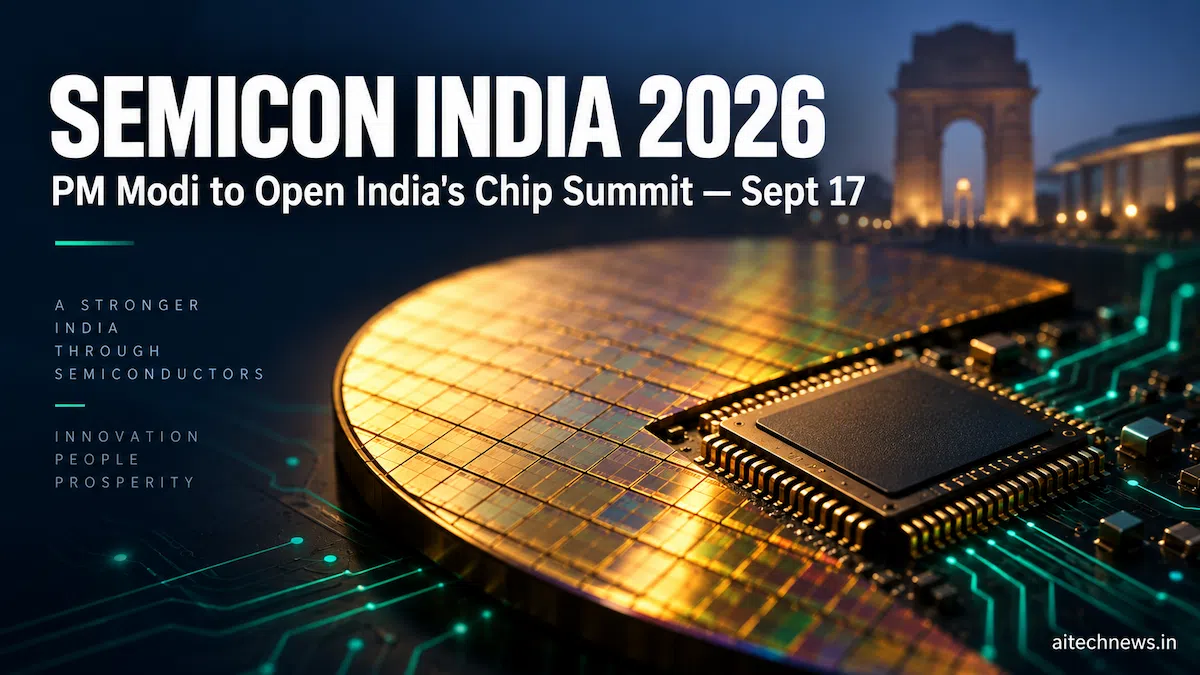
Prime Minister Narendra Modi will inaugurate SEMICON India 2026 on September 17 at Yashobhoomi (India International Convention & Expo Centre) in New Delhi, kicking off a three-day summit that’s being pitched as India’s most ambitious chip industry gathering yet. For India’s AI ecosystem — which has spent the last two years complaining about GPU scarcity and import costs — this isn’t just another government ribbon-cutting. It’s a checkpoint on whether India can eventually build the hardware its own AI boom depends on.
The fifth edition of the event runs September 17–19, organised jointly by the India Semiconductor Mission (ISM), the Ministry of Electronics and Information Technology (MeitY), and global industry body SEMI, under the theme “Silicon to Systems: Building the Ecosystem.”
What’s Actually Happening at SEMICON India 2026
According to MeitY, the summit will bring together 600+ exhibitors, including around 300 international companies, across 15,000 square metres of exhibition space, with more than 150 speakers, six country pavilions, and 12 state government pavilions. The agenda covers the full chip value chain — manufacturing, chip design, advanced packaging, materials, AI hardware, supply-chain resilience, and talent development — under a new “Sand to Silicon to Systems” experience zone.
Alongside the main conference, there’s a startup pitch competition, a student hackathon, and a dedicated Women’s Forum — signalling that this isn’t purely a big-fab showcase, but also a pitch to India’s chip-design and AI-hardware startups.
The State Race: Who’s Offering What
A big part of the story at SEMICON India isn’t the Centre — it’s the states competing for factories. Verified incentive structures currently on the table include:
STATE-BY-STATE INCENTIVE COMPARISON
Gujarat
+40% capital subsidy75% land subsidy for the first 200 acres at Dholera’s Semicon City, plus full stamp duty reimbursement. Dholera now hosts Tata Electronics’ fab, being built with ASML.
Tamil Nadu
Up to 50% of central incentiveCapital subsidy available for all ISM-approved semiconductor and electronics projects in the state.
Andhra Pradesh
60% of central subsidyAdditional power and customs benefits layered on top of the central government’s support package.
Odisha
Up to 30% capex subsidyFull tax and duty exemptions. The state broke ground on one of India’s first advanced 3D semiconductor packaging units earlier this year.
Uttar Pradesh
Not a subsidy story — a scale storyUP now produces roughly 65% of India’s mobile phones and accounts for close to 55% of the country’s electronics component manufacturing, built largely around the Noida–Greater Noida corridor.
India’s broader semiconductor manufacturing boom — of which SEMICON India 2026 is the flagship event — has already seen 12 projects approved under the India Semiconductor Mission, with the first units already in commercial production and a larger Semicon 2.0 phase — backed by an outlay north of ₹1.27 lakh crore — now underway.
Why This Matters for India’s AI Ambitions
Here’s the part most coverage of this event will skip: India’s AI startups don’t manufacture chips — they import GPUs, mostly from Nvidia, at prices that eat into runway. The IndiaAI Mission has subsidised GPU access for startups like Sarvam AI, but that’s compute access, not compute sovereignty. None of the fabs being discussed at SEMICON India will produce an AI training chip in the next two to three years — the nearest projects are focused on legacy nodes, packaging, and display/automotive-grade chips, not cutting-edge AI silicon.
So the realistic near-term win for AI founders isn’t “cheaper GPUs by next year.” It’s a maturing packaging and design ecosystem (via the Design Linked Incentive scheme, which has already backed 23–24 chip-design projects) that could, over five to seven years, reduce India’s total dependence on imported compute — and produce a generation of India-trained chip engineers who currently have to leave the country to work on AI silicon.
Quick Facts
| Detail | Info |
|---|---|
| Dates | September 17–19, 2026 |
| Venue | Yashobhoomi (IICC), Dwarka, New Delhi |
| Inaugurated by | PM Narendra Modi |
| Organisers | ISM, MeitY, SEMI |
| Exhibitors | 600+, including ~300 international |
| Theme | “Silicon to Systems: Building the Ecosystem” |
FAQs
Will SEMICON India 2026 reduce AI chip prices in India?
Not immediately. The projects being showcased are mostly in packaging, legacy-node manufacturing, and design services — not cutting-edge AI training chips. Any price impact on GPUs is a multi-year story, not a 2026 one.
Is this the same India Semiconductor Mission that funds AI startups?
It’s related but distinct. ISM funds fabs and chip-design projects; the separate IndiaAI Mission subsidises GPU compute access for AI startups like Sarvam AI. Both fall under MeitY.
Which states are leading India’s chip investment race?
Gujarat (Dholera, home to the Tata-ASML fab), followed by Tamil Nadu, Andhra Pradesh, Odisha, and Uttar Pradesh, each offering different capital subsidy structures.
Disclaimer: This article is compiled from official government and industry statements. Dates, figures, and incentive percentages are as announced at the time of publishing and may be revised by the respective authorities closer to the event.
- Source: SEMI — Official Press Release
- Source: ANI News
- Source: Ahlawat & Associates — State Incentive Data
- Source: Free Press Journal — UP Electronics Manufacturing Data