
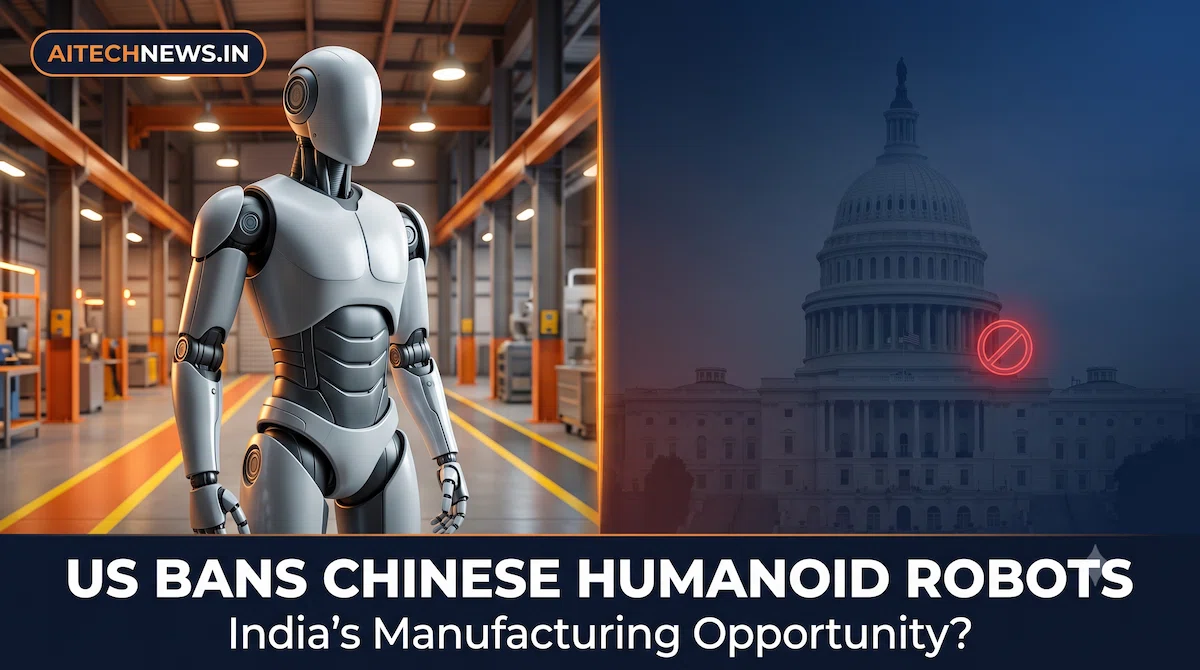
The FCC has blocked new Chinese humanoid and quadruped robots from the US market over confirmed security flaws in their firmware. With Chinese manufacturers responsible for roughly 87% of global shipments, the order removes the default supplier for a huge share of the market — and puts a spotlight on whether India’s humanoid robots industry is ready to step in.
The race to build India humanoid robots for export just got a tailwind. On Tuesday, the US Federal Communications Commission barred new Chinese-made humanoid and quadruped robots — along with certain connected power inverters — from receiving the equipment authorization required to be imported, marketed, or sold in the United States, citing national security risks.
The move instantly locks out the suppliers behind nearly nine in ten humanoid robots shipped worldwide, and India’s small but ambitious robotics industry is one of the players positioned to ask: could this be its opening?
What the FCC Actually Banned
The order, issued under the Secure and Trusted Communications Networks Act, adds new Chinese humanoid and quadruped robot models to the FCC’s national security “Covered List.” The same legal mechanism previously pushed Huawei out of US telecom networks and grounded DJI’s drone business domestically.
The FCC cited documented security flaws in hardware from Chinese robotics maker Unitree. In March 2025, researchers catalogued CVE-2025-2894 — a backdoor in Unitree’s Go1 quadruped that auto-connected to a China-based cloud tunnel and handed remote control to anyone holding the right API key; vulnerable units were later confirmed running inside networks at MIT, Princeton, Carnegie Mellon and the University of Waterloo.
A second, more severe flaw disclosed later — dubbed UniPwn — is a Bluetooth exploit affecting Unitree’s Go2, B2, G1 and H1 models that grants root-level access and can spread automatically between nearby robots. Neither flaw has been fully patched.
Importantly, the ban is not retroactive. Robot models already authorized for US sale can keep operating, the federal government is exempt, and Chinese and non-Chinese firms alike can still seek a “conditional approval” pathway if they can demonstrate their hardware doesn’t pose a security risk. The restriction applies specifically to new models seeking US authorization from here on.
Why India Humanoid Robots Could Benefit From the Ban
The scale of China’s dominance is what makes this order significant. Independent estimates from Omdia, IDC and Morgan Stanley put China’s share of global humanoid robot shipments in 2025 at roughly 85–90%, led by AgiBot and Unitree, which together shipped more units than the rest of the world combined. A ban of this size doesn’t just affect one company — it removes the default supplier for US buyers overnight, at a moment when warehouses, EV and battery plants, and hazardous-manufacturing sites are all scaling up humanoid deployments.
That gap is exactly the kind of structural opening India’s robotics industry has been positioning for.
India’s Pitch: Early, Real, But Still Small
India isn’t starting from zero. Noida-based Addverb Technologies — majority-owned by Reliance Industries — has already unveiled its first humanoid robot and is targeting production of roughly 100 units in its first year for customers in solar, battery, electronics and hazardous-industry manufacturing.
Addverb has said it expects the US and other developed markets to generate humanoid demand even ahead of India itself, and the company is reportedly raising $100 million, largely earmarked for humanoid R&D. It has also built Bot-Verse, a Noida facility with the capacity to produce up to 100,000 robots a year across its product lines.
Beyond Addverb, India’s wider robotics base includes Kerala’s Genrobotics (sanitation and industrial-safety robots), Bengaluru’s Invento Robotics (service and companion robots), and warehouse-automation player GreyOrange — none at humanoid scale yet, but each part of an ecosystem policy has been quietly building for years.
On the policy side, India’s Production Linked Incentive (PLI) scheme has drawn more than ₹2.16 lakh crore (about $26 billion) in committed investment across electronics manufacturing, according to government data cited by industry trackers, and the Electronics Components Manufacturing Scheme’s outlay nearly doubled to ₹40,000 crore in the 2026-27 Union Budget.
MeitY’s draft National Strategy on Robotics separately calls for dedicated R&D centres of excellence and regulatory sandboxes. By most industry estimates, India’s robotics market is now among the fastest-growing in Asia, expanding more than 20% year-on-year, albeit from a small base.
The Reality Check
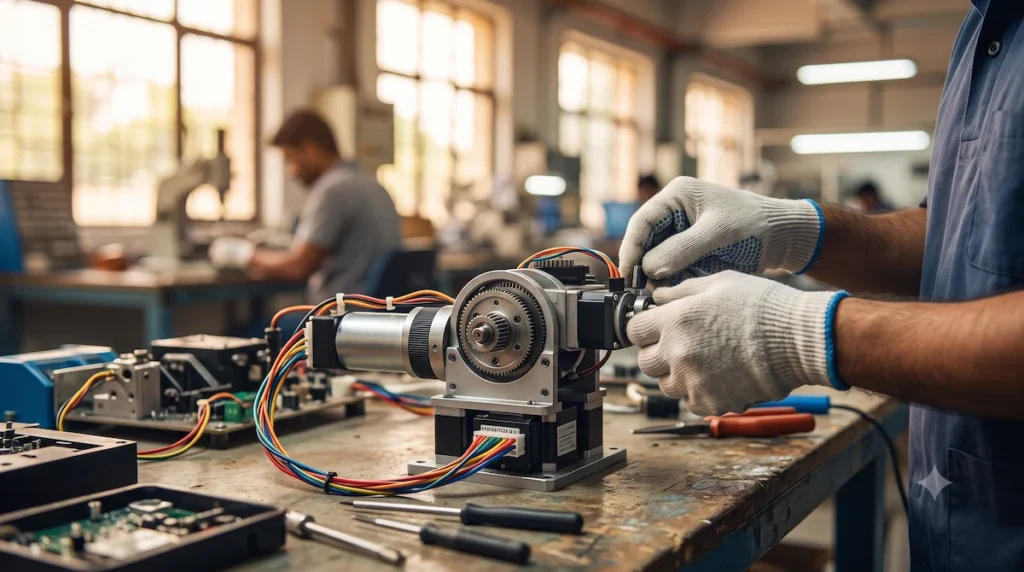
Ambition needs a dose of caution here. Addverb itself has acknowledged that India’s robotics supply chain remains underdeveloped — high-precision actuators and sensors are still largely imported, often from the same Chinese supply chains this ban is trying to route around. By one industry estimate, India’s robot density sits at roughly 67 robots per 10,000 manufacturing workers, well behind South Korea’s 400-plus, a reminder of how much ground is still to cover.
There is, as of publication, no confirmed trade agreement, US-India robotics pact, or government statement directly linking this FCC action to Indian manufacturers. The opportunity described here is an analytical read of market conditions and public company statements — not a reported policy outcome.
Any Indian firm hoping to sell humanoids into the US would still need to independently clear FCC equipment authorization, prove export-grade reliability, and compete against well-capitalized US, Korean, and Japanese robotics makers who are equally positioned to benefit from China’s exit.
What to Watch Next
Whether the FCC publishes exemptions for non-Chinese suppliers, and whether any Indian firm applies for or receives authorization
Addverb’s progress toward its stated 2026 humanoid production and export targets
Any formal India-US dialogue on robotics or AI-hardware supply chains following this order
Whether India’s government announces a dedicated PLI-style incentive for robotics, distinct from the existing electronics components scheme
Bottom Line
The FCC’s order is a real, immediate policy shift with genuine market consequences: China’s humanoid robot makers have lost default access to new US business. Whether India’s humanoid robots industry benefits is still an open question. The ingredients — a domestic player in Addverb, supportive manufacturing policy, and a fast-growing local robotics market — are real. So are the gaps in components, scale, and certification standing between opportunity and actual export orders. For now, this is a story to track, not a victory to declare.
FAQs
Does the FCC ban affect Chinese robots already sold in the US?
No. It applies only to new Chinese humanoid and quadruped robot models seeking future US market authorization; previously authorized models can keep operating.
Which Indian company is closest to competing in humanoid robots?
Addverb Technologies, backed by Reliance Industries, is India’s most advanced humanoid robotics player, having unveiled its first unit and targeting scaled production through 2026.
Is there an official India-US deal tied to this ban?
No. No confirmed agreement exists connecting the FCC order to Indian manufacturers — the India angle here is market analysis, not reported policy.
Does the FCC ban affect Chinese robots already sold in the US?
No. It applies only to new Chinese humanoid and quadruped robot models seeking future US market authorization; previously authorized models can keep operating.
Which Indian company is closest to competing in humanoid robots?
Addverb Technologies, backed by Reliance Industries, is India’s most advanced humanoid robotics player, having unveiled its first unit and targeting scaled production through 2026.
Is there an official India-US deal tied to this ban?
No. No confirmed agreement exists connecting the FCC order to Indian manufacturers — the India angle here is market analysis, not reported policy.
FCC public order (July 28, 2026) · Reuters · The Washington Post · Forbes · Tech Times · U.S. News & World Report · Bin4ry/UniPwn security disclosure · CyberInsider · Addverb Technologies press statements · Inc42 · Ministry of Electronics and Information Technology (MeitY) · Omdia and IDC humanoid-robot shipment data